Polymorphisms in oxidative pathway related genes and susceptibility to inflammatory bowel disease
Nezha Senhaji, Sellama Nadifi, Aurora Serrano, Daniel León Rodríguez, Nadia Serbati, Mehdi Karkouri, Wafaa Badre, Javier Martin

TL;DR
This study investigates how genetic variations in oxidative pathway genes may affect the risk of inflammatory bowel disease in the Moroccan population.
Contribution
The study is the first to assess the role of NOS2A, HIF1A, and NFKB1 polymorphisms in IBD susceptibility in a Moroccan population.
Findings
NOS2A_(CCTTT)n polymorphisms showed significant differences in allele frequencies between IBD patients and healthy controls.
Specific (CCTTT) repeat alleles were associated with increased risk for Crohn's disease and ulcerative colitis.
HIF1A and NFKB1 polymorphisms did not show significant associations with IBD susceptibility.
Abstract
To better characterize the genetic factors, implicated in oxidative pathway, determining susceptibility to inflammatory bowel disease (IBD), we assessed for the first time the potential role of NOS2A, HIF1A and NFKB1 polymorphisms on the risk of developing IBD in Moroccan population. The distribution of (TAAA)n_rs12720460 and (CCTTT)n_rs3833912 NOS2A microsatellite repeats, HIF-1A_rs11549467 and NFKB1–94ins/delATTG_rs28362491 was analyzed in 507 subjects grouped in 199 IBD and 308 healthy controls. Genotyping was performed with polymerase chain reaction-fluorescent method and the TaqMan® allelic discrimination technology. The allele and genotype frequencies of HIF1A_rs11549467, NFKB1_rs28362491 and NOS2A_(TAAA)n did not differ significantly between patients and controls. Analysis of NOS2A_(CCTTT)n markers evidenced differences between patients and healthy controls. A preferential…
Genes, proteins, chemicals, diseases, species, mutations and cell lines named across the full text — each resolved to its canonical identifier and authoritative record.
Peer Reviews
No public reviews on file for this paper yet. If you reviewed it on a platform where reviews are public (OpenReview, ICLR, NeurIPS, ICML), you can paste yours below so the community can read it here.
Videos
No videos yet. Explain this paper in a talk, walkthrough, or lecture? Add one.
Taxonomy
TopicsInflammatory Bowel Disease · Helicobacter pylori-related gastroenterology studies · Pharmacological Effects of Natural Compounds
Introduction
Inflammatory bowel disease (IBD), a chronic and relapsing-remitting disorder of the gastrointestinal tract, encompasses Crohn’s disease (CD) and ulcerative colitis (UC).
IBD was thought to be a western disease, with higher prevalence reported in developed countries [1]. However, during the last few decades, incidence rates of the two major forms of IBD have been increasing in developing countries [2], including Morocco.
Chronic intestinal inflammation is a hallmark of both disorders, and is believed to result from a number of abnormal conditions. The involvement of oxidative damage in IBD development has been thoroughly documented. Oxidative stress mainly contributes to aberrant inflammatory responses of intestinal cells to commensal bacteria and dietary antigens. During IBD, activated leukocytes generate a wide spectrum of proinflammatory cytokines, in addition to excessive oxidative reactions that alter the redox equilibrium within the gut mucosa. Therefore, capacity to maintain inflammation by induction of transcription factors and redox-sensitive signaling pathways may influence the occurrence and severity of the disease [3].Induction of inducible nitric oxide synthase (iNOS) was reported to play a key role in oxidative stress-induced inflammation [4]. The genetic polymorphisms of the NOS2A (nitric oxide synthase) gene have been proposed to be involved in IBD aetiology[5].Two functionally relevant polymorphisms located at NOS2A gene promoter region were reported, the first one is a highly polymorphic pentanucleotide (CCTTT)n microsatellite repeat which is important in the regulation of NOS2A transcription[6]. The second one is located at the proximal promoter region and consists of an insertion/deletion of one TAAA repeat[7].
Perpetuation of inflammation is also mediated by cellular stress responses of inflammatory cells that produce soluble mediators and reactive species which act by further inducing changes in transcription factors, among which hypoxia-inducible factor-1α (HIF-1α) and nuclear factor κB (NF-κB) [8]. HIF-1-α is a key regulator of cellular response to hypoxia, the gene encoding the HIF-1α subunit (HIF1A) carries a common missense mutation, A588T (G>A, rs11549467), that has been related to increased trans-activation capacity [9]. The involvement of HIF-1-α in the enhancement of the inflammatory response was demonstrated, elevated levels of HIF-1-α in biopsies of primary lesions of patients confirmed its role in inflammatory diseases [10]. HIF-1-α has been shown to induce the secretion of inflammatory mediators by indirect signaling through NF-kB-mediated cytokine and chemokine secretion [11].
NF-κB is activated during inflammation, giving rise to induction of gene expression of several genes involved in mucosal inflammation such as cytokines (TNFA, IL6, IL1β…), Cox-2, and NOS2A [12][13].A functional NFKB1 promoter polymorphism, consisting of a common insertion/deletion (94ins/delATTG) that seems to affect promoter activity of the NFKB1 gene and differential nuclear protein binding[14], was associated to the risk of CD [15] and UC [14].
In search of relevant gene polymorphisms related to oxidative stress signaling that are involved in IBD development, we explored the association of HIF1A_rs11549467, NFKB1_rs28362491 NOS2A(CCTTT)n_rs3833912 and NOS2A(TAAA)_rs12720460 polymorphisms with IBD (CD and UC) in a Moroccan population.
Material and methods
Study population
Peripheral blood was obtained from 311 healthy unrelated blood donors. 199 patients diagnosed with IBD at the CHU Ibn Rochd Hospital (Casablanca, Morocco) were included in this study. The diagnosis of CD or UC was established according to conventional endoscopic, clinical, histological and radiological criteria as previously described[14];[16];[17].CD phenotype was classified according to the Montreal classification [18]. UC anatomic location was subgrouped using Paris classification [19]. Patient’s clinical and demographic characteristics were collected in a case report form including questions on disease location and phenotype, age at diagnosis and other clinical features. The local ethics committee approved the study in accordance with the declaration of Helsinki for experiments involving humans, and a written informed consent was obtained from all participants.
DNA analysis
Genomic DNA was extracted from peripheral blood using the salting out procedure and from Formalin Fixed Paraffin Embedded Tissues using the QIAamp® DNA FFPE Tissue Kit (Qiagen). DNA quality and quantity was determined with the NanoDrop™ 1000 Spectrophotometer (Thermo Fisher Scientific, Wilmington, DE) and the QuBit Quantification Platform (Invitrogen, Ltd., Paisley, UK) using the QuBit high-sensitivity assay reagents.
The NOS2A (TAAA)n_rs12720460 and (CCTTT)n_rs3833912genotyping was performed using a polymerase chain reaction (PCR)-based method combined with fluorescent technology as previously described [20]. Forward and reverse primers were:
F: 5’-TGC CAC TCC GCT CCA G-3’; R: 5’-GGC CTC TGA GAT GTT GGT CTT-3’for (TAAA)n, and F: 5’-ACC CCT GGA AGC CTA CAA CTG CAT-3’; R: 5’-GCC ACT GCACCC TAG CCT GTC TCA-3’ for (CCTTT)n. The forward primers were 5’ labeled with the fluorescent dye 6-Carboxyfluorescein amino hexy FAM. The different alleles were resolved after capillary electrophoresis on automated DNA sequencer (ABI 3130xl Genetic Analyzer, Applied Biosystems) and analyzed with the GeneMapper® 4.0 software (Applied Biosystems). Selected samples from each genotype were sequenced in order to confirm the length of each allele.
Genotyping of HIF1A (G/A) rs11549467 and NFKB1–94ins/delATTG (rs28362491) was performed on the LightCycler 480 System (Roche, Barcelona, Spain) using a pre-designed TaqMan SNP genotyping assays (Applied Biosystems, Foster City, CA, USA) as previously described [21];[22]. PCR was carried out in a total reaction volume of 5 μl with the following amplification protocol: initial denaturation at 95°C for 3 min followed by 50 cycles of denaturation at 95°C for 3 s, and annealing/extension at 60°C for 20 s. The primer sequences of NFKB1 promoter polymorphism IN/DEL -94ATTG were: F: 5’-GCC TCC GTG CTG CCT-3’ and R: 5’-AGG GAA GCC CCC AGGAA-3’, and the probe sequences were NFKB1-INS: 5’-VIC-CCCGACCATTGATTGG-NFQ-3’ and NFKB1-DEL: 5’-FAM-TTCCCCGACCATTGG-NFQ-3’.
Statistical analysis
Genotype and allele distributions among patients with CD, UC and IBD versus healthy controls were compared using the χ^2^ test or Fisher test as appropriate. Odds ratios (ORs) with a confidence interval (CI) of 95% were assessed to measure the strength of association. Statistical power was calculated using Power Calculator of Genetic Studies 2006 software (http://www.sph.umich.edu/csg/abecasis/CaTS/). A chi-square test was used to test for deviation from Hardy-Weinberg equilibrium (HWE). Statistical analyses were performed with Plink software V1.07 (http://pngu.mgh.harvard.edu/purcell/plink/). P-value<0.05 was considered to be statistically significant. Bonferroni correction was applied to significant P-values of NOS2A polymorphisms to correct by the number of comparisons.
Results
Hundred ninety-nine patients with IBD (136 CD; 63 UC) and 308 control subjects were included in this study. The success rates of genotyping assays ranged between 95 and 100%. Baseline demographic and clinical characteristics of cases are presented in a previous report [36].
HIF1A (G/A) rs11549467 and NFKB1–94ins/delATTG (rs28362491) polymorphisms
In both patients and controls, the genotype distribution of examined polymorphisms complied with the Hardy-Weinberg expectations.
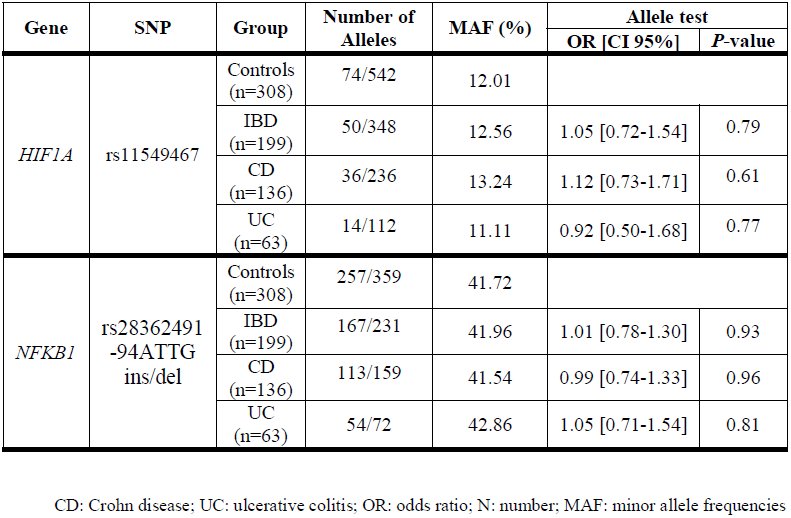
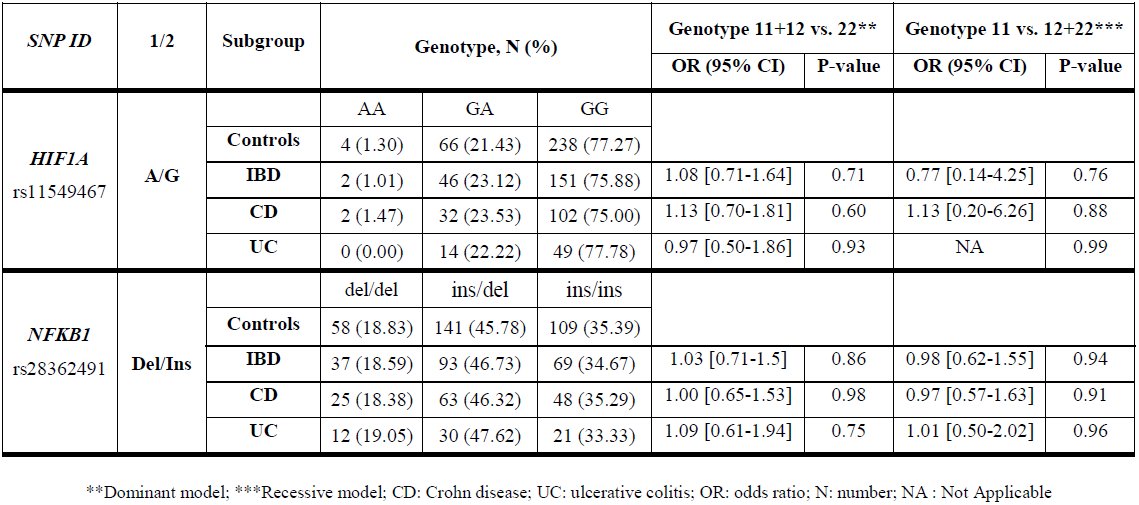
In order to study associations of HIF1A (rs11549467) and NFKB1 (rs28362491) variants in IBD overall and in CD and UC in particular, the distribution of polymorphic alleles was assessed. Genotype and allele frequencies are given in Tables 1 and 2.
Table 1:: Minor Allele Frequencies of HIF1A and NFKB1 genetic variants in IBD patients and healthy controls from Morocco.
Table 2:: Genotype and genetic models distribution of HIF1A and NFKB1 SNPs in IBD patients and controls.
The analysis of both HIF1A (rs11549467) and NFKB1 (rs28362491) polymorphisms distribution among patients and controls did not reveal any statistically significant association, both in terms of allele and genotype frequencies. Similarly, we did not observe any effect on disease risk when Genetic models were assessed (Table 2).
NOS2A (TAAA)n and (CCTTT)n repeat microsatellite polymorphisms
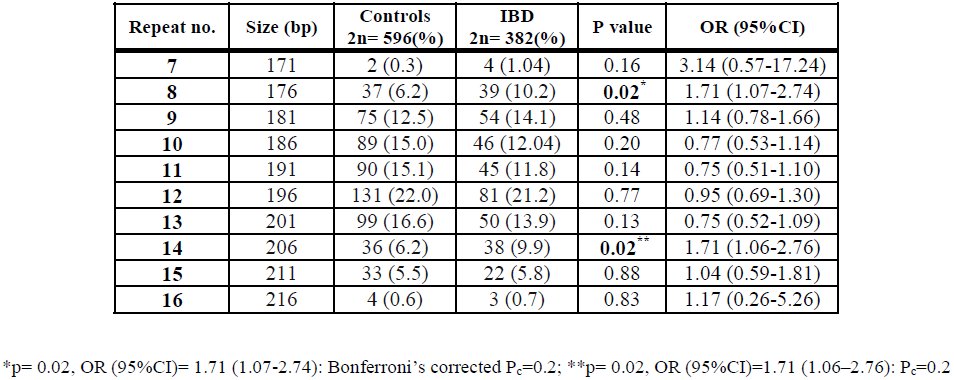
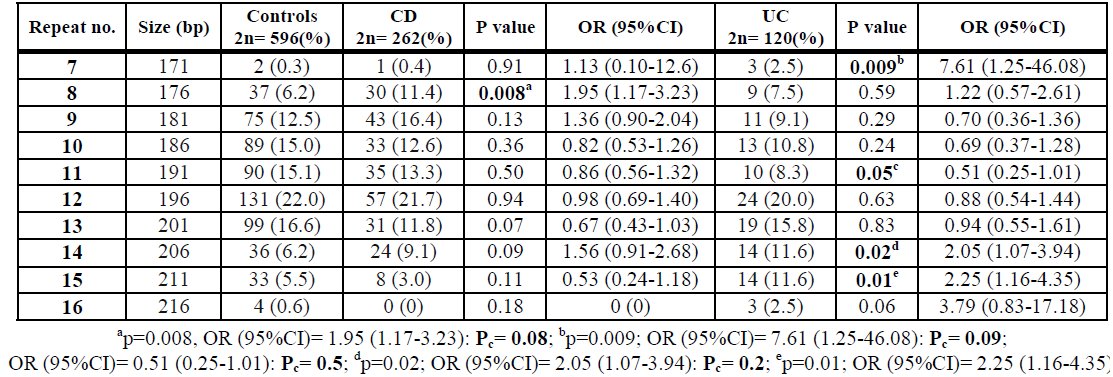
We explored the potential influence of NOS2A polymorphisms on the susceptibility to IBD in the Moroccan population. Tables 3 and 4 show the distribution of the pentanucleotide (CCTTT)n microsatellite alleles in controls, IBD, CD and UC cases. Ten different alleles, comprising of 7-16 repeats i.e. 171-216 bp, were observed in our population. (CCTTT)12 was observed to be the most frequent allele in IBD (21.2%), CD (21.7%), UC cases (20.0%) and controls (22.0%). The overall (CCTTT)n distribution showed differences between cases and controls.
Table 3:: Allelic frequencies of (CCTTT)n microsatellite polymorphism of NOS2A gene for Moroccan IBD patients and healthy controls.
Table 4:: Allelic frequencies of (CCTTT)n microsatellite polymorphism of NOS2A gene for CD, UC patients and healthy controls.
When individual CCTTT alleles were analyzed, a significant increase in frequency of the 8-repeat (10.2% vs. 6.2%; P=0.02, OR=1.71, 95%CI=1.07–2.74) and 14-repeat (9.9% vs. 6.2%; P=0.02, OR=1.71, 95%CI=1.06–2.76) alleles was observed in IBD cases compared with controls respectively.
Similarly the (CCTTT)8 repeat/allele was found to be higher in CD patients cohort as compared to controls (11.4% vs. 6.2%; P=0.008, OR=1.95, 95%CI=1.17–3.23). Whereas the increased distribution of the (CCTTT)14 repeatamong CD cases compared to controls did not reach the significance level (9.1% vs. 6.2%; P=0.09, OR=1.56, 95%CI=0.91–2.68).
Furthermore, determination of allele frequencies in UC patients revealed significant association of the 7, 11, 14 and 15 repeats polymorphic forms of the microsatellite to disease risk. Similar trend, though non-significant, was observed for the 16 repeat (P=0.06, OR=3.79, 95%CI=0.83–17.18).
However, it should be noted that after Bonferroni correction by the number of comparisons, none of the observed associations remained significant in all patient groups.
We further analyzed the distribution of TAAA insertion/deletion polymorphism of NOS2A gene in our population. In this regard, no statistically significant allele or genotype differences were observed between IBD patients and controls (Table 5). Nor were significant differences between stratified CD and UC patients when compared to controls.
Table 5:: Allele and genotype frequencies of NOS2A TAAA polymorphism in IBD patients and controls
Discussion
IBD is an inflammatory disease resulting from a compound effect of a number of abnormal conditions. Genetic factors may play a pivotal role in the development of IBD. In this regard, we explored the potential contribution of genetic polymorphisms of genes related to oxidative pathway to the risk of IBD development. Our attention was focused on functionally relevant polymorphisms located in the NOS2A and NFKB1genes, and a common missense mutation of HIF1A gene.
We found differential distribution of (CCTTT)n microsatellite repeats between patients and controls; namely the (CCTTT)8 and (CCTTT)14 repeats for IBD, the (CCTTT)8 for CD and the (CCTTT)7, (CCTTT)11, (CCTTT)14 and (CCTTT)15 repeats for UC patients. As for Caucasians, the most common allele observed in our population was the 12 repeats instead of 10 and 11 repeats for Northwestern Colombians [20].To our knowledge only two reports investigated the involvement of NOS2A gene polymorphisms in IBD etiology. Concordantly to our results, M C. Martín et al., evidenced the influence of the inducible nitric oxide synthase (CCTTT)n microsatellite repeats on UC risk [5]. However, in contrast to our finding J. Oliver et al., demonstrated no tendency toward an association with IBD predisposition [23]. Polymorphisms of NOS2A have also been involved in other autoimmune diseases such multiple sclerosis and rheumatoid arthritis [24], [25].
In terms of functional relevance, CCTTT polymorphic markers have been described to affect nitric oxide synthase (NOS) transcription [6]. The involvement of the inducible (calcium-independent) isoform, iNOS in inflammation has been largely demonstrated [26] and is directly related to the large amounts of NO produced by the enzyme after transcriptional induction and the injurious levels of RNS generated by activated leukocytes, macrophages and epithelial cells in the intestinal mucosa [27]. The overexpression of iNOS during active IBD is characterized by elevated rectal NO levels [28].Biopsies of UC-active patients demonstrate higher iNOS transcripts and enzyme levels as compared to controls or healthy relatives [29]. It was also demonstrated that in UC, greatly increased production of iNOS-derived NO reacts with tyrosine leading to production of nitrotyrosine which is associated with infiltration of neutrophils in the epithelium [30][31].
In the other hand, the present study sought to assess the association of HIF1A (G/A) rs11549467 and NFKB1–94ins/delATTG (rs28362491) polymorphisms with IBD among Moroccan patients. Data on association of these genes with IBD in the North African population are currently lacking. Our results suggest that the studied NFKB1 gene variation do not influence susceptibility to IBD (CD and UC) in the cohort tested herein. Our findings are in accordance with previous investigations analyzing Spanish [32] British [33]and German populations [34]. In contrast, an association of the –94ins/delATTG polymorphism with UC was demonstrated in a North American population [14]. These discrepant results may have been caused by clinical, population and genetic differences in addition to ethnic origin heterogeneity.
In addition, the present case-control study could not establish a role for HIF1A (G/A) rs11549467 polymorphism in the pathogenesis of both CD and UC and also found no evidence for disease risk when evaluating genetic models. This later polymorphism was shown to be associated with autoimmune diseases such as systemic sclerosis [35], however no investigation has assessed its involvement in IBD etiology.
Conclusion
Our results suggest although not formally demonstrate that, variation in the distribution of CCTTT repeats in the NOS2A gene may contribute to IBD development in the Moroccan population. Additionally, our data do not support a role for the NFKB1and HIF1A polymorphisms in the pathogenesis of IBD.
The reference list from the paper itself. Each links out to its DOI / PubMed record.
- 1Esmat, S., et al., Epidemiological and clinical characteristics of inflammatory bowel diseases in Cairo, Egypt. World J Gastroenterol, 2014. 20(3): p. 814–21.
- 2Cosnes, J., et al., Epidemiology and natural history of inflammatory bowel diseases. Gastroenterology, 2011. 140(6): p. 1785–94.
- 3Biasi, F., et al., Inflammatory bowel disease: mechanisms, redox considerations, and therapeutic targets. Antioxid Redox Signal, 2013. 19(14): p. 1711–47.
- 4Zhu, H. and Y.R. Li, Oxidative stress and redox signaling mechanisms of inflammatory bowel disease: updated experimental and clinical evidence. Exp Biol Med (Maywood), 2012. 237(5): p. 474–80.
- 5Martin, M.C., et al., Influence of the inducible nitric oxide synthase gene (NOS 2A) on inflammatory bowel disease susceptibility. Immunogenetics, 2007. 59(11): p. 833–7.
- 6Warpeha, K.M., et al., Genotyping and functional analysis of a polymorphic (CCTTT)(n) repeat of NOS 2A in diabetic retinopathy. FASEB J, 1999. 13(13): p. 1825–32.
- 7Bellamy, R. and A.V. Hill, A bi-allelic tetranucleotide repeat in the promoter of the human inducible nitric oxide synthase gene. Clin Genet, 1997. 52(3): p. 192–3.
- 8Reuter, S., et al., Oxidative stress, inflammation, and cancer: how are they linked? Free Radic Biol Med, 2010. 49(11): p. 1603–16.