The Quantum Reverse Shannon Theorem based on One-Shot Information Theory
Mario Berta, Matthias Christandl, Renato Renner

TL;DR
This paper presents a new proof of the Quantum Reverse Shannon Theorem using recent one-shot information-theoretic results, simplifying the understanding of quantum channel simulation with shared entanglement and classical communication.
Contribution
The paper introduces a novel proof of the Quantum Reverse Shannon Theorem based on one-shot quantum information theory techniques, offering a clearer conceptual framework.
Findings
New proof of the Quantum Reverse Shannon Theorem
Utilizes one-shot Quantum State Merging and Post-Selection Technique
Simplifies understanding of quantum channel simulation
Abstract
The Quantum Reverse Shannon Theorem states that any quantum channel can be simulated by an unlimited amount of shared entanglement and an amount of classical communication equal to the channel's entanglement assisted classical capacity. In this paper, we provide a new proof of this theorem, which has previously been proved by Bennett, Devetak, Harrow, Shor, and Winter. Our proof has a clear structure being based on two recent information-theoretic results: one-shot Quantum State Merging and the Post-Selection Technique for quantum channels.
Click any figure to enlarge with its caption.
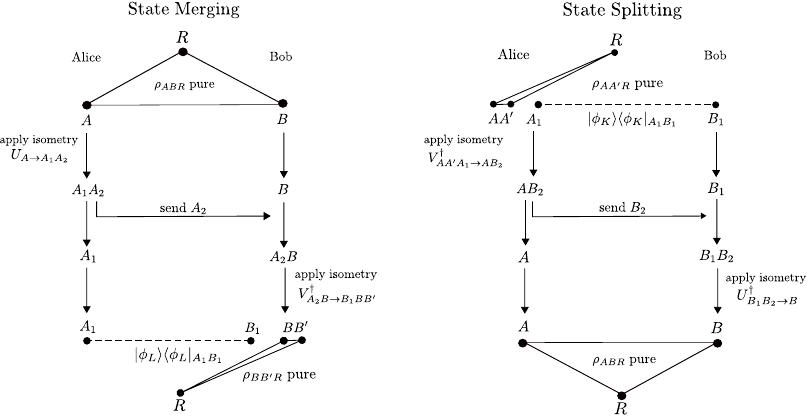 Figure 1
 Figure 2
 Figure 3
 Figure 4
Peer Reviews
No public reviews on file for this paper yet. If you reviewed it on a platform where reviews are public (OpenReview, ICLR, NeurIPS, ICML), you can paste yours below so the community can read it here.
Videos
No videos yet. Explain this paper in a talk, walkthrough, or lecture? Add one.
The Quantum Reverse Shannon Theorem based on One-Shot Information Theory
Mario Berta
Institute for Theoretical Physics, ETH Zurich, 8093 Zurich, Switzerland.
Matthias Christandl
Institute for Theoretical Physics, ETH Zurich, 8093 Zurich, Switzerland.
Renato Renner
Institute for Theoretical Physics, ETH Zurich, 8093 Zurich, Switzerland.
Abstract
The Quantum Reverse Shannon Theorem states that any quantum channel can be simulated by an unlimited amount of shared entanglement and an amount of classical communication equal to the channel’s entanglement assisted classical capacity. In this paper, we provide a new proof of this theorem, which has previously been proved by Bennett, Devetak, Harrow, Shor, and Winter. Our proof has a clear structure being based on two recent information-theoretic results: one-shot Quantum State Merging and the Post-Selection Technique for quantum channels.
I Introduction
The birth of classical information theory can be dated to 1948, when Shannon derived his famous Noisy Channel Coding Theorem Shannon48 . It shows that the capacity of a classical channel is given by the maximum, over the input distributions , of the mutual information between the input and the output . That is
[TABLE]
where denotes the Shannon entropy. Shannon also showed that the capacity does not increase if one allows to use shared randomness between the sender and the receiver. In 2001 Bennett et al. Bennett02 proved the Classical Reverse Shannon Theorem which states that, given free shared randomness between the sender and the receiver, every channel can be simulated using an amount of classical communication equal to the capacity of the channel. This is particularly interesting because it implies that in the presence of free shared randomness, the capacity of a channel to simulate another channel is given by the ratio of their plain capacities and hence only a single parameter remains to characterize classical channels.
In contrast to the classical case, a quantum channel has various distinct capacities Holevo98 ; Schumacher97 ; Bennett02 ; Devetak_05 ; Lloyd97 ; Shor_02 . In Bennett02 Bennett et al. argue that the entanglement assisted classical capacity of a quantum channel is the natural quantum generalization of the classical capacity of a classical channel. They show that the entanglement assisted classical capacity is given by the quantum mutual information
[TABLE]
where the maximum ranges over all input distributions , is a purification of , is the identity channel, and denotes the von Neumann entropy. Motivated by this, they conjectured the Quantum Reverse Shannon Theorem (QRST) in Bennett02 . Subsequently Bennett, Devetak, Harrow, Shor and Winter proved the theorem in Bennett06 . The theorem states that any quantum channel can be simulated by an unlimited amount of shared entanglement and an amount of classical communication equal to the channel’s entanglement assisted classical capacity. So if entanglement is for free we can conclude, in complete analogy with the classical case, that the capacity of a quantum channel to simulate another quantum channel is given by and hence only a single parameter remains to characterize quantum channels.
In addition, again analogue to the classical scenario winter_new ; Bennett06 , the Quantum Reverse Shannon Theorem gives rise to a strong converse for the entanglement assisted classical capacity of quantum channels. That is, if one sends classical information through a quantum channel at a rate of for some (using arbitrary entanglement as assistance), then the fidelity of the coding scheme decreases exponentially in Bennett06 .
Free entanglement in quantum information theory is usually given in the form of maximally entangled states. But for the Quantum Reverse Shannon Theorem it surprisingly turned out that maximally entangled states are not the appropriate resource for general input sources. More precisely, even if one has arbitrarily many maximally entangled states as an entanglement resource, the Quantum Reverse Shannon Theorem cannot be proven Bennett06 . This is because of an issue known as entanglement spread, which arises from the fact that entanglement cannot be conditionally discarded without using communication Harrow09 . If we change the entanglement resource from maximally entangled states to embezzling states vanDam03 however, the problem of entanglement spread can be overcome and the Quantum Reverse Shannon Theorem can be proven.
A -ebit embezzling state is a bipartite state with the feature that the transformation , where denotes an ebit (maximally entangled state of Schmidt-rank ), can be accomplished up to an error with local operations. Remarkably, -ebit embezzling states exist for all vanDam03 .
In this paper we present a proof of the Quantum Reverse Shannon Theorem based on one-shot information theory. In quantum information theory one usually makes the assumption that the resources are independent and identically distributed (iid) and is interested in asymptotic rates. In this case many operational quantities can be expressed in terms of a few information measures (which are usually based on the von Neumann entropy). In contrast to this, one-shot information theory applies to arbitrary (structureless) resources. For example, in the context of source coding, it is possible to analyze scenarios where only finitely many, possible correlated messaged are encoded. For this the smooth entropy formalism was introduced by Renner et al. Ren05 ; wolf:04n ; renner:04n . Smooth entropy measures have properties similar to the ones of the von Neumann entropy and like in the iid case many operational interpretations are known Berta08 ; Wullschleger08 ; koenig-2008 ; datta-2008-2 ; datta-2008 ; Ren05 ; datta-2008-4 ; datta-2008-5 ; datta-2008-6 ; datta-2008-7 ; wang10 ; renes10 ; Renes10_2 ; tomamichel10 ; buscemi10_1 ; buscemi10_2 .
For our proof of the Quantum Reverse Shannon Theorem we work in this smooth entropy formalism and use a one-shot version for Quantum State Merging and its dual Quantum State Splitting as well as the Post-Selection Technique for quantum channels. As in the original proof of the Quantum Reverse Shannon Theorem Bennett06 we need embezzling states.
Quantum State Merging was introduced by Horodecki et al. in Horodecki05 ; Horodecki06 . It has since become an important tool in quantum information processing and was subsequently reformulated in Abeyesinghe06 , where it is called mother protocol. Quantum State Merging corresponds to the quantum generalization of classical Slepian and Wolf coding Slepian71 . For its description, one considers a sender system, traditionally called Alice, a receiver system, Bob, as well as a reference system . In Quantum State Merging, Alice, Bob, and the reference are initially in a joint pure state and one asks how much of a given resource, such as classical or quantum communication or entanglement, is needed in order to move the -part of from Alice to Bob. The dual of this, called Quantum State Splitting, addresses the problem of how much of a given resource, such as classical or quantum communication or entanglement, is needed in order to transfer the -part of a pure state , where part is initially with Alice, from Alice to Bob.
The Post-Selection Technique was introduced in ChristKoenRennerPostSelect and is a tool in order to estimate the closeness of two completely positive and trace preserving (CPTP) maps that act symmetrically on an -partite system, in the metric induced by the diamond norm, the dual of the completely bounded norm Kitaev97 . The definition of this norm involves a maximization over all possible inputs to the joint mapping consisting of the CPTP map tensored with an identity map on an outside system. The Post-Selection Technique allows to drop this maximization. In fact, it suffices to consider a single de Finetti type input state, i.e. a state which consist of identical and independent copies of an (unknown) state on a single subsystem. The technique was applied in quantum cryptography to show that security of discrete-variable quantum key distribution against a restricted type of attacks, called collective attacks, already implies security against the most general attacks ChristKoenRennerPostSelect .
Our proof of the Quantum Reverse Shannon Theorem is based on the following idea. Let be a quantum channel that takes inputs on Alice’s side and outputs on Bob’s side. To find a way to simulate this quantum channel, it is useful to think of as
[TABLE]
where is an additional register and is some isometry from to . This is the Stinespring dilation Stinespring55 . Now the idea is to first simulate the isometry locally at Alice’s side, resulting in , and in a second step use Quantum State Splitting to do an optimal state transfer of the -part to Bob’s side, such that he holds in the end. This simulates the channel . To prove the Quantum Reverse Shannon Theorem, it is then sufficient to show that the classical communication rate of the Quantum State Splitting protocol is .
We realize this idea in two steps. Firstly, we propose a new version of Quantum State Splitting (since the known protocols are not good enough to achieve a classical communication rate of ), which is based on one-shot Quantum State Merging Berta08 . For the analysis we require a decoupling theorem, which is optimal in the one-shot case Wullschleger08 ; Dup09 . This means that the decoupling can be achieved optimally even if only a single instance of a quantum state is available. Secondly, we use the Post-Selection Technique to show that our protocol for Quantum State Splitting is sufficient to asymptotically simulate the channel with a classical communication rate of . This then completes the proof of the Quantum Reverse Shannon Theorem.
Our paper is structured as follows. In Section II we introduce our notation and give some definitions. In particular, we review the relevant smooth entropy measures. Our results about Quantum State Splitting are then discussed in Section III. Finally, we give our proof of the Quantum Reverse Shannon Theorem in Section IV. The argument uses various technical statements (e.g. properties of smooth entropies), which are proved in the appendix.
II Smooth Entropy Measures – Notation and Definitions
We assume that all Hilbert spaces, in the following denoted , are finite-dimensional. The dimension of is denoted by . The set of linear operators on is denoted by and the set of positive semi-definite operators on is denoted by . We define the sets of subnormalized states and normalized states .
The tensor product of and is denoted by . Given a multipartite operator , we write for the corresponding reduced operator. For , we write for the enlargement on any , where denotes the identity in . Isometries from to are denoted by .
For , with bases , and , the canonical identity mapping from to with respect to these bases is denoted by , i.e. . A linear map is positive if for all . It is completely positive if the map is positive for all . Completely positive and trace preserving maps are called CPTP maps or quantum channels.
The support of is denoted by , the projector onto is denoted by and , the rank of . For we write for the operator norm of , which is equal to the maximum eigenvalue of .
Recall the following standard definitions. The von Neumann entropy of is defined as111All logarithms are taken to base 2.
[TABLE]
The quantum relative entropy of with respect to is given by
[TABLE]
if and otherwise. The conditional von Neumann entropy of given for is defined as
[TABLE]
The mutual information between and for is given by
[TABLE]
Note that we can also write
[TABLE]
We now give the definitions of the smooth entropy measures that we need in this work. In Appendix B some basic properties are summarized. For a more detailed discussion of the smooth entropy formalism we refer to koenig-2008 ; Ren05 ; Tomamichel08 ; Tomamichel09 ; datta-2008-2 .
Following Datta datta-2008-2 we define the max-relative entropy of with respect to as
[TABLE]
The conditional min-entropy of given for is defined as
[TABLE]
In the special case where is trivial, we get .
The max-information that has about for is defined as
[TABLE]
Note that unlike the mutual information, this definition is not symmetric.
The smooth entropy measures are defined by extremizing the non-smooth measures over a set of nearby states, where our notion of nearby is expressed in terms of the purified distance. For , it is defined as (Tomamichel09, , Definition 4)
[TABLE]
where denotes the generalized fidelity (which equals the standard fidelity222The fidelity between is defined by , where . if at least one of the states is normalized),
[TABLE]
The purified distance is a distance measure on (Tomamichel09, , Lemma 5), in particular, it satisfies the triangle inequality for . corresponds to one half times the minimum trace distance333The trace distance between is defined by . The trace distance is often defined with an additional factor one half; we choose not to do this. between purifications of and .
Henceforth we call , -close if and denote this by . We use the purified distance to specify a ball of subnormalized density operators around :
[TABLE]
Miscellaneous properties of the purified distance that we use for our proof are stated in Appendix A. For a further discussion we refer to Tomamichel09 .
For , the smooth conditional min-entropy of given for is defined as
[TABLE]
The smooth max-information that has about for is defined as
[TABLE]
The smooth entropy measure can be seen as a generalization of its corresponding von Neumann quantity in the sense that the latter can be retrieved asymptotically by evaluating the smooth entropy measure on iid states (cf. Remark B.20 and Corollary B.22). In Section III we give an operational meaning to the smooth max-information (Theorem III.10 and Theorem III.11).444For an operational meaning of the smooth conditional min-entropy see e.g. Ren05 ; Berta08 .
Since all Hilbert spaces in this paper are assumed to be finite dimensional, we are allowed to replace the infima by minima and the suprema by maxima in all the definitions of this section. We will do so in the following.
III Quantum State Splitting
The main goal of this section is to prove that there exists a one-shot Quantum State Splitting protocol (Theorem III.10) that is optimal in terms of its quantum communication cost (Theorem III.11). The protocol is obtained by inverting a one-shot Quantum State Merging protocol.
The main technical ingredient for the construction of these protocols is the following decoupling theorem (Theorem III.1). The proof of the decoupling theorem can be found in Appendix C.
Theorem III.1**.**
Let , and consider a decomposition of the system into two subsystems and . Furthermore define . If
[TABLE]
then
[TABLE]
where is the Haar measure over the unitaries on system , normalized to .
An excellent introduction into the subject of decoupling can be found in Hayden11 . Note that our decoupling theorem (Theorem III.1) can be seen as a special case of a more general decoupling theorem Wullschleger08 ; Dup09 . It is possible to formulate the decoupling criterion in Theorem III.1 more generally in terms of smooth entropies, which is then optimal in the most general one-shot case Wullschleger08 ; Berta08 .
Quantum State Merging, Quantum State Splitting, and other related quantum information processing primitives are discussed in detail in Horodecki05 ; Horodecki06 ; Abeyesinghe06 ; Oppenheim08 ; Berta08 . Note that we are not only interested in asymptotic rates, but in (tight) one-shot protocols. This is reflected by the following definitions.
Definition III.2** (Quantum State Merging).**
Consider a bipartite system with parties Alice and Bob. Let and , where Alice controls , Bob and is a reference system. A CPTP map is called -error Quantum State Merging of if it consists of applying local operations at Alice’s side, local operations at Bob’s side, sending qubits from Alice to Bob and outputs a state
[TABLE]
where is a maximally entangled state of Schmidt-rank and . is called quantum communication cost and entanglement gain.
Quantum State Merging is also called Fully Quantum Slepian Wolf (FQSW) or mother protocol Abeyesinghe06 .
Lemma III.3**.**
Let and . Then there exists an -error Quantum State Merging protocol for with a quantum communication cost of
[TABLE]
and an entanglement gain of
[TABLE]
where .
Proof.
The intuition is as follows (cf. Figure 1). First Alice applies a unitary . After this she sends to Bob who then performs a local isometry . We choose such that it decouples from the reference . After sending the -part to Bob, the state on is given by and Bob holds a purification of this. But is the reduced state of and since all purifications are equal up to local isometries, there exists an isometry on Bob’s side that transforms the state into .
More formally, let with . According to the decoupling theorem (Theorem III.1), there exists a unitary such that for , . By an upper bound of the purified distance in terms of the trace distance (Lemma A.1) this implies .
We apply this unitary and then send to Bob; therefore . Uhlmann’s theorem Uhlmann76 ; Jozsa94 tells us that there exists an isometry such that
[TABLE]
Hence the entanglement gain is given by . Now if has full rank this is already what we want. In general . But in this case we can restrict the Hilbert space to the subspace , on which has full rank. ∎
Definition III.4** (Quantum State Splitting with maximally entangled states).**
Consider a bipartite system with parties Alice and Bob. Let and , where Alice controls and is a reference system. Furthermore let be a maximally entangled state of Schmidt-rank between Alice and Bob. A CPTP map is called -error Quantum State Splitting of with maximally entangled states if it consists of applying local operations at Alice’s side, local operations at Bob’s side, sending qubits from Alice to Bob and outputs a state
[TABLE]
where . is called quantum communication cost and entanglement cost.
This is also called the Fully Quantum Reverse Shannon (FQRS) protocol Abeyesinghe06 , which is a bit misleading, since there is a danger of confusion with the Quantum Reverse Shannon Theorem.
Quantum State Splitting with maximally entangled states is dual to Quantum State Merging in the sense that every Quantum State Merging protocol already defines a protocol for Quantum State Splitting with maximally entangled states and vice versa.
Lemma III.5**.**
Let and . Then there exists an -error Quantum State Splitting protocol with maximally entangled states for with a quantum communication cost of
[TABLE]
and an entanglement cost of
[TABLE]
where .
Proof.
The Quantum State Splitting protocol with maximally entangled states is defined by running the Quantum State Merging protocol of Theorem III.3 backwards (see Figure 1). The claim then follows from Theorem III.3. ∎
In order to obtain a Quantum State Splitting protocol that is optimal in terms of its quantum communication cost, we need to replace the maximally entangled states by embezzling states vanDam03 .
Definition III.6**.**
Let . A state is called a -ebit embezzling state if there exist isometries and such that
[TABLE]
where denotes an ebit (maximally entangled state of Schmidt rank ).
Proposition III.7**.**
vanDam03 -ebit embezzling states exist for all .
We would like to highlight two interesting examples. For the first example consider the state defined by
[TABLE]
where , denotes an ebit and is such that is normalized. Note that applying the cyclic shift operator that sends at Alice’s side (modulo ) and the corresponding cyclic shift operator at Bob’s side maps to up to an accuracy of Leung_08 . For the choice , is a -ebit embezzling state with the isometries and .
The second example is the state defined by
[TABLE]
It is a -ebit embezzling state vanDam03 .555The state is even a -universal embezzling state vanDam03 . That is, for any of Schmidt-rank at most , there exist isometries and such that