A Note on the Injection Distance
Stanislav Bulygin, Olav Geil, Diego Ruano

TL;DR
This paper demonstrates that Gabidulin codes are asymptotically optimal under the injection distance in noncoherent network coding, extending their known optimality from subspace distance.
Contribution
It establishes the asymptotic optimality of Gabidulin codes with respect to the injection distance in noncoherent network coding.
Findings
Gabidulin codes are asymptotically optimal for injection distance.
Extension of optimality from subspace distance to injection distance.
Supports the effectiveness of these codes in noncoherent network coding scenarios.
Abstract
Koetter and Kschischang showed in [R. Koetter and F.R. Kschischang, "Coding for Errors and Erasures in Random Network Coding," IEEE Trans. Inform. Theory, {54(8), 2008] that the network coding counterpart of Gabidulin codes performs asymptotically optimal with respect to the subspace distance. Recently, Silva and Kschischang introduced in [D. Silva and F.R. Kschischang, "On Metrics for Error Correction in Network Coding," To appear in IEEE Trans. Inform. Theory, ArXiv: 0805.3824v4[cs.IT], 2009] the injection distance to give a detailed picture of what happens in noncoherent network coding. We show that the above codes are also asymptotically optimal with respect to this distance.
Click any figure to enlarge with its caption.
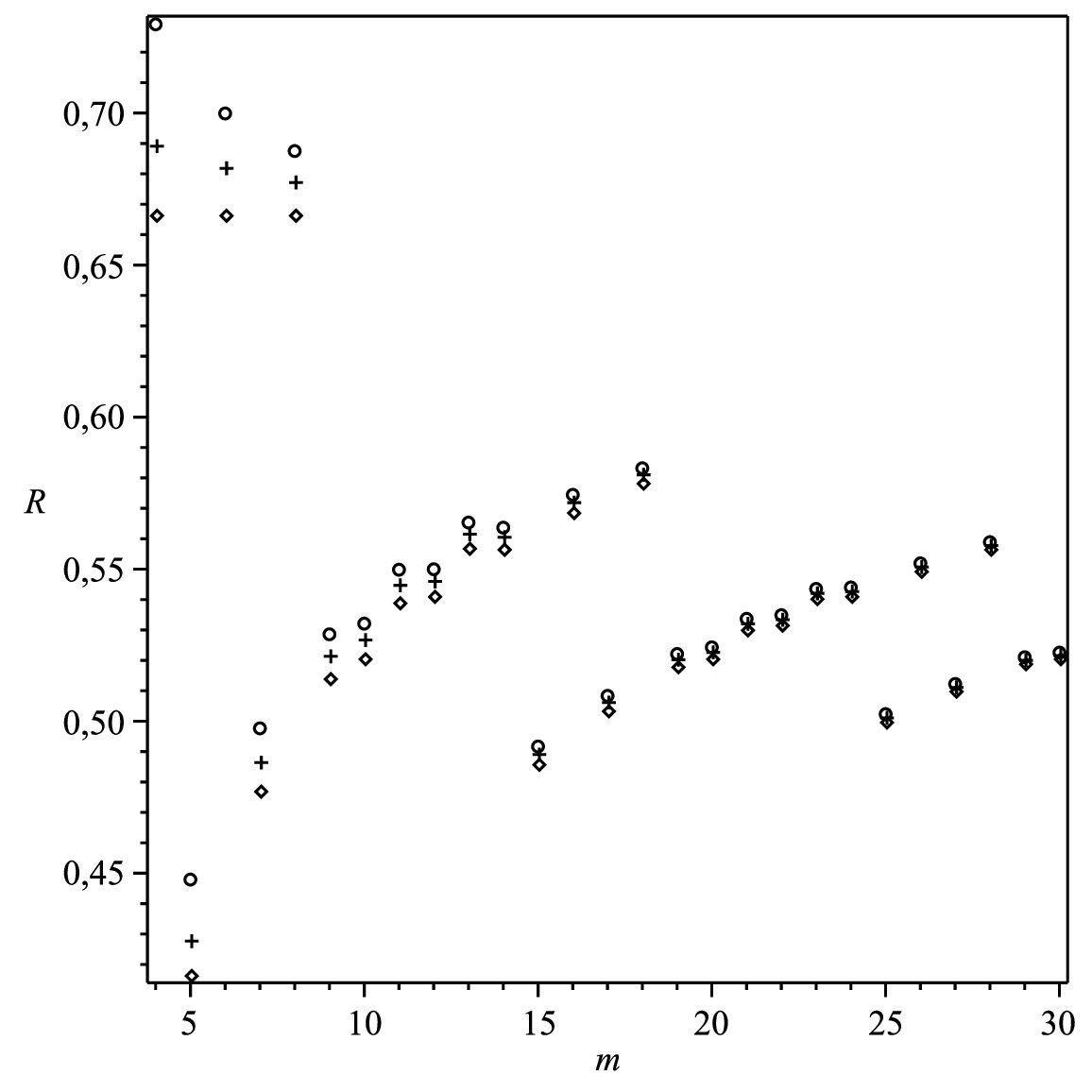 Figure 1
Peer Reviews
No public reviews on file for this paper yet. If you reviewed it on a platform where reviews are public (OpenReview, ICLR, NeurIPS, ICML), you can paste yours below so the community can read it here.
Videos
No videos yet. Explain this paper in a talk, walkthrough, or lecture? Add one.
Taxonomy
TopicsCooperative Communication and Network Coding · Wireless Communication Security Techniques · Coding theory and cryptography
A Note on the Injection Distance
Stanislav Bulygin1, Olav Geil2 and Diego Ruano2
1Center for Advanced Security Research Darmstadt, Technische Universität Darmstadt, Germany
Email: [email protected]
2Department of Mathematical Sciences, Aalborg University, Denmark
Email: {olav,diego}@math.aau.dk
Abstract
Kötter and Kschischang showed in [1] that the network coding counterpart of Gabidulin codes performs asymptotically optimal with respect to the subspace distance. Recently, Silva and Kschischang introduced in [2] the injection distance to give a detailed picture of what happens in noncoherent network coding. We show that the above codes are also asymptotically optimal with respect to this distance.
I Introduction
The concept of error correction in linear network coding was introduced by Cai and Yeung in [3], [4] and [5]. The scenario considered there is known as coherent network coding meaning that the network topology as well as the linear network code are assumed to be known both to the sender and to the receivers.
Noncoherent network coding was considered by Kötter and Kschischang in [1] for the first time. Here, neither the sender nor the receivers are assumed to know the topology or the linear network code. To mimic the communication situation Kötter and Kschischang coined the concept of an operator channel which takes as input and output subsets of some fixed ambient vector space . The set of vector subspaces is denoted by . The game of error correction now is to identify the set of messages with a collection of subspaces called a subspace code. If has been chosen cleverly it will, under certain assumptions, be possible to recover the message at the receiving end by performing some decoding algorithm. As part of their description they introduced the subspace distance in . Using this distance then a minimum distance of is obtained. Let be the number of errors and be the number of erasures occurred during the transmission over the channel (we will not formally define here what these concepts mean). The original message can be recovered if is less than the minimum distance of the subspace code under consideration. However, the converse does not necessarily hold. Kötter and Kschischang adapted the rank-metric code construction by Gabidulin to work in the above setting and gave an efficient decoding algorithm for them. They presented a Singleton bound and demonstrated that the adapted Gabidulin codes attain it asymptotically.
In [2] Silva and Kschischang considered a slightly different model of non-coherent network coding. In particular they coined a new distance, namely the injection distance. Their interpretation of the number of errors and the number of erasures also differs from the one in [1]. The advantage of the model in [2] is that it allows not only a sufficient, but also a necessary condition for decoding to be possible. We now describe the model in detail. As above each message is identified with a codeword in . The sender injects a possibly overcomplete basis for this subspace into the network. The nodes then forward a linear combination of the incoming vectors on each outgoing edge and possibly add an error vector. Let be an matrix which rows are the source packets and for a specific receiver denote by the matrix which rows are the received packets. Let the number of error vectors be and denote by the matrix which rows are the errors. With respect to the specific receiver let be the transfer matrix for the linear code (the error free part) and let be the transfer matrix for the errors. This gives us the model
[TABLE]
The transfer matrices and are unknown to the receiver and are chosen by the adversary while respecting the constraint . Here, is a parameter called the rank deficiency of , known to all the participants.
Knowing the decoding rule to use is
[TABLE]
where
[TABLE]
Here, the last equality corresponds to [2, Theorem 16]. The ability of a subspace code to support the above decoding algorithm is described by the following parameter.
Definition 1
The injection distance between spaces is defined as follows
[TABLE]
This in an obvious way translates into a minimum distance for any subspace code .
Theorem 1
Assume there is a bijective map between the set of messages and the subspace code . The code is guaranteed to correct packet errors, under rank deficiency , if and only if .
The injection distance relates to the subspace distance from [1] as follows
[TABLE]
Hence, except for a factor the two distances are the same if . A subspace code is called equidimensional if all of its codewords have the same fixed dimension. It is clear that except for a factor the minimum distance of an equidimensional subspace code is the same no matter which of the metrics or is used.
II Asymptotic results
A subspace code with an -dimensional vector space over (the finite field with elements), with size , maximum dimension of a codeword and minimum injection distance is said to be of type []. The parameter
[TABLE]
is called the rate of the code (see [1, Definition 2]). This parameter clearly serves as a measure of the efficiency of communication in a model where every block of information consists of vectors of size that are injected into the system. In other words, in a situation where we inject a possible overcomplete basis of vectors into the system, the dimension of the codeword is unimportant. Following the ideas of [1] we will give a Singleton type upper bound on in terms of and . This will then give us an upper bound for which we finally show to be reached asymptotically by the network coding counterparts of Gabidulin codes.
We consider the definition of puncturing from [1].
Definition 2
Let , with and let be a subspace of of dimension . A punctured code is constructed from by replacing by . That is,
- •
, if has dimension .
- •
* a random subspace of dimension , otherwise.*
We remark that the definition of is not unique.
This definition allows us to extend [1, Theorem 8] for the injection distance.
Proposition 1
Let be a code with . Then a punctured code is of type , with .
Proof: It is clear that and the maximum dimension of the codewords is .
Let with , and . Let and . One has that and therefore since and . Hence,
[TABLE]
Since , we have as many codewords in as in .
For nonnegative integers with , the -ary Gaussian coefficient is
[TABLE]
and for is defined to be . The number of vector subspaces of dimension of an -dimensional vector space is given by . We may establish a Singleton type bound for codes with and the injection distance. This result extends [1, Theorem 9] where a Singleton bound is established for the subspace distance and equidimensional codes.
Theorem 2
Let be a [] code, with . Then,
[TABLE]
Proof: We can puncture times the code to obtain a code of type [] , with , by Proposition 1 (if we do not puncture it and ). One has that , with . We bound the number of subspaces of with dimension lower than or equal to :
[TABLE]
since .
For a code with a Singleton bound would be a trivial bound because, for fixed, is a symmetric function on which has a maximum at , for even, or two maximums at , for odd.
Remark 1
In [1, Theorem 9], for equidimensional codes and the subspace distance, a Singleton bound is obtained by considering a punctured code and bounding the number of vector subspaces. The same argument is considered for the dual code, since . The bound is the minimum of these two values.
Although for , , one cannot consider the dual of in the proof of the Singleton bound. Namely, let be a code with dimension and let the dimension of the words of . One has that the words of have dimension , and the words of its punctured code have dimension .
Let be a code with . Then the dimension of the smallest codeword of is . After puncturing it times, one has that the dimension of the smallest codeword is . Then,
[TABLE]
however, it is not clear which of the Gaussian coefficients it the largest one. For instance, the largest Gaussian coefficient is (for even) if and only if , that is, .
We consider the codes from [1, Section V-B], these codes are the translation of the Gabidulin rank-matrix code construction to subspace codes, these codes nearly achieve the Singleton bound for the subspace distance. Moreover, they verify the assumption and we claim that they also nearly achieve the Singleton-Bound for the injection distance (Theorem 2).
Gabidulin codes are equidimensional which allows us to calculate their injection distance as follows . Here, the last part is from [1]. They are of type , with and . We have that , since if and only if , that is, .
We consider the bound from theorem 2,
[TABLE]
The last inequality follows from (see [1, Lemma 4]).
Therefore, a code achieving the bound in Theorem 2 cannot have more than times as many codewords as a Gabidulin code. Consider now the rate corresponding to (2)
[TABLE]
As by construction this tends to as goes to infinity. In other words the network coding counterpart of Gabidulin codes asymptotically has the maximal rate. The next example illustrates that already for small the Gabidulin codes perform quite well.
Example 1
In this Example we consider codes of the Gabidulin type over the field , the finite field with elements. We consider a sequence of values
[TABLE]
with , and for . The corresponding codes have length equal to
[TABLE]
In Figure 1, the rates of the Gabidulin type codes are plotted with ’s . The ’s correspond to the upper bound (1) and the ’s correspond to the upper bound (2).
The reference list from the paper itself. Each links out to its DOI / PubMed record.
- 1[1] R. Kötter and F. R. Kschischang, “Coding for Errors and Erasures in Random Network Coding,” IEEE Trans. Inform. Theory , 54(8) , 2008, pp. 3579-3591.
- 2[2] D. Silva and F. R. Kschischang, “On Metrics for Error Correction in Network Coding,” Ar Xiv :0805.3824 v 4[cs.IT], 2009, To appear in IEEE Trans. Inform. Theory, 28 pages.
- 3[3] N. Cai and R. W. Yeung, “Network coding and error correction,” in Proc. 2002, IEEE Inform. Theory Workshop, Oct. 20-25, 2002, pp. 119-122.
- 4[4] R. W. Yeung and N. Cai, “Network error correction, part I: Basic concepts and upper bounds,” Commun. Inform. Syst., 6 , No. 1, 2006, pp. 19-36.
- 5[5] N. Cai and R. W. Yeung, “Network error correction, part II: Lower bounds,” Commun. Inform. Syst., 6 , No. 1, 2006, pp. 37-54.