Comment on "Time-averaged properties of unstable periodic orbits and chaotic orbits in ordinary differential equation systems"
Michael A. Zaks, Denis S. Goldobin

TL;DR
This paper clarifies that differences in mean properties between chaotic and unstable periodic orbits are due to improper averaging, and when correct weights are used, the discrepancy vanishes, emphasizing the importance of natural measure in chaotic systems.
Contribution
It demonstrates that accounting for the natural measure resolves apparent discrepancies between chaotic and periodic orbit averages.
Findings
Discrepancies are artifacts of improper averaging.
Correct weighting by natural measure aligns averages.
Proper analysis removes the supposed differences.
Abstract
The recent paper claims that mean characteristics of chaotic orbits differ from the corresponding values averaged over the set of unstable periodic orbits, embedded in the chaotic attractor. We demonstrate that the alleged discrepancy is an artifact of the improper averaging: Since the natural measure is non-uniformly distributed over the attractor, different periodic orbits make different contributions into the time averages. As soon as the corresponding weights are accounted for, the discrepancy disappears.
Click any figure to enlarge with its caption.
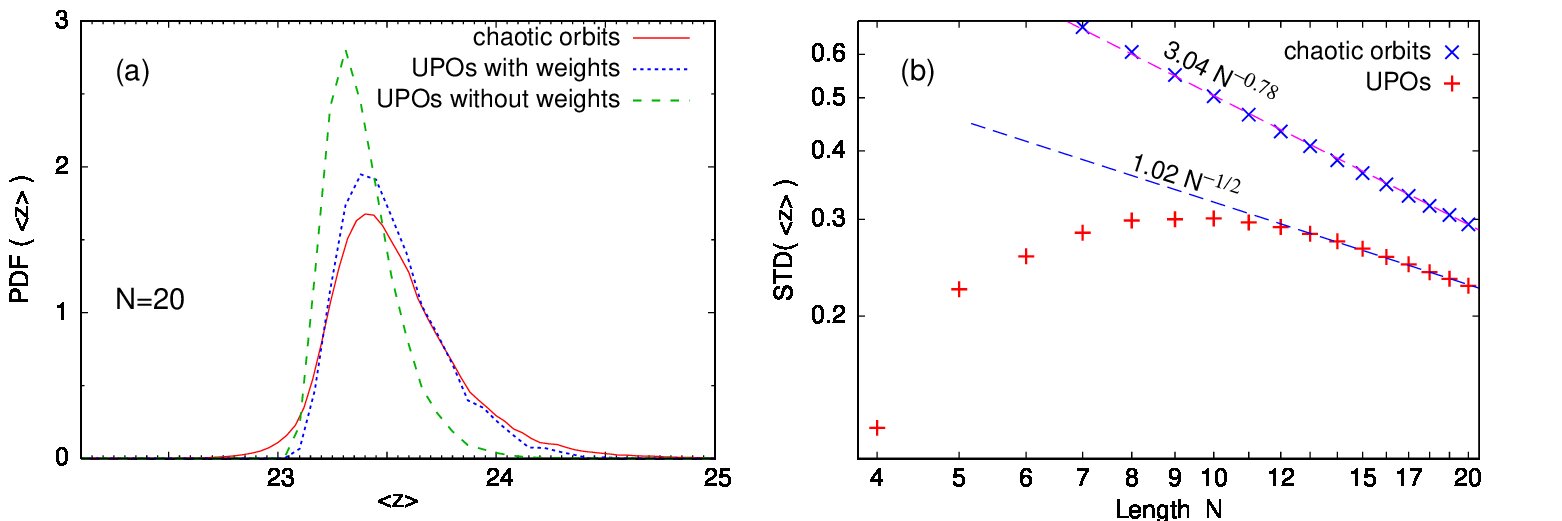 Figure 1
Peer Reviews
No public reviews on file for this paper yet. If you reviewed it on a platform where reviews are public (OpenReview, ICLR, NeurIPS, ICML), you can paste yours below so the community can read it here.
Videos
No videos yet. Explain this paper in a talk, walkthrough, or lecture? Add one.
Comment on “Time-averaged properties of unstable periodic
orbits and chaotic orbits in ordinary differential equation systems”
Michael A. Zaks
Institut für Physik, Humboldt-Universität zu Berlin, D-12489 Berlin, Germany
Denis S. Goldobin
Department of Theoretical Physics, Perm State University, 614990 Perm, Russia
Abstract
The recent paper claims that mean characteristics of chaotic orbits differ from the corresponding values averaged over the set of unstable periodic orbits, embedded in the chaotic attractor. We demonstrate that the alleged discrepancy is an artifact of the improper averaging: Since the natural measure is non-uniformly distributed over the attractor, different periodic orbits make different contributions into the time averages. As soon as the corresponding weights are accounted for, the discrepancy disappears.
pacs:
05.45-a
Recent Rapid Communication Saiki_Yamada compares properties of periodic orbits (UPOs) embedded into a chaotic attractor to those of chaotic trajectories on this attractor. Analysis is based on numerical data, and culminates in the statement: “time-averaged properties along a set of UPOs and a set of chaotic orbits with finite lengths are totally different from each other”. It is further conjectured that “the time averages of the dynamical quantities along UPOs with the same period of the Poincaré map have a limiting distribution with nonzero variance”. In this comment we show that under the proper averaging procedure, there seems to be neither the “total” difference between the averages, nor an argument for the above conjecture.
Due to ergodicity, the value of time average for an observable converges to where is the natural measure, and integration is performed over the whole attractor. Approximation of by summation over the set of UPOs – apparently the method employed in Saiki_Yamada – provides correct results only in exceptional cases when is uniformly distrubuted over the attractor: for linear mappings like the Bernoulli map, symmetric tent map etc. In general, however, the density of the natural measure varies along the attractor. As a consequence, a chaotic orbit does not walk uniformly over the attracting set: it visits certain regions relatively often or stays there relatively long. Contribution of such regions into the time averages is larger than of those visited seldom. As shown in Grebogi_Ott_Yorke_88 (see also Chapter 9.5 of the textbook Ott_book ), non-uniform distribution of the natural measure can be recovered from the properties of UPOs embedded in the attractor. In particular, for invertible two-dimensional maps (and hence for three-dimensional flows which induce such maps), the weight with which an UPO contributes to the time average, is inversely proportional to the largest eigenvalue of the corresponding fixed point. Below we demonstrate that taken the weights into account, the discrepancy between the mean values from the chaotic timeseries and the mean values from the UPOs disappears.
We restrict ourselves to the first example considered in Saiki_Yamada : attractor in the celebrated Lorenz equations
[TABLE]
with Lorenz63 , and take the same observable: the value of the variable . In fact, already in Eckhardt-Ott-94 fractal characteristics of the Lorenz attractor were evaluated with the help of the properly weighted UPO data. Our results are obtained by averaging for each orbit from the complete set of 111014 UPOs with turns in the phase space around either of the attractor “wings”. For each we also computed segments of chaotic trajectories with turns, and calculated values of for every such segment.
Comparison of eigenvalues for different UPOs with the same discloses strong inhomogeneity in the distribution of natural measure. Already among 186 orbits with the largest (4618.57) and the smallest (415.59) eigenvalues differ by the factor of 11.1. At there are 27594 UPOs, and the ratio between the extremal eigenvalues is 77.2. Accordingly, the contribution of the “most unstable” UPO is hardly discernible, compared to the contribution of the “least unstable” one.
As seen in the left panel of Fig.1, taking the weights into account shifts and re-shapes the distribution of mean values. The solid curve shows the bell-shaped distribution of for segments of chaotic orbits with length 20. The dashed curve shows the histogram obtained by summation of from all UPOs of the same length. Similarly to Fig.1 of Saiki_Yamada , the maxima of these two curves are shifted with respect to each other. The expectation values of for these two distributions are distinctly different: equals 23.555 for chaotic trajectories and 23.420 for summation over UPOs. This difference, however, almost vanishes for the histogram which incorporates the weights of UPOs: the dotted curve in Fig.1(a) is much closer to the solid curve, and has =23.554. In the case of shorter orbits with length reported in Saiki_Yamada the same effect takes place: ensemble of chaotic orbits predicts =23.562, which is definitely distinct from the value 23.420 obtained by summation over UPOs, but is much closer to the value 23.550 yielded by proper summation with weights.
Obviously, the distribution obtained from finite segments of chaotic orbits cannot be identical to the distribution produced by the set of UPOs of the same length. rotations in a piece of a chaotic orbit do not necessarily constitute a visit into the neighborhood of an UPO of the same length: they can consist of several visits into vicinities of the shorter UPOs, be a part of the passage near the longer UPO, etc. Therefore – at least in the checked range of – distributions based on chaotic orbits are broader than their counterparts built from the UPOs data. As shown in the right panel of Fig.1, the breadth of both distributions decays as a power of . For chaotic segments it approaches the law (which nearly coincides with the values from Saiki_Yamada ), whereas the standard deviation for a distribution from the set of UPOs with properly assigned weights decays as . Of course, the employed values of are, at best, moderate, and one cannot judge on the asymptotical properties of the dependence. At any rate, however, these data unambiguously show that in the range there are no arguments against eventual convergence to the -shaped distribution111In fact, even for the set of unweighted UPOs, the standard deviation of decays as . This also implies convergence to the -shaped distribution, – centered, of course, not at the value of the time average..
Since for small and moderate values of the distributions are typically broad, it hardly makes sense to discuss whether an attractor of a particular set of equations is accurately modeled by a single UPO of the given length: some of the UPOs are definitely inappropriate, whereas some others may prove to be good. Average values computed along the UPO match the averages along chaotic orbits either in a pathological case when all UPOs except one possess giant eigenvalues (and, hence, negligible statistical weights), or if one deliberately chooses the UPO whose characteristics are close to that of the whole ensemble. For the latter, however, the ensemble (or, at least, its representative parts) should be examined, so there is hardly a gain in the computational efficiency.
The last remark concerns estimates of the topological entropy in Saiki_Yamada . It is known (see e.g. Sparrow82 ) that at a chaotic orbit can make not more than 25 consecutive turns around one wing of the Lorenz attractor before a jump to another wing. Once each turn in the half-space is coded by ”1” and each code in the complementary half-space is coded by ”0”, all binary strings with length are met in the code of a sufficiently long chaotic trajectory. The only missing periodic orbits are those whose symbolic labels consist exclusively of ones or of zeroes. Accordingly, the number of UPOs with the length for is given by the recursive formula , summation being taken along all divisors of . However, estimate of the topological entropy as is applicable only for the newborn attractor at in which all symbolic strings of arbitrarily large are encountered. This is not the case for =28: upwards from =25 the tree of symbolic sequences is “pruned”, and the growth of number of UPOs as a function of may become slower. In any case, the range of orbit length employed in Saiki_Yamada for the evaluation of the is far too short and hardly appropriate for reliable estimates.
The reference list from the paper itself. Each links out to its DOI / PubMed record.
- 1(1) Y. Saiki, and M. Yamada, Phys. Rev. E 79 , 015201(R) (2009).
- 2(2) C. Grebogi, E. Ott, J. A. Yorke, Phys. Rev. A 37 , 1711 (1988).
- 3(3) E. Ott, Chaos in Dynamical Systems (University Press, Cambridge, 1993).
- 4(4) E. N. Lorenz, J. Atmos. Sci. 20 , 130 (1963).
- 5(5) B. Eckhardt, G. Ott, Z. Phys. B 93 , 259 (1994).
- 6(6) C. Sparrow, The Lorenz equations: Bifurcations, chaos, and strange attractors (Springer, 1982).