A Study of Wall-Crossing: Flavored Kinks in D=2 QED
Sungjay Lee, Piljin Yi

TL;DR
This paper investigates the spectrum and wall-crossing phenomena of flavored BPS kinks in two-dimensional N=(2,2) QED, revealing new insights into their quantum degeneracies, spectrum correspondence with four-dimensional theories, and complex supermultiplet structures.
Contribution
It provides a detailed analysis of flavored kink solitons in D=2 N=(2,2) QED, including their quantum degeneracies and a novel connection to D=4 Seiberg-Witten theory beyond hypermultiplets.
Findings
Flavored kinks are more numerous and qualitatively different in the large mass regime.
Spectrum correspondence extends beyond hypermultiplets to include complex dyon supermultiplets.
Wall-crossing behavior of BPS states is characterized and compared to D=4 dyons.
Abstract
We study spectrum of D=2 N=(2,2) QED with N+1 massive charged chiral multiplets, with care given to precise supermultiplet countings. In the infrared the theory flows to CP^N model with twisted masses, where we construct generic flavored kink solitons for the large mass regime, and study their quantum degeneracies. These kinks are qualitatively different and far more numerous than those of small mass regime, with features reminiscent of multi-pronged (p,q) string web, complete with the wall-crossing behavior. It has been also conjectured that spectrum of this theory is equivalent to the hypermultiplet spectrum of a certain D=4 Seiberg-Witten theory. We find that the correspondence actually extends beyond hypermultiplets in D=4, and that many of the relevant indices match. However, a D=2 BPS state is typically mapped to several different kind of dyons whose individual supermultiplets are…
Click any figure to enlarge with its caption.
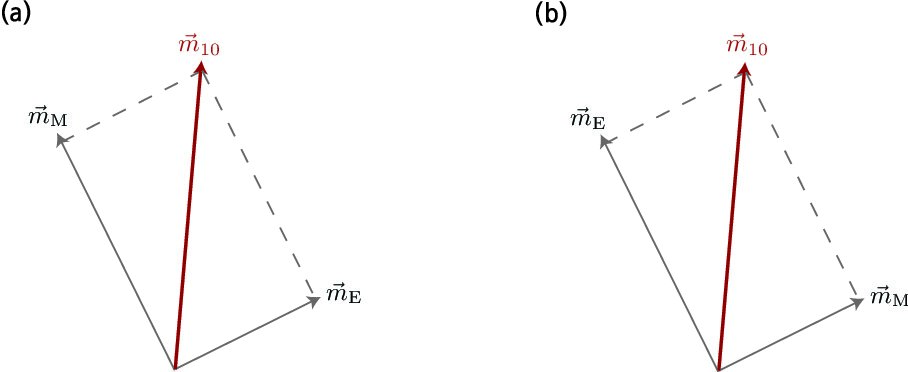 Figure 1
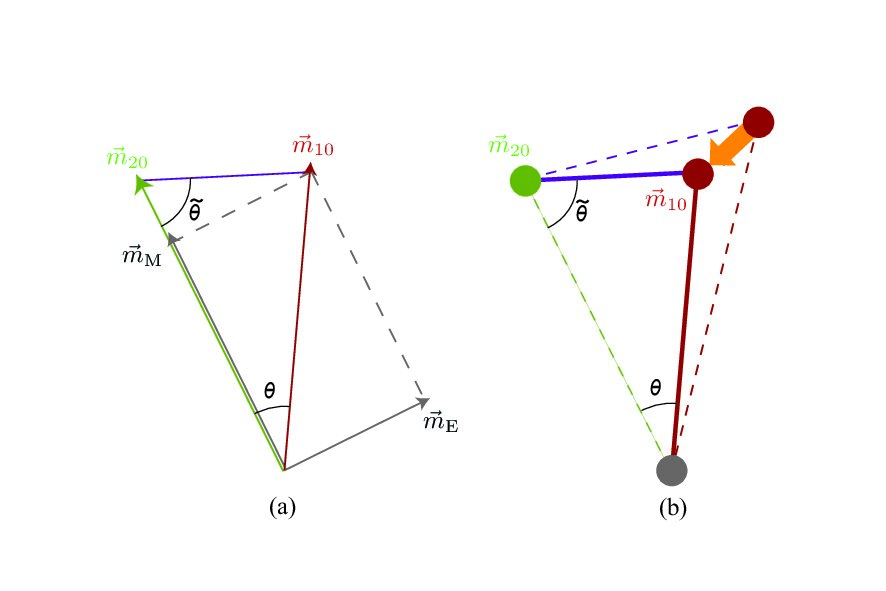 Figure 2
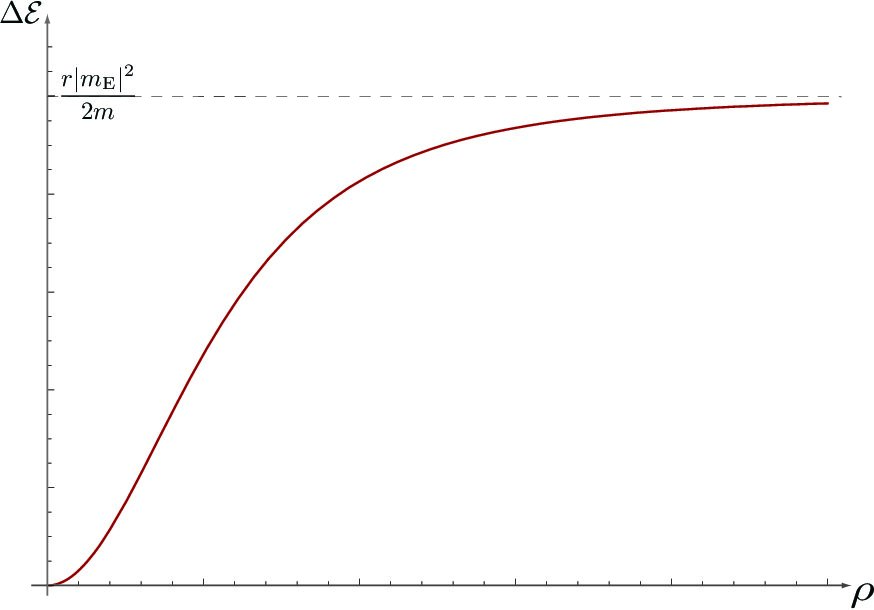 Figure 3
 Figure 4
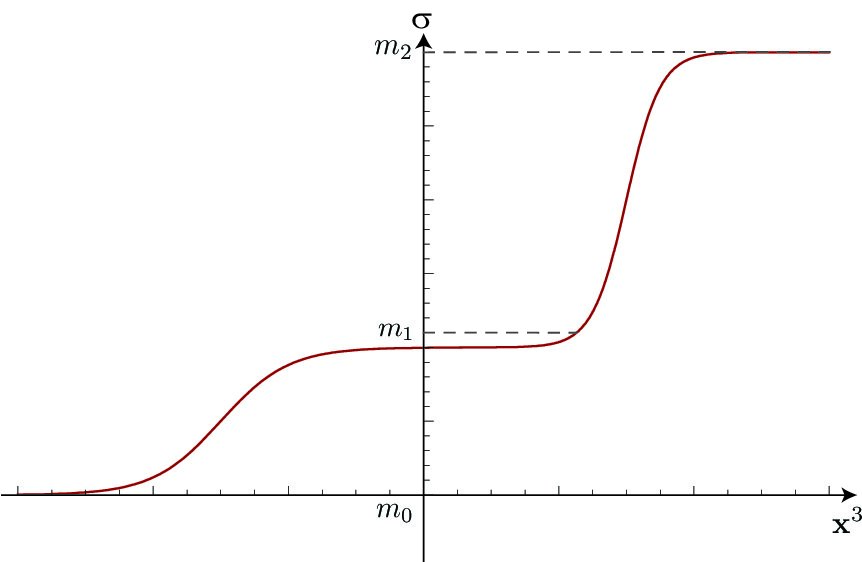 Figure 5
Peer Reviews
No public reviews on file for this paper yet. If you reviewed it on a platform where reviews are public (OpenReview, ICLR, NeurIPS, ICML), you can paste yours below so the community can read it here.
Videos
No videos yet. Explain this paper in a talk, walkthrough, or lecture? Add one.
KIAS-P09052
**A Study of Wall-Crossing:
Flavored Kinks in QED **
Sungjay [email protected] and Piljin [email protected]
School of Physics, Korea Institute for Advanced Study, Seoul 130-722, Korea
We study spectrum of QED with massive charged chiral multiplets, with care given to precise supermultiplet countings. In the infrared the theory flows to model with twisted masses, where we construct generic flavored kink solitons for the large mass regime, and study their quantum degeneracies. These kinks are qualitatively different and far more numerous than those of small mass regime, with features reminiscent of multi-pronged string web, complete with the wall-crossing behavior. It has been also conjectured that spectrum of this theory is equivalent to the hypermultiplet spectrum of a certain Seiberg-Witten theory. We find that the correspondence actually extends beyond hypermultiplets in , and that many of the relevant indices match. However, a BPS state is typically mapped to several different kind of dyons whose individual supermultiplets are rather complicated; the match of index comes about only after summing over indices of these different dyons. We note general wall-crossing behavior of flavored BPS kink states, and compare it to those of dyons.
Contents
1 Introduction
The wall-crossing in four-dimensional supersymmetric theory [1, 2, 3] has been a subject of interests to many string theorists and mathematicians. This phenomenon of discontinuity in the BPS spectrum across walls of marginal stability, as one changes either parameters or vacuum expectation value of a theory, has been a source of enormous difficulty in understanding the detailed structure of theories like Seiberg-Witten theories and Calabi-Yau compactified type II string theories.
For BPS states in four-dimensional theories, this phenomenon has been understood in various physical viewpoints,#1#1#1See Ref. [4] for a review in the field theory side. such as from geometric realization of BPS states in string theory [5, 6], from solitonic dynamics [7, 8] and quantum bound states thereof [9, 10], from a classical soliton picture of the low energy effective theory [11, 12], and also later from supergravity attractor flow [13]. From the spacetime viewpoint, the wall-crossing occurs simply because the wavefunction of the BPS state in question becomes so large (as one approaches a wall of marginal stability) that the state in question cannot be regarded as a one-particle state anymore [9, 10, 13]. Despite this simple and compelling physical picture, a systematic and practical approach to the wall-crossing phenomenon which can cover all part of the moduli space had not been available.
Recently, there appeared a new remarkable development in this regard. It states that such discontinuities of spectrum across walls of marginal stability is actually necessary for the continuity of the vacuum moduli space metric. According to Gaiotto, Moore and Neitzke (GMN) [14, 15], the continuity of the vacuum moduli space metric of -compactified Seiberg-Witten theory implies the so-called Kontsevich-Soibelman relations [16] among BPS dyons across any given wall of marginal stability, which in turn tells us how the BPS spectra would change across such walls. Cecotti and Vafa [17] has recently suggested another interesting explanation of Kontsevich-Soibelman’s formulae with spin refinement [18], using the partition function of A-model topological string.
While the derivation by GMN was intended for Seiberg-Witten theory, the idea itself must be applicable to all wall-crossing phenomena. This new machinary is also important in that for the first time we have a systematic and local prescription for computing BPS spectrum. Although there were powerful methods which allowed explicit construction/counting of BPS states in certain regions of the moduli space [9, 10, 19, 20], this new wall-crossing formula is far more comprehensive in its potential applications.
This observation that discontinuity of BPS spectra is related to continuity of some physical quantity has, on the other hand, a previously known analog in the context of two-dimensional theories. Cecotti and Vafa [21, 22] noted some time ago that if one assumes continuity of a twisted partition function
[TABLE]
throughout parameter space of the theory, this necessarily implies (dis-)appearance of BPS topological kinks across walls of marginal stability. Here is the fermion number, and ’s are the parameters of the theory. The above twisted partition is in turn related to the natural metric in the parameter space, and obeys the so-called equation [23]. In fact, GMN also noted that some of mathematical structures of equation is very closely mirrored by those that appear in their formulation of the four-dimensional wall-crossing.
Independent of this, another interesting similarity between and theories was noted in the literature: It has been conjectured [24, 25] that two-dimensional QED with massive chiral multiplets possesses a BPS spectrum which is related to that of Seiberg-Witten theory with massive flavors at the root of the baryonic branch. In view of the new development in the Seiberg-Witten theory concerning the wall-crossing, and given its analog in system, it is of some interest to clarify the precise correspondence and potential differences. In this article, we aim to study the two-dimensional theory with care given to precise BPS multiplet countings, and compare their wall-crossing phenomena against that of the Seiberg-Witten theory.
QED with chiral multiplets with twisted masses has been studied much previously. Initial studies by Hanany and Hori [26] and also by Dorey [24, 25] concentrated on implications of effective superpotential of the gauge-multiplet and its similarity to certain Seiberg-Witten spectral curve of theory. Later works [27, 28, 29, 30, 31] refined this relationship further by giving physical reasonings, if somewhat sketchy, for the correspondence and also looked at spectrum more closely by considering massive excitations of simple kink solutions.
In this paper, we expand on these existing works and solve for all possible flavored kinks. We give precise criteria for existence of such flavored kink states, set up the low energy dynamics of kinks, count their degeneracies, and provide wall-crossing formula. This allows a more refined look at the proposed “equivalence” of the spectra. We also hope that it will provide a playground for understanding wall-crossing phenomena in when conserved charged other than the topological ones are present.
In section 2 and 3, we review the theory and search for all possible kink soliton solutions. Although kinks are simple and well-known objects, global charge allows the variety of kink solutions to increase greatly. Apart from simple “dyonic” kinks whose flavor charge is proportional to the topological charge, there are much more flavored kinks whose central charges and stability criteria mimics those of the open string webs [6, 7]. In section 4, we quantize these solitons, elevate them to quantum BPS states, and count their degeneracy. These BPS states exhibit wall-crossing behavior, just as open string web does, which we put in the context of general and theories following Cecotti and Vafa’s results. In section 5, we compare this spectra to its conjectured counterpart in Seiberg-Witten theory. Although, the two sides have some common features, essentially due to the open string web analogy, absence of “angular momentum” in the theory leads to quantitatively different spectra. However, a set of distinct dyons with different quark contents are mapped to a single type of favored kink; interestingly, if one sum over the relevant indices of the former, the result matches precisely with the degeneracy of the flavored kink. We rely on the four-dimensional wall-crossing formula to reach this conclusion. We close with conclusion.
2 with twisted masses
Let us first summarize basic properties of supersymmetric theories in two dimensions.#2#2#2Please see Appendix A for fruther notations and conventions. In particular we discuss the massive representation of SUSY algebra and the CFIV index [21] which effectively counts the short multiplets only.
supersymmetry algebra
The superalgebra can read off from the four-dimensional superalgebra via trivial dimensional reduction as
[TABLE]
where the central charge is
[TABLE]
For later convenience, let us summarize the charges of supersymmetric generators
[TABLE]
Here symmetry comes from the rotational symmetry in four dimensions.
In massive theories, one of the two symmetries are explicitly broken, and suppose we choose the following basis that preserveq
[TABLE]
Making the central charge real via a suitable rotation, the supersymmetry algebra can be recast as
[TABLE]
One can therefore conclude that, for massive BPS multiplets, the algebra eventually is reduced to that of a single fermion oscillator.
CFIV index
With this, the index that count BPS multiplets is
[TABLE]
This is a proper index since for long multiplets in Fock vacuum of R-charge
[TABLE]
the index identically vanishes
[TABLE]
On the other hand, for generic BPS multiplets
[TABLE]
one can have non-vanishing
[TABLE]
The simplicity of theory is such that we have only two types of BPS multiplets, labeled by this sign, which is because of the small supersymmetry compounded by absence of spin.#3#3#3 The mirror symmetry, or t-duality in two-dimensional supersymmetric theory, exchanges those two R-symmetries
(2.12)
In the mirror-symmetric dual, the proper index now in turn is defined with charge,
\displaystyle\Omega=\text{tr}\Big{[}(-1)^{A}A\Big{]}\ .
2.1 review on massive -model
We consider a two-dimensional supersymmetric QED which flows down to a massive -model with twisted masses. It is well-known that the massless -model can be easily understood as IR limit of a gauged linear sigma model (GLSM) with a photon field and chiral matter fields of unit charge. Introducing the Fayet-Iliopoulos (FI) parameter together with theta-angle , the Lagrangian takes the following form
[TABLE]
where run from . Again, the notations and conventions used here are introduced in appendix A. For a positive FI parameter , the supersymmetric vacuum can be described by
[TABLE]
which defines a projective space . On the generic point of vacuum moduli space, the vector multiplet and chiral mode orthogonal to are combined to a long multiplet of mass by the Higgs mechanism. In the IR limit where diverges, these modes become very heavy so that they decouple from the low-energy dynamics of the theory. It leads to a model.
We will present a simple way to obtain the effective Lagrangian for the above low-energy theory, model. For simplicity, let us first turn off the theta-angle for a while. Note that we can then rewrite the Fayet-Iliopoulos (FI) term as
[TABLE]
The decoupling phenomenon of massive modes in the Higgs phase can be realized effectively as the vanishing Maxwell term in the limit of . The low-energy theory at IR is now governed by the following Lagrangian
[TABLE]
Here the vector multiplet becomes an auxiliary fields that one can solve out:
[TABLE]
Componentwise, the gauge field, for examples, is determined by
[TABLE]
which implies that above procedure can be understood as supersymmetric version of solving the Gauss law in GLSM. Inserting the result back into the Lagrangian, one can finally obtain
[TABLE]
Assuming one of matter fields, say , does not vanish, one can rewrite the above Lagrangian as
[TABLE]
where we used for the last equality the chirality of . (2.20) is precisely the lagrangian for the supersymmetric non-linear sigma model with target space . Here chiral superfields () are defined as
[TABLE]
from which one can identify it bosonic and fermionic part as
[TABLE]
The model we are eventually interested in is a massive version of this theory. The so-called twisted masses can be introduced by gauging the flavor symmetry and give expectation values to the corresponding twisted chiral field as
[TABLE]
These vev acts as mass terms for the chiral multiplets, and can be incorporated into the Lagrangian as
[TABLE]
With these twisted masses, there are classical discrete vacua in this theory. They correspond to
[TABLE]
for each . With such discrete set of vacua, various topological kink solitons are present, which are the objects of our interest. One can show that this massive theory flows down to
[TABLE]
In this article, we will be classifying and counting BPS multiplets of this theory, with a care given to quantum degeneracy and wall-crossing in weak coupling regime of the sigma model.
The FI parameter indeed receives the quantum correction at one-loop level, which leads to the RG running of renormalized FI parameter
[TABLE]
where denotes the RG-invariant dynamical scale where the perturbative analysis breaks down. In order to rely on our analysis in the article, we therefore have to introduce sufficiently large twisted masses
[TABLE]
such that the renormalized coupling are frozen in the weak-coupling regime. On the other hand, the low-energy theory of (2.13) in another interesting parameter region have been explored in [26, 24] to study the BPS states in model at strong coupling, which will be briefly discussed in section 5. It has been shown that there is the discrepancy between BPS spectra at weak and strong coupling of the theory, which strongly implies the existence of curves of marginal stability somewhere at strong coupling region. Quantum aspects of central charges and strong/weak coupling marginal stability walls were also recently investigated in Ref. [32, 33].
As emphasized again, we will explore the curves of marginal stability and wall-crossing phenomena not in strong-coupling regime but in weak-coupling regime.
conserved charges
For later convenience, we summarize some conserved charges. The bosonic part of energy functional of this theory takes the following simple form
[TABLE]
In the infrared, one can express the energy functional in terms of sigma model variables as
[TABLE]
Introducing the twisted mass terms, flavor symmetry group of model is spontaneously broken down to . Those charges are defined by following: charges can be parameterized by a following -vector
[TABLE]
where each component is given by
[TABLE]
Note that the charge components () always satisfy the traceless condition
[TABLE]
central charge
Finally let us recall the expression of central charge for massive model. Based on the two-dimensional Witten effect and simple BPS spectra of (2.26) such as fundamental excitations and kink solutions, central charge takes the following form at weak coupling limit
[TABLE]
as discussed in [24]. Here denotes the topological charge associated with kinks. Because the theory possesses discrete vacua, naturally live in the root lattice. For a topological kink from vacuum j to vacuum i, our convention is such that , , and for .
The exact expression for central charge has also proposed in [26] as
[TABLE]
where are determined by roots of the polynomial equation
[TABLE]
and are given by
[TABLE]
We will discuss in Section 5 an interesting implication of the exact expression of central charge in relation to four-dimensional supersymmetric gauge theories.
2.2 BPS equations
The supersymmetry transformation for can be read off from those of GLSM fields: for examples, the variation rules for fermions are given by
[TABLE]
where we suppressed the irrelevant terms in our discussion. The transformation rules for GLSM fermion fields are given by
[TABLE]
where run form . Here we substitute (2.18) for the GLSM gauge fields:
[TABLE]
and also substitute the following for the GLSM vector scalar
[TABLE]
with . We dropped again the fermion contribution here, which are irrelevant in our discussion below.
Inserting the above results (2.38) back into (2.37), BPS solitons of -model should satisfy the following condition
[TABLE]
where is defined as
[TABLE]
2.3 BPS (multi-)kinks
simple BPS kinks
Let us first review BPS kinks solutions. Since they are static particle, the BPS equation (2.41) can be simplifies as
[TABLE]
As referred to appendix for detailed computation, one can show that
[TABLE]
from which one can massage the above BPS equation into
[TABLE]
Since \big{(}\tau^{3}\hat{\tau}_{m_{n}}\big{)}^{2}=-|m_{n0}|^{2}, the BPS equation is finally given by
[TABLE]
provided that . The solutions are therefore given by
[TABLE]
The energy of this configuration saturate a topological energy bound since
[TABLE]
composite kinks
Let us denote a BPS kink which interpolates from th vacuum to th vacuum as -kink. Suppose that the phases of two mass-parameters and are aligned as parallel. Without loss of generality, one can set . Then, the -kink can be also understood as a bound state of a -kink and a -kink: the BPS equations for -kink are
[TABLE]
or equivalently
[TABLE]
The solution then turns out to be
[TABLE]
after a suitable choice of the origin. Here parameterizes the relative distance between constituent BPS kinks. Note that the phase factor of each describes one-parameter degeneracy of such kink solutions, so in fact we can have an arbitrary complex number multiplying each of ’s. The fact that they have the same energy can be directly checked. See Appendix A.
Obviously, this can be repeated for other ’s straightforwardly. When all ’s are aligned in the complex plane, the general solution is
[TABLE]
with arbitrary complex numbers ’s which are moduli coordinates of the soliton.
The GLSM field (2.40) is useful for describing the general behavior of the kink solution, which is depicted in Figure 2.1 for this solution. For a finite , starts with the vacuum , approaches the vacuum (never touches it), and eventually goes to the vacuum as increases. This shows that the solution indeed a sequential sum of 10-kink and 21-kink.
2.4 zero modes
Here we briefly dwell on details of fermion zero mode counting. Bosonic ones were already noted in previous section: there is one complex bosonic collective coordinate for each kink, provided that all masses are of the same phase. We will find below that for each kink there is also one complex fermionic zero modes. The linearized fermion equations of motion are given by
[TABLE]
with
[TABLE]
where the covariant derivatives are defined as
[TABLE]
Here run from . The twisted mass terms are written as if it is gauge field along directions, and contributes
[TABLE]
Clearly the derivative runs only for .
For simplicity let us again take the example of a double-kink with aligned masses . The BPS solution in this case was
[TABLE]
Recall that, despite its deceptively simple appearance, the solution should be viewed as a combination of two kinks, one from 0 to 1 and another from 1 to 2, which will interact with each other when one begins to move them around. The fermionic zero modes in this background are equally simple and deceptive. There are exactly one zero mode for each , and we find (in the limit of )
[TABLE]
with the constant spinor obeying .
The Goldstino mode, in the limit , is the combination , quantization of which endows the soliton with the basic BPS multiplet structure. The other combination is more interesting. This is a superpartner to the nontrivial bosonic moduli of the kinks that encodes relative separation and mutual interaction of 10-kink and 21-kink. We will come back to them later when we search for quantum spectrum of flavored kinks.
3 Flavored kink solitons and marginal stability
Since the theory has flavor charges, BPS objects may carry both topological and flavor charges. A kink with generic flavor charge will be called flavored kinks. We present in this section the explicit construction of flavored kink solitons together with preliminary discussion on their marginal stability behavior. An important fact here is that these generic flavored kinks appears only when the mass parameters of the theory is misaligned, i.e., when they are no longer lined up in the complex plain. This is analogous to (dis-)appearance of generic dyons in SYM and also of 1/4 BPS dyons in SYM, depending on how the vacuum expectation values of adjoint scalar fields are aligned or misaligned.
In order to investigate the dyonic spectrum of the two-dimensional model, let us introduce the time-dependence on the phase factor of sigma model fields . Then, the BPS equation (2.41) can be rewritten as
[TABLE]
Inserting (2.39) into the above equation, one can show that flavored kinks should satisfy the following
[TABLE]
3.1 simple flavored kinks
Let us again review simple flavored kink solutions whose topological charge and flavor charge are parallel [24]. In this case, without loss of generality, one can turn off all complex field expect one, say .
Then, the above BPS equations (3.2) can be simplified as
[TABLE]
where are defined by
[TABLE]
In order to have solutions to this equation, we have to demand the projectors to satisfy the following compatibility condition
[TABLE]
One can easily find a family of solution, parameterized by
[TABLE]
where vectors and are orthogonal decomposition of as depicted in figure 3.1.
For the case (a), the flavored kink solution is
[TABLE]
For the case (b), the flavor kink solution is instead given by
[TABLE]
Without loss of generality, let us concentrate on the case (a). Some conserved charges of the simple flavored kink solutions are in order.
flavor charge
For a simple flavored kink, the nonvanishing flavor charges (2.31) are
[TABLE]
energy
For the simple flavored kinks, the energy functional (2.29) can be massaged into a sum of complete squares like
[TABLE]
where we used . Since
[TABLE]
the solutions are indeed BPS with
3.2 composite flavored kinks and marginal stability
It has been noted previously that the solitonic sector of this QED has some features reminiscent of certain Seiberg-Witten theory, where the topological charge and the flavor charges are mapped to the magnetic charge and the electric charges, respectively. On the other hand, dyonic solitons in the supersymmetric gauge theories in four dimensions are such that magnetic and electric charges are generically not parallel [7, 6]. This is in turn related to existence of multi-pronged strings in string theory.
These class of BPS states are useful in that one can study the issue of marginal stability in weakly-coupled regime of the theory. In this subsection, we will look for their analog in theory, considering flavored kinks whose topological and flavor charge are not parallel misaligned, and discuss their marginal stability briefly. In section 4, their quantum spectrum and wall-crossing phenomena will be explored in more details.
For simplicity, let us first assume that
[TABLE]
For this ansatz, the BPS equation (3.2) can be rewritten as
[TABLE]
Guided by the previous example of simple flavored kink, let us rewrite the second equation into the following form
[TABLE]
In order to find out half-BPS solutions, we therefore have to demand three projectors to commute to each other
[TABLE]
One can again easily parameterize the solutions of the above relations as
[TABLE]
where vectors and are depicted in figure 3.2.
The BPS solutions of interests are
[TABLE]
after a suitable choice of origin of .
flavor charge and marginal stability
For the above solution, the flavor charges (2.31) are
[TABLE]
When we place the mass parameter on a so-called wall of marginal stability, as depicted in figure 3.2 (b), the relative distance diverges such that the -flavored kink decays into two constituent - and -flavored kinks. This is an underlying physical reason for the phenomenon of wall-crossing. At wall-crossing, one can easily show that the GLSM field actually turn touches the vacuum , as described in figure 3.2 (b).
For classical soliton whose flavored charges are not quantized, this can be viewed backward as a process where the flavor charges are increased until the kink solution decompose into two. This “maximal” or “critical” flavor charge can can be read off from the solution as
[TABLE]
With quantized (and thus fixed) flavor charges, we can use this formula to determine the critical values of and , which in turn determine the marginal stability wall for breaking this soliton to a simple flavored 10-kink and a simple flavored 21-kink.
central charge
As discussed before, the central charge of the present model can take the following form
[TABLE]
For the composite flavored kinks, the central charge can be decomposed into those of constituent particles, say
[TABLE]
On the wall of marginal stability where the flavor charges take their critical values , the central charges of constituent particles become
[TABLE]
Note that, on the wall of marginal stability, the phases of two mass-parameters satisfy the relations below
[TABLE]
from which one can conclude that phase difference between and is
[TABLE]
As expected, we find that phases of the two central charges coincides at the marginal stability wall.
4 Quantum BPS states and wall-crossing
4.1 low energy interactions of kinks
In this section, we construct and count quantum BPS states of topological kinks with flavor charges, by studying the low energy interactions of simple kinks. When are all of same phase, each kink carries one complex bosonic moduli, and their moduli space is naturally Kähler. The holomorphic coordinates ’s are defined in terms of the soliton solution as
[TABLE]
The moduli space dynamics is obtained by taking time-dependence of the form with small velocity as usual. The Kähler potential is found by integrating the field theory kinetic term as [38]
[TABLE]
from which the moduli space metric follows
[TABLE]
Here let us first concentrate on model, from which we can read off the indices of all BPS states following an argument of type found in Ref. [19].
For the moment, let us further assume . This causes two different restrictions on the mass parameters for our purpose. One is the special ratio between the two absolute values, which is harmless in counting supersymmetric states. The other, namely alignment of the two phases, pose a physical restriction to the spectrum. We will shortly abandon the latter.
The moduli space metric is then compactly written as
[TABLE]
with
[TABLE]
for and
[TABLE]
for . This shows that plays the role of the center of mass coordinates, while
[TABLE]
plays the role of the relative coordinate. It is important for a later purpose to note that in the limit of is reduced simply to
[TABLE]
On the other hand, in the limit of , we have
[TABLE]
so is itself a good coordinate near origin where the two kinks coincides in real space.
The phases of are each -periodic and turning on their (integral) momenta corresponds to turning on flavor charges of type ; is the charge of -th diagonal unbroken favor group. Defining the phase of as and as , we find
[TABLE]
and thus
[TABLE]
where and are conjugate momenta of and . The actual flavor charge for these are
[TABLE]
Note that is integral while should be integral or half-integral depending on whether is even or odd. Such a correlation between relative and center of mass charges is common, and here due to the identification
[TABLE]
The total moduli space has the form
[TABLE]
where the relative moduli space has a topology of and where acts as (4.11). The center of mass phase and the quotient action depends on the masses of individual kinks, in general.
Such a charge state, say with , precisely corresponds to the classical solution we find in the previous section with . As we saw there, however, a flavored kink states of this kind do not appear unless some of the twisted masses are misaligned in the complex plane. On the other hand, with such misaligned masses, the composite kink for which we obtained the moduli dynamics is no longer a solution to the equation of motion unless . With and , the relative moduli space makes sense only if while the flavored kinks appears only if .
These two issues are in fact tied together. Whenever , unflavored 20-kink configuration costs more energy than the central charge bound and this extra energy,
[TABLE]
should be interpreted as a potential in the two-kink moduli space dynamics.
With , we find
[TABLE]
Thus, the bosonic part of relative moduli space dynamics must be modified to
[TABLE]
where
[TABLE]
happens to be a holomorphic Killing vector field on the moduli space.
This potential energy on the moduli space , depicted in figure 4.1, shows physical separations between simple kinks are no longer a moduli degree of freedom, since it generates an attractive force between the two kinks. On the other hand, when the conjugate momentum of is turned on, this induces a repulsive angular momentum barrier between the two kinks. For finite relative charge , then, one can generically expect flavored two kinks states with the relative position determined by the balance of these two forces. The amount of the flavor charge, the mass parameter , and the size of are all interrelated, which was shown implicitly in the classical analysis of section 3.
More generally, we may consider -kink dynamics, regarded as a collection of 10-kink, 21-kink,32-kink etc, with
[TABLE]
for and . The above Lagrangian generalizes to
[TABLE]
where’s are linear combinations of holomorphic Killing vector fields, induced by flavor rotations on the soliton.
4.2 counting generic BPS states
This form of moduli dynamics with potential has well-known supersymmetric extensions, provided that is a Killing vector field. Such massive nonlinear sigma-model mechanics first appeared with complex supersymmetry in a work by Freedman and Alvarez-Gaume [39], while the form of relevance for us was found more recently in the context of BPS dyons of the Seiberg-Witten theory [10, 40, 4]. In this subsection, let us outline this modified moduli dynamics and solve for flavored BPS multi-kink states explicitly. See appendix B for a short review.
Without the potential, the moduli dynamics of the kinks would be the ordinary nonlinear sigma model where the real fermions match 1-1 with real bosons. Therefore the supercharge in question can be understood geometrically as the spinorial Dirac operator on the moduli space,
[TABLE]
where ’s are the covariant derivative with ordinary spin connection and ’s the Dirac matrices.
The addition potential energy shifts this supercharge. With general -kink case, the supercharge is shifted as
[TABLE]
Taking square of this supercharge, one finds
[TABLE]
where the central charge (to be distinguished from of the field theory) is defined via Lie-derivatives
[TABLE]
with respect to the Killing vectors, whose action is part of the global flavor rotations acting the kinks.
Since the BPS state must saturate the bound , the search for BPS states in any given kink sector boils down to finding zero modes of on the moduli space. This task is in principle very complicated. However, one can reduce counting problem to that of two-body problems, at least for the index of such quantum mechanics.
With , the operator has a massgap which separate the continuum from the ground state. Such operators are called Fredholm operators, for which usual index theorem applies; one simply choose to scale up the values of ’s, thus increasing the mass gap indefinitely, while keeping the index unaffected. This localizes the index computation to the fixed points of the vector fields ’s. Once this happens, the counting problem becomes that of harmonic oscillators and factorizes into minimal units with two bosonic and two fermionic coordinates [19]. The latter is a two-kink problem, so it suffices to count BPS bound states in a two-kink problem in order to compute index for arbitrary multi-kink states.
For flavored 20-kink state problem, we have seen that the supercharge reduces to
[TABLE]
when and with real and real . The Hamiltonian is nonnegative and has the general form
[TABLE]
where the ellipsis denotes terms involving fermions and ’s are the canonical conjugate momenta of the moduli coordinates ’s.
With , the metric for is
[TABLE]
where
[TABLE]
In the relevant orthonormal frame,
[TABLE]
the supercharge reduces to
[TABLE]
in the charge sector, that is, when