Benchmark ultra-cool dwarfs in widely separated binary systems
Z.H. Zhang, D. J. Pinfield, A. C. Day-Jones, B. Burningham, H. R. A., Jones

TL;DR
This paper identifies and analyzes widely separated binary systems with ultra-cool dwarfs as companions, providing valuable benchmark objects for studying their physical properties with minimal theoretical dependence.
Contribution
First identification of a wide ultra-cool dwarf + giant binary system, expanding the set of benchmark objects for astrophysical research.
Findings
Eight ultra-cool dwarfs are confirmed members of wide binary systems.
SDSS 0832 is a companion to the K3 giant Eta Cancri.
First wide ultra-cool dwarf + giant binary system discovered.
Abstract
Ultra-cool dwarfs as wide companions to subgiants, giants, white dwarfs and main sequence stars can be very good benchmark objects, for which we can infer physical properties with minimal reference to theoretical models, through association with the primary stars. We have searched for benchmark ultra-cool dwarfs in widely separated binary systems using SDSS, UKIDSS, and 2MASS. We then estimate spectral types using SDSS spectroscopy and multi-band colors, place constraints on distance, and perform proper motions calculations for all candidates which have sufficient epoch baseline coverage. Analysis of the proper motion and distance constraints show that eight of our ultra-cool dwarfs are members of widely separated binary systems. Another L3.5 dwarf, SDSS 0832, is shown to be a companion to the bright K3 giant Eta Cancri. Such primaries can provide age and metallicity constraints for any…
Click any figure to enlarge with its caption.
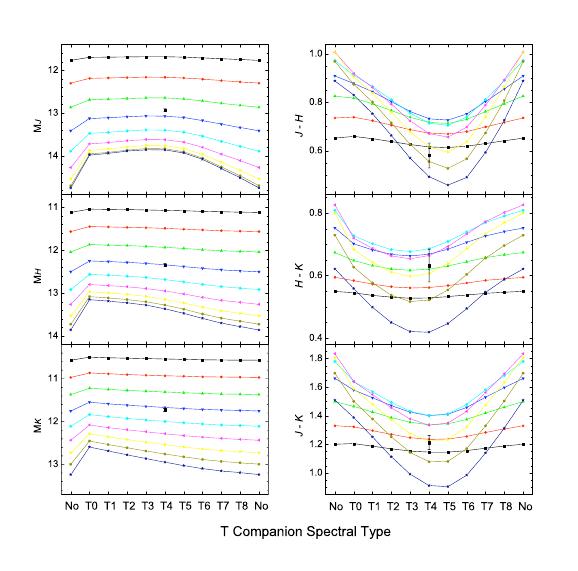 Figure 1
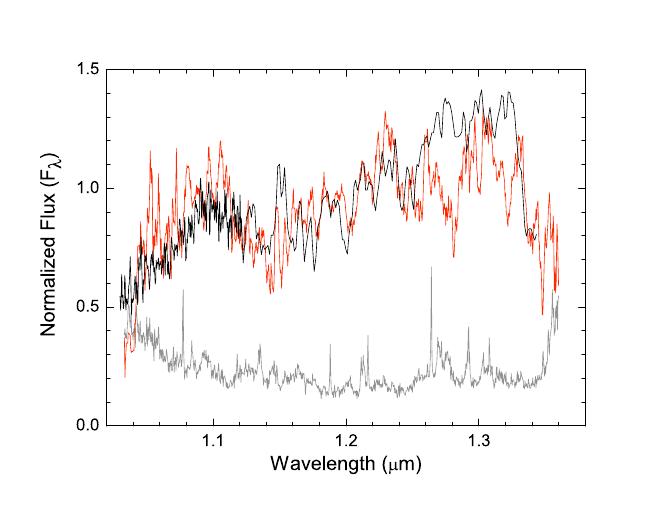 Figure 2
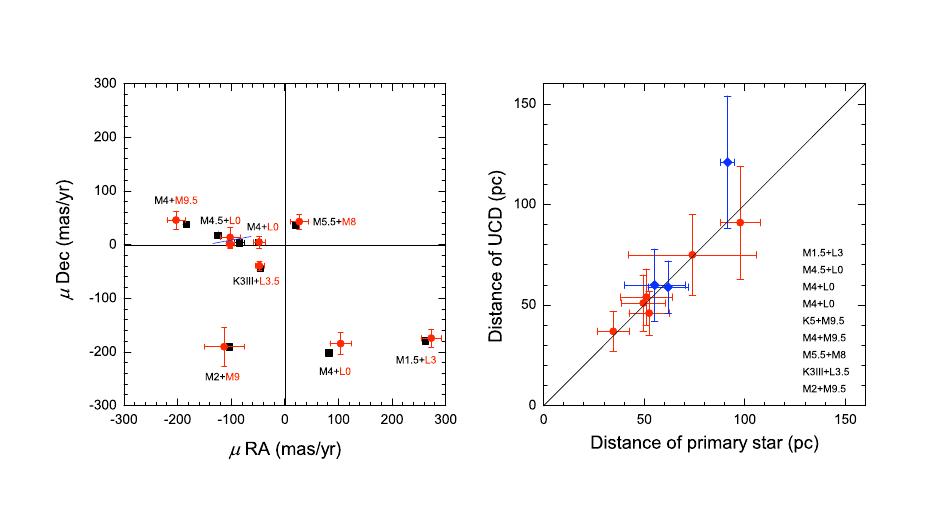 Figure 3
Peer Reviews
No public reviews on file for this paper yet. If you reviewed it on a platform where reviews are public (OpenReview, ICLR, NeurIPS, ICML), you can paste yours below so the community can read it here.
Videos
No videos yet. Explain this paper in a talk, walkthrough, or lecture? Add one.
Taxonomy
TopicsStellar, planetary, and galactic studies · Astronomy and Astrophysical Research · Astrophysics and Star Formation Studies
11institutetext: Centre for Astrophysics Research, University of Hertfordshrie, Hatfield AL10 9AB, UK 22institutetext: Department of Astronomy, Universidad de Chile, Casilla postal 36D, Santiago, Chile
Benchmark ultra-cool dwarfs in widely separated binary systems
Z.H. Zhang 11 [email protected]
D. J. Pinfield 11
A. C. Day-Jones 22
B. Burningham 11
H. R. A. Jones 11
Abstract
Ultra-cool dwarfs as wide companions to subgiants, giants, white dwarfs and main sequence stars can be very good benchmark objects, for which we can infer physical properties with minimal reference to theoretical models, through association with the primary stars. We have searched for benchmark ultra-cool dwarfs in widely separated binary systems using SDSS, UKIDSS, and 2MASS. We then estimate spectral types using SDSS spectroscopy and multi-band colors, place constraints on distance, and perform proper motions calculations for all candidates which have sufficient epoch baseline coverage. Analysis of the proper motion and distance constraints show that eight of our ultra-cool dwarfs are members of widely separated binary systems. Another L3.5 dwarf, SDSS 0832, is shown to be a companion to the bright K3 giant Cancri. Such primaries can provide age and metallicity constraints for any companion objects, yielding excellent benchmark objects. This is the first wide ultra-cool dwarf + giant binary system identified.
1 Introduction
Current brown dwarf (BD) models have difficulty in accurately reproducing observations, and benchmark objects are thus needed to calibrate both atmospheric and evolutionary models. In order for a brown dwarf to be considered a benchmark it must have one or more properties (e.g. age, mass, distance, metallicity) that can be constrained relatively independently of models. BDs as members of binaries are very useful for this purpose, where the host star can provide age, distance and in some cases metallicity constraints. How useful these systems are, is dependent on how well we understand the nature and physics of the primary stars. Evolved stars, e.g. subgiants, giants and white dwarfs can constraint accurate ages, as well as metallicity in the case of subgiants and early phase giant stars, via robust spectroscopic models. These types of binary system can populate the full age range of the disk up to 10 Gyrspin . In this paper we report the discovery of nine common proper motion (PM) binary systems with ultra-cool dwarf (UCD) components. One is a benchmark L dwarf companion to the giant star Cancri, and the other eight are late M and early L dwarf companions to K-M dwarf stars.
2 Ultra-cool dwarf selection criteria
The color of the Sloan Digital Sky Survey (SDSS)aba as we have shown in our previous workzha , is particularly useful for the selection of UCDs. In this work, we focus on a bluer sample to increase the sample size and fraction of objects that have measured SDSS spectrazhab . Our selections here include and for objects with SDSS spectra, and a more constraining selection for objects without spectra, requiring , and . In addition we placed an additional selection of early L dwarf candidates towards the Praesepe (M44) cluster. We used the same color criteria as previously described for SDSS objects without spectra, but limited our search to , and , corresponding to early L dwarfs at 100200 pc.
SDSS selected candidates were cross matched with point sources in the Two Micron All Sky Survey (2MASS)skr and UKIRT Infrared Deep Sky Survey (UKIDSS)law catalogues. 563 objects with spectra were cross matched in SDSS and 2MASS, of which 469 were also cross matched in UKIDSS large area survey (LAS). 1761 objects without spectra were cross matched in SDSS and 2MASS, of which 338 objects were cross matched in UKIDSS. So 807 SDSS objects (see online material for these UCDs) were cross matched in 2MASS and UKIDSS of which 469 objects have SDSS spectra. For our UCD sample towards Praesepe, we cross matched candidates with the UKIDSS Galactic Cluster Survey.
For 469 UCD candidates with SDSS spectra, we assigned their spectral type with the HAMMER pipelinecov . 34 objects of them are new L dwarfs. We used optical-NIR colorspectral type relationshipszha ; zhb to assign the spectral types of 338 objects without SDSS spectra.
3 Ultra-cool dwarf binaries
A total of 807 objects in our sample matched in 2MASS-UKIDSS, so we calculated their PMs from their database coordinates and epochs, following the method described in Zhang et al. (2006)zha . Eight of them were found to have common PMs to K-M dwarfs. One of our Praesepe candidates, SDSS J083231.87+202700.0 (SDSS 0832), which was observed with EFOSC2 on NTT, and was found to have a common PM with a K3 giant Cancri. The distances of each companion in nine common PM pairs are measured, and distances of companions in each of these pairs are consistent with a binary nature. The statistical probabilities they are random line of sight contamination that have common PMs are all very low ( by average) have common PMs by random chance are all very low, and we thus conclude that these systems are all genuine associationszhab . Figure 1 shows the PMs and distances of these nine binaries. Four of these binaries have projected separations between 3001000 AU, four between 20003000 AU, and one 15000 AU. Figure 2 shows the J band spectrum of SDSS 0832.
4 Eta Cancri AB
With a separation of 15019 AU, Cancri AB is an extremely wide binary, however, it is a statistically solid association, with the two components presumably having a common composition and age.
Cancri A is a bright K3 giant with a V band magnitude of 5.33 at a distance of 91.5 pcvan . It’s parameters have been measured by various groupsbro ; all ; luc ; hek : [Fe/H] = 0.100.08, Mass = 1.500.1 M*⊙*. We have used these properties to constrain the age of Cancri A by comparison to evolutionary tracks. In this way the evolutionary modelsgir lead to an age constraint of 2.23.8 Gyrs.
Using the M spectral type relationslium we thus estimate that its spectral type must be L3-4 if it is a single L dwarf. With these magnitudes and an age from Cancri A the evolutionary modelscha00 predict that M=68$$-72 MJ, T_{\rm eff}=1920$$\pm100 K and log (cms{}^{-2})=5.33$$-5.35. Cancri B has bluer color than normal early L dwarfs. We investigated the possibility that the colors of Cancri B may result from unresolved binarity. T dwarfs have slightly bluer and significantly bluer and than L dwarfskna04 ; pinf . Combining the light of an L and T dwarf could thus result in these colors being bluer than those of a single L dwarf. We experimented with a variety of L + T combinations and used the spectral typeMJHK relationslium to provide absolute magnitudes which we flux-combined to give unresolved color magnitude predictions. We found that an L4 + T4 unresolved combination through SED fitting would have colors and magnitudes very similar to those of Cancri B. Figure 3 shows the JHK absolute magnitudes and colors of unresolved L+T binaries.
The reference list from the paper itself. Each links out to its DOI / PubMed record.
- 1(1) Pinfield D.J., Jones H.R.A., Lucas P.W. et al., MNRAS 368 (2006) 1281
- 2(2) Abazajian K.N. et al., Ap JS 182 (2009) 543
- 3(3) Zhang Z.H., Pokorny R.S., Jones H.R.A. et al., A&A 497 (2009) 619
- 4(4) Zhang Z.H., Pinfield D.J., Day-Jones A.C. et al., MNRAS accepted (2010), ar Xiv: 1001.3609
- 5(5) Skrutskie M.F. et al., AJ 131 (2006) 1163
- 6(6) Lawrence A. et al., MNRAS 379 (2007) 1599
- 7(7) Covey K.R. et al., AJ 134 (2007) 2398
- 8(8) Zhang Z.H., Jones, H.R.A., Pinfield, D.J. et al., APRIM 2008 (2009) P 191, ar Xiv: 0902.2677