ATLAS SUSY search prospects at 10 TeV
Janet Dietrich (for the ATLAS collaboration)

TL;DR
This paper evaluates ATLAS detector's potential to discover Supersymmetry and Universal Extra Dimensions at 10 TeV with early LHC data, focusing on inclusive searches with jets, leptons, and missing energy.
Contribution
It provides the first detailed prospects for ATLAS SUSY and UED searches at 10 TeV with 200 pb^-1 of data, highlighting discovery potential.
Findings
Potential to discover SUSY with early LHC data
Sensitivity to Universal Extra Dimensions signals
Discovery reach outlined for inclusive channels
Abstract
The search for physics beyond the Standard Model (BSM) is one of the most important goals for the general purpose detector ATLAS at the Large Hadron Collider at CERN. Already with early LHC data, the ATLAS experiment should be sensitive to discover physics beyond the Standard Model. This paper summarizes the prospects of the ATLAS experiment to find experimental evidence for Supersymmetry (SUSY) and Universal Extra Dimensions (UED) in channels with jets, leptons and missing transverse energy for an integrated luminosity of L = 200pb-1 at a centre-of-mass energy sqrt s = 10 TeV. Only a selection of the results is presented focussing on the the discovery reach for inclusive searches.
Click any figure to enlarge with its caption.
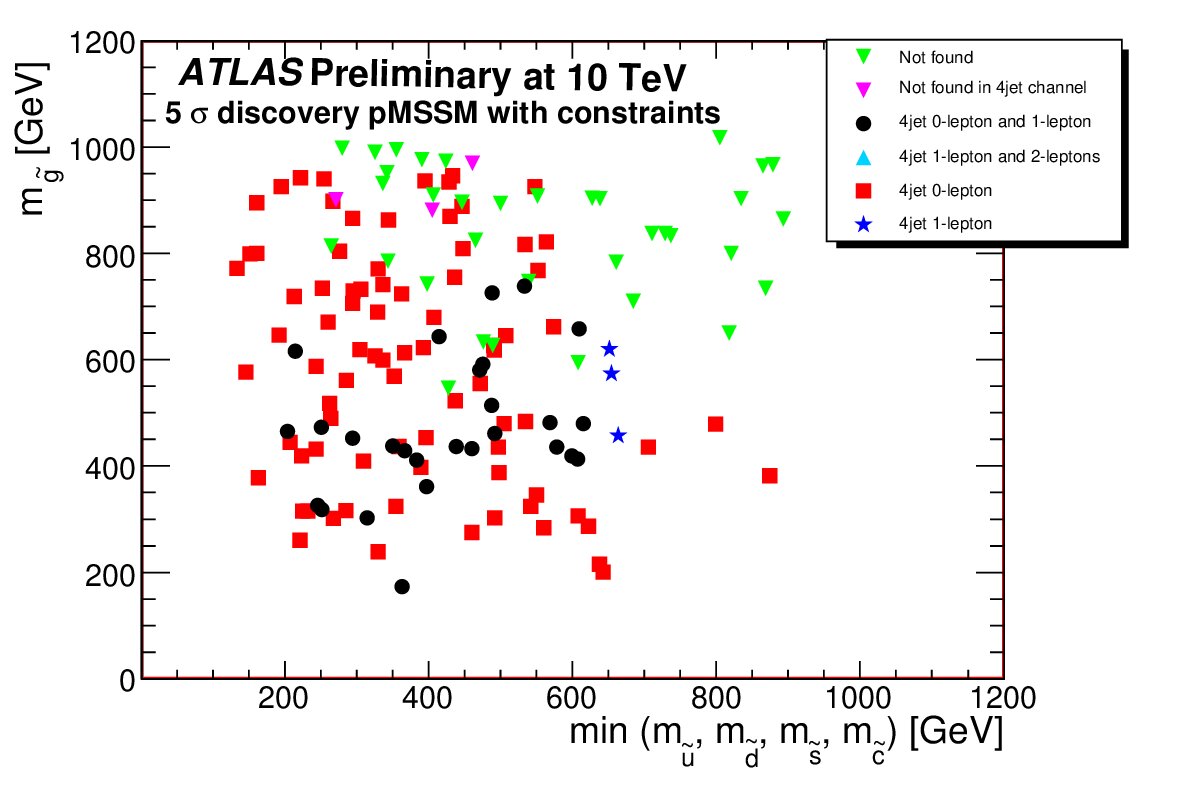 Figure 1
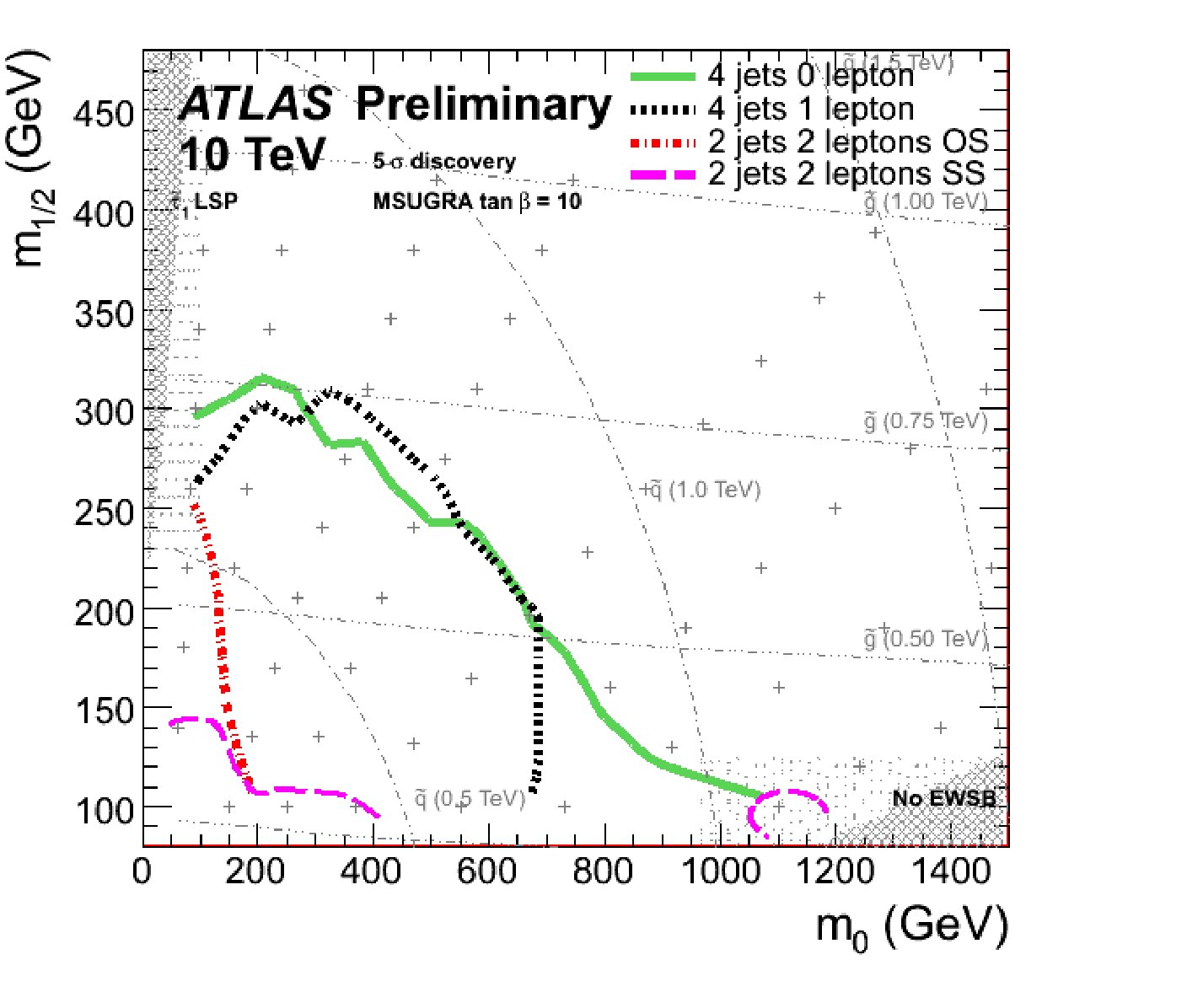 Figure 2
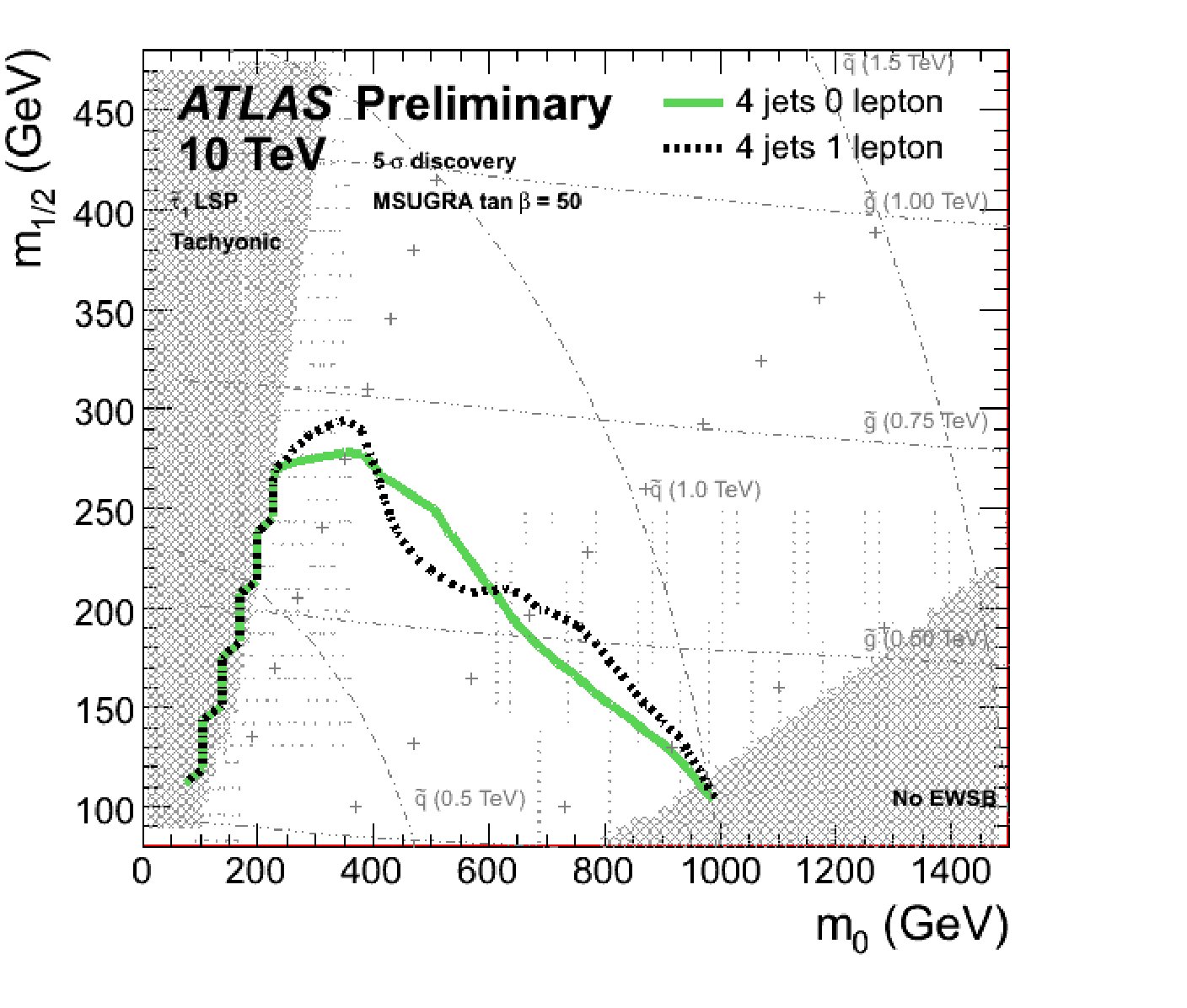 Figure 3
 Figure 4
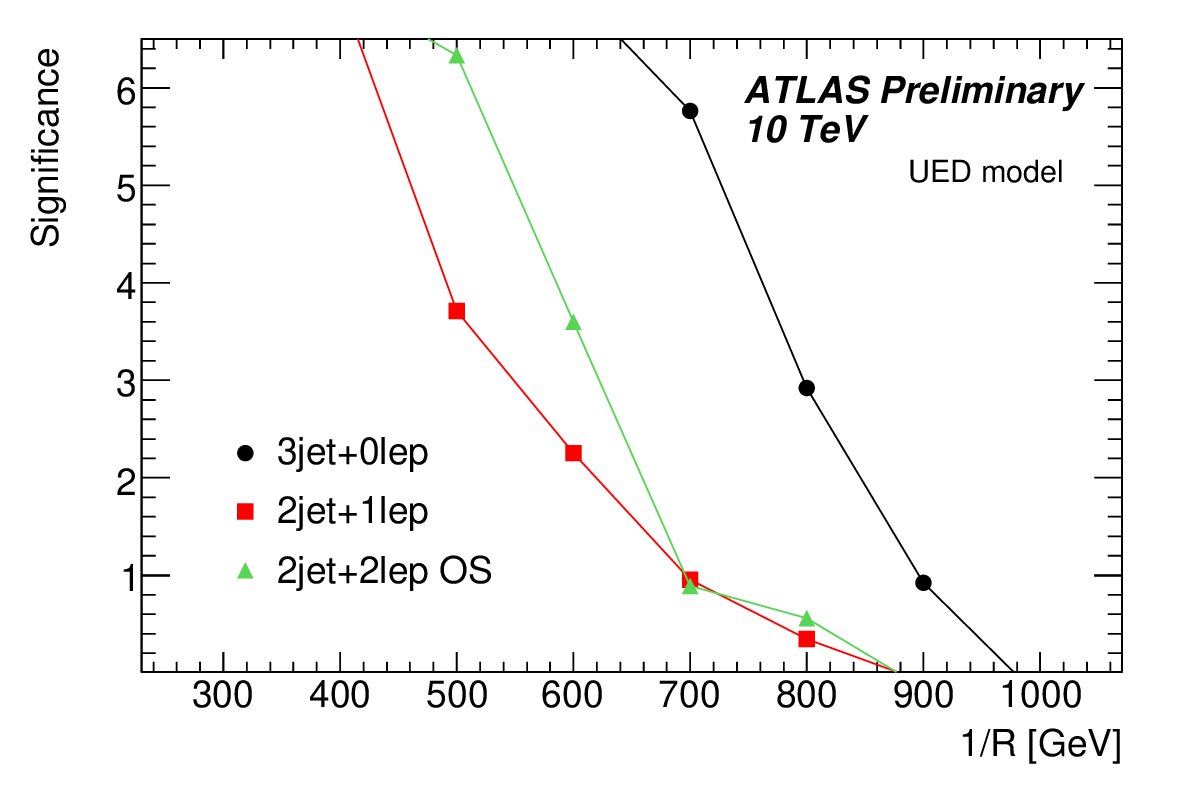 Figure 5
Peer Reviews
No public reviews on file for this paper yet. If you reviewed it on a platform where reviews are public (OpenReview, ICLR, NeurIPS, ICML), you can paste yours below so the community can read it here.
Videos
No videos yet. Explain this paper in a talk, walkthrough, or lecture? Add one.
Taxonomy
TopicsParticle physics theoretical and experimental studies · Dark Matter and Cosmic Phenomena · Computational Physics and Python Applications
ATLAS SUSY search prospects at 10 TeV
Physikalisches Institut, Albert-Ludwigs-Universität Freiburg, Germany
E-mail I would like to thank the organisers of the EPS09 for the invitation to present a poster and everyone in the ATLAS Collaboration whose work contributed to this poster. The author acknowledges the support by the Landesstiftung Baden Württemberg and the BMBF.
Abstract:
The search for physics beyond the Standard Model (BSM) is one of the most important goals for the general purpose detector ATLAS at the Large Hadron Collider at CERN. Already with early LHC data, the ATLAS experiment should be sensitive to discover physics beyond the Standard Model. This paper summarizes the prospects of the ATLAS experiment to find experimental evidence for Supersymmetry (SUSY) and Universal Extra Dimensions (UED) in channels with jets, leptons and missing transverse energy for an integrated luminosity of at a centre-of-mass energy = TeV.
Only a selection of the results is presented focussing on the the discovery reach for inclusive searches.
Inclusive searches for SUSY signals
Searches for SUSY have to deal with models that have a relatively large set of free parameters. In this article I will focus on R-parity conserving SUSY particle production. In order to cover many different topologies both models in the phenomenological minimal supersymmetric Standard Model (pMSSM) [1] and SUSY look alike scenarios such as Universal Extra Dimensions (UED) with Kaluza-Klein-parity conservation were considered.
ATLAS studied various channels with different numbers of jets (, , ) and leptons (0,1,2), trying to keep the SUSY searches robust and inclusive in order to cover as many signatures and topologies as possible. The applied selection cuts used in the inclusive SUSY searches are for example: require hadronic jets and above a certain threshold, and spherical events. In the no-lepton search mode events with an isolated high ( GeV) electron or muon are vetoed while for the 1 (2) lepton mode one (two) identified high lepton(s) is (are) required. Additionally a cut on the transverse mass , constructed from the identified lepton and the missing transverse energy, is applied in the one lepton channel. A full description of all selection cuts is presented in [2]. The final discriminating variable between SUSY and background we have used to search for an excess of events in various channels is . It is defined as the scalar sum of transverse momenta of all main objects as: where is the number of jets (2-4) and is the number of leptons (0-2). Further high jets or leptons are not included in the sum.
Discovery reach
We have explored the reach of our search strategies by studying grids of models in the parameter space of mSUGRA, pMSSM and UED. For each point in these grids the same set of selection cuts are applied and the significance is calculated. Note that for the significance calculation a systematic uncertainty of on the SM background estimate was taken into account. For a detailed explanation of the statistical procedure see [3] page 1590-1591.
The following plots show only the channels with the largest discovery reach for each lepton multiplicity. No attempt was made to combine the significance of the various channels. The 5 discovery reach lines in the - plane for different channels for the mSUGRA model with GeV, , and , are shown in figure 1. The plots show only the 4jet 0 lepton, 4jet 1 lepton channel and 2 jet 2lepton channel with opposite charges (left plot). The 0 and 1 lepton channels have similar potential for a discovery in the studied mSUGRA grids. The discovery reach for the 2 leptons channel with same sign charges is taken from reference [4].
Figure 2 shows the 5 discovery reach for the pMSSM grid with constraints as a function of the minimal mass of the first and second generation squarks and the mass of the gluino (left side). Most considered SUSY signals can be discovered with the 4 jets channels if the cross section is larger than pb and for squark and gluino masses up to 600 GeV. A few points are only found with the 2 or 3 jets channels with 0 or 1 lepton. In general the 4jets 0-lepton channel is more effective than the 1-lepton one, because many points do not lead to significant high lepton production.
The discovery reach for the UED model as a function of 222For UED models the extra dimension is compactified with the radius R that defines the size of the extra dimension., for the 3 jet 0-lepton channel, the 2 jet 1 lepton and the 2 jet channel with 2 leptons with opposite sign charges is shown in figure 2 on the right side. The largest discovery reach is found in the 3 jet 0 lepton channel. A significance can be achieved up to GeV with this channel.
Conclusion
The discovery potential for inclusive SUSY search channels with 0 leptons, 1 lepton or 2 opposite sign leptons and , or jets have been investigated for a scenario assuming an LHC centre-of-mass energy of = TeV and an integrated luminosity of . The results of the scans show that ATLAS could discover signals of R-parity conserving SUSY with gluino and squark masses less than 600-700 GeV in many scenarios. Signals of Universal Extra Dimensions can be discovered if GeV.
The reference list from the paper itself. Each links out to its DOI / PubMed record.
- 1[1] Berger, Carola F. and Gainer, James S. and Hewett, Jo Anne L. and Rizzo, Thomas G., Supersymmetry Without Prejudice , JHEP 02 (2009) 023
- 2[2] ATLAS collaboration, Prospects for Supersymmetry and Univeral Extra Dimensions discovery based on inclusive searches at a 10 Te V centre-of-mass energy with the ATLAS detector , Geneva, 2009, [ ATL-PHYS-PUB-2009-084 ]
- 3[3] ATLAS collaboration, Expected Performance of the ATLAS Experiment, Detector, Trigger and Physics , CERN-OPEN-2008-020, Geneva, 2009, [ ar Xiv:0901.0512 ]
- 4[4] ATLAS collaboration, BSM physics with two same-sign leptons multi-jets plus missing transverse energy in ATLAS , Geneva, 2009, [ ATL-PHYS-PUB-2009-085 ]