
TL;DR
This paper introduces exploded manifolds, a mathematical framework extending smooth manifolds with tropical and holomorphic curve theories, facilitating Gromov-Witten invariants computation relative to divisors.
Contribution
It presents the concept of exploded manifolds, integrating tropical geometry with holomorphic curve theory to advance Gromov-Witten invariants calculations.
Findings
Exploded manifolds extend smooth manifolds with tropical structures.
They enable computation of Gromov-Witten invariants relative to divisors.
The framework connects tropical curve counts with holomorphic curve theory.
Abstract
This paper provides an introduction to exploded manifolds. The category of exploded manifolds is an extension of the category of smooth manifolds with an excellent holomorphic curve theory. Each exploded manifold has a tropical part which is a union of convex polytopes glued along faces. Exploded manifolds are useful for defining and computing Gromov-Witten invariants relative to normal crossing divisors, and using tropical curve counts to compute Gromov-Witten invariants.
Click any figure to enlarge with its caption.
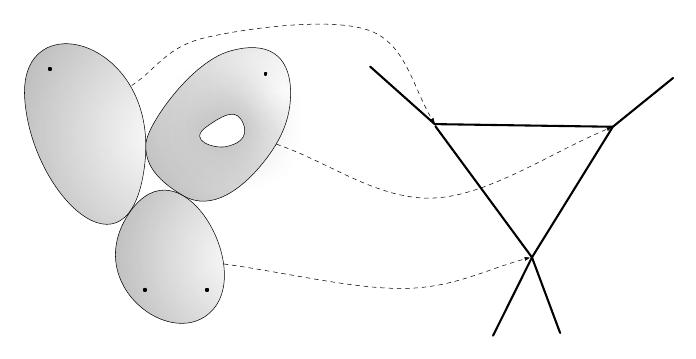 Figure 1
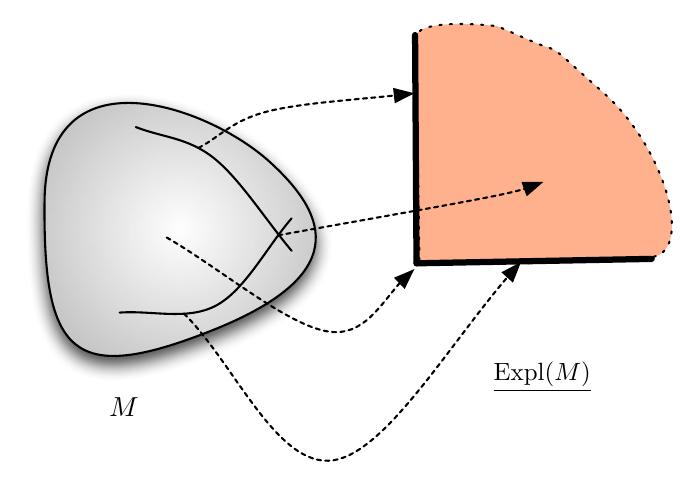 Figure 2
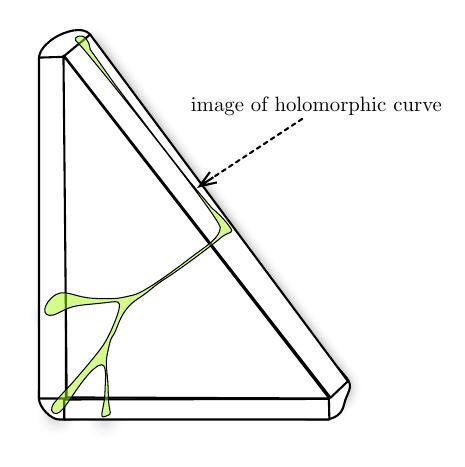 Figure 3
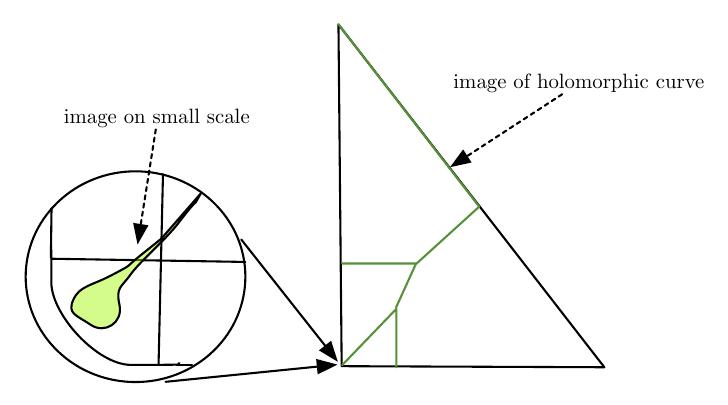 Figure 4
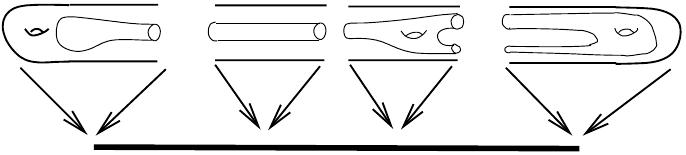 Figure 5
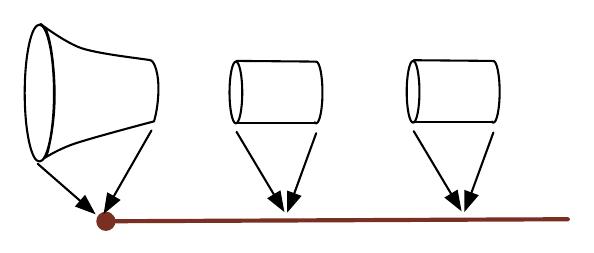 Figure 6
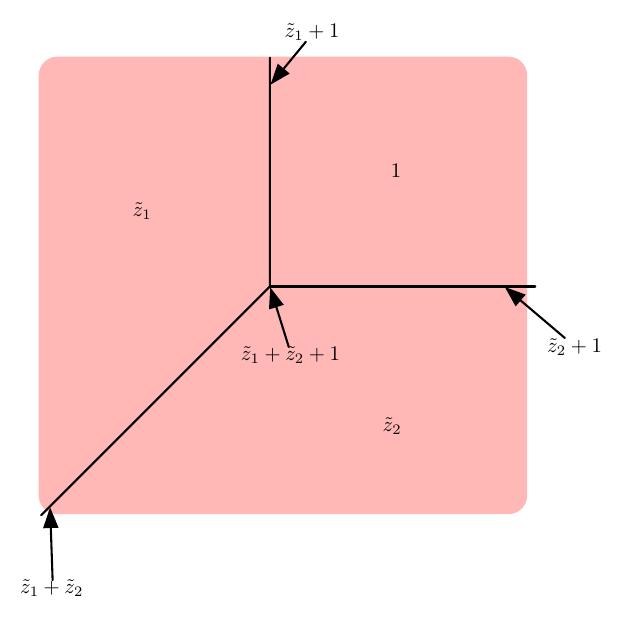 Figure 7
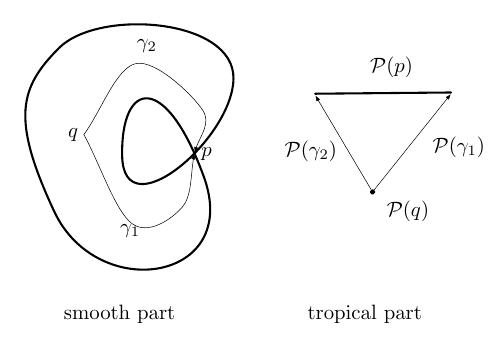 Figure 8
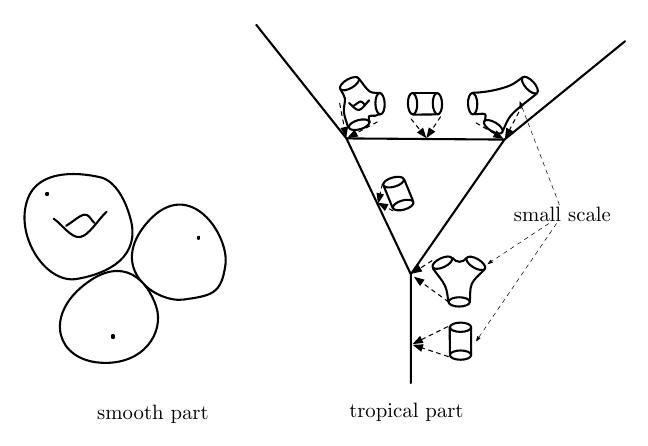 Figure 9
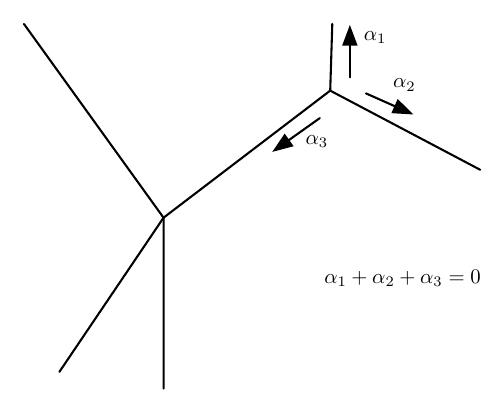 Figure 10
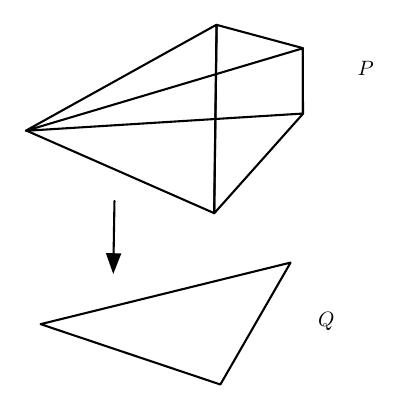 Figure 11
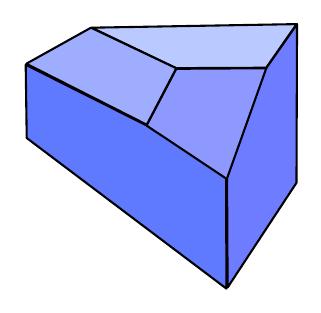 Figure 12
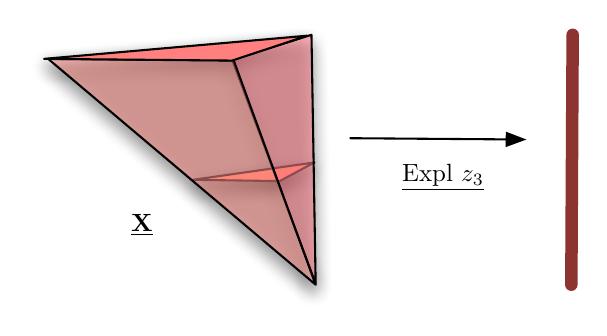 Figure 13
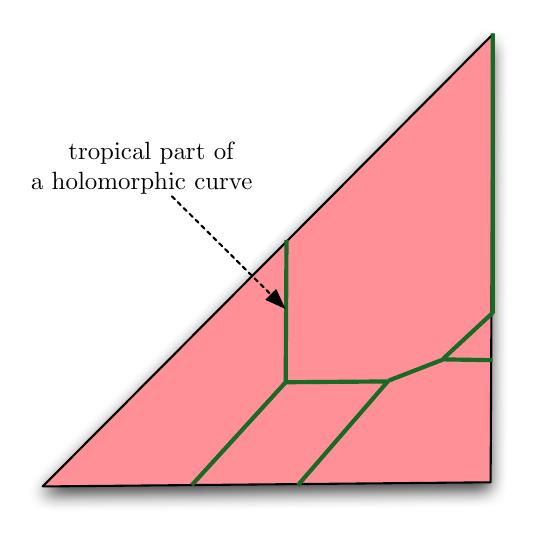 Figure 14
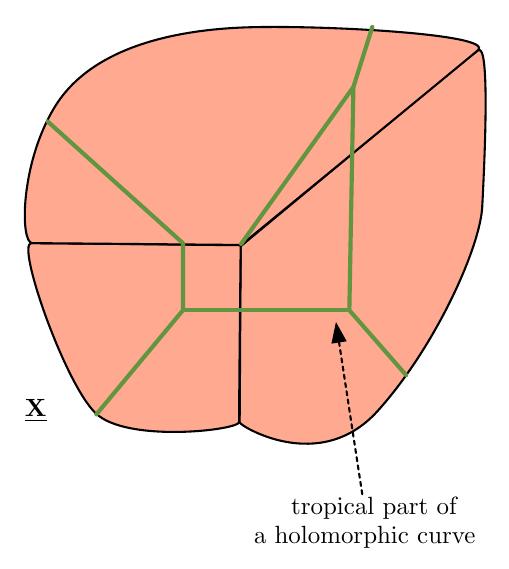 Figure 15
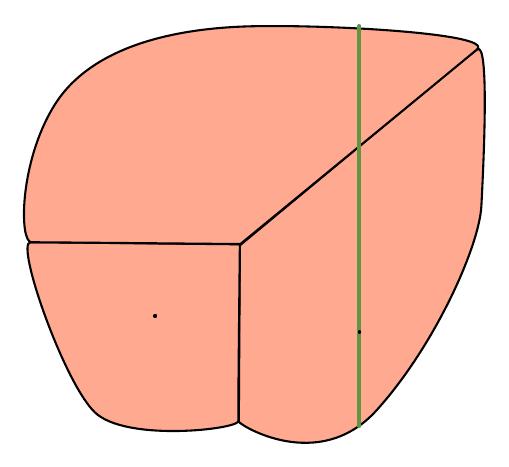 Figure 16
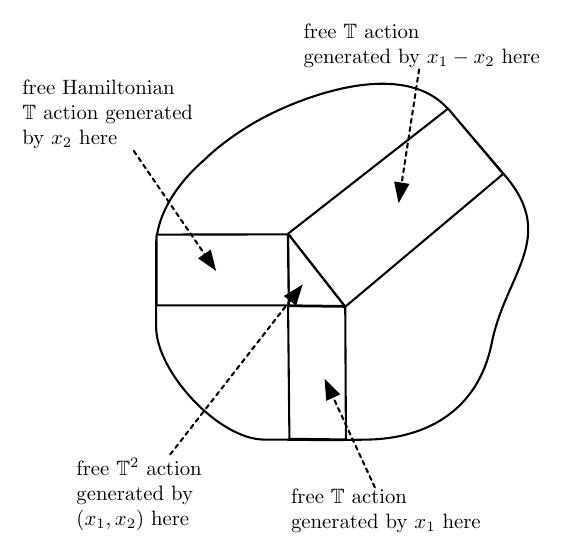 Figure 17
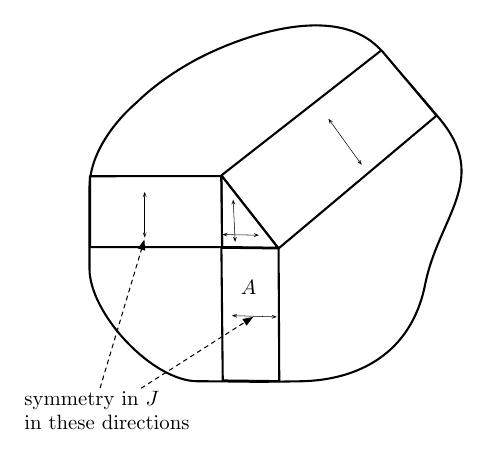 Figure 18
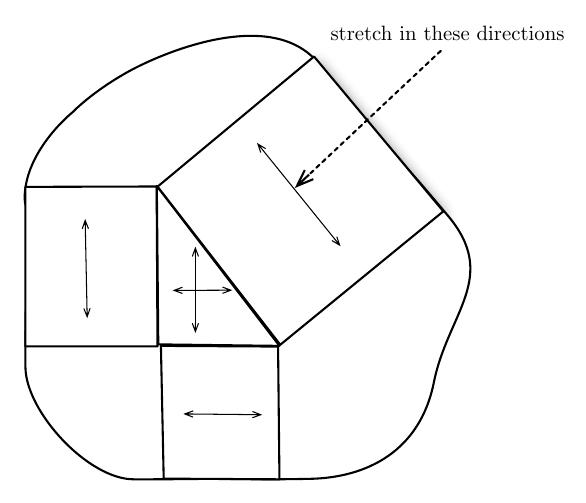 Figure 19
Peer Reviews
No public reviews on file for this paper yet. If you reviewed it on a platform where reviews are public (OpenReview, ICLR, NeurIPS, ICML), you can paste yours below so the community can read it here.
Videos
No videos yet. Explain this paper in a talk, walkthrough, or lecture? Add one.
Taxonomy
TopicsPolynomial and algebraic computation · Algebraic Geometry and Number Theory · Advanced Combinatorial Mathematics
Exploded Manifolds
Brett Parker
Abstract
This paper provides an introduction to exploded manifolds. The category of exploded manifolds is an extension of the category of smooth manifolds with an excellent holomorphic curve theory. Each exploded manifold has a tropical part which is a union of convex polytopes glued along faces. Exploded manifolds are useful for defining and computing Gromov-Witten invariants relative to normal crossing divisors, and using tropical curve counts to compute Gromov-Witten invariants.
Contents
- 1 Introduction
- 2 Tropical semiring and exploded semiring
- 3 Exploded manifolds
- 4 Stratified structure
- 5 The explosion functor and log geometry
- 6 Tangent space
- 7 regularity
- 8 Almost complex structures
- 9 Fiber products
- 10 Families and refinements
- 11 Moduli stack of exploded curves
1 Introduction
The category of exploded manifolds is useful for
defining and computing Gromov-Witten invariants relative to normal crossing divisors,
- 2.
computing Gromov-Witten invariants using normal crossing degenerations and degenerations appearing in tropical geometry such as Mikhalkin’s higher dimensional pair of pants decomposition of projective hypersurfaces [16].
- 3.
relating ‘tropical’ curve counts to counts of holomorphic curves in a significantly more general setting than toric manifolds.
This introductory section sketches how exploded manifolds are useful for studying holomorphic curves. The rest of this paper contains an introduction to exploded manifolds, including definitions and differential geometric properties. DeRham cohomology of exploded manifolds is discussed in [20] and the papers [19], [22] and [21] go on to construct Gromov-Witten invariants of exploded manifolds.
The word ‘tropical’ is in quotes above, because some objects which are called tropical in this paper are much more general than what is traditionally studied in tropical geometry. (For example, our tropical curves will satisfy a balancing condition only when certain topological conditions hold.) Each exploded manifold has a tropical part , which can be thought of as a collection of convex polytopes glued over faces using integral affine maps. The operation of taking the tropical part of an exploded manifold is functorial. (This contrasts to the common procedure of taking the tropicalization of a subvariety of a torus defined over Puiseux series, which is only functorial under monomial maps).
A second important functor is called the explosion functor. Given a complex manifold with normal crossing divisors, the explosion of is an exploded manifold . For example, if is a toric manifold with its toric divisors, the tropical part of is the toric fan of . The tropical part of any holomorphic curve in is a tropical curve in . More generally, if is a complex manifold with a collection of transversely intersecting complex codimension submanifolds, then the tropical part of has one vertex for each connected component of , a copy of for each submanifold, a face for each intersection and an dimensional quadrant for each -fold intersection. (This is sometimes called the dual intersection complex of .)
This explosion functor can be viewed as a base change in the language of log geometry, and log geometry provides one language for describing some holomorphic exploded manifolds. The paper [23] explores the link between exploded Gromov-Witten invariants and log Gromov-Witten invariants defined by Gross and Siebert in [9], and separately by Abramovich and Chen in [1], [4], [3] and [2]. Defining log Gromov-Witten invariants may be regarded as a step in Gross and Siebert’s program on mirror symmetry using tropical geometry. (See for example [8].) Inspired by the Strominger-Yau-Zaslow conjecture [24], many other researchers have been exploring the link between tropical geometry and mirror symmetry, such as Kontsevich and Soibelman in [12] and Fukaya in [7].
Exploded manifolds have an excellent holomorphic curve theory. As in the smooth setting, holomorphic curves refer to both abstract holomorphic curves (which in our case are one complex dimensional complex exploded manifolds), and holomorphic maps of abstract holomorphic curves to exploded manifolds with an (almost) complex structure. An abstract exploded curve has a smooth part which corresponds to a nodal Riemann surface with punctures, and a tropical part which is a metric graph with one vertex for each component, one internal edge for each node, and one semi infinite edge for each puncture. It is called stable if the nodal Riemann surface is stable.
It turns out that the moduli stack of stable exploded curves with genus and punctures is equal to the explosion of Deligne Mumford space , where is viewed as a complex orbifold with normal crossing divisors given by the boundary, which consists of the nodal Riemann surfaces. The explosion of the forgetful map is actually a smooth family in the exploded category which has as the fiber over each point in the corresponding exploded curve quotiented by its automorphisms.
The paper [21] proves that the moduli stack of holomorphic curves in an exploded manifold also has an exploded structure. In nice cases, the moduli space of holomorphic curves is itself an exploded manifold. In the case that holomorphic curves in an exploded manifold are suitably tamed by a symplectic form, the moduli space of holomorphic curves is compact, and has a virtual fundamental class, allowing Gromov-Witten invariants to be defined in the exploded setting. For example, to define Gromov-Witten invariants of a Kähler manifold relative to normal crossing divisors, take the Gromov-Witten invariants of the corresponding exploded manifold . As outlined in [23], it is expected that the Gromov-Witten invariants of are the same as the log Gromov-Witten invariants of defined by Gross and Siebert or Abramovich and Chen. Sometimes, these relative Gromov-Witten invariants can be determined by considering only the tropical curves in the tropical part of . For instance, in the case that is a toric manifold, and we use the toric boundary divisors, work of Mikhalkin, in [17] and of Siebert and Nishinou in [18] translates to saying that genus zero relative Gromov-Witten invariants can be computed by considering tropical curves in .
A similar (but less functorial) construction can associate an exploded manifold to a symplectic manifold with orthogonally intersecting codimension symplectic submanifolds, allowing Gromov-Witten invariants relative to these symplectic submanifolds to be defined. The approach of Ionel to relative Gromov-Witten invariants from [10] should give similar invariants in this case.
As an example application of these relative Gromov-Witten invariants, suppose that there existed a connected compact symplectic -manifold containing orthogonally intersecting embedded symplectic spheres, which intersect each other once and have topological self intersection numbers , and . Then we could construct an exploded manifold for which the tropical part of holomorphic curves behave like the tropical curve in the following picture:
In particular, away from the central vertex, the tropical part of holomorphic curves in obey a balancing condition, although when they pass through the left pointing edge in the above picture of , they are deflected to the left. (In general, the tropical part of a holomorphic curve in an exploded manifold is always a piecewise linear map of a metric graph into the tropical part of , but it does not always have to satisfy the balancing condition familiar to tropical geometers. For example, let be a bundle over with nontrivial Chern class and divisor given by the zero section. Then the tropical part of is , and the tropical part of holomorphic curves in need not satisfy the usual balancing condition.)
In our hypothetical exploded manifold , consider the following enumerative problem: count the (virtual) number of rigid holomorphic curves that
pass through a given point in 2. 2.
have tropical parts which have two seminfinite ends , one of which is mapped in the direction in the above picture, and one of which is mapped in the direction in the above picture.
The paper [21] proves that this enumerative problem should have as an answer a rational number which does not depend on the point through which our holomorphic curves are required to pass. If we choose our point to have tropical part in the left hand half of , the balancing condition for tropical curves in implies that there are no holomorphic curve passing through our given point. On the other hand, if we choose our point to have tropical part in the right hand half of , the only possible tropical curve satisfying our conditions is drawn below, and a simple calculation implies that there is exactly one holomorphic curve satisfying our conditions passing through this point. The conclusion to be drawn from this contradictory situation is that there does not exist a compact symplectic manifold with embedded symplectic spheres as described above.
The reader may ask how these Gromov-Witten invariants of exploded manifolds correspond to Gromov-Witten invariants of smooth manifolds. Each smooth manifold can also be considered as an exploded manifold, so instead of considering holomorphic curves in a smooth symplectic manifold , we can consider the exploded holomorphic curves. Each exploded manifold has a ‘smooth part’ which is a topological space. The smooth part of an exploded holomorphic curve in is a holomorphic curve in considered as a smooth manifold. The smooth part of the moduli space of exploded curves in is the usual moduli space of holomorphic curves in . The moduli space of exploded curves in therefore contains all the information present in the usual moduli space of holomorphic curves in , so we may as well work in the exploded category for computing Gromov-Witten invariants. This has the advantage that many degenerations which look nasty from the smooth perspective turn out to be smooth families in the exploded category.
For example, applying the explosion functor to a normal crossings degeneration gives a smooth family of exploded manifolds. As shown in [21], holomorphic curve invariants such as Gromov-Witten invariants do not change in connected families of exploded manifolds, so the Gromov-Witten invariants can be computed in any fiber of the resulting family. In particular, suppose that a normal crossing degeneration has a singular fiber which is a union of pieces . The Gromov-Witten invariants of a smooth fiber can then be computed using the Gromov-Witten invariants of an exploded manifold corresponding to this singular fiber, the computation of which involves tropical curve counts in the tropical part of coupled with relative Gromov-Witten invariants of the pieces . If these pieces are simple, then this can simplify the computation of Gromov-Witten invariants considerably.
As a concrete example, consider the complex dimensional toric manifold with moment map the polytope defined by the equations
[TABLE]
The corresponding toric fan is dual to the above polytope, and has edges which are the span of the vectors , , , , and . The corresponding toric manifold can be considered as a partial compactification of where the coordinates and correspond to projection of the above fan onto the first, second and third components respectively.
Consider the map from our toric manifold to . This map can be considered as a normal crossing degeneration. The fiber over any point in is equal to , but the fiber over [math] is singular, and consists of the three toric boundary divisors corresponding to the top faces of the above polytope. (Each is isomorphic to blown up at one point.) Consider this toric manifold as a complex manifold with transversely intersecting complex submanifolds given by the toric boundary divisors of the top faces , and , and call the corresponding exploded manifold . Similarly, we can consider as a complex manifold with the divisor [math]. The explosion of the map is a smooth family of exploded manifolds
[TABLE]
The tropical part of can be identified with the positive span of , and , and the tropical part of can be identified with projection to the third coordinate.
There are now a large number of exploded manifolds in this family that correspond to the singular fiber of our original degeneration. The following is a picture of the tropical part of one of these exploded manifolds with the tropical part of a holomorphic curve.
In this case, the number of holomorphic curves in the above exploded manifold passing through a given number of points can be calculated using Mikhalkin’s tropical methods from [15], by choosing the points to have tropical parts that appear in the interior of the above triangle in ‘tropical general position’.
An example of a degeneration ‘breaking a manifold into simple pieces’ is given by Mikhalkin’s higher dimensional pair of pants decomposition of projective hypersurfaces from [16]. An exploded version of this construction is discussed in example 10.11 beginning on page 10.11. In particular, given any dimensional projective hypersurface which intersects the toric boundary of nicely, one can take the intersection of with the boundary of to be a normal crossing divisor of . Then there is a connected family of exploded manifolds containing both and an exploded manifold which has as its tropical part the dimensional balanced polyhedral complex which appears as the base of Mikhalkin’s singular fibration from [16], and which has a smooth part a union of ‘higer dimensional pairs of pants’, which are copies of with normal crossing divisors given by hyperplanes. To compute the relative Gromov-Witten invariants of , one can compute the corresponding invariants of . A similar construction gives a connected family of exploded manifolds containing both and an exploded manifold with tropical part a truncated version of the tropical part of .
For an analytic perspective on degenerations that can be treated nicely in the exploded category, consider the following example. Think of the following picture as the image of some smooth map from a symplectic manifold to .
Assume that in the regions pictured above, the Hamiltonian flow generated by the specified function on is a free circle action, and that in the central triangle, the two coordinate functions generate commuting free circle actions. From this point on, we shall describe a family of almost complex manifolds, forgetting the original symplectic structure. (The symplectic form is necessary to tame holomorphic curves in the family we shall construct, but we shall not say more about it in this example.) It is possible to choose an almost complex structure on our symplectic manifold so that the symplectic form is positive on holomorphic tangent planes, and so that is preserved by the circle actions in the regions where they are defined, and so that also has the symmetry specified in the picture below.
In particular, it is possible to identify the region labeled above with where is a manifold with boundary, is the coordinate on , and the circle action is independent of . In this region, we may choose to send the vector field generating the circle action to , and require that is independent of and preserved by the circle action. We may specify similarly in the other regions with circle actions - choosing independent of both and in the central triangle region which can be identified with some manifold times a triangle in with vertices , and .
We are now ready to describe a family of almost complex manifolds for . We may replace the region with , extending symmetrically, replace the other regions with circle actions by similarly stretched regions, and replace the central triangle region with times a triangle with vertices , and , again extending symmetrically. We may depict this by stretching in all the directions pictured in which has symmetry.
The following is a picture of the image of a holomorphic curve in a member of our family with . The picture has been rescaled by a factor of about .
The important point here is as follows: Consider the image of a holomorphic curve in the picture which has been rescaled by a factor of for very small . The pieces of a holomorphic curve which look large will approximate a special type of holomorphic cylinder which is preserved by one of our circle actions. The projection of this cylinder to our picture is simply a line with integral slope. In the limit , the image of holomorphic curves in the picture rescaled by will look piecewise linear.
For extremely small , the image of a holomorphic curve in the picture rescaled by a factor of about will look something like this:
It is unreasonable to expect that the rescaled image as will in general contain all the information necessary to reconstruct holomorphic curve invariants. We must also somehow keep track of information which is on a smaller scale as . This is one striking feature that exploded manifolds have. Exploded manifolds have multiple topologies; the tropical part of an exploded manifold could in some sense be thought of as the large scale of the exploded manifold.
The above family of almost complex manifolds fit into a smooth connected family of exploded manifolds, one of which has a tropical part which looks like the above rescaled picture. (The example containing discussed earlier is a concrete example of such a family of exploded manifolds.) This family of exploded manifolds can be thought of as representing a symplectic triple sum. If we think of this family as ‘stretching over a triangle’, then there are analogous families of exploded manifolds ‘stretching over’ any compact convex polytope with integer vertices.
For example, the usual symplectic sum can be represented by a family of exploded manifolds ‘stretching over’ an interval, and containing an exploded manifold that can be represented pictorially as follows:
This case of a family representing a symplectic sum has been studied by Eliashberg Givental and Hofer in [5], Ionel and Parker in [11], Jun Li in [14], and Ruan and A. Li in [13]. In each of these cases, the researchers did not need knowledge of the large scale to describe the limiting problem of finding holomorphic curves. The relationship between the moduli spaces considered by the above researchers and the exploded moduli space is as follows: Consider the schematic diagram above in which the large scale or tropical part of our exploded manifold is represented as an interval, and the pictures above it represent what is seen of a holomorphic curve in the small scale at different places. All but a finite number of those small scale pieces will have holomorphic curves with translational symmetry in the left right direction, such as depicted in the second picture from the left. The remaining interesting pieces have an order to them. The above researchers record these interesting pieces, along with the order in which they come, and also consider two different pieces of holomorphic curve in the middle to be equivalent if they differ by a or action (in [11],[14], [13], there is a action, but in [5] there is only a action.) Approaching holomorphic curve from the exploded category can be thought of as a generalization of the above researchers’ work to the case of stretching in multiple directions.
2 Tropical semiring and exploded semiring
We shall need the following semirings to describe coordinates on exploded manifolds.
The tropical semiring is a semiring which is equal to with ‘multiplication’ being the operation of usual addition and ‘addition’ being the operation of taking a minimum. Write elements of as where . Then we can write the operations as follows
[TABLE]
[TABLE]
can be thought of as something which is infinitesimally small, so use the following order on :
[TABLE]
Given a ring , the exploded semiring consists of elements with and . Multiplication and addition are as follows:
[TABLE]
[TABLE]
It is easily checked that addition and multiplication are associative and obey the usual distributive rule. The reader familiar with Puiseaux series will notice that may be viewed as arising from taking the leading term of Puiseaux series with coefficients in . We will mainly be interested in and .
There are semiring homomorphisms
[TABLE]
defined by
[TABLE]
[TABLE]
The homomorphism is especially important. We shall call the tropical part of . There will be an analogous tropical part of exploded manifolds which can be thought of as the large scale.
Define to be the sub semiring of consisting of elements of the form where . There is a semiring homomorphism
[TABLE]
given by
[TABLE]
Call the smooth part of . Note that this smooth part homomorphism can be thought of as setting , which is intuitive when is thought of as infinitesimally small.
We shall use the following order on , which again is intuitive if is thought of as being infinitesimally small and positive:
[TABLE]
3 Exploded manifolds
A smooth manifold can be regarded as a topological space with a sheaf of smooth real valued functions. Similarly, an exploded manifold can be regarded as a (maybe non Hausdorff) topological space with a sheaf of valued functions. The following definition of abstract exploded spaces is far too general, but it allows us to talk about local models for exploded manifolds as abstract exploded spaces without giving too many definitions beforehand. Think of this as analogous to introducing manifolds by making a definition of an ‘abstract smooth space’ as a topological space with a sheaf of real valued functions, then taking about with its sheaf of smooth functions as an abstract smooth space, then defining a manifold as an abstract smooth space locally modeled on .
Definition 3.1** (Abstract exploded space).**
An abstract exploded space consists the following:
*A (possibly non-Hausdorff) topological space whose topology is induced from a surjective map to a Hausdorff topological space, . *111I added this important condition on the topology of after publishing. A similar condition was present in my original definition of exploded manifolds in http://arxiv.org/abs/0706.3917. The published version assumed this was the case for exploded manifolds without it actually being implied by the definition. Sorry. ** 2. 2.
A sheaf of Abelian groups on this topological space called the sheaf of exploded functions on so that:
- (a)
Each element is a map
[TABLE] 2. (b)
Multiplication is given by pointwise multiplication in . 3. (c)
* includes the constant functions if .* 4. (d)
Restriction maps are given by restriction of functions.
Definition 3.2** (Morphism of abstract exploded spaces).**
A morphism of abstract exploded spaces is a continuous map
[TABLE]
so that preserves in the sense that if , then is in
[TABLE]
It may occur to the reader that from the perspective of differential geometry, using instead of would be a more natural choice for extending the category of smooth manifolds. The choice of is used so that holomorphic curve theory works out easily in the category of exploded manifolds. Making the same definitions but replacing with and with would give an interesting category worthy of study.
The next sequence of examples will give local models for exploded manifolds.
Example 3.3** (Smooth Manifold).**
Any smooth manifold can be considered as an abstract exploded space as follows: the toplogical space is just with the usual topology, and the sheaf consists of all functions of the form where and is a locally constant valued function.
Readers should convince themselves that this is just a different way of encoding the usual data of a smooth manifold, and that a morphism between smooth manifolds regarded as abstract exploded spaces is simply a smooth map. In other words, the category of smooth manifolds a full subcategory of the category abstract exploded spaces.
The reader should check that a point considered as an exploded manifold is a final object in the category of abstract exploded spaces: given any abstract exploded space , and a point , there exists a unique map .
Example 3.3 should be considered as a ‘completely smooth’ exploded manifold. At the other extreme, we have the following ‘completely tropical’ exploded manifold.
Example 3.4** ().**
The exploded manifold is best described using coordinates where each . The set is identified with by prescribing the values of in , and given the trivial topology in which the only open subsets are the empty set and the entire set. We shall regard as being complex dimensional, or real dimensional.
Exploded functions can be written in these coordinates as
[TABLE]
where , and are all constant. The above function takes values as follows: if a point has coordinates , then takes the value on .
The exploded manifold has a ‘large scale’ or ‘tropical part’ which is (given the usual topology and integral affine structure on ), which can be regarded as giving another, (non Hausdorff) topology on the set of points in . There is a map from the set of points in to which is given in coordinates by
[TABLE]
Note that there is a worth of points over every point .
Before continuing, the reader should be able to verify the following observations:
A morphism from to a smooth manifold is simply given by a constant map . 2. 2.
A morphism from a connected smooth manifold to has the information of a map from to a point and a smooth map from to the worth of points over . The map is determined by specifying the exploded functions
[TABLE]
Note in particular that is equal to the sheaf of smooth morphisms of to . This is true in general. A smooth morphism from any abstract exploded space is equivalent to the choice of exploded functions in corresponding to .
The following special case is worth emphasizing: Given any abstract exploded space , the sheaf can be identified with the sheaf of morphisms to . Think of this as analogous the sheaf of smooth functions on a manifold being identified as the sheaf of smooth maps to . 3. 3.
A morphism is given by an exploded function . This induces an integral affine map called the tropical part of .
[TABLE]
[TABLE]
The next example describes a hybrid object, part ‘smooth’, part ‘tropical’.
Example 3.5** ().**
The exploded manifold is more complicated. We shall describe this using the coordinate . The set of points is identified with by specifying the value of .
Recall the following smooth part homomorphism
[TABLE]
[TABLE]
The above map gives a map from the set of points to . Pulling back the usual topology on defines the topology on . We shall refer to as the smooth part of , and use the notation .
We can write any exploded function as
[TABLE]
The tropical part or large scale of is , and the map from the set of points in to is given by
[TABLE]
This exploded manifold should be thought of as follows: Over , there is a copy of which should be considered as a manifold with an asymptotically cylindrical end at [math], drawn on the left hand side above with this cylindrical end pointing right. Each copy of over where should be thought of as some ‘cylinder at infinity’. Note that even though there is a worth of two dimensional cylinders involved in this exploded manifold, it should still be thought of being two dimensional. This strange feature is essential for the exploded category to have a good holomorphic curve theory. (Actually, we could just as easily had a worth of cylinders at infinity, and worked over the semiring instead of , but this author prefers the real numbers.)
The exploded manifold is a kind of hybrid of the last two examples. Restricting to an open set contained inside we get part of a smooth manifold. Restricting to a subset contained inside , we get part of .
For any abstract exploded space , we can define to consist of all functions in which take values only in . Note that a smooth morphism from any exploded manifold described in examples so far is given by a choice of exploded function . This will be true for exploded manifolds in general.
Example 3.6** (A holomorphic curve in ).**
The following is an example of a holomorphic curve in . Consider the subset of where .
If and are less than , then , so there are no solutions in this region. There are also no solutions where and because in this region , which only takes values in . Similarly, there are no solutions where and , because in this region .
Below is a picture of the tropical part of with labels indicating simplifications of in various regions.
The tropical part of the subset where is the black tropical curve drawn above, which coincides with the subset where the tropical parts of at least two terms of coincide. This subset where is actually a holomorphic curve inside . We can parametrize this curve using the following 3 coordinate charts modeled on :
[TABLE]
[TABLE]
[TABLE]
[TABLE]
The tropical part of the image of is the line pointing right in the above picture, the tropical part of is the line pointing up, and the line pointing left and down is the image of the tropical part of .
A similar example is considered on page 8.5.
The isomorphism type of a coordinate chart on a smooth manifold only depends on dimension. The isomorphism type of a coordinate chart on an exploded manifold is determined by the dimension and an integral affine polytope. Below we define some integral affine notions.
Definition 3.7** (Integral affine).**
An integral affine map is a map of the form
[TABLE]
where is an integer matrix and .
An integral affine polytope is a convex polytope with nonempty interior and faces of rational slopes, defined by some finite set of inequalities:
[TABLE]
where and .
Integral affine polytopes form a category with morphisms being integral affine maps between polytopes.
Call complete if is complete when given the usual Euclidean metric on (ie. no strict inequalities are used to define .) Call open if it can be defined using only strict inequalities.
Example 3.8** ().**
Given an integral affine polytope , define the abstract exploded space as follows:
The set of points in is equal to the set of points so that . The coordinates then restrict to give coordinate functions
[TABLE]
In coordinates, the set of points in is equal to
[TABLE]
Consider the collection of exploded functions on so that on , . Choose some finite generating set of these functions so that any other function of this type can be written as where and . Recalling that if and , define the functions . Then consider the following map
[TABLE]
Give the topology which is the pullback of the usual topology on under the above map , and call the image of this map the smooth part of , written as . The sheaf of exploded functions on can then be described as functions of the form , where is smooth and and are locally constant. (This topology and sheaf of exploded functions is independent of the choice of generating set .)
Naturally, the tropical part of is given by
[TABLE]
Simple examples of the above construction are which is equal to and which is equal . (Where no ambiguity is present, we shall write polytopes such as simply as .)
Remark 3.9**.**
should be understood as an -fold product of . If the polytope contains no entire lines, a good way to describe is as a subset of . In particular, the monomials give an injective map
[TABLE]
so that any exploded function on may be described as the pullback of some exploded function on . We may therefore think of as a subset of . This subset is described by the monomial relations between the , which may be written in a finite number of equations of the form
[TABLE]
so in the case that contains no entire lines, we may consider as a subset of described by setting some monomials equal to . Similarly, if is times a polytope that contains no lines, we may consider as a subset of defined by setting some monomials equal to .
Note also that the smooth part of may be regarded as the subset of (which is the smooth part of ) defined by setting the same monomials equal to , with as variables in place of .
The functions above which generate the smooth functions will come up often, so make the following definition.
Definition 3.10** (Basis of smooth monomials).**
The smooth monomials on are the functions of the form . A set of smooth monomials is a basis for the smooth monomials on if every smooth monomial on can be written as some product of nonnegative powers of the times a complex number.
We can construct similarly to . This has coordinates , with the product topology. Similarly, the smooth part is the product . The exploded manifold has exploded functions equal to functions of the form , where is smooth and and are locally constant. The tropical part is equal to , with . The real dimension of is considered to be .
Example 3.11** (A nontrivial example of ).**
Let be defined by
[TABLE]
A basis for smooth monomials on is given by
[TABLE]
The smooth part of is the image of the map
[TABLE]
which is equal to the subset of where .
Example 3.12** ().**
Let . We shall use the notation for . In this case a basis for the smooth monomials on is given by and . Any smooth morphism is equal to for some smooth function . The two functions and satisfy the relation , so is the union of the two coordinate planes in , which can be considered as two copies of glued over [math]. The function is also equivalent to the choice of two smooth functions , so that . The equivalence is given by
[TABLE]
The three different possibilities above correspond to three different ‘strata’ of where is in or . The ability to solve problems such as differential equations on exploded manifolds stratum by stratum is part of the usefulness of the exploded category, as complicated problems can be broken into simple pieces.
Before continuing, the reader should be able to do the following easy exercises:
A morphism is equivalent to the choice of exploded functions so that
[TABLE] 2. 2.
A morphism is equivalent to a choice of continuous map so that there exists some smooth map
[TABLE]
so that
[TABLE] 3. 3.
Any morphism induces an integral affine map so that the following diagram commutes
[TABLE] 4. 4.
is isomorphic as an abstract exploded space to if and only if is isomorphic as an integral affine polytope to . 5. 5.
Any morphism induces a continuous map so that the following diagram commutes
[TABLE]
Definition 3.13** (Exploded manifold).**
A smooth exploded manifold is an abstract exploded space locally isomorphic to . In other words, for all there exists some open neighborhood of and some so that is isomorphic as an abstract exploded space to .
A smooth map of exploded manifolds is a morphism of abstract exploded spaces.
Lemma 6.10 on page 6.10 proves that the above definition is equivalent to defining an exploded manifold as an abstract exploded space locally isomorphic to open subsets of .
Definition 3.14** (Smooth part).**
The smooth part of a smooth exploded manifold is the Hausdorff222After publishing, I added an extra condition to Definition 3.1 to ensure that is Hausdorff. For example, we do not want two copies of glued over an open interval to be a valid exploded manifold. topological space which is the quotient of the topological space by the equivalence relation if every open subset of which contains contains . (The fact that this relation is symmetric follows from the fact that is locally isomorphic to . )
It should be clear that gives a functor from the category of smooth exploded manifolds to the category of Hausdorff topological spaces, and that the smooth part of coordinate charts described earlier agrees with the above definition.
As every smooth map factors through , the the smooth part of also has a kind of smooth structure given by the sheaf of functions on which pull back to smooth maps .
A compact exploded manifold is an exploded manifold for which is compact. A stronger notion which agrees better with the notion of compactness for smooth manifolds is given below:
Definition 3.15** (Complete).**
An exploded manifold is complete if is compact, and every smooth map of into extends to a smooth map of into .
A map is proper if is proper. A map is complete if it is proper and every smooth map extends to a smooth map if and only if extends to a smooth map .
For example, is complete, and any compact manifold is complete when thought of as an exploded manifold. The inclusion into is an example of a map which is proper but not complete. An equivalent condition for an exploded manifold to be complete is that it is compact and locally isomorphic to where the polytope is closed, (and hence complete when is given the standard metric). The second property of completeness can always be tested locally by looking at the tropical part of a coordinate chart or map. For a map , this second property holds if and only if the inverse image under the tropical part of of any complete subset of is a complete subset of .
4 Stratified structure
Definition 4.1** (Faces and strata of polytopes).**
A face of an integral affine polytope is a subset of which is defined by an equation
[TABLE]
A stratum of an integral affine polytope is a subset of which is equal to a face of minus all proper subfaces. This can also be thought of as the interior of a face of .
For example under this definition, the faces of a triangle are the entire triangle, the closure of each edge and each vertex. The strata of a triangle consist of the interior of the triangle, the interior of each edge and each vertex.
Lemma 4.2**.**
If is an isomorphism onto an open subset, then is an isomorphism of onto a face of .
Proof:
Let be an open subset of , and let be the image of in . We shall show that is a union of faces of . It will follow from this that the image of must be a face of .
First consider the case of an open subset of . Any open subset of is of the form
[TABLE]
for some open subset . Therefore, if contains some point where , then , so all points where are in . Also, for some , and are in , so the points where and are in , so .
Now in the general case, given any point with coordinates
, suppose that
[TABLE]
is any integral affine map so that there is some point for which . Then we can construct a corresponding smooth map with tropical part so that as follows:
[TABLE]
[TABLE]
Therefore, as is an open subset of , is the entire interval . Therefore, if contains a point on the interior of some interval in , contains the entire interval. It follows that if contains a point on a face of , then contains the entire face. Therefore is a union of faces of . If is isomorphic to , it follows that is isomorphic to . The only way for a union of faces of to be isomorphic to a polytope is to be a single face of , so is isomorphic to a face of .
Definition 4.3** (Strata).**
A stratum of is a subset
[TABLE]
where is a stratum of .
A stratum of an exploded manifold is a subset of which is an equivalence class of the following equivalence relation: Say that and are in the same stratum of if there exist a finite sequence of points and neighborhoods isomorphic to so that and are in the same stratum of for .
Observe that Lemma 4.2 implies that the strata of considered as an exploded manifold are the same as the strata described in the initial part of the above definition.
Lemma 6.10 from page 6.10 states that any open subset of an exploded manifold is an exploded manifold. In particular, given any point , there exists an open neighborhood of contained inside which is isomorphic to .
Lemma 4.2 together with Lemma 6.10 implies that all points in a given stratum are contained in coordinate charts of the form , where , and are fixed. The points in these coordinate charts which are in this stratum correspond to where is the interior stratum of . Therefore, each stratum of is a connected exploded manifold locally isomorphic to , where is a fixed open integral affine polytope. As the smooth part of is , the smooth part of the stratum is a connected dimensional smooth manifold.
Open subsets of correspond to closed subsets of . In particular, consider the stratum of corresponding to the interior of . This is a closed subset of which corresponds to a single point in . As the tropical part of any open subset of is a union of faces of , the closure of any stratum of contains this point , and the closure of any stratum of contains . In general, if is a stratum of , the closure of is equal to the union of for all strata whose closure contains (so closure in and goes the opposite direction to closure in .)
Therefore, the closure of each stratum in is a union of strata. This makes the smooth part of a stratified space, with each stratum a smooth manifold, and the closure of each stratum a union of manifolds with even codimension.
Consider the tropical part of the stratified structure of . Each stratum is locally isomorphic to and a neighborhood of in is locally isomorphic to for some fixed polytope with interior . The map is a bundle over the manifold , and a neighborhood of is isomorphic to a bundle over . (This last fact may be proved using equivariant coordinate charts constructed in [19].)
We can therefore associate to a flat integral affine -bundle over the manifold . Monodromy around any loop in gives an automorphism of . (We shall later restrict to the case that is basic, in which case this monodromy will always be trivial.) As monodromy around a loop in a single coordinate chart is always trivial, choosing a base point in gives a homomorphism from the fundamental group of the closure of to the group of automorphisms of . If is in the closure of , then any choice of path from a base point in to a base point in gives an identification of as a face of the polytope associated with . Again, in the case that is basic, this identification will not depend on the path chosen.
Definition 4.4** (Tropical structure).**
The tropical structure of is a category with a functor to the category of integral affine polytopes so that
The objects in correspond to points in . 2. 2.
The morphisms from to in correspond to homotopy classes of continuous paths from to in so that if , is contained in the closure of the stratum of containing . Composition of morphisms in corresponds to composition of homotopy classes of paths. 3. 3.
* is the integral affine polygon associated to the stratum containing , and is the inclusion discussed above given by parallel transport along .*
Definition 4.5** (tropical part).**
The tropical part of an exploded manifold is a stratified topological space in which each stratum is given the structure of the quotient of an integral affine polytope by some automorphisms.
As a topological space, the tropical part of is defined as the quotient of the disjoint union of all by all the inclusions