Minimal surfaces in R3 properly projecting into R2
Antonio Alarcón
Departamento de Geometría y Topología
Universidad de Granada
E-18071 Granada
Spain
[email protected]
and
Francisco J. López
Departamento de Geometría y Topología
Universidad de Granada
E-18071 Granada
Spain
[email protected]
Abstract.
For all open Riemann surface N and real number θ∈(0,π/2), we construct a conformal minimal immersion X=(X1,X2,X3):N→R3 such that X3+tan(θ)∣X1∣:N→R is positive and proper. Furthermore, X can be chosen with arbitrarily prescribed flux map.
Moreover, we produce properly immersed hyperbolic minimal surfaces with non empty boundary in R3 lying above a negative sublinear graph.
Key words and phrases:
Proper minimal surfaces, Riemann
surfaces of arbitrary conformal structure
2000 Mathematics Subject Classification:
53A10;
49Q05, 49Q10, 53C42
Research of both authors is partially
supported by MCYT-FEDER research project MTM2007-61775 and Junta
de Andalucía Grant P09-FQM-5088
1. Introduction
The conformal structure of a complete minimal surface plays a fundamental role in its global properties. It is then important to determine the conformal type of a given minimal surface. An open Riemann surface is said to be hyperbolic if an only if it carries a negative non-constant subharmonic function. Otherwise, it is said to be parabolic. Compact Riemann surfaces with empty boundary are said to be elliptic.
Complete minimal surfaces with finite total curvature or complete embedded minimal surfaces with finite topology in R3 are properly immersed and have parabolic conformal type (for further information, see [Os, JM, CM, MPR, MP2]). On the other hand, there exist properly immersed hyperbolic minimal surfaces in R3 with arbitrary non-compact topology (see [Mo] for a pioneering work, and [FMM, AL] and references therein for a good setting).
It is then interesting to elucidate how properness and completeness influence the conformal geometry of minimal surfaces. In [Lo2] it is shown that any open Riemann surface admits a conformal complete minimal immersion in R3, even with arbitrarily prescribed flux map. In this paper we extend this result to the family of proper minimal immersions, proving considerably more (see Theorem 5.6):
Theorem I. For all open Riemann surface N, group morphism p:H1(N,Z)→R3 and real number θ∈(0,2π), there exists a conformal minimal immersion X=(X1,X2,X3):N→R3 satisfying that:
X3+tan(θ)∣X1∣:N→R* is positive and proper, and*
∫γ∂X=ip(γ)* for all γ∈H1(N,Z), where ∂ is the complex differential operator.*
The strength of the theorem lies in the case θ≈0. As a matter of fact, if the theorem holds for some θ0∈(0,π/2) then it is trivially valid for any θ∈[θ0,π/2). Furthermore, the result is sharp in the sense that the angle θ cannot be zero. Indeed, by the Strong Half Space Theorem [HM] properly immersed minimal surfaces in a half space are planes. Contrariwise, Theorem I shows that any wedge of angle greater than π in R3 contains minimal surfaces properly immersed in R3, even of hyperbolic type. In particular, neither open wedges nor closed wedges of angle greater than π are universal regions for surfaces (see [MP1] for a good setting). Other Picard conditions for properly immersed minimal surfaces in R3 guaranteeing parabolicity can be found in
[Lo1].
From Theorem I follow some remarkable results concerning not only
minimal surfaces. We are going to mention three of them related to
proper harmonic maps into C, proper holomorphic null curves in
C3 and maximal surfaces in the Lorentz-Minkowski space
R13.
Schoen and Yau conjectured that there are no proper harmonic maps
from D to C with flat metrics, and connected this question
with the existence of hyperbolic minimal surfaces in R3
properly projecting into R2 [SY, p.18]. A
counterexample to this conjecture follows from the results in
[DF], which imply the existence of proper harmonic maps from
any finite bordered Riemann surface into R2. It
remains open whether or not a hyperbolic minimal surface in R3
can be properly projected into R2. The following direct corollary of Theorem I provides a full answer to Schoen and Yau’s questions:
Corollary. Any open Riemann surface N admits a conformal minimal immersion X=(X1,X2,X3):N→R3 such that (X1,X3):N→R2 is a proper (harmonic) map.
It is well known that any open Riemann surface properly
holomorphically embeds in C3 and immerses in C2 [Bi, Nar, Re]. Moreover, there are proper null immersions in C3 of
the unit disc [Mo], and of any open parabolic Riemann surface
of finite topology [Pi, Lo2]. Theorem I also shows that
any open Riemann surface admits a proper null immersion in
C3, and a holomorphic immersion in C2 properly projecting
into R2. Indeed, choosing p=0 in Theorem I and labeling
X∗=(X1∗,X2∗,X3∗) as the conjugate minimal immersion of
X, the map X+iX∗=(F1,F2,F3):N→C3 is a
proper holomorphic null immersion, and (F1,F3):N→C2 is a holomorphic immersion which properly projects into
R2.
Finally, from Theorem I follows the existence of proper Lorentzian null holomorphic immersions in C3 (see [UY]) and proper conformal
maximal immersions in the Lorentz-Minkowski space, with singularities and arbitrary conformal structure. See [Al] for the hyperbolic
simply connected case.
The last part of the paper is devoted to properly immersed minimal surfaces in R3 with non-empty boundary. A Riemann surface M with non-empty boundary is said to be parabolic if bounded harmonic functions on M are determined by their boundary values, or equivalently, if the harmonic measure of M with respect to a point P∈M−∂(M) is full on ∂(M). Otherwise, the surface is said to be hyperbolic (see [AS, Pe] for a good setting). For instance, D−{1} is parabolic whereas D+:=D∩{z∈C∣\mboxIm(z)>0} is hyperbolic. Properly immersed minimal surfaces with non-empty boundary lying in a half space of R3 are parabolic [CKMR], and the same result holds for proper minimal graphs in R3 [Ne]. It is also known that any properly immersed minimal surface in R3 with non-empty boundary lying over a negative sublinear graph in R3 and whose Gaussian image is contained in a hyperbolic domain of the Riemann sphere is parabolic [LP]. We prove the following complementary result (see Theorem 6.1), which also shows that the condition about the size of the Gauss map in [LP] plays an important role:
Theorem II. There exists a conformal minimal immersion X=(X1,X2,X3):D+→R3 such that (X1,X3):D+→R2 is proper and limn→∞min{∣X1(pn)∣+1X3(pn),0}=0 for all divergent sequence {pn}n∈N in D+.
Theorem II contributes to the understanding of Meeks’ conjecture about parabolicity of minimal surfaces with boundary. This conjecture asserts that any properly immersed minimal surface lying above a negative half catenoid is parabolic.
The techniques developed in this paper may be applied to a wide
range of problems on minimal surface theory. In the papers
[AFL1, AFL2] complete minimal surfaces in RN with prescribed coordinate functions are
constructed, and in [AL] some Calabi-Yau type conjectures are treated. Our tools come from deep results on approximation
theory by meromorphic functions [Sc1, Sc2, Ro]. The most
useful one is the Approximation Lemma in Section
4, where accurate use of Runge-Mergelyan approximation
theorems and classical theory of Riemann surfaces [AS, FK] is made. In this way, we can refine the classical
construction methods of complete minimal surfaces (see, among
others, [JX, Nad, LMM] for a good
setting).
The paper is laid out as follows. In Section 2 we
introduce the necessary background on Riemann surfaces and the required notations for a well understanding of the subsequent sections. Section 3 is devoted to
some preliminaries on minimal surfaces in R3.
In Section 4 we state and prove the Approximation Lemma. Finally,
Theorems I and II are proved in Sections 5 and
6, respectively.
2. Background on Riemann Surfaces
Given a compact topological space K and f=(fj)j=1,…,n:K→Kn, K=R, C, we denote by
[TABLE]
the maximum norm of f on K. The corresponding space of continuous functions on K will be endowed with the C0 topology associated to ∥⋅∥0,K.
Given a topological surface N, ∂(N) will denote the one dimensional topological manifold determined by the boundary points of N. Given A⊂N, call by A∘ and A the interior and the closure of A in N, respectively. Open connected subsets of N−∂(N) will be called domains, and those proper connected topological subspaces of N being surfaces with boundary are said to be regions.
A Riemann surface M is said to be open if it is non-compact and ∂(M)=∅. As usual, C=C∪{∞} will denote the Riemann sphere. We denote ∂ as the global complex operator given by ∂∣U=∂z∂dz for any conformal chart (U,z) on M.
Remark 2.1**.**
Throughout this paper N and σN2 will denote a fixed but arbitrary open Riemann surface and conformal Riemannian metric on it.
In the following, we introduce the necessary notations for a well understanding of Sections 3 and 4.
For any A⊂N, we denote by Div(A) the free commutative group of divisors of A with multiplicative notation. If D=∏i=1nQini∈Div(S), where ni∈Z−{0} for all i, the set {Q1,…,Qn} is said to be the support of D, written \mboxsupp(D).
A divisor D∈Div(A) is said to be integral if D=∏i=1nQini and ni≥0 for all i. Given D1, D2∈Div(A), D1≥D2 if and only if D1D2−1 is integral.
Given an open subset W⊂N, we write Fh(W) and Fm(W) for the spaces of holomorphic and meromorphic functions on W, respectively. Likewise, Ωh(W) and Ωm(W) will denote the spaces of holomorphic and meromorphic 1-forms on W, respectively.
Let S be a compact subset of N. By definition, a connected component V of N−S is said to be bounded if V is compact. S is said to be Runge if N−S has no bounded components. Recall that a compact Jordan arc in N is said to be analytical (smooth, continuous,…) if it is contained in an open analytical (smooth, continuous,…) Jordan arc in N.
Definition 2.2**.**
A (possibly non-connected) compact subset S⊂N is said to be admissible if and only if (see Figure 2.1):
- (a)
S is Runge,
2. (b)
MS:=S∘ is non-empty and consists of a finite collection of pairwise disjoint compact regions in W with C0 boundary,
3. (c)
CS:=S−MS consists of a finite collection of pairwise disjoint analytical Jordan arcs, and
4. (d)
any component α of CS with an endpoint P∈MS admits an analytical extension β in N such that the unique component of β−α with endpoint P lies in MS.
A compact subset S⊂N satisfying (b), (c) and (d) is Runge (hence admissible) if and only if i∗:H1(S,Z)→H1(N,Z) is a monomorphism, where H1(⋅,Z) means first homology group, i:S→N is the inclusion map and i∗ is the induced group morphism. Elementary topological arguments give that H1(S,Z) is finitely generated and χ(MS)≥χ(S)≥χ(MS)−k for any admissible S, where χ(⋅) means Euler characteristic and k is the number of Jordan arcs in CS. In particular, χ(S) is finite.
Notice that if S⊂N is a compact Runge subset consisting of a finite collection of pairwise disjoint compact regions with C0 boundary, then S is admissible. For most of the admissible subsets S we will deal with in this paper, MS will have smooth (or even analytical) boundary and the arcs in CS will meet transversally ∂(MS).
In the sequel, S will denote an admissible set.
Definition 2.3**.**
We denote by
Fh(S) the space of continuous functions f:S→C being holomorphic on an open neighborhood of MS in N, and
Fm(S) the space of continuous functions f:S→C being meromorphic on an open neighborhood of MS in N and satisfying that f−1(∞)⊂S∘=MS−∂(MS).
As usual, a 1-form θ on S is said to be of type (1,0) if for any conformal chart (U,z) in N, θ∣U∩S=h(z)dz for some function h:U∩S→C.
Finite sequences Θ=(θ1,…,θn), where θj is a (1,0)-type 1-form for all j, are said to be n-dimensional vectorial (1,0)-forms on S. The space of continuous n-dimensional (1,0)-forms on S will be endowed with the C0 topology induced by the norm
[TABLE]
Fix any arbitrary meromorphic 1-form ϑS on N with neither zeros nor poles on S (the existence of a such ϑS is well known, it follows from Riemann-Roch theorem on open Riemann surfaces). Notice that the following notions will not depend on the chosen ϑS.
Definition 2.4**.**
We denote by
Ωh(S) the space of 1-forms θ of type (1,0) on S such that θ/ϑS∈Fh(S), and
Ωm(S) the space of 1-forms θ of type (1,0) on S such that θ/ϑS∈Fm(S).
The inclusions Fh(S)⊂Fm(S) and Ωh(S)⊂Ωm(S) are trivial.
For any f∈Fm(S) we denote by (f)0 and (f)∞ its associated integral divisors of zeroes and poles in S, respectively, and label (f)=(f)∞(f)0 as the divisor associated to f on S. Obviously, \mboxsupp((f)∞)=f−1(∞) and \mboxsupp((f)0)=f−1(0). Likewise we define (θ)0, (θ)∞ for any θ∈Ωm(S) and call (θ)=(θ)∞(θ)0 as the divisor of θ on S.
Definition 2.5**.**
Let W be an open subset of N containing S. We shall say that
a function f∈Fh(S) can be approximated in the C0 topology on S by functions in Fh(W) if
there exists {fn}n∈N⊂Fh(W) such that {∥fn∣S−f∥0,S}n∈N→0,
a function f∈Fm(S) can be approximated in the C0 topology on S by functions in Fm(W) if
there exists {fn}n∈N⊂Fm(W) such that fn∣S−f∈Fh(S) for all n and {∥fn∣S−f∥0,S}n∈N→0 (in particular, (fn)∞=(f)∞ on S∘ for all n),
a 1-form θ∈Ωh(S) can be approximated in the C0 topology on S by 1-forms in Ωh(W) if
there exists {θn}n∈N⊂Ωh(W) such that {∥θn∣S−θ∥0,S}n∈N→0, and
a 1-form θ∈Ωm(S) can be approximated in the C0 topology on S by 1-forms in Ωm(W) if
there exists {θn}n∈N⊂Ωm(W) such that θn∣S−θ∈Ωh(S) for all n and {∥θn∣S−θ∥0,S}n∈N→0 (in particular (θn)∞=(θ)∞ on S∘ for all n).
The notion of approximation in the C0 topology of vectorial functions in Fh(S)n (respectively, 1-forms in Ωh(S)n) by vectorial functions in Fh(W)n (respectively, 1-forms in Ωh(W)n) is set in a similar way. Likewise for the spaces Fm(S)n and Ωm(S)n.
The following definition deals with the notion of smoothness of functions and 1-forms on admissible subsets.
Definition 2.6**.**
Let S be a compact admissible subset in N.
A function f:S→Kn, K=R, C, or C, n∈N, is said to be smooth if f∣MS admits a smooth extension f0 to an open domain V in N containing MS, and for any component α of CS and any open analytical Jordan arc β in W containing α, f∣α admits a smooth extension fβ to β satisfying that fβ∣V∩β=f0∣V∩β.
A vectorial 1-form Θ∈Ωm(S)n is said to be smooth if Θ/ϑS:S→Cn is smooth.
Definition 2.7**.**
Given a smooth f∈Fm(S), we set df as the 1-form of type (1,0) given by
[TABLE]
for any component α of CS,
where (U,z=x+iy) is any conformal chart on N satisfying that z(α∩U)⊂R (the existence of such a conformal chart is guaranteed by the analyticity of α).
It is clear that df is well defined, belongs to Ωm(S) (to Ωh(S) if f∈Fh(S)) and is smooth. Furthermore, df∣α(t)=(f∘α)′(t)dt for any component α of CS, where t is any smooth parameter along α.
A smooth 1-form θ∈Ωm(S) is said to be exact if θ=df for some smooth f∈Fm(S), or equivalently if ∫γθ=0 for all γ∈H1(S,Z).
3. Weierstrass Representation and Flux Map of Minimal Surfaces
Let R be an open Riemann surface and let X=(X1,X2,X3):R→R3 be a conformal minimal immersion. Denote by ϕj=∂Xj, j=1,2,3, and Φ=∂X≡(ϕj)j=1,2,3. The 1-forms ϕk are holomorphic, have no real periods and satisfy that ∑k=13ϕk2=0. Furthermore, the intrinsic metric in R is given by
ds2=∑k=13∣ϕk∣2, hence ϕk, k=1,2,3, have no common zeroes.
Conversely, any vectorial holomorphic 1-form Φ=(ϕ1,ϕ2,ϕ3) on R without real periods and satisfying that ∑k=13ϕk2=0 and ∑k=13∣ϕk(P)∣2=0 for all P∈R, determines a conformal minimal immersion X:R→R3 by the expression:
[TABLE]
By definition, the triple Φ is said to be the Weierstrass representation of X. The meromorphic function g=ϕ1−iϕ2ϕ3 corresponds to the Gauss map of X up to the stereographic projection and
[TABLE]
see [Os].
We need the following
Definition 3.1**.**
For any subset A⊂N, we denote by M(A) the space of conformal minimal immersions of open domains W⊂N containing A into R3.
Let S⊂N be a compact admissible subset.
Definition 3.2**.**
Given X∈M(S) and an arclength parameterized curve γ(s) in S, the conormal vector field of X along γ is the unique unitary tangent vector field μ of X along γ such that {dX(γ′(s)),μ(s)} is a positive basis for all s. If in addition γ is closed, the flux pX(γ) of X along γ is given by ∫γμ(s)ds.
It is easy to check that pX(γ)=\mboxIm∫γ∂X and that the flux map pX:H1(M,Z)→R3 is a group morphism.
Definition 3.3**.**
A smooth map X:S→R3 (see Definition 2.6) is said to be a generalized minimal immersion if X∣MS∈M(MS) and X∣CS is regular, that is to say, if X∣α is a regular curve for all α⊂CS.
We denote by Mg(S) the space of generalized minimal immersions of S into R3.
It is clear that Y∣S∈Mg(S) for all Y∈M(S).
Consider X∈Mg(S) and let ϖ:CS→R3 be a smooth normal field along CS respect to X. This simply means that for any (analytical) arclength parameterized α(s)⊂CS, ϖ(α(s)) is smooth, unitary and orthogonal to (X∣α)′(s), ϖ extends smoothly to any open analytical arc β in W containing α and ϖ is tangent to X on β∩S. The normal field ϖ is said to be orientable respect to X if for any component α⊂CS having endpoints P1, P2 lying in ∂(MS), the basis Bi={(X∣α)′(si),ϖ(si)} of the tangent plane of X∣MS at Pi, i=1,2, are both positive or negative (with respect to the orientation of N), where si is the value of the arclength parameter s for which α(si)=Pi, i=1,2.
The following objects will play a crucial role in the statement of our approximation results by minimal surfaces (see Theorem 4.9 in Section 4).
Definition 3.4**.**
We call Mg∗(S) as the space of marked immersions Xϖ:=(X,ϖ), where X∈Mg(S) and ϖ is an orientable smooth normal field along CS respect to X.
Given Xϖ∈Mg∗(S), let ∂Xϖ=(ϕ^j)j=1,2,3 be the complex vectorial
“1-form” on S given by ∂Xϖ∣MS=∂(X∣MS), ∂Xϖ(α′(s))=dX(α′(s))+iϖ(s), where α is a component of
CS and s is the arclength parameter of X∣α for
which {dX(α′(si)),ϖ(si)} are positive, where as above
s1 and s2 are the values of s for which α(s)∈∂(MS). If (U,z=x+iy) is a
conformal chart on N such that α∩U=z−1(R∩z(U)), it is clear that (\partial X_{\varpi})|_{\alpha\cap U}=\big{[}dX(\alpha^{\prime}(s))+i\varpi(s)\big{]}s^{\prime}(x)dz|_{\alpha\cap U}, hence
∂Xϖ∈Ωh(S)3. Furthermore, g^=ϕ^3/(ϕ^1−iϕ^2)∈Fm(S)
provided that g^−1(∞)⊂S∘.
Obviously, ϕ^j is smooth on S, j=1,2,3, and the
same occurs for g^. Notice that ∑j=13ϕ^j2=0, ∑j=13∣ϕ^j∣2 never vanishes on S and \mboxRe(ϕ^j) is an “exact” real 1-form on S,
j=1,2,3, hence we also have X(P)=X(Q)+\mboxRe∫QP(ϕ^j)j=1,2,3, P, Q∈S.
For these reasons, (g^,ϕ^3) will be called as the generalized “Weierstrass data” of Xϖ.
As X∣MS∈M(MS), then (ϕj)j=1,2,3:=(ϕ^j∣MS)j=1,2,3, and g:=g^∣MS are the Weierstrass data and the meromorphic Gauss map of X∣MS, respectively.
The space Mg∗(S) is naturally endowed with the following C1 topology:
Definition 3.5**.**
Given Xϖ, Yξ∈Mg∗(S), we set
[TABLE]
Given F∈M(S), we denote by ϖF the conormal field of F along CS. Notice that (∂F)∣S=∂FϖF, where FϖF:=(F∣S,ϖF)∈Mg∗(S). If F, G∈M(S), we set
[TABLE]
Definition 3.6**.**
Let W be an open subset of N containing S. We shall say that a marked immersion Xϖ∈Mg∗(S) can be approximated in the C1 topology on S by conformal minimal immersions in M(W) if for any ϵ>0 there exists Y∈M(W) such that ∥Y−Xϖ∥1,S<ϵ.
The group homomorphism
[TABLE]
is said to be the generalized flux map of Xϖ. Obviously, pXϖY=pY∣H1(S,Z) provided that X=Y∣S.
4. The Approximation Lemmas
The aim of this section is to obtain an approximation result for marked minimal immersions on admissible subsets by minimal immersions defined on an arbitrary larger domain of finite topology (see Theorem 4.9 below).
Throughout this section, W will denote a domain of finite topology in N and S an admissible compact subset contained in W.
Several extensions of classical Runge-Mergelyan theorems can be found in [Ro, Sc1, Sc2]. For our purposes, we need only the following compilation result:
Theorem 4.1**.**
For any f∈Fm(S) and integral divisor D∈Div(S) with \mboxsupp(D)⊂S∘, there exists {fn}n∈N∈Fm(W) such that fn∣S−f∈Fh(S) and \big{(}f_{n}|_{S}-f\big{)}_{0}\geq D for all n, and {∥fn∣S−f∥0,S}n∈N→0.
We start with the following
Lemma 4.2**.**
Consider f∈Fm(S) such that f never vanishes on S−S∘(=∂(MS)∪CS).
Then there exists {fn}n∈N⊂Fm(W) satisfying that fn∣S−f∈Fh(S) and (fn)=(f) on W for all n, and {∥fn∣S−f∥0,S}n∈N→0. In particular, fn is holomorphic and never vanishing on W−S for all n.
Proof.
Let μ and b denote the genus of W and the number of topological ends of W−\mboxsupp((f)).
It is well known (see [FK]) that there exist 2μ+b−1
cohomologically independent 1-forms in Ωm(W)∩Ωh(W−\mboxsupp((f))) generating the first holomorphic De
Rham cohomology group Hhol1(W−\mboxsupp((f))). Furthermore, the 1-forms can be chosen having at most single poles at points of \mboxsupp((f)). Thus, the map
Hhol1(W−\mboxsupp((f)))→C2μ+b−1, τ↦(∫cτ)c∈B0, where B0 is any homology basis of W−\mboxsupp((f)),
is a linear isomorphism. By hypothesis, \mboxsupp((f))⊂S∘ and df/f∈Ωm(S). Thus, there exists \tau\in\Omega_{\mathfrak{m}}(W)\cap\Omega_{\mathfrak{h}}\big{(}W-\mbox{supp}((f))\big{)} with single poles at points of \mboxsupp((f)) such that 2πi1∫γτ∈Z for all \gamma\in\mathcal{H}_{1}\big{(}W-\mbox{supp}((f)),\mathbb{Z}\big{)} and df/f−τ∈Ωh(S) is exact.
Set f0=fe−∫τ. Since log(f0)∈Fh(S) then f0∈Fh(S) and it
never vanishes on S. By Theorem
4.1, there exists {hn}n∈N⊂Fh(W) such that {∥hn∣S−log(f0)∥0,S}n∈N→0. It suffices to take fn=ehn+∫τ for all n.
∎
Lemma 4.3**.**
Consider θ∈Ωm(S) never vanishing on S−S∘.
Then there exists {θn}n∈N∈Ωm(W) satisfying that θn−θ∈Ωh(S) and (θn)=(θ) on W, and {∥θn∣S−θ∥0,S}n∈N→0. In particular, θn is holomorphic and never vanishing on W−S for all n.
Proof.
First of all, notice that there exists τ∈Ωh(W) with finitely many zeroes. Indeed, since W has finite topology and up to elementary surgery operations, we can be view W as an open domain in a non-simply connected compact Riemann surface W^, ∂(W^)=∅. It suffices to take a non-identically zero holomorphic 1-form τ^ on W^ and set τ=τ^∣W.
Label f=θ/τ∈Fm(S). By Lemma 4.2, there exists
{fn}n∈N in Fm(W) such that {∥fn∣S−f∥0,S}n∈N→0 and (fn)=(f)
on W for all n. It suffices to set θn:=fnτ for all n∈N.
∎
The following lemma is the kernel of this section. It is the key for proving Theorem 4.9.
Lemma 4.4** (The Approximation Lemma).**
Let Φ=(ϕj)j=1,2,3 be a smooth triple in Ωh(S)3 such that ∑j=13ϕj2=0 and ∑j=13∣ϕj∣2 never vanishes on S. Then Φ can be approximated in the C0 topology on S by a sequence {Φn=(ϕj,n)j=1,2,3}n∈N⊂Ωh(W)3 satisfying that:
- (i)
∑j=13ϕj,n2=0* and ∑j=13∣ϕj,n∣2 never vanishes on W,
*
2. (ii)
Φn−Φ* is exact on S for all n.*
Proof.
Label g=ϕ1−iϕ2ϕ3, η1=g1ϕ3=ϕ1−iϕ2 and η2=gϕ3=−ϕ1−iϕ2, and notice that η1, η2∈Ωh(S).
Let BS be a homology basis of H1(S,Z), and label ν∈N as the number of elements in BS.
The following two claims reduce the proof to a more comfortable setting.
Claim 4.5**.**
Without loss of generality, we can assume that g∣MS is not constant.
Proof.
Suppose for a moment that g∣MS is constant, and up to
replacing Φ by Φ⋅A for a suitable orthogonal
matrix A∈O(3,R), assume that g=∞.
For each h∈Fh(W), set η2(h)=(g+h)2η1
and ϕ3(h)=η1(g+h). Consider the holomorphic map
T:Fh(W)→C2ν,
T(h)=(∫c(η2(h)−η2,ϕ3(h)−ϕ3))c∈B. Note that T−1(0) is conical, that is to say, if
T(h)=0 then T(λh)=0 for all
λ∈C. Furthermore, since Fh(W) has infinite dimension we can choose a non-constant h∈T−1(0). Take {λn}n∈N⊂C converging to zero, set hn:=λnh∈T−1(0) for all n, and notice that {hn}n∈N→0 in the C0 topology on S.
Set
Ψn≡(ψ1,n,ψ2,n,ψ3,n):=(21(η1−η2(hn)),2i(η1+η2(hn)),ϕ3(hn))∈Ωh(S)3, and observe that
∑j=13ψj,n2=0, ∑j=13∣ψj,n∣2 never
vanishes on S and gn=ψ1,n−iψ2,nψ3,n
is holomorphic and non-constant on MS, n large enough (without loss of generality, for all n). Since T(hn)=0, it is clear that Ψn−Φ is exact on S, n∈N. If the lemma holds for Ψn for all n, we can
construct a sequence {Ψ^n,m}m∈N⊂Ωh(S)3 converging to Ψn in the C0 topology
on S and satisfying that Ψ^n,m−Ψn is exact on
S for all n. A standard diagonal argument proves the claim.
∎
Claim 4.6**.**
Without loss of generality, we can assume that g, 1/g and dg never vanish on ∂(MS)∪CS (hence the same holds for ηi, i=1,2, and ϕj, j=1,2,3). In particular, g∈Fm(S) and dg∈Ωm(S).
Proof.
Take a sequence M1⊃M2⊃… of compact regions in W such that Mn∘ is a tubular neighborhood of MS in W for all n, Mn⊂Mn−1∘ for any n, ∩n∈NMn=MS, Φ holomorphically extends (with the same name) to M1, ∑j=13∣ϕj∣2=0 on M1, and g, 1/g, and dg never vanish on ∂(Mn) for all n (take into account Claim 4.5). Choose Mn in such a way that Sn:=Mn∪CS⊂W is an admissible subset and γ−Mn∘ is a (non-empty) Jordan arc for any component γ of CS. In particular, CSn=CS−Mn∘, n∈N.
Let (hn,ψ3,n)∈Fm(Sn)×Ωh(Sn) be any smooth data such that
(hn,ψ3,n)∣MSn=(g,ϕ3)∣MSn and ∑j=13∣ψj,n∣2 never vanishes on Sn, where \Psi_{n}=(\psi_{j,n})_{j=1,2,3}=\big{(}\frac{1}{2}(1/h_{n}-h_{n}),\frac{i}{2}(1/h_{n}+h_{n}),1\big{)}\psi_{3,n}\in\Omega_{\mathfrak{h}}(S_{n})^{3}, n∈N,
hn, 1/hn and dhn never vanish on ∂(MSn)∪CSn,
Ψn∣S−Φ is exact on S, and
the sequence {Ψn∣S}n∈N⊂Ωh(S)3 converges to Φ in the C0 topology on S.
The existence of such data follows from classical approximation results by smooth functions.
Label T⊂Ωh(W)3 as the subspace of data Ψ formally satisfying (i) and (ii) in the statement of the lemma. If the lemma held for any of the data in {Ψn∣n∈N}, Ψn would lie in the closure of T in Ωh(Sn)3 with respect to the C0 topology on Sn for all n∈N. By a standard diagonal argument again, the same would occur for Φ and we are done.
∎
Consider the period map
[TABLE]
The meromorphic data inside the integrals are the difference between the Weierstrass data on S associated to (eh1g,eh2ϕ3) and the ones associated to (g,ϕ3). The Weierstrass data determined by (eh1g,eh2ϕ3) satisfy (i), and if in addition P((h1,h2))=0 then also (ii).
The first key step in the proof of the lemma is to show that the Implicit Function Theorem can be applied to P at (0,0). To do this, endow Fh(S) with the maximum norm, and observe that P is Fréchet differentiable. It suffices to check that the Fréchet derivative A0 of P at (0,0) has maximal rank.
Claim 4.7**.**
A0:Fh(W)×Fh(W)→C3ν* is surjective.*
Proof.
Reason by contradiction and assume that A0(Fh(W)×Fh(W)) lies in a complex subspace
\mathcal{U}=\{\big{(}(x_{c},y_{c},z_{c})\big{)}_{c\in\mathcal{B}_{S}}\in\mathbb{C}^{3\nu}\,|\;\sum_{c\in\mathcal{B}_{S}}\big{(}A_{c}x_{c}+B_{c}y_{c}+D_{c}z_{c}\big{)}=0\}, where
Ac, Bc and Dc∈C for all c∈BS and \sum_{c\in\mathcal{B}_{S}}\big{(}|A_{c}|+|B_{c}|+|D_{c}|\big{)}\neq 0. This simply means that:
[TABLE]
for all h∈Fh(W), where Γ1=∑c∈BSAcc, Γ2=∑c∈BSBcc and
Γ3=∑c∈BSDcc.
Label Σ0={f∈Fh(W)∣(f)≥(ϕ3)2}. By Theorem 4.1, the function h=df/ϕ3∈Fh(S) lies in the closure of Fh(W) in the C0 topology on Fh(S) for any f∈Σ0. Therefore, equation (4.1) can be applied formally to h=df/ϕ3, getting that ∫Γ1g1df=∫Γ2gdf=0 for all f∈Σ0. Integrating by parts,
[TABLE]
for all f∈Σ0.
Let us show that Γ1=0.
Let μ and b denote the genus of W and the number of ends of W.
It is well known (see [FK]) that there exist 2μ+b−1 cohomologically independent 1-forms in Ωh(W) generating the first holomorphic De Rham cohomology group Hhol1(W) of W. Thus, the map Hhol1(W)⟶C2μ+b−1, τ↦(∫cτ)c∈B0, where B0 is any homology basis of W, is a linear isomorphism. Assume that Γ1=0 and take [τ]∈Hhol1(W) such that ∫Γ1τ=0. Since W is an open surface, Fh(W) has infinite dimension and we can find F∈Fh(W) such that
(τ+dF)0≥(dg)0(g)∞2(ϕ3)2. Set h:=dg(τ+dF)g2 and note that (h)≥(ϕ3)2. By Theorem 4.1, h lies in the closure of Σ0 in Fh(S) with respect to the C0 topology, hence equation (4.2) can be formally applied to h, giving that ∫Γ1τ+dF=∫Γ1τ=0, a contradiction.
By a similar argument Γ2=0 and equation (4.1) becomes:
[TABLE]
for all h∈Fh(W).
Since \sum_{c\in\mathcal{B}_{S}}\big{(}|A_{c}|+|B_{c}|+|D_{c}|\big{)}\neq 0, then Γ3=0.
Reason as above and choose [τ]∈Hhol1(W) and F∈Fh(W) such that ∫Γ3τ=0 and
(τ+dF)0≥(ϕ3). Set h:=ϕ3τ+dF and note that h∈Fh(S). By Theorem 4.1, h lies in the closure of Fh(W) in Fh(S) with respect to the C0 topology, and equation (4.3) gives that ∫Γ3τ+dF=∫Γ3τ=0, a contradiction. This proves the claim.
∎
Let {e1,…,e3ν} be a basis of C3ν, fix
Hi=(h1,i,h2,i)∈A0−1(ei) for all i, and set Q0:C3ν→C3ν as the analytical map given by
[TABLE]
By Claim 4.7 d(Q0)0 is
an isomorphism, so there exists a closed Euclidean ball U⊂C3ν centered at the origin such that Q0:U→Q0(U) is an analytical diffeomorphism. Furthermore,
notice that 0=Q0(0)∈Q0(U) is an interior
point of Q0(U).
On the other hand, by Lemmas 4.2 and
4.3 there exists a sequence {(fn,ψn)}n∈N⊂Fm(W)×Ωh(W) such that
(fn)=(g) and (ψn)=(ϕ3) for all n, and
{(fn,ψn)∣S}n∈N→(g,ϕ3) in the
C0 topology on S.
Label Pn:Fh(W)×Fh(W)→C3ν as the Fréchet differentiable map
[TABLE]
where η1,n=21ψn(1/fn−fn) and
η2,n=2iψn(1/fn+fn), and call Qn:C3ν→C3ν as the analytical map Qn((zi)i=1,…,3ν)=Pn(∑i=1,…,3νziHi) for all n∈N. Since {Qn}n∈N→Q0 uniformly on compacts subsets of C3ν, without loss of generality we can suppose that Qn:U→Qn(U) is an analytical diffeomorphism and 0∈Qn(U) for all n. Label yn=(y1,n,…,y3ν,n) as the unique point in U such that Qn(yn)=0 and note that {yn}n∈N→0. Setting
[TABLE]
for all n∈N, the sequence {(gn,ϕ3,n)}n∈N solves the lemma.
∎
The proof of the following corollary is just an elementary adjustment of the above one.
Corollary 4.8**.**
In the previous lemma we can choose ϕ3,n=ϕ3 for all n∈N, provided that ϕ3 extends holomorphically to W and ϕ3 never vanishes on CS.
Proof.
Without loss of generality, we can suppose that g, 1/g and dg never vanish on ∂(MS)∪CS. Indeed, consider a sequence {Mn}n∈N like in the proof of Claim 4.6. We have that ∩n=1∞Mn=MS, Sn:=Mn∪CS is admissible in W, g, 1/g and dg never vanishes on ∂(Mn) and γ−Mn∘ is a (non-empty) Jordan arc for any component γ of CS, for all n∈N. Let hn∈Fm(Sn) be a smooth datum such that:
hn∣MSn=g∣MSn and ∑j=13∣ψj,n∣2 never vanishes on Sn, where \Psi_{n}=(\psi_{j,n})_{j=1,2,3}=\big{(}\frac{1}{2}(1/h_{n}-h_{n}),\frac{i}{2}(1/h_{n}+h_{n}),1\big{)}\phi_{3}\in\Omega_{\mathfrak{h}}(S_{n})^{3}, n∈N,
hn, 1/hn and dhn never vanish on ∂(MSn)∪CSn,
Ψn∣S−Φ is exact on S, and
the sequence {Ψn∣S}n∈N⊂Ωh(S)3 converges to Φ in the C0 topology on S.
Reasoning as in the proof of Claim 4.6, if the Lemma held for any of the data in {Ψn∣n∈N} the same would occur for Φ and we are done.
Reasoning like in the proof of Lemma 4.4, we can prove that A^0:Fh(W)→Cν is surjective, where A^0 is the Fréchet derivative of
P^:Fh(W)→C2ν, P^(h):=P(h,0). Then take H^i∈A^0−1(ei) for all i, where {e1,…,e2ν} is a basis of C2ν, and define Q^0:C2ν→C2ν by Q^0((zi)i=1,…,2ν)=P^(∑i=1,…,2νziH^i).
Use Riemann-Roch Theorem to find a holomorphic function H∈Fh(W) such that (H)=(ϕ3∣W−S), and then Lemma 4.2 to get {fn}n∈N⊂Fm(W) such that (fn)=(g∣S) for all n and {fn∣S}n∈N→g/H in the C0 topology on S.
Set P^n:Fh(W)→C2ν by \hat{\mathcal{P}}_{n}(h)=\big{(}\int_{c}(e^{-h}\eta_{1,n}-\eta_{1},e^{h}\eta_{2,n}-\eta_{2})\big{)}_{c\in\mathcal{B}_{S}}, where η1,n=21ϕ3(fnH1−fnH) and
η2,n=2iϕ3(fnH1+fnH), and call Q^n:C2ν→C2ν as the analytical map Q^n((zi)i=1,…,2ν)=P^n(∑i=1,…,2νziH^i) for all n∈N. To finish, reason as in the proof of Lemma 4.4.
∎
As a consequence of Lemma 4.4 and Corollary 4.8, one has the following approximation result of marked immersions by conformal minimal immersions. It will play a crucial role in the proof of the main results of this paper.
Theorem 4.9**.**
Let S⊂N be admissible and connected, and let W⊂N be a domain of finite topology containing S such that i∗:H1(S,Z)→H1(W,Z) is an isomorphism, where i:S→W denotes the inclusion map. Let Xϖ∈Mg∗(S), and write X=(Xj)j=1,2,3 and ∂Xϖ=(ϕ^j)j=1,2,3.
Then, for any ξ>0 there exists Y∈M(W) such that pY=pXϖ and ∥Y−Xϖ∥1,S<ξ.
Furthermore, if ϕ^3 extends to a holomorphic 1-form on W that never vanishes on CS, then Y=(Yj)j=1,2,3 can be chosen so that Y3∣S=X3.
Proof.
Applying Lemma 4.4 and Corollary 4.8 to the data (ϕ^j)j=1,2,3, and then integrating with the suitable initial condition (take into account that S is connected), we can find a sequence {Fn}n∈N⊂M(W) such that
{∥Fn−Xϖ∥1,S}n∈N→0 and
the flux map pFn=pXϖ for all n∈N. Furthermore, if ϕ^3 extends to a holomorphic 1-form on W that never vanishes on CS, then Fn=(Fn,j)j=1,2,3 can be chosen so that Fn,3∣S=X3 for all n∈N.
It suffices to set Y:=Fn for a large enough n.
∎
The strength of this result is that only smoothness is assumed for X on CS. This provides an enormous capability for modeling minimal surfaces in R3.
5. Properness and Conformal Structure of Minimal
Surfaces
The Runge type lemma for minimal surfaces below concentrates most of the technical
computations required in the proof of the main theorem of this
section. Roughly speaking, this lemma asserts that a compact minimal surface whose boundary lies outside a wedge on R3 can be stretched near the boundary in such a way that the boundary of the new surface lies outside a parallel wedge. The strength of this lemma is that in this process the topology and conformal structure of the surface can be arbitrarily enlarged. Moreover, the flux map of the arising surface can be prescribed. See Figure 5.1.
From now on, we label xk:R3→R as the k-th coordinate
function, k=1,2,3. For each θ∈(0,π/2), δ∈R, we call
[TABLE]
Although Theorem I in the Introduction was stated for θ∈(0,π/2), in the following lemma and for technical reasons we will restrict ourselves to the case θ∈(0,π/4).
Lemma 5.1**.**
Let M, V⊂N be two Runge compact regions with analytical boundary such that M⊂V∘.
Consider X∈M(M) and let p:H1(V,Z)→R be any morphism extension of pX. Suppose there are θ∈(0,π/4) and δ∈(0,+∞) such that X(∂(M))⊂Πδ(θ)∪Πδ(−θ).
Then, for any ϵ>0 there exists Y∈M(V) such that
- (1)
pY=p.**
2. (2)
∥Y−X∥1,M<ϵ.**
3. (3)
Y(∂(V))⊂Πδ+1(θ)∪Πδ+1(−θ).**
4. (4)
Y(V−M)⊂Πδ(θ)∪Πδ(−θ).**
Before proving Lemma 5.1 let us show the following particular instance:
Lemma 5.2**.**
Lemma 5.1 holds when the Euler characteristic χ(V−M∘) vanishes.
5.1. Proof of Lemma 5.2
Since M⊂V∘ and V∘−M has no bounded components in V∘, then
V−M∘=∪j=1kAj, where A1,…,Ak are pairwise disjoint compact annuli. Write ∂(Aj)=αj∪βj, where αj⊂∂(M) and βj⊂∂(V) for all j.
First of all, let us introduce some subsets of V−M∘. See Figure 5.2.
Since X(∂(M))⊂Πδ(θ)∪Πδ(−θ),
each αj can be divided into finitely many compact Jordan arcs αji, i=1,…,nj≥2, laid end to end
and satisfying that either X(αji)⊂Πδ(θ) or X(αji)⊂Πδ(−θ) for all i. Up to refining the partitions, we can assume that nj=m∈N for all j. Set I={1,…,m}×{1,…,k}.
An arc αji is said to be positive if X(αji)⊂Πδ(θ), and negative otherwise. Notice that
X(αji)⊂Πδ(−θ) for any negative (and possibly for some positive)
αji. We also label Qji and Qji+1 as the
endpoints of αji, in such a way that
Qji+1=αji∩αji+1, i=1,…,m, (obviously, Qjm+1=Qj1).
Let {rji∣i=1,…,m} be a collection of pairwise
disjoint analytical compact Jordan arcs in Aj such that rji has
initial point Qji∈αj, final point Pji∈βj, rji is otherwise disjoint from ∂(Aj), and rji meets transversally αji at Qji, for all
i and j. As above, Pjm+1=Pj1 and rjm+1=rj1.
Let W be a small open tubular neighborhood of V in N, and notice that i∗:H1(M,Z)→H1(W,Z) is an isomorphism, where i:M→W denotes the inclusion map.
Consider the admissible set
[TABLE]
Call Ωji as the closed disc in Aj
bounded by αji∪rji∪rji+1 and the compact Jordan arc βji⊂βj connecting Pji and
Pji+1, and containing no Pjk for k=i,i+1. Obviously Ωji∩Ωji+1=rji+1,
i<m, Ωjm∩Ωj1=rj1, and
Aj=∪i=1mΩji. The region Ωji is said to
be positive (respectively, negative) if αji is positive
(respectively, negative). See Figure 5.2.
Set I+={(i,j)∈I∣Ωji\mboxispositive} and I−={(i,j)∈I∣Ωji\mboxisnegative}. Without loss of generality, and up to a symmetry with respect to the plane {x1=0}, we suppose that I+=∅.
The proof consists of three different construction steps. In the first one we construct an immersion H∈M(V) satisfying the theses of the lemma on M0 (see properties (1H) to (4H) below). In the second step we deform H on ∪(i,j)∈I+Ωji to obtain Z∈M(V) satisfying the theses of the lemma on M_{0}\cup\big{(}\cup_{(i,j)\in\mathcal{I}_{+}}\Omega_{j}^{i}\big{)}, see properties (1Z) to (4Z) for details. Finally, in the third step of the proof (which is symmetric to the second one) we modify Z on ∪(i,j)∈I−Ωji to get the immersion Y∈M(V) which solves the lemma. Each stage preserves the already done in the previous ones.
The first step of the proof consists of constructing H∈M(V) satisfying, among other properties, the theses of the lemma just on M0. To be more precise, H will satisfy that:
- (1H)
pH=p.
2. (2H)
∥H−X∥1,M<ϵ/3.
3. (3H)
H(Pji)∈Πδ+1(θ)∩Πδ+1(−θ) for all (i,j)∈I.
4. (4H)
\displaystyle\left\{\begin{array}[]{ll}\text{\rm\bf(4{}{H}^{+})}&\text{H(r{j}^{i}\cup\alpha_{j}^{i}\cup r_{j}^{i+1})\subset\Pi_{\delta}(\theta)forall(i,j)\in\mathcal{I}{+}.}\\
\text{\rm\bf(4{}{H}^{-})}&\text{H(r_{j}^{i}\cup\alpha_{j}^{i}\cup r_{j}^{i+1})\subset\Pi_{\delta}(-\theta)forall(i,j)\in\mathcal{I}_{-}.}\end{array}\right.
In particular, if (i,j)∈I+ and (i+1,j)∈I− then H(rji+1)⊂Πδ(θ)∩Πδ(−θ).
We proceed as follows. Take X^∈Mg(M0) such that X^∣M=X, and
[TABLE]
In addition, choose X^
in such a way that:
[TABLE]
See Figure 5.3. The existence of such a X^ is elementary.
Choose any arbitrary smooth normal field ϖ0 along CM0=∪(i,j)∈Irji respect to X^ so that X^ϖ0∈Mg∗(M0). Applying Theorem 4.9 to
X^ϖ0, W and a small enough ξ∈(0,ϵ/3) one can find H∈M(V) such that
pH=pX^ϖ0=pX=p (hence (1H) holds) and
[TABLE]
Properties (3H) and (4H) follow from (5.1), (5.2) and (5.3) provided that ξ is chosen small enough. This concludes the construction of H.
In the second step of the proof, we will deform H hardly on M\cup\big{(}\cup_{(i,j)\in\mathcal{I}_{-}}\Omega_{j}^{i}\big{)} and strongly on V-\big{[}M\cup\big{(}\cup_{(i,j)\in\mathcal{I}_{-}}\Omega_{j}^{i}\big{)}\big{]} to obtain a new immersion Z∈M(V). This deformation will preserve the coordinate function x3+tan(θ)x1, that is to say,
[TABLE]
Furthermore, Z will satisfy the theses of Lemma 5.1 just on M0∪(∪(i,j)∈I+Ωji).
To be more precise, Z will satisfy that:
- **(1Z) **
pZ=pH=p.
2. **(2Z) **
∥Z−H∥1,M<ϵ/3.
3. **(3Z) **
\displaystyle\left\{\begin{array}[]{ll}\text{\rm\bf(3{}{Z}^{+})}&\text{Z(\beta{j}^{i})\subset\Pi_{\delta+1}(\theta)\cup\Pi_{\delta+1}(-\theta)forall(i,j)\in\mathcal{I}{+}.}\\
\text{\rm\bf(3{}{Z}^{-})}&\text{Z({P_{j}^{i},P_{j}^{i+1}})\subset\Pi_{\delta+1}(\theta)\cap\Pi_{\delta+1}(-\theta)forall(i,j)\in\mathcal{I}_{-}.}\end{array}\right.
4. **(4Z) **
\displaystyle\left\{\begin{array}[]{ll}\text{\rm\bf(4{}{Z}^{+})}&\text{Z(\Omega{j}^{i})\subset\Pi_{\delta}(\theta)\cup\Pi_{\delta}(-\theta)forall(i,j)\in\mathcal{I}{+}.}\\
\text{\rm\bf(4{}{Z}^{-})}&\text{Z(r_{j}^{i}\cup\alpha_{j}^{i}\cup r_{j}^{i+1})\subset\Pi_{\delta}(-\theta)forall(i,j)\in\mathcal{I}_{-}.}\end{array}\right.
In order to construct Z and for a simpler writing, it will be convenient to rotate H as follows. Let L+:R3→R3 denote
the counterclockwise rotation of angle θ around the straight line parallel to the x2-axis and containing the
point (0,0,δ). As θ∈(0,π/4) then
[TABLE]
where δ1=δ+cos(θ) and δ2=cos(θ)+sin(θ)cot(2θ).
Call H+=(Hj+)j=1,2,3:=L+∘H∈M(V), and notice that H3+=(x3+tan(θ)x1)∘H on V.
For any (i,j)∈I+, let Kji be a closed disc with analytical boundary in Ωji such that Kji∩∂(Ωji) consists of a (non-empty) compact Jordan arc in βji−{Pji,Pji+1},
[TABLE]
(that is to say, H3+>δ1 on βji−Kji), and
[TABLE]
(that is to say, H3+>δ on Ωji−Kji).
This choice is possible from (3H), (4H+), (5.4) and a continuity argument, provided that Kji is chosen large enough in Ωji. See Figures 5.4 and 5.5.
Since −2θ∈(−π/2,0) and H+(∪(i,j)∈I+Kji) is compact, there exists λ+>0 such that
[TABLE]
The key idea in this deformation stage is to push (H1+,H3+)(∪(i,j)∈I+Kji)⊂R2 to the left in the direction of the x1-axis a distance λ+, while preserving H3+ on V (see Figure 5.5) and hardly modifying H+ on M\cup\big{(}\cup_{(i,j)\in\mathcal{I}_{-}}\Omega_{j}^{i}\big{)}. In this way we obtain a new immersion Z+∈M(V) such that x3∘Z+=H3+ on V and Z+(∪(i,j)∈I+Kji)⊂L+(Πδ+1(−θ)). By (5.5), (5.6) and (5.7), Z:=(L+)−1∘Z+ will satisfy the desired properties. No matter the values of both x2∘Z+ on V-\big{[}M\cup\big{(}\cup_{(i,j)\in\mathcal{I}_{-}}\Omega_{j}^{i}\big{)}\big{]} and x1∘Z+ on V-\big{[}M\cup\big{(}\cup_{(i,j)\in\mathcal{I}_{+}}K_{j}^{i}\big{)}\cup\big{(}\cup_{(i,j)\in\mathcal{I}_{-}}\Omega_{j}^{i}\big{)}\big{]}.
To carry out this deformation, we have to introduce a suitable admissible set and marked immersion on it.
For any (i,j)∈I+, let γji be a compact analytical Jordan arc in Ωji satisfying that the endpoints Sji and Tji of γji lie in αji−{Qji,Qji+1}
and ∂(Kji)−βji, respectively, and γji
is otherwise disjoint from Kji∪∂(Ωji). Without loss of generality, we can suppose that γji and αji (resp., ∂(Kji)) meet transversally at Sji (resp., Tji) and ∂H3+ never vanishes on γji. See Figure 5.4. Consider the admissible set
[TABLE]
and notice that M_{S_{+}}=M\cup\big{(}\cup_{(i,j)\in\mathcal{I}_{-}}\Omega_{j}^{i}\big{)}\cup\big{(}\cup_{(i,j)\in\mathcal{I}_{+}}K_{j}^{i}\big{)} and CS+=∪(i,j)∈I+γji.
Claim 5.3**.**
There exists H^ϖ++∈Mg∗(S+), where H^+=(H^j+)j=1,2,3, such that
- (i)
H^+=H+* on M\cup\big{(}\cup_{(i,j)\in\mathcal{I}_{-}}\Omega_{j}^{i}\big{)},*
2. (ii)
H^1+=H1+−λ+* on ∪(i,j)∈I+Kji,*
3. (iii)
H^3+=H3+* and (∂H^ϖ++)3=∂H3+ on S+.*
Proof.
Call ψ3+:=∂H3+, and write g+ for the meromorphic Gauss map of H+.
Consider any smooth g^+∈Fm(S) such that: g^+=g+ on MS+, g^+ never vanishes on CS+ and \frac{1}{2}\mbox{Re}\big{(}\int_{\gamma_{i,j}}(1/\hat{g}^{+}-\hat{g}^{+})\psi_{3}^{+}\big{)}=H_{1}^{+}(T_{i,j})-H_{1}^{+}(S_{i,j})-\lambda^{+}, where we have oriented γji with initial point Si,j and final point Ti,j, (i,j)∈I+. The existence of a such g^+ follows from the surjectivity of the continuous map
[TABLE]
where V is the space {h∈Fm(S)∣ h is smooth, h=g+ on MS+ and h never vanishes on CS+} endowed with the C0 topology on S, and ν+ is the number of elements of I+.
If suffices to set H^+:S+→R3,
H^+=H+(P0+)+∫P0+Ψ^+, and \varpi_{+}(s):=\mbox{Im}\big{(}\hat{\Psi}^{+}(({\gamma_{j}^{i}})^{\prime}(s))\big{)}, where
[TABLE]
P0+∈MS+, and
s is the arclength parameter along γji, (i,j)∈I+.
∎
Applying Theorem 4.9 to H^ϖ++, W and a small enough ξ∈(0,ϵ/3), there exists Z+∈M(V) such that
[TABLE]
[TABLE]
and x3∘Z+∣S+=x3∘H^+. In particular, x3∘Z+=x3∘H+ on V (see Claim 5.3-(iii)).
Then, one has:
- (a1)
∥Z+−H+∥1,M<ϵ/3. See (5.8) and Claim 5.3-(i).
2. (a2)
Z^{+}\big{(}\cup_{(i,j)\in\mathcal{I}_{+}}\overline{\Omega_{j}^{i}-K_{j}^{i}}\big{)}\subset\Pi_{\delta}(0). Indeed, by (5.6) one has H+(∪(i,j)∈I+Ωji−Kji)⊂Πδ(0)={x3>δ}. Since x3∘Z+=x3∘H+, then the inclusion holds.
3. (a3)
Z^{+}\big{(}\cup_{(i,j)\in\mathcal{I}_{+}}(\beta_{j}^{i}-K_{j}^{i})\big{)}\subset\Pi_{\delta_{1}}(0). Indeed, by (5.5) one infers that H+(∪(i,j)∈I+(βji−Kji))⊂Πδ1(0)={x3>δ1}. Since x3∘Z+=x3∘H+, we are done.
Furthermore, if ξ>0 is chosen small enough then, from (5.8),
- (a4)
Z+(∪(i,j)∈I+Kji)⊂Πδ2(−2θ). Take into account (5.7) and Claim 5.3-(ii).
2. (a5)
Z+({Pji,Pji+1})⊂Πδ2(−2θ)∩Πδ1(0), for any (i,j)∈I−. Use (3H), (5.4) and Claim 5.3-(i).
3. (a6)
Z+(rji∪αji∪rji+1)⊂Πδ(−2θ) for any (i,j)∈I−. It follows from (4H−), (5.4) and Claim 5.3-(i).
Taking into account (5.4), it is not hard to check that the immersion Z:=(L+)−1∘Z+∈M(V) satisfies the desired properties. Indeed, (1Z), (2Z), (3Z−) and (4Z−) follow from (5.9), (5.8), (a5) and (a6), respectively. Finally, (3Z+) follows from (a3) and (a4), whereas (4Z+) follows from (a2) and (a4).
This concludes the second step of the proof.
The third step of the proof is symmetric to the second one. We will deform Z hardly on M\cup\big{(}\cup_{(i,j)\in\mathcal{I}_{+}}\Omega_{j}^{i}\big{)} and strongly on V-\big{[}M\cup\big{(}\cup_{(i,j)\in\mathcal{I}_{+}}\Omega_{j}^{i}\big{)}\big{]}. Now we will preserve the coordinate function (x3−tan(θ)x1)∘Z on V. The so-arising immersion Y∈M(V) will be the solution of the lemma. To be more precise, it will verify
- (1Y)
pY=pZ=p.
2. (2Y)
∥Y−Z∥1,M<ϵ/3.
3. (3Y)
Y(∂V)⊂Πδ+1(θ)∪Πδ+1(−θ).
4. (4Y)
Y(V−M)⊂Πδ(θ)∪Πδ(−θ).
Remark 5.4**.**
If I−=∅, it suffices to set Y:=Z and notice that properties (1Y) to (4Y) follow directly from (1Z), (2Z), (3Z+) and (4Z+) above.
Assume that I−=∅, and let us construct Y.
First, set L−:=(L+)−1 and observe that
[TABLE]
Denote by Z−:=L−∘Z∈M(V), and notice that x3∘Z−=(x3−tan(θ)x1)∘Z on V.
Taking into account (5.10), properties (3Z) and (4Z) can be rewritten in terms of Z− as follows:
- (3Z−)
\displaystyle\left\{\begin{array}[]{ll}\text{\rm\bf(3{}{Z^{-}}^{+})}&\text{Z^{-}(\beta{j}^{i})\subset\Pi_{\delta_{2}}(2\theta)\cup\Pi_{\delta_{1}}(0)forall(i,j)\in\mathcal{I}{+}.}\\
\text{\rm\bf(3{}{Z^{-}}^{-})}&\text{Z^{-}({P_{j}^{i},P_{j}^{i+1}})\subset\Pi_{\delta_{2}}(2\theta)\cap\Pi_{\delta_{1}}(0)forall(i,j)\in\mathcal{I}_{-}.}\end{array}\right.
2. (4Z−)
\displaystyle\left\{\begin{array}[]{ll}\text{\rm\bf(4{}{Z^{-}}^{+})}&\text{Z^{-}(\Omega{j}^{i})\subset\Pi_{\delta}(2\theta)\cup\Pi_{\delta}(0)forall(i,j)\in\mathcal{I}{+}.}\\
\text{\rm\bf(4{}{Z^{-}}^{-})}&\text{Z^{-}(r_{j}^{i}\cup\alpha_{j}^{i}\cup r_{j}^{i+1})\subset\Pi_{\delta}(0)forall(i,j)\in\mathcal{I}_{-}.}\end{array}\right.
For any (i,j)∈I− let Kji be a closed disc with analytical boundary in
Ωji such that Kji∩∂(Ωji)=∅ consists of a compact Jordan arc in βji−{Pji,Pji+1},
[TABLE]
and
[TABLE]
This choice is possible from (3Z−−), (4Z−−) and a continuity argument, provided that Kji is chosen large enough in Ωji.
Since 2θ∈(0,π/2) and Z−(∪(i,j)∈I−Kji) is compact, then there exists λ−>0 such that
[TABLE]
Now the idea is to push (Z1−,Z3−)(∪(i,j)∈I−Kji)⊂R2 to the right in the direction of the x1-axis a distance λ−, while preserving Z3− on V and hardly modifying Z− on M\cup\big{(}\cup_{(i,j)\in\mathcal{I}_{+}}\Omega_{j}^{i}\big{)}. By (5.11), (5.12) and (5.13), the arising immersion Y− will satisfy the desired properties (up to composing with L+, we get Y). This time, no matter the values of both x2∘Z− on V-\big{[}M\cup\big{(}\cup_{(i,j)\in\mathcal{I}_{+}}\Omega_{j}^{i}\big{)}\big{]} and x1∘Z− on V-\big{[}M\cup\big{(}\cup_{(i,j)\in\mathcal{I}_{-}}K_{j}^{i}\big{)}\cup\big{(}\cup_{(i,j)\in\mathcal{I}_{+}}\Omega_{j}^{i}\big{)}\big{]}.
We proceed as in the previous step.
For any (i,j)∈I−, let γji be a compact analytical Jordan arc in Ωji satisfying that the endpoints Sji and Tji of γji lie in αji−{Qji,Qji+1}
and ∂(Kji)−βji, respectively, and γji
is otherwise disjoint from Kji∪∂(Ωji). Without loss of generality, we can assume that γji and αji (resp., ∂(Kji)) meet transversally at Sji (resp., Tji) and ∂Z3− never vanishes on γji. Consider the admissible subset
[TABLE]
Following the arguments in Claim 5.3 one can prove the following
Claim 5.5**.**
There exists Z^ϖ−−∈Mg∗(S−), where Z^−=(Z^j−)j=1,2,3, such that
- (i)
Z^−=Z−* on M\cup\big{(}\cup_{(i,j)\in\mathcal{I}_{+}}\Omega_{j}^{i}\big{)},*
2. (ii)
Z^1−=Z1−+λ−* on ∪(i,j)∈I−Kji,*
3. (iii)
Z^3−=Z3−* and (∂Z^ϖ−−)3=∂Z3− on S−.*
Again by Theorem 4.9 applied to Z^ϖ−−, W and a small enough ξ∈(0,ϵ/3), there exists Y−∈M(V) such that
[TABLE]
[TABLE]
and x3∘Y−∣S−=x3∘Z^−, hence x3∘Y−=x3∘Z− on V (see Claim 5.5-(iii)).
Arguing as above, if ξ is small enough one has
- (b1)
∥Y−−Z−∥1,M<ϵ/3. Use (5.14) and Claim 5.5-(i).
2. (b2)
Y^{-}\big{(}\cup_{(i,j)\in\mathcal{I}_{-}}\overline{\Omega_{j}^{i}-K_{j}^{i}}\big{)}\subset\Pi_{\delta}(0). Use that x3∘Y−=x3∘Z− on V and (5.12).
3. (b3)
Y^{-}\big{(}\cup_{(i,j)\in\mathcal{I}_{-}}(\beta_{j}^{i}-K_{j}^{i})\big{)}\subset\Pi_{\delta_{1}}(0). Use that x3∘Y−=x3∘Z− on V and (5.11).
4. (b4)
Y−(∪(i,j)∈I−Kji)⊂Πδ2(2θ). Take into account (5.13), (5.14) and Claim 5.5-(ii).
5. (b5)
Y−(∪(i,j)∈I+βji)⊂Πδ2(2θ)∪Πδ1(0). It is implied by (3Z−+) and (5.14).
6. (b6)
Y−(∪(i,j)∈I+Ωji)⊂Πδ(0)∪Πδ(2θ). See (4Z−+) and (5.14).
Taking into account (5.10), it is easy to check that the immersion Y:=L+∘Y−∈M(V) satisfies the desired properties. Indeed, properties (1Y) and (2Y) follow from (5.15) and (b1), respectively. Property (3Y) follows from (b3), (b4) and (b5), whereas (4Y) from (b2), (b4) and (b6). This concludes the third step of the proof.
To check that Y solves the lemma, observe that (1Y) proves (1), (2H), (2Z) and (2Y) imply (2), (3Y)=(3) and (4Y)=(4). This concludes the proof of Lemma 5.2.
5.2. Proof of Lemma 5.1
Since M is Runge, then for any component C of V−M∘ one has ∂(C)∩∂(V)=∅. In particular V−M∘ does not contain closed discs and −χ(V−M∘)∈N∪{0}.
The proof goes by induction on
−χ(V−M∘). Lemma 5.2 shows the basis of the induction: the result holds for −χ(V−M∘)=0. To check the inductive step, assume that
Lemma 5.1 holds for −χ(V−M∘)=m∈N∪{0} and let us prove it for −χ(V−M∘)=m+1.
Since −χ(V−M∘)=m+1>0, there exists an
analytic Jordan curve γ^∈H1(V,Z)−H1(M,Z) intersecting V−M∘ in a Jordan arc γ with endpoints P1,P2∈∂(M) and otherwise disjoint from ∂(M). Without loss of generality we can assume that γ matches smoothly with M, and so M∪γ is admissible.
Consider
Fϖ∈Mg∗(M∪γ) such that F∣M=X,
F(γ)⊂Πδ(θ)∪Πδ(−θ), and
pFϖ(γ^)=p(γ^). Here, we have taken into account
that F(Pi)∈Πδ(θ)∪Πδ(−θ), for i=1,2.
Notice that pFϖ=p∣H1(M∪γ,Z).
Let W⊂V∘ be a small open tubular neighborhood of M∪γ in N. Notice that i∗:H1(M∪γ,Z)→H1(W,Z) is an isomorphism, where i:M∪γ→W is the inclusion map. Applying Theorem 4.9 to
Fϖ, S=M∪γ and W, we can find a compact region M′ with non-empty analytical boundary and a minimal immersion
Z∈M(M′) such that
M∪γ⊂(M′)∘⊂M′⊂W⊂V∘, j∗:H1(M∪γ,Z)→H1(M′,Z) is an isomorphism, where j:M∪γ→M′ is the inclusion map, −χ(V−(M′)∘)=m, M′ is Runge in N,
∥Z−X∥1,M<ϵ/2, Z(∂(M′))⊂Πδ(θ)∪Πδ(−θ) and pZ=p∣H1(M′,Z).
Then, applying the induction hypothesis
to M′, V, Z, δ, θ and ϵ/2, we obtain an
immersion Y∈M(V) which satisfies the conclusion of the
Lemma.
The proof is done.
5.3. Main Theorem
Now we can prove the main theorem of this section.
Theorem 5.6**.**
Let p:H1(N,Z)→R3 and θ be a group morphism and a real number in (0,π/2), respectively.
Let M⊂N be a Runge compact region, and consider a non-flat Y∈M(M) satisfying that pY=p∣H1(M,Z) and (x3+tan(θ)∣x1∣)∘Y>1.
Then for any ϵ>0 there exists a conformal minimal immersion X:N→R3 satisfying the following properties:
pX=p,**
(x3+tan(θ)∣x1∣)∘X:N→R* is a positive proper function, and*
∥X−Y∥1,M<ϵ.**
Proof.
Without loss of generality, we can assume that ϵ<1 and θ∈(0,π/4).
Let {Mn∣n∈N} be an exhaustion of N by Runge compact regions with analytical boundary satisfying that M1=M and Mn⊂Mn+1∘ ∀n∈N.
Label Y1=Y, and by Lemma 5.1 and an inductive
process, construct a sequence {Yn}n∈N of minimal
immersions and a sequence {ϵn}n∈N of positives satisfying that
- (a)
Yn∈M(Mn) for all n∈N,
2. (b)
∥Yn−Yn−1∥1,Mn−1<ϵn for all n≥2, where
[TABLE]
(notice that ∥∂Yk∥0,Mk>0 since Yk is an immersion),
3. (c)
pYn=p∣H1(Mn,Z) for all n∈N,
4. (d)
Yn(∂(Mn))⊂Πn(θ)∪Πn(−θ) and Yn(Mn−Mn−1)⊂Πn−1(θ)∪Πn−1(−θ) for all n≥2.
By items (a) and (b) and Harnack’s theorem, {Yn}n∈N uniformly converges on compact subsets of N to a
conformal minimal (possibly branched) immersion X:N→R3.
Let us check that (x3+tan(θ)∣x1∣)∘X is positive and proper.
Indeed, from (b) one has ∥X−Yn∥1,Mn≤ϵ/2n for all n. In
particular from (d) we have that (x3+tan(θ)∣x1∣)∘X≥n−1−ϵ/2n−1 on Mn−Mn−1, for all n≥2.
On the other hand, (x3+tan(θ)∣x1∣)∘X≥1−ϵ>0 on M1, and so (x3+tan(θ)∣x1∣)∘X is a
positive proper function on N.
To show that X is an immersion it suffices to check that ∥∂X∥0,Mm>0 for all m∈N. Taking into account (b),
[TABLE]
Finally, item (c) gives that pX=p and we are done.
∎
6. Proper Minimal Surfaces in Regions with Sublinear
Boundary
The main goal of this section is to prove the existence of proper hyperbolic minimal surfaces with non-empty boundary in R3 contained in the region above a negative sublinear graph.
Throughout this section N will be the complex plane C.
Theorem 6.1**.**
Let C denote the set [−1,1]×(0,1]⊂R2≡C endowed with the conformal structure induced by C.
Then there exists X∈M(C) satisfying that:
- (1)
(x1,x3)∘X:C→R2* is proper.
*
2. (2)
If we set f:C→(−∞,0], f:=min{∣x1∘X∣+1x3∘X,0}, then f=0 on (x1∘X)−1((−∞,0]), and limn→∞f(Pn)=0 for any divergent sequence {Pn}n∈N in C.
Proof.
Let Dn denote the rectangle [−2,2]×[n+11,2]⊂R2≡C, n∈N. Label also
D=[−2,2]×[0,2].
The immersion X will be constructed recursively. Let us show the following
Lemma 6.2**.**
Fix ϵ1∈(0,1). There exists a sequence of non-flat Xn∈M(D), k∈N, such
that
- (i)
∥Xn−Xn−1∥1,Dn−1<ϵn,* where*
[TABLE]
for all n≥2.
2. (ii)
Xn([−2,2]×{n+11})⊂Πn(n1).**
3. (iii)
Xn(Dn−Dn−1)⊂Πn−1(n−11)∪Πn(n1)* for all n≥2.*
4. (iv)
If P∈Dn and (x1∘Xn)(P)<0, then (x3∘Xn)(P)>1−∑k=2nϵk>0.
Proof.
Let us construct the sequence inductively. Take any non-flat X1∈M(D) satisfying that X1(D1)⊂Π1(1). Notice that X1 fulfills (ii) and (iv) whereas (i) and (iii) make no sense for n=1. Assume there exists a non-flat immersion Xn−1, n≥2,
satisfying (i), (ii), (iii) and (iv), and let us construct
Xn.
Denote by L:R3→R3 the rotation of angle n−11 around
the straight line parallel to the x2-axis and containing the
point (0,0,n−1). Notice that
[TABLE]
where
ζ=n−1+cos(1/n)sec(1/(n2−n)).
Call Y=(Yj)j=1,2,3:=L∘Xn−1∈M(D). From
(ii) and (6.1), we have
[TABLE]
By continuity and equation (6.2), there exists μ∈(n+11,n1), close enough to 1/n so that
[TABLE]
that is to say, Y3>n−1 on Θ.
Denote by Δ:=[−2,2]×[0,μ]. Notice that
Dn−Dn−1⊂Δ∪Θ, and
∅=Dn−1∩Δ=Dn−1∘∩Θ∘=Θ∘∩Δ∘ (see Figure 6.1).
Since −n(n−1)1∈(−π/2,0) and Y(Δ) is compact, then there exists λ>0 such that
[TABLE]
The key idea to construct Xn is similar to the one in (the second step of) the proof of Lemma 5.2. We deform Y by pushing (x1,x3)∘Y(Δ)⊂R2 to the left in the direction of the x1-axis a distance λ, while preserving Y3 on D and hardly modifying Y on Dn−1. In this way we obtain a new immersion Z∈M(D) such that x3∘Z=Y3 on D and Z(Δ)⊂L(Πn(n1)). By (6.3) and (6.4), Xn:=L−1∘Z will satisfy the desired properties. No matter the values of both x2∘Z on Θ∪Δ and x1∘Z on Θ.
Consider γ an analytic Jordan arc on Θ with
endpoints Q1∈∂(Dn−1) and Q2∈∂(Δ)
and otherwise disjoint from ∂(Θ), and meeting transversally Dn−1 and Δ (see Figure 6.1). Moreover, we choose γ so that ∂Y3 never vanishes on γ. Denote by
Λ the admissible subset Λ:=Dn−1∪γ∪Δ in C and consider
Fϖ∈Mg∗(Λ), where F=(Fj)j=1,2,3, satisfying
- (A)
F=Y on Dn−1,
2. (B)
F1=Y1−λ on Δ,
3. (C)
F3=Y3 and (∂Fϖ)3=∂Y3 on Λ.
The existence of Fϖ follows by similar arguments to those used in Claim 5.3.
Let W⊂C be an open topological disc containing D, and without loss of generality, suppose that ∂Y3 extends holomorphically to W.
We can apply Theorem 4.9 to the data W,
S=Λ, Fϖ and a ξ∈(0,ϵn) to obtain
Z=(Zk)k=1,2,3∈M(D) such that
∥Z−Fϖ∥1,Λ<ξ and Z3=F3=Y3. Then,
Z(Θ)⊂Πn−1(0) (take into account (6.3) and that Z3=Y3),
and, if ξ is chosen small enough,
∥Z−Y∥1,Dn−1<ϵn.
Z(Δ)⊂Πζ(−n(n−1)1). Use (6.4) and (B).
If P∈Dn−1 and Z(P)∈L({x1<0}), then Z(P)∈L({x3>1−∑k=2n−1ϵk}). Use (iv) and the induction hypothesis.
Define Xn:=L−1∘Z∈M(D). From (6.1) and translating the above
properties, we get
- (a)
∥Xn−Xn−1∥1,Dn−1<ϵn.
2. (b)
Xn(Θ)⊂Πn−1(n−11).
3. (c)
Xn(Δ)⊂Πn(n1).
4. (d)
If P∈Dn−1 and (x1∘Xn)(P)<0, then (x3∘Xn)(P)>1−∑k=2n−1ϵk.
Property (a) directly gives (i). Since [−2,2]×{n+11}⊂Δ, (c) implies (ii). Taking into
account that Dn−Dn−1⊂Θ∪Δ, (iii) follows
from (b) and (c). Finally, (a) and (d) (respectively, (b) and (c)) give (iv) for points P∈Dn−1 (respectively, P∈Θ∪Δ).
∎
From (i) and Harnack’s theorem, the sequence {Xn}n∈N
uniformly converges on compact sets of (−2,2)×(0,2) to a
conformal minimal (possibly branched) immersion X^:(−2,2)×(0,2)→R3. From (i) and reasoning as in the proof of Theorem 5.6, we deduce that X^ is an immersion and X:=X^∣C∈M(C).
Let us check that X satisfies item (1). Denote by Cn=[−1,1]×[n+11,1]⊂C,
n∈N. From (iii) we get that ∥(x1,x3)∘Xn∥0,Cn−Cn−1∘≥distR3(0,Πn−1(n−11)∪Πn(n1)). Then (i) gives ∥(x1,x3)∘X∥0,Cn−Cn−1∘≥distR3(0,Πn−1(n−11)∪Πn(n1))−ϵ1. Since limn→∞distR3(0,Πn−1(n−11)∪Πn(n1))=∞, we infer that (x1,x3)∘X:C→R2 is proper.
Finally, let us show that X satisfies item (2).
Consider P∈C such that (x1∘X)(P)<0. For n large
enough, P∈Cn⊂Dn and (x1∘Xn)(P)<0 as well.
Therefore (iv) gives (x3∘X)(P)=limn→∞(x3∘Xn)(P)≥1−ϵ1>0, and so
f(P)=0. Finally, consider a divergent
sequence {Pn}n∈N in C with (x1∘X)(Pn)≥0. For any n∈N we label k(n)∈N as the
natural number such that Pn∈Ck(n)−Ck(n)−1 and note that {k(n)}n∈N is divergent. From (i), (iii) and the fact (x1∘X)(Pn)≥0, one has
(x3+tan(k(n)−11)x1)(X(Pn))>k(n)−2ϵ1.
Hence, for n large enough,
[TABLE]
which converges to [math] as n goes to ∞. This shows (2) and concludes the proof.
∎
By Caratheodory’s Theorem, the set C in the above Theorem is biholomorphic to the half disc D+, which corresponds to the statement of Theorem II in the introduction.

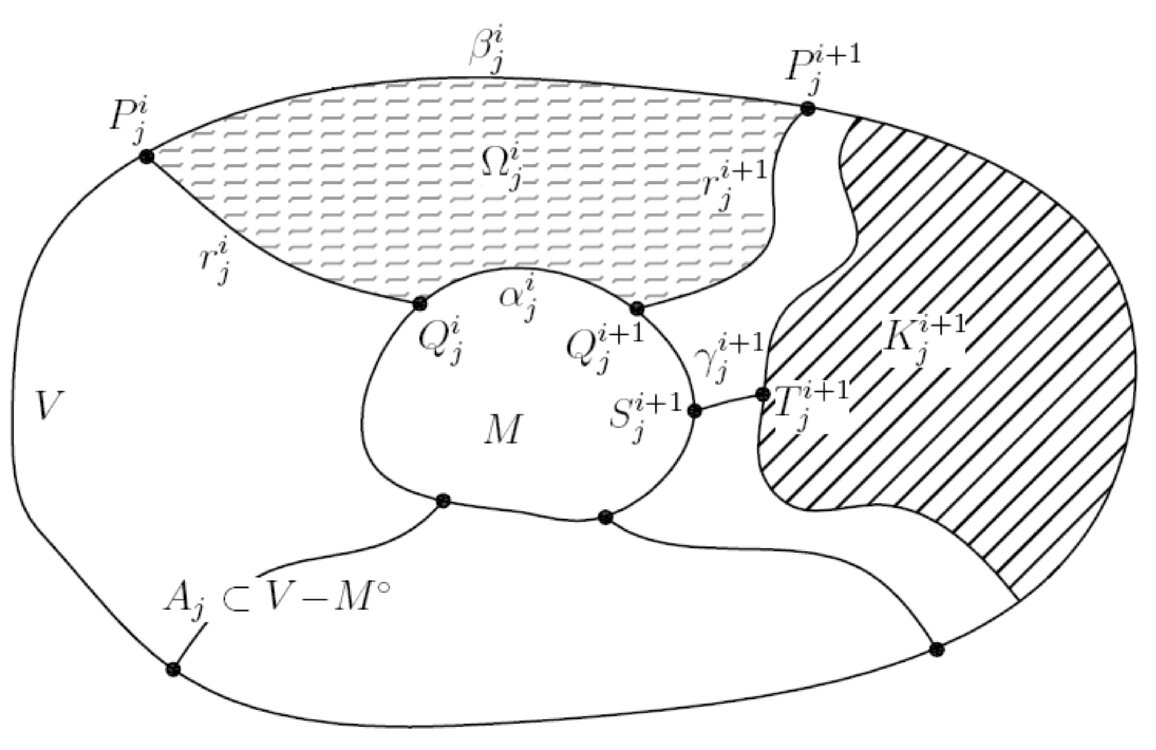 Figure 1
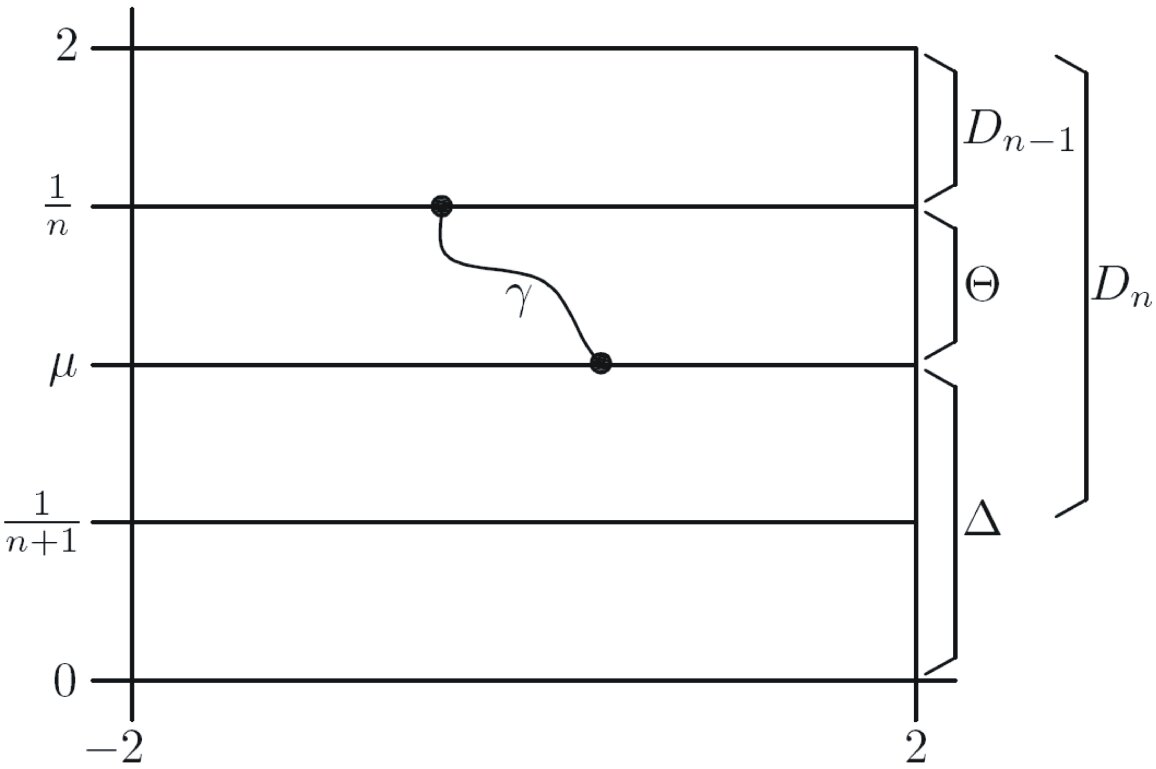 Figure 2