Decoherence and thermalization of a pure quantum state in quantum field theory
Alexandre Giraud, Julien Serreau

TL;DR
This paper investigates the real-time evolution of a self-interacting quantum field, demonstrating how a pure state undergoes decoherence and thermalization, with classical statistical field theory effectively describing the decoherence process.
Contribution
It provides a complete solution to nonequilibrium quantum dynamics of an O(N) scalar field using a 1/N-expansion at next-to-leading order, including scattering and memory effects.
Findings
Pure quantum states lose coherence over time.
The reduced density matrix thermalizes at long times.
Decoherence physics aligns with classical statistical field theory.
Abstract
We study the real-time evolution of a self-interacting O(N) scalar field initially prepared in a pure quantum state. We present a complete solution of the nonequilibrium quantum dynamics from a 1/N-expansion of the two-particle-irreducible effective action at next-to-leading order, which includes scattering and memory effects. Restricting one's attention (or ability to measure) to a subset of the infinite hierarchy of correlation functions, the system is described by an effective (reduced) density matrix which, unlike the full density matrix, has a nontrivial time evolution. In particular, starting from a pure quantum state, we observe the loss of putity/coherence and, on longer time scales, thermalization of the reduced density matrix. We point out that the physics of decoherence is well described by classical statistical field theory.
Click any figure to enlarge with its caption.
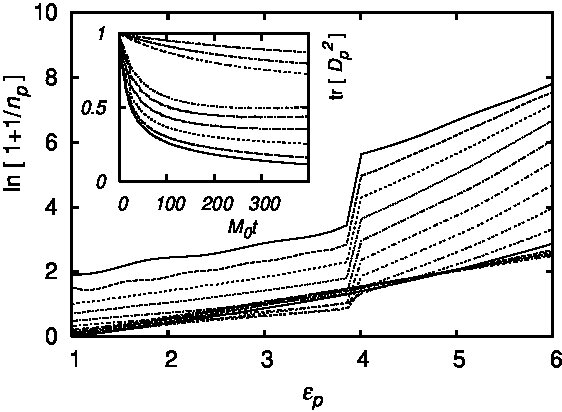 Figure 1
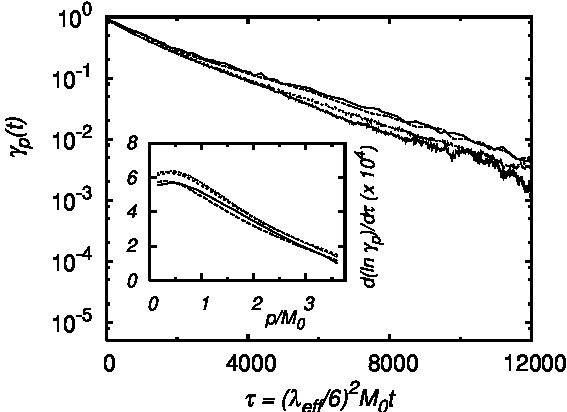 Figure 2
 Figure 3
Peer Reviews
No public reviews on file for this paper yet. If you reviewed it on a platform where reviews are public (OpenReview, ICLR, NeurIPS, ICML), you can paste yours below so the community can read it here.
Videos
No videos yet. Explain this paper in a talk, walkthrough, or lecture? Add one.
Decoherence and thermalization of a pure quantum state
in quantum field theory
Alexandre Giraud
Julien Serreau
Astro-Particule et Cosmologie, Université Paris 7 – Denis Diderot,
10 rue A. Domont et L. Duquet, 75205 Paris cedex 13, France111APC is unité mixte de recherche UMR7164 (CNRS, Université Paris 7, CEA, Observatoire de Paris)
Abstract
We study the real-time evolution of a self-interacting scalar field initially prepared in a pure, coherent quantum state. We present a complete solution of the nonequilibrium quantum dynamics from a -expansion of the two-particle-irreducible effective action at next-to-leading order, which includes scattering and memory effects. We demonstrate that, restricting one’s attention (or ability to measure) to a subset of the infinite hierarchy of correlation functions, one observes an effective loss of putity/coherence and, on longer time scales, thermalization. We point out that the physics of decoherence is well described by classical statistical field theory.
Decoherence, nonequilibrium quantum field theory.
pacs:
03.65.Yz, 03.70.+k, 11.10.Wx.
Quantum decoherence is a fundamental process whose understanding is a central issue in many areas of physics. Topical examples include measurement theory in quantum mechanics Zurek:1981xq , the physics of Bose-Einstein condensates Graham , or of quantum computers GPS , neutrino physics Giunti:2002xg , high-energy nuclear collisions Muller:2005yu , black hole physics Hsu:2009ve , or the description of primordial fluctuations in inflationary cosmology Polarski:1995jg ; Campo:2008ju . It is a genuine nonequilibrium process, which requires the real-time description of quantum dynamics. Analytic descriptions can be obtained for exactly solvable models and/or simple enough approximations, e.g. assuming a linear coupling between the system and its environment, neglecting back-reaction, etc. A complete microscopic description in realistic quantum field theories (QFT) is a notoriously difficult task Calzetta:1995ea , which requires first principle calculations of the nonequilibrium quantum dynamics.
Recent years have witnessed substantial progress concerning the description of quantum fields out of equilibrium Berges:2004vw . Two-particle-irreducible (2PI) functional techniques provide a powerful tool to devise systematic, practicable approximation schemes, valid for arbitrarily far from equilibrium situations Calzetta:1995ea ; Berges:2004vw . It has been demonstrated that a coupling or -expansion of the 2PI effective action at lowest nontrivial order can describe far-from-equilibrium dynamics and subsequent (quantum) thermalization without further assumption Berges:2001fi ; Aarts:2001yn ; Berges:2000ur . In this letter, we use 2PI techniques to compute the dynamics of decoherence from first principles in QFT 222For recent works in a similar context, see Herranen:2008di ; Koksma:2009wa ..
There are various uses of the concept of (de)coherence Anastopoulos:2000hg , the most widely discussed being the so-called environment-induced decoherence, which results from the interaction of the system under study with a (thermal) bath of unobserved degrees of freedom (d.o.f.) Zurek:1981xq . Even in the absence of an environment, decoherence of a subset of d.o.f. may result from some kind of coarse-graining Lombardo:1995fg ; Habib:1995ee . Here, we adopt a different point of view, also advocated e.g. in Calzetta:1995ea ; Balian ; Campo:2008ju ; Koksma:2009wa . Even if one keeps all the dynamical d.o.f., reconstructing the actual state of a given (closed) system requires a precise knowledge of its independent correlation functions. In practice, however, such information is often not experimentally accessible and one has to infer the state of the system from the subset of measured correlation functions. This “incomplete description” picture actually underlies the very concept of thermalization Balian ; Calzetta:1995ea . Similarly, a system prepared in a pure quantum state may appear as a statistical mixture to the observer who has only partial information.
In this letter, we show that, starting from a pure, coherent quantum (Gaussian) state, an observer who only measures the subset of equal-time two-point functions, observes an effective loss of purity/coherence and, eventually, (apparent) thermalization. We study a relativistic self-interacting scalar field and present a complete numerical solution of the nonequilibrium dynamics from a -expansion of the 2PI effective action at next-to-leading order (NLO) Berges:2001fi . The approach allows us to study the strong coupling regime and is a valid description for states with a high degree of quantum coherence which, as explained below, are characterized by strong – possibly non-perturbative – field fluctuations.
A pure quantum state remains such under a unitary evolution. Here, although the complete information about the initial Gaussian state is contained in the set of two-point functions, nontrivial higher correlators develop in time due to the non-Gaussian dynamics: The information about the initial state spreads in the space of correlation functions and gets lost to our observer, resulting in the effective loss of purity/coherence and, at late times, the thermalization of the effective density matrix. We stress that no environment of incoherent d.o.f. is needed. We illustrate this point by preparing a completely pure initial state. Finally, we show that the regime of decoherence, characterized by strong field fluctuations, is well-described by classical (statistical) field theory.
We consider a relativistic real scalar field () with classical action
[TABLE]
where summation over repeated indices is implied. For vanishing field expectation value, , the correlation functions of the quantum theory can be obtained from the 2PI effective action , parametrized by the time-ordered connected propagator Cornwall:1974vz . The -expansion of at NLO includes the infinite series of diagrams shown in Fig. 1, where the lines represent the propagator Berges:2001fi .
To set up the initial-value problem, it is useful to decompose the two-point function into a statistical () and a spectral () component, both real functions:
[TABLE]
Notice that and . For Gaussian initial conditions, the equations of motion, obtained as , read
[TABLE]
where . The effective mass term is given by
[TABLE]
and the self-energies by Berges:2001fi
[TABLE]
The functions and resum the infinite series of bubble diagrams in Fig. 1:
[TABLE]
with the elementary bubble
[TABLE]
The self-energy kernels and describe scattering and memory effects and are responsible for non-Gaussian correlations to develop in time, a key ingredient in the present discussion. Gaussian – collisionless – evolution equations, such as leading-order Large-, or Hartree approximations, where the RHSs of Eqs. (3)-(4) vanish identically, are known to fail to describe phenomena such as damping of unequal-time correlators or thermalization Berges:2004vw . We show below that they also fail to capture the physics of decoherence in the present approach.
We consider spatially homogeneous and isotropic states, for which . Accordingly, we introduce the Fourier decomposition ()
[TABLE]
and similarly for . We consider an observer who only has access to the subset of equal-time two-point functions: , and . The mimimum-bias state compatible with these measured observables is described by an effective Gaussian density matrix Balian , where the product runs over independent d.o.f. in momentum space with, up to a normalization,
[TABLE]
where , with
[TABLE]
Contrarily to the correlators , and , which can be modified by a canonical redefinition of the field variables , is a canonical invariant and, actually, the only truly intrinsic property of the density matrix (13) Campo:2008ju . It provides an absolute measure of the quantum purity of the system’s state through 333The Schwartz inequality with and , implies that .
[TABLE]
which equals for a pure state. Note also that, whenever the system is well-described by a thermal ensemble of weakly interacting quasi-particle (QP), defines a QP occupation number and follows a Bose-Einstein distribution as a function of the QP energy Berges:2001fi . We shall make use of this property to characterize the degree of thermalization of the system, although we stress that none of our results rely on such a QP interpretation.
Note finally that is time-independent for Gaussian approximations 444Gaussian dynamics is equivalent to a time-dependent canonical transformation; is a canonical invariant.. Therefore, no loss of quantum purity, in the sense discussed here, occurs for such approximations. We stress that this is not in conflict with existing studies of decoherence in free field Polarski:1995jg or mean-field approximations Habib:1995ee , which typically consider an effective coarse-grained Gaussian density matrix where one averages out some rapidly varying d.o.f. This results in an effective loss of information and hence of quantum purity/coherence, due e.g. to dephasing Habib:1995ee , already at the Gaussian level. In the present incomplete description approach, decoherence is due to the non-Gaussian dynamics, i.e. direct scattering and memory effects 555The loss of information from the subset of Gaussian correlators is measured by the so-called correlation entropy Calzetta:1995ea ; Balian ; Campo:2008ju ; Koksma:2009wa : ..
We now come to the discussion of quantum coherence which, unlike purity, is a basis-dependent notion. The equal-time two-point correlators can be parametrized as
[TABLE]
where
[TABLE]
provides an alternative definition of a QP occupation number . Note that . Here, the energy scale defines the QP basis in which to discuss decoherence. We use , which we found gives a good description of the oscillation frequency of two-point correlators. The basis-dependent occupation number is related to the canonical invariant through the coherence parameter 666Note that and , not being canonical invariants, are in general not conserved by Gaussian dynamics.
[TABLE]
The case or, equivalently, , corresponds to the thermal-like density matrix . This includes the vacuum-like state: . Moreover, controls the size of off-diagonal matrix elements of the density matrix in the so-called two-mode coherent state basis 777It can be directly related to the parameter of LABEL:Campo:2008ju.: The latter exhibits non-trivial correlations (i.e. quantum coherence) between macroscopically distant semi-classical states for . Note that this limit is also characterized by strong field fluctuations since the correlators , and are .
At time , we prepare modes with in a pure, highly coherent quantum state characterized by , and , while modes with , with the ultra-violet cutoff, are prepared in a vacuum-like state: and 888Initial conditions for the spectral correlator are fixed by the equal-time commutation relations of field operators.. We emphasize that there are no incoherent d.o.f.: The initial state is a completely pure quantum state. Eqs. (3)-(11) are solved numerically without further approximation (except for discretization of time/momentum-integrals and truncation of memory-integrals). We show results for and , where is the initial effective mass.
Fig. 2 presents an overview of the time-evolution. It shows snapshots of the function as a function of at various times. One observes a substantial growth of for all modes, signaling the effective loss of quantum purity at early times, followed by a slow approach to an effective quantum thermal equilibrium, characterized by a Bose-Einstein distribution. The loss of quantum purity is further illustrated in the inset, which shows the rapid decay of for modes .
After the loss of quantum purity, we find that , signaling a corresponding loss of quantum coherence according to Eq. (20). Fig. 3 shows the time evolution of the coherence parameter for the mode , for various sets of parameters. In all cases we find that decoherence is well-described by an exponential law. The inset shows the corresponding decoherence rates for the modes .
Classical scaling: In the highly coherent limit, , one has, roughly speaking which signals the enhancement of classical vs. quantum fluctuations Aarts:2001yn . In this regime one can neglect the second term in brackets on the LHSs of Eqs. (10) and (6). It is then easy to check that under the simultaneous rescaling of the correlators and the coupling constant: , and , with an arbitrary constant, the and -components of , and scale just as and respectively and that Eqs. (3)-(4) are left invariant. This is characteristic of the regime of strong field fluctuations, where a classical (statistical) field theory description is appropriate. Indeed, in classical field theory, the action being defined up to a multiplicative constant, a rescaling of the field (i.e. of the initial conditions) can be entirely absorbed in a change of coupling. Therefore, as long as the system is highly coherent (), we expect the dynamics not to depend separately on and , but instead on the combination where . We checked, from our numerical simulation of the full quantum dynamics, that this is indeed the case during the early-time decoherence regime, as illustrated in Fig. 3: Runs with different values of and but the same are essentially indistinguishable. Furthermore, we observe that, despite the rather strong (effective) couplings employed in some simulations, the decoherence rates approximately follow a perturbative-like -scaling, as also illustrated on Fig. 3.
As a final remark, we mention that fixing the value of the initial mass absorbs a large -dependence. This simple, though approximate, renormalization turns out to be numerically sufficient for the results presented here. We find that, if the late time thermalization is cutoff-dependent, a known artifact of Gaussian initial conditions Borsanyi:2008ar , the regime of effective loss of quantum purity/coherence is largely cut-off insensitive.
To the best of our knowledge, this work provides the first complete microscopic description of the process of decoherence in a realistic QFT. It is an exciting observation that the relevant dynamics is well-described by classical statistical field theory, which can be solved exactly by means of standard Monte-Carlo Techniques. A particularly interesting question is to investigate how the present results are modified as one includes the knowledge of higher order equal-time correlation functions in the set of measured observables.
Acknowledgements: We thank R. Balian for interesting discussions and for pointing out LABEL:Balian as well as D. Campo and R. Parentani for interesting discussions and useful suggestions concerning the manuscript.
The reference list from the paper itself. Each links out to its DOI / PubMed record.
- 1(1) W.H. Zurek, Rev. Mod. Phys. 75 (2003) 715.
- 2(2) R. Graham, Phys. Rev. Lett. 81 (1998) 5262.
- 3(3) T. Gorin, C. Pineda, T.H. Seligman, Phys. Rev. Lett. 99 (2007) 240405.
- 4(4) C. Giunti, JHEP 0211 (2002) 017; G.G. Raffelt, G. Sigl, Phys. Rev. D 75 (2007) 083002; G.M. Fuller, C.T. Kishimoto, Phys. Rev. Lett. 102 (2009) 201303.
- 5(5) B. Müller, A. Schäfer, Phys. Rev. C 73 (2006) 054905.
- 6(6) S.D.H. Hsu, D. Reeb, Phys. Rev. D 79 (2009) 124037.
- 7(7) D. Polarski, A.A. Starobinsky, Class. Quant. Grav. 13 (1996) 377; J. Lesgourgues, D. Polarski, A.A. Starobinsky, Nucl. Phys. B 497 (1997) 479.
- 8(8) D. Campo, R. Parentani, Phys. Rev. D 78 (2008) 065044; Phys. Rev. D 72 (2005) 045015.