Does the LFIR-LHCN correlation hold for low LFIR isolated galaxies?
B. Ocana-Flaquer, S. Leon, D. Espada, S. Martin Ruiz, U. Lisenfeld, S., Verley, J. Sabater Montes, L. Verdes-Montenegro

TL;DR
This study investigates whether low star formation activity isolated galaxies follow the established correlation between HCN luminosity and far-infrared luminosity, which is known for more active galaxies.
Contribution
The paper tests the applicability of the $L_{HCN}$-$L_{FIR}$ relation to low star formation, isolated galaxies using new HCN(1-0) emission observations.
Findings
Low $L_{FIR}$ IGs show deviations from the established correlation.
Results suggest the relation may not hold for galaxies with very low star formation.
Implications for understanding star formation in isolated galaxy environments.
Abstract
Low Isolated Galaxies (IGs) from the AMIGA sample have low level of Star Formation (SF) activity. We observed the HCN(1-0) emission in a sample of IGs in order to test whether they follow the tight relation between and found for galaxies with more active SF.
Click any figure to enlarge with its caption.
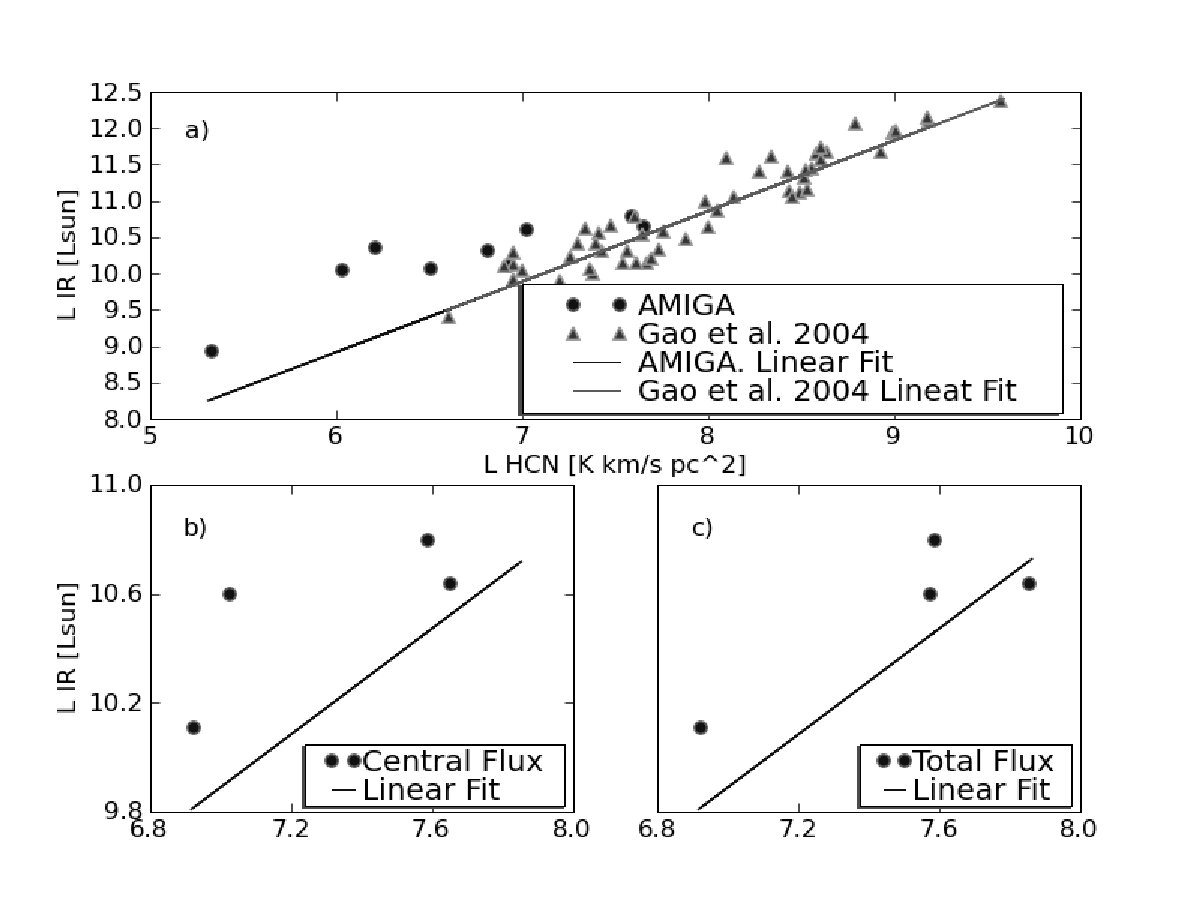 Figure 1
Peer Reviews
No public reviews on file for this paper yet. If you reviewed it on a platform where reviews are public (OpenReview, ICLR, NeurIPS, ICML), you can paste yours below so the community can read it here.
Videos
No videos yet. Explain this paper in a talk, walkthrough, or lecture? Add one.
Taxonomy
TopicsParticle Detector Development and Performance · Distributed and Parallel Computing Systems · Advanced Data Storage Technologies
Does the correlation hold for low isolated galaxies?
Breezy Ocaña Flaquer1, Stephane Leon1, Daniel Espada2, Sergio Martín Ruiz2, Ute Lisenfeld3, Simon Verley3, José Sabater Montes4 and Lourdes Verdes-Montenegro4
Abstract
Low Isolated Galaxies (IGs) from the AMIGA sample have low level of Star Formation (SF) activity. We observed the HCN(1-0) emission in a sample of IGs in order to test whether they follow the tight relation between and found for galaxies with more active SF.
1IRAM - Spain, 2CfA - USA, 3UGR - Spain, 4IAA - Spain
Results
Gao and Solomon (2004a, b) (GS) found a surprisingly tight and linear correlation between , a good tracer of the SF rate, and , probing the dense molecular gas, for a sample of IR-Luminous galaxies. An open question is whether this correlation is also followed by galaxies with less active SF. In order to answer this question we observed with the IRAM 30m telescope HCN(1-0) in 15 isolated galaxies from the AMIGA sample (Verdes-Montenegro et al. 2005) with the purpose to test whether the GS relation is independent of the environment and luminosity. We found that IG have lower than expected from the relation (see Fig. 1 a), with ratio of 0.05. However, this might be due to extended emission of the HCN missed by our observations which were in most cases only done at one central pointing. Four galaxies of our sample were mapped. In 2 of them, there is indeed substantial emission outside the central parts (see Fig. 1 b+c), and their value for derived from the mapping,follows the relation from GS much closer. Further mapping and a detailed study of the possible missing emission is necessary before drawing firm conclusions.
The reference list from the paper itself. Each links out to its DOI / PubMed record.
- 1Gao and Solomon (2004 a) Gao, Y. and Solomon, P. M.: 2004 a, Ap JS 152 , 63
- 2Gao and Solomon (2004 b) Gao, Y. and Solomon, P. M.: 2004 b, Ap J 606 , 271
- 3Verdes-Montenegro et al. (2005) Verdes-Montenegro, L., Sulentic, J., Lisenfeld, U., Leon, S., Espada, D., Garcia, E., Sabater, J., and Verley, S.: 2005, A&A 436 , 443