The XBS sample of type 1 AGNs: Radio loudness vs. physical parameters
A. Caccianiga, P. Severgnini, R. Della Ceca, A. Corral, E. Marchese

TL;DR
This study investigates how the radio-loudness of type 1 AGNs correlates with black hole mass, revealing that higher mass black holes are significantly more likely to be radio-loud.
Contribution
It provides the first large-sample analysis of the relationship between AGN radio-loudness and black hole mass using XMM-Newton Bright Survey data.
Findings
Radio-loud AGNs are about 10 times more common at black hole masses >10^9 Msun.
A strong correlation exists between black hole mass and radio-loudness in type 1 AGNs.
The study enhances understanding of the physical parameters influencing AGN radio properties.
Abstract
We have studied the relationship between the AGN radio-loudness and the mass of the central black-hole by using the ~190 type 1 AGN selected in the XMM-Newton Bright Survey (XBS). We find that radio-loud AGNs are much more frequent at high black-hole masses being a factor ~10 times more common for masses >10^9 Msun when compared to masses between 10^7-10^9 Msun.
Click any figure to enlarge with its caption.
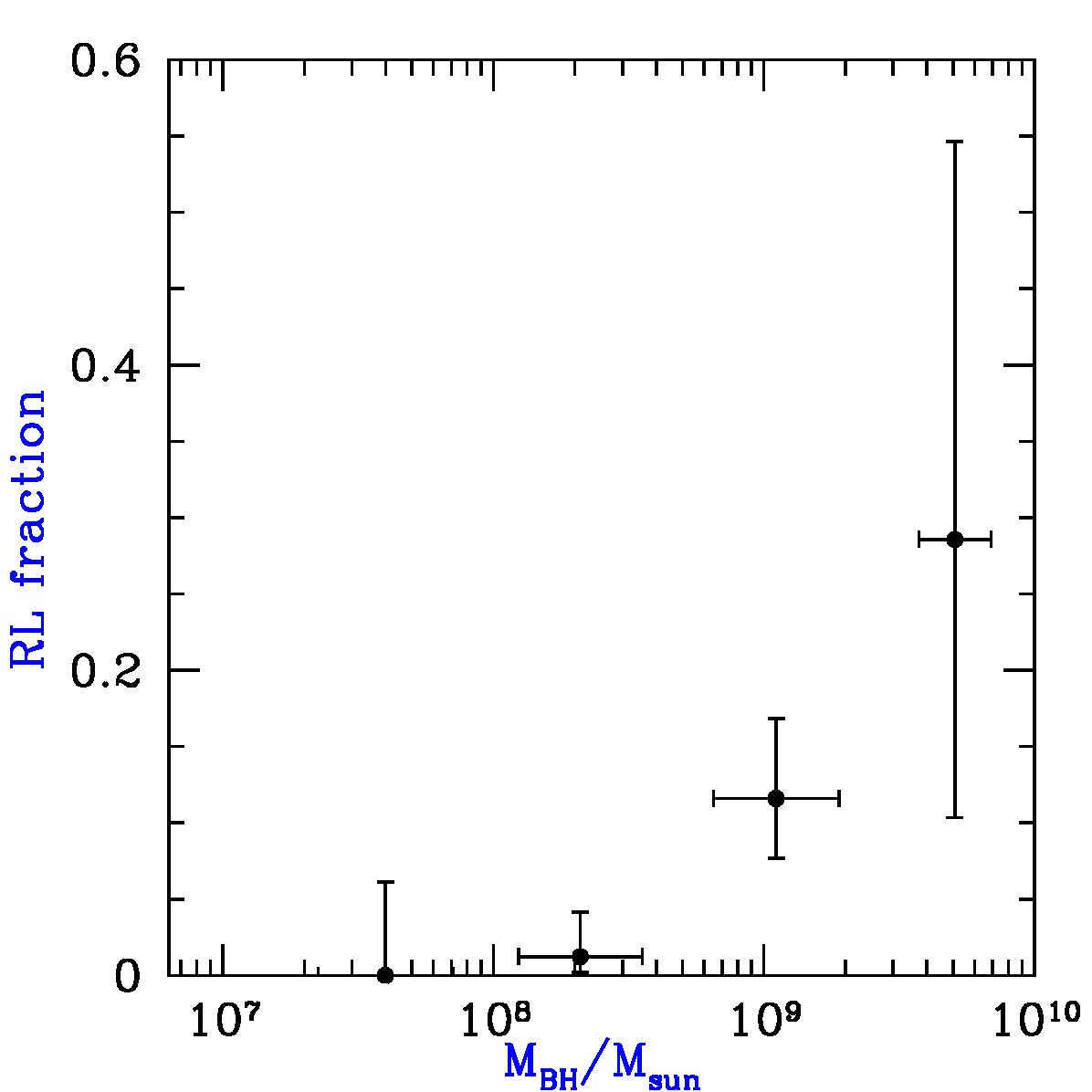 Figure 1
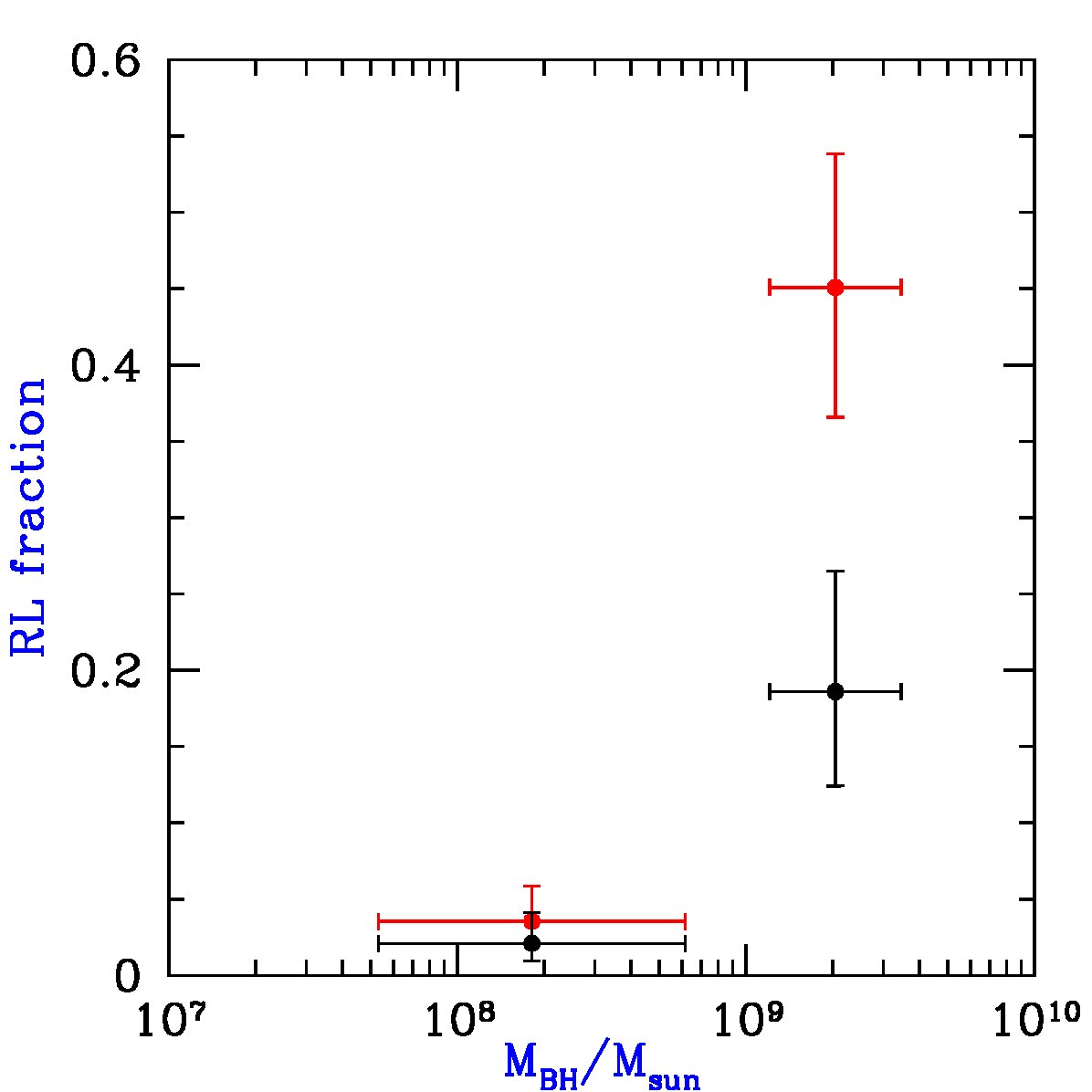 Figure 2
Peer Reviews
No public reviews on file for this paper yet. If you reviewed it on a platform where reviews are public (OpenReview, ICLR, NeurIPS, ICML), you can paste yours below so the community can read it here.
Videos
No videos yet. Explain this paper in a talk, walkthrough, or lecture? Add one.
Taxonomy
TopicsAstrophysical Phenomena and Observations · Pulsars and Gravitational Waves Research
The XBS sample of type 1 AGNs:
Radio loudness vs. physical parameters
A. Caccianiga, P. Severgnini, R. Della Ceca, A. Corral, E. Marchese on behalf of the XMM-Newton SSC collaboration
Abstract
We have studied the relationship between the AGN radio-loudness and the mass of the central black-hole by using the 190 type 1 AGN selected in the XMM-Newton Bright Survey (XBS). We find that radio-loud AGNs are much more frequent at high black-hole masses being a factor 10 times more common for masses 109 M{}_{\hbox{\odot}} when compared to masses between 107-109 M{}_{\hbox{\odot}}.
INAF-Osservatorio Astronomico di Brera, Milan, Italy
1. The XBS sample of type1 AGN: computing R and MBH
The XMM-Newton Bright Survey (XBS, Della Ceca et al. 2004) includes an X-ray flux-limited (F[0.5-4.5 keV]710*-14* erg s*-1* cm*-2*) sample which is now almost completely identified (92%, Caccianiga et al. 2008). In the area covered by the NRAO VLA Sky Survey (NVSS, Condon et al. 1998) there are 186 XBS objects that are spectroscopically classified as type 1 AGN. For all these objects we have computed the radio-loudness parameter (R, as in Kellerman et al. 1984) using the integrated flux at 1.4 GHz, if detected in the NVSS survey, or an upper limit on R, if not detected. We have then used single-epoch optical spectra to estimate the black-hole masses (MBH) applying the most recent relationships between MBH and different emission-line widths (see Vestergaard & Peterson, 2006; Vestergaard & Osmer 2009).
2. Results: RL fraction versus black-hole mass
We have computed the fraction of radio-loud AGN (RL, R10) as a function of MBH (Fig. 1, left). We observe a significant increase of the fraction of radio-loud (RL) AGN for large MBH. In particular the RL fraction is around 1-4% for masses of 108 M{}_{\hbox{\odot}} while it increases up to 30% for masses 5109 M{}_{\hbox{\odot}}. Since the NVSS flux limit is not deep enough to guarantee the detection of all the RL AGN present in the XBS, we have tested the stability of our result by applying the non-parametric method described by Avni et al. (1980) to estimate the distribution of the missing RL AGN taking into account the upper limits. We find that the result discussed above is even more significant when the fraction of RL AGN, corrected for the missing objects, is plotted (filled points in Fig.1, right panel).
3. Conclusions
We have found that RL AGNs are much more frequent at high black-hole masses being a factor 10 times more common for masses 109 M{}_{\hbox{\odot}} when compared to masses between 107-108 M{}_{\hbox{\odot}}. A similar increase of the RL fraction with MBH has been previously suggested by Rafter, Crenshaw & Wiita (2009) using an optically selected sample of AGNs. Recent works (e.g. Sikora, Stawarz, Lasota 2007) suggest that the black-hole spin may be the key parameter that regulates the radio-loudness of an AGN. Interestingly, N-body simulations, aimed at investigating the spin development of the central black-hole, have led to the conclusion that more massive black-holes should have also higher spin values (e.g. Lagos, Padilla & Cora 2009). Therefore, the observed correlation between the radio-loud fraction and the black-hole mass could be explained, at least qualitatively, in the context of the so-called “spin paradigm”.
Acknowledgments.
We acknowledge financial support from ASI (grant n. I/088/06/0 and COFIS contract)
References
Avni, Y, Soltan, A., Tananbaum, H., Zamorani, G. 1980, ApJ, 238, 800
Caccianiga, A., Severgnini, P., Della Ceca, R. et al. 2008, A&A, 477, 735
Condon, J. J., et al. 1998, AJ, 115, 1693
Della Ceca, R., Maccacaro, T., Caccianiga, A. et al. 2004, A&A, 428, 383
Lagos, C., Padilla, N. D. & Cora, S. A. 2009, MNRAS, 395, 625
Rafter, S. E., Crenshaw, D.M., & Wiita, P. J. 2009, AJ, 137, 42
Sikora, M., Stawarz, L. & Lasota, J.-P. 2007, ApJ, 658, 815
Vestergaard, M. & Peterson, B. M. 2006, ApJ, 641, 689
Vestergaard, M. & Osmer, P. S. 2009, ApJ, 699, 800