Pomeron Odderon interference in production of two pi+ pi- pairs at LHC and ILC
B.Pire, F.Schwennsen, L.Szymanowski, S.Wallon

TL;DR
This paper explores detecting the perturbative Odderon through two pion pair production in photon collisions at high energies, proposing methods for observation at LHC and ILC, with a focus on charge asymmetries and generalized distribution amplitudes.
Contribution
It introduces a novel approach to identify the Odderon via charge asymmetries in pion pair production, utilizing kT-factorization and generalized distribution amplitudes.
Findings
Charge asymmetries can signal Odderon presence.
Ultraperipheral LHC collisions face background challenges.
ILC offers a cleaner environment for this physics.
Abstract
We propose to look for the Odderon through the production of two pion pairs in photon collisions at high energies. We calculate the corresponding matrix elements in kT-factorization and discuss the possibility to reveal the existence of the perturbative Odderon by charge asymmetries, relying on models for the generalized distribution amplitudes of pi+ pi-. The application of this strategy to ultraperipheral collisions at the LHC suffers from the difficulty to trigger on interesting events and is plagued with severe background problems in p-p mode. Electron - positron colliders like ILC seem to better suit this physics.
Click any figure to enlarge with its caption.
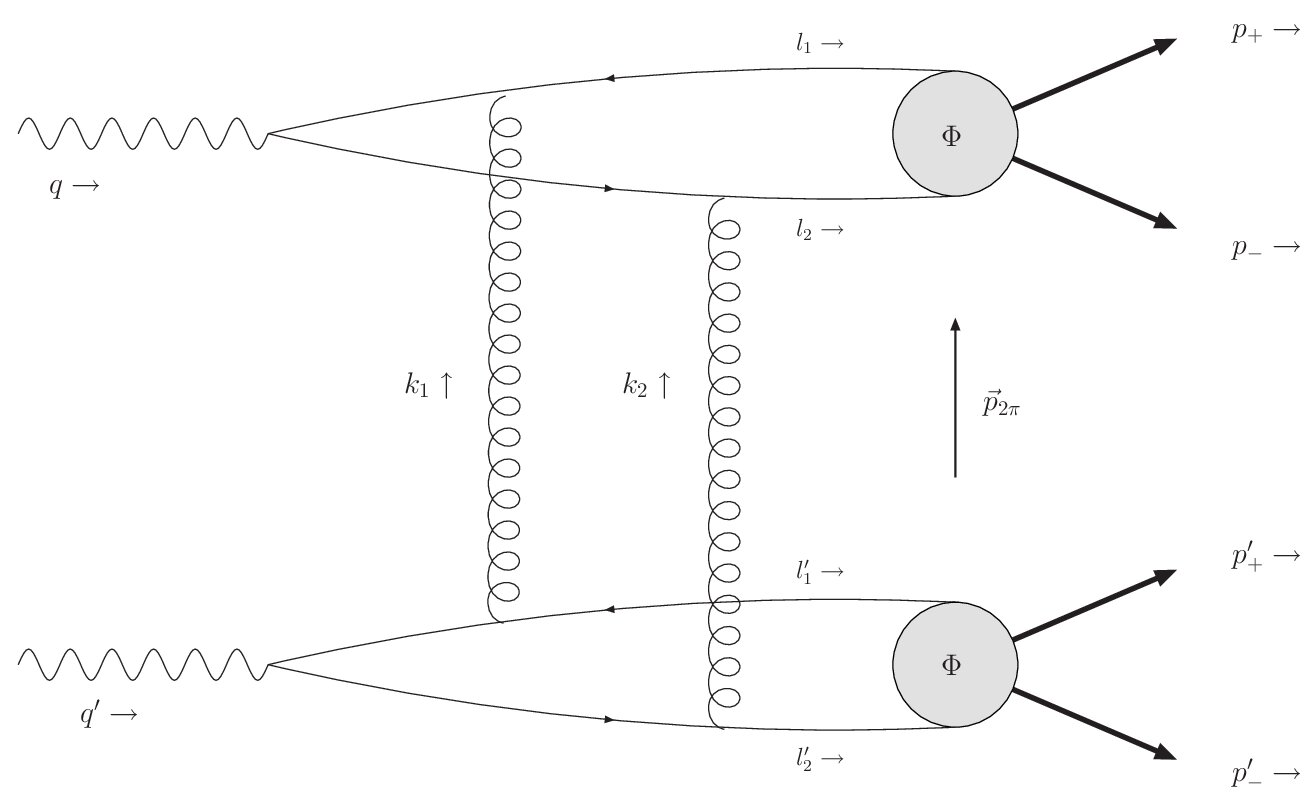 Figure 1
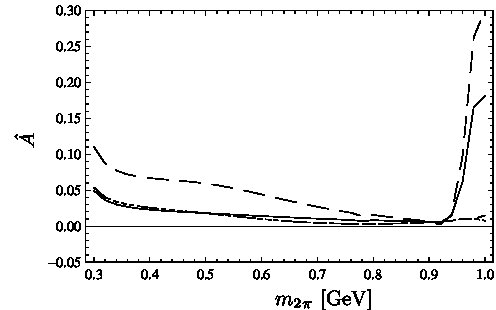 Figure 2
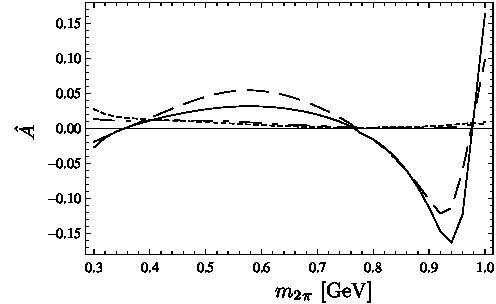 Figure 2
Peer Reviews
No public reviews on file for this paper yet. If you reviewed it on a platform where reviews are public (OpenReview, ICLR, NeurIPS, ICML), you can paste yours below so the community can read it here.
Videos
No videos yet. Explain this paper in a talk, walkthrough, or lecture? Add one.
Taxonomy
TopicsParticle physics theoretical and experimental studies · High-Energy Particle Collisions Research · Quantum Chromodynamics and Particle Interactions
Pomeron Odderon interference in production of two pairs at LHC and ILC
B. Pire
CPHT, École Polytechnique, CNRS, 91128 Palaiseau Cedex, France
F. Schwennsen
CPHT, École Polytechnique, CNRS, 91128 Palaiseau Cedex, France *&
*LPT, Université Paris-Sud, CNRS, 91405 Orsay, France
L. Szymanowski
Soltan Institute for Nuclear Studies, PL-00-681 Warsaw, Poland
LPT, Université Paris-Sud, CNRS, 91405 Orsay, France *&
*UPMC Univ. Paris 06, faculté de physique, 4 place Jussieu, 75252 Paris Cedex 05, France
Abstract:
We propose to look for the Odderon through the production of two pion pairs in photon collisions at high energies. We calculate the corresponding matrix elements in -factorization and discuss the possibility to reveal the existence of the perturbative Odderon by charge asymmetries, relying on models for the generalized distribution amplitudes of . The application of this strategy to ultraperipheral collisions at the LHC suffers from the difficulty to trigger on interesting events and is plagued with severe background problems in - mode. Electron - positron colliders like ILC seem to better suit this physics.
At high energies, amplitudes of reactions with rapidity gaps in hadronic interactions are dominated by the exchange of a color singlet, -even state – called the Pomeron. In perturbative QCD, the Pomeron can be described at lowest order as the exchange of two gluons in the color singlet state. Its -odd partner, the Odderon, while needed [1], has never been seen in the perturbative regime, where it can be described (at lowest order) by the exchange of three gluons in a color singlet state. Due to its small exchange amplitude one should rather consider observables sensitive to interference effects. We present here our results [2] on such an observable in the hard regime, a charge asymmetry in the production of two pairs in photon-photon collisions.
Figure 1 shows a sample diagram of the process under consideration. We consider large energies such that the amplitude can be expressed in terms of two impact factors convoluted over the transverse momenta of the exchanged gluons. The impact factors are universal and consist of a perturbative part – describing the transition of a photon into a quark-antiquark pair – and a non-perturbative part, the two pion generalized distribution amplitude (GDA) parametrizing the quark-antiquark hadronization into the pion pair [3, 4]. This comes as a variant of the approach which has been previously proposed in the case of the electroproduction of a pion pair [5, 6], and which is based on the fact that the -state does not have any definite charge parity. These GDAs which are functions of the longitudinal momentum fraction of the quark, of the angle (in the rest frame of the pion pair) and of the invariant mass of the pion pair are the only phenomenological inputs. A useful parametrization in terms of Legendre polynomials where , reads [3]:
[TABLE]
where can be identified with the electromagnetic pion form factor . For the component we use [2] different models partially following Ref. [5] and Ref. [6].
The key to obtain an observable which linearly depends on the Odderon amplitude is the orthogonality of the -even GDA (entering ) and the -odd one (entering the Pomeron amplitude ) in the space of Legendre polynomials. We thus define the charge asymmetry as:
[TABLE]
[TABLE]
The result for is shown in Fig. 2 with two different choices for the integration regions. We stress that our framework is only justified for .
Our Born order estimate should be corrected by BFKL effects which can be estimated semi-phenomenologically from HERA data (intercept ), leading for GeV to an increase of for the counting rates and to a slight decrease of the asymmetry
The question naturally arises whether it is possible to measure this asymmetry in ultraperipheral collisions at the LHC, either in proton-proton or in ion-ion collisions. Various difficulties in - mode coming either from difficulties to trigger on exclusive events, or from background separation, seem to lead to a negative answer. In ion-ion collisions, the trigger problem may be solved by detecting neutrons from giant dipole resonances in the Zero Degree Calorimeters, but the rates are lower. In contrast, an electron-positron collider such as the projected ILC would be the ideal environment to study the process under consideration. Photon-photon collisions are indeed the dominant processes there and no pile up phenomenon can blur the picture of a scattering event. Studies of similar exclusive processes [7] teach us that high rates may be expected.
This work is supported in part by the Polish Grant N202 249235, the French-Polish scientific agreement Polonium, by the grant ANR-06-JCJC-0084 and by the ECO-NET program, contract 12584QK.
The reference list from the paper itself. Each links out to its DOI / PubMed record.
- 1[1] L. Łukaszuk and B. Nicolescu, Nuovo Cim. Lett. 8 405 (1973).
- 2[2] B. Pire et al. , Phys. Rev. D 78 094009 (2008) , ar Xiv:0811.0255, ar Xiv:0908.1475 and ar Xiv:0906.5512.
- 3[3] M. V. Polyakov, Nucl. Phys. B 555 231 (1999).
- 4[4] M. Diehl, T. Gousset, and B. Pire, Phys. Rev. D 62 073014 (2000).
- 5[5] P. Hägler et al. , Phys. Lett. B 535 117 (2002) and Eur. Phys. J. C 26 261 (2002).
- 6[6] N. Warkentin et al. , Eur. Phys. J. A 32 273 (2007).
- 7[7] J. Kwiecinski and L. Motyka, Phys. Lett. B 438 , 203 (1998); B. Pire et al. , Eur. Phys. J. C 44 , 545 (2005); M. Segond et al. , Eur. Phys. J. C 52 (2007) 93.