On arithmetical nature of Tichy-Uitz's function
Elena Zhabitskaya

TL;DR
This paper investigates the arithmetical properties of a specific singular function from a family introduced by Tichy and Uitz, focusing on the case where the parameter is related to the golden ratio.
Contribution
It provides a detailed analysis of the arithmetical nature of the Tichy-Uitz function for a particular parameter value, extending understanding of its properties.
Findings
Identifies the arithmetical characteristics of g_λ for λ=(3−√5)/2
Connects the function's properties to number theory and algebraic structures
Enhances understanding of singular functions related to continued fractions
Abstract
R.F.Tichy and J.Uitz introduced a one parameter family , , of singular functions. When the function coincides with the famous Minkowski question mark function. In this paper we describe the arithmetical nature of the function when .
Click any figure to enlarge with its caption.
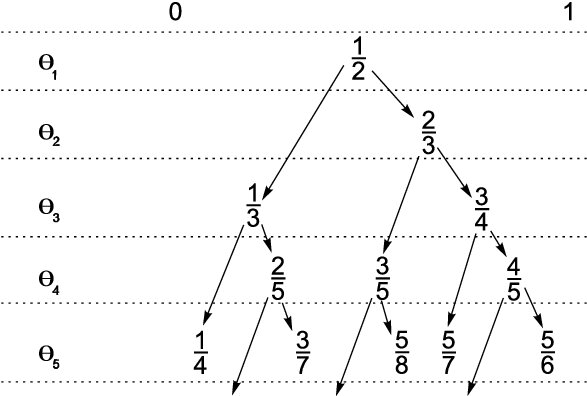 Figure 1
Peer Reviews
No public reviews on file for this paper yet. If you reviewed it on a platform where reviews are public (OpenReview, ICLR, NeurIPS, ICML), you can paste yours below so the community can read it here.
Videos
No videos yet. Explain this paper in a talk, walkthrough, or lecture? Add one.
Taxonomy
TopicsMathematical Dynamics and Fractals · Advanced Mathematical Theories and Applications · Mathematics and Applications
On arithmetical nature of Tichy-Uitz’s function
Jabitskaya E. N. 111 Research is supported by RFBR grant No 09-01-00371-a
In [1] R. F. Tichy and J. Uitz introduced a one parameter family , , of singular functions. When the function coincides with the famous Minkowski question mark function. In this paper we describe the arithmetical nature of the function when .
Key words: continued fractions, Minkowski’s function.
2000 Mathematical Subject Classification: 11J70.
1 Stern-Brocot sequences
We remind the definition of Stern-Brocot sequences .
Consider the two-point set . Let and
[TABLE]
where , , and . Then
[TABLE]
with
[TABLE]
Here
[TABLE]
is the mediant of the fractions and .
The elements of can be characterized in the following way. A rational number belongs to if and only if in the continued fraction expansion
[TABLE]
the sum of partial quotients is exactly :
[TABLE]
So consists of all rational such that .
2 Tichy-Uitz’s singular functions
In [1] R. F. Tichy and J. Uitz considered a one parameter family , , of singular functions. In this section we describe the construction of from [1]. This construction is an inductive one.
Given put
[TABLE]
Suppose that is defined for all elements . Then we define for . Each is of the form where and are consecutive elements from . Then
[TABLE]
So we have defined for all rational numbers from . One can see that the function is a continuous function from to . So it can be extended to a continuous function from the whole segment to .
For every the function increases in . By the Lebesgue theorem is a differentiable function almost everywhere. Moreower, it is easy to see that almost everywhere (is the scence of Lebesgue mesure). Certain properties of functions were investigated in [1]. Some related topics one can find in [6] and [7]. Here we should note that in the case the function coincides with the famous Minkowski question mark function .This function may be considered as the limit distribution function for Stern-Brocot sequences . The aim of the present paper is to explain the arithmetical nature of the function when .
3 Minkowski’s function
Let us consider the function . This function was introduced by Minkowski. As it follows from the definition of for :
[TABLE]
and for
[TABLE]
The definition of for irrational follows by continuity.
R. Salem in [2] found a new presentation for . If is represented in the form of regular continued fraction
[TABLE]
then
[TABLE]
For rational the representation (2) and consequently (3) is finite.
Minkowski’s question mark function may be treated as the limit distribution function for Stern-Brocot sequences in the following sense:
[TABLE]
A finite formula for the right hand side of (4) was given by T. Rivoal in the preprint [5]. Various properties of Minkowski question mark function were investigated in papers [8] by A. Denjoy, [3] by P. Viader, J. Paradis, L. Bibiloni and in [4] by A. A. Dushistova, I. D. Kan and N. G. Moshchevitin.
4 General form of formula (3)
The formula (3) can be generalized on the whole family of functions in the following way.
Proposition Let and is the regular continued fraction expansion of , then
[TABLE]
Proof: By definition of
[TABLE]
and
[TABLE]
where and are consecutive elements from . We can also rewrite the formula (6) in the form
[TABLE]
The equality
[TABLE]
follows from the formula (6) immediately since . Suppose that the formula (5) is proved for , then it is enough to prove it for and for .
Let is odd, then by applying formula (6) we get
[TABLE]
and by applying formula (7) we get
[TABLE]
For even the proof is analogously.
5 Regular reduced continued fractions and the main result
Any real number can be expressed uniquely in the form
[TABLE]
which is known as regular reduced continued fraction (eine reduziert-regelmassige Kettenbrouch [10], [9]).
For a rational number the representation (10) takes the form:
[TABLE]
For such we denote .
Analogously to the sequence we define the sequence :
[TABLE]
where , .
We arrange the elements of in the increasing order:
[TABLE]
We would like to note that in the special case formula (5) gives:
[TABLE]
where
[TABLE]
For rational the representation (12) is finite.
The Theorem 1 below is the main results of the present paper. It generalizes the formula (4) on the regular reduced continued fractions.
Theorem 1
Function , where , coincides with the distributional function of the sequence , that is
[TABLE]
Now we consider the function
[TABLE]
Our purpose is to prove that . Function is increasing as a distribution function, so it is enough to prove that coincides with for rational , that is
[TABLE]
for any two consecutive elements of for any .
6 Auxiliary results
The following result is well known. We present it without a proof.
Lemma 1
Let is represented in the form (1) and in the form (11). To get the set from we should replace by
* if is odd (empty string if ).* 2. 2.
* if is even and .* 3. 3.
* if is even and .*
Lemma 2
For the number of elements in one has
[TABLE]
so where
[TABLE]
is the nth Fibonacci number.
Proof. We prove the lemma by induction. Since , , then the base of induction is true. Let us suppose that the lemma is true for and , then . There are two cases: either or . In the first case , so , in the second case , so . Thus we have one-one correspondence between and , and so .
Defenition 1
Let be consecutive elements of , . We denote the mediant by , the mediant we denote by .
Lemma 3
Let be consecutive elements of , , then , .
Proof. Let . Then , .
Now let us construct an infinite tree whose nodes are labeled by rationals in . We identify the nodes with the rationals they labeled by. The root is labeled by . From node come two arrows: the left arrow goes to and the right arrow goes to . The nodes of the tree are partitioned into levels. belongs to the level 1. If belongs to the level , then belongs to the level , and belongs to the level (figure 1).
It follows from the construction of the tree that nodes from level of are marked by numbers from . So belongs to the level if and only if .
The subtree of with root in the node we denote by . The set of nodes of from level 1 to level we denote by . The set of nodes of we denote by . Note that there exist a levels preserving isomorphism between and . If belongs to the level , then
[TABLE]
Besides
[TABLE]
7 Proof of Theorem 1
We remind that it is enough to prove (13) for any consecutive elements of and .
To prove the equality (13) we consider the subtree of . Note that
[TABLE]
Consequently
[TABLE]
On the other hand
[TABLE]
Let , then . Therefore
[TABLE]
The reference list from the paper itself. Each links out to its DOI / PubMed record.
- 1[1] R. F. Tichy, J. Uitz. An extension of Minkowski’s singular function. — Appl. Math. Lett., 8 (1995), 39-46.
- 2[2] R. Salem. On some singular monotonic functions which are strictly increasing. — Trans. Amer. Math. Soc. 53(1943), pp. 427-439.
- 3[3] P. Viader, J. Paradis, L. Bibiloni. — A new light of Minkovski’s ? ( x ) ? 𝑥 ?(x) function. J. Number Theory., 73 (1998), 212 -227.
- 4[4] A. A. Dushistova, I. D. Kan and N. G. Moshchevitin. — Differentiability of the Minkovski question mark function. Preprint available at ar Xiv:0903.5537 v 1.pdf (2009)
- 5[5] T. Rivoal. Suites de Stern-Brocot et fonction de Minkowski. — Preprint available at http ://www-fourier.ujf-grenoble.fr/ rivoal
- 6[6] J. C. Alexander, D. B. Zagier. The entropy of certain infitely convolved Bernoulli measures. — J. London Math. Soc., 44 (1991), 121-134.
- 7[7] J. P. Graber, P. Kirschenhofer, R. F. Tichy. Combinatorial and arithmetical properties of linear numeration systems. — Combinatorica 22 (2) (2002) 245-267.
- 8[8] A. Denjoy. Sur une fonction reele de Minkowski. — J. Math. Pures Appl. 17(1938), pp. 105-151.