Hydrogen-induced disintegration of fullerenes and nanotubes: An ab initio study
Savas Berber, David Tomanek

TL;DR
This study uses ab initio calculations to explore how hydrogen atoms cause disintegration of carbon nanostructures like fullerenes and nanotubes by weakening bonds and relieving stress, leading to structural breakdown.
Contribution
It provides new insights into hydrogen-induced disintegration mechanisms in carbon nanostructures through detailed ab initio analysis.
Findings
Hydrogen preferentially chemisorbs along lines in carbon structures.
Hydrogen weakens bonds and relieves stress locally.
Hydrogen can induce step-wise disintegration of outer walls.
Abstract
We use ab initio density functional calculations to study hydrogen-induced disintegration of single- and multi-wall carbon fullerenes and nanotubes. Our results indicate that hydrogen atoms preferentially chemisorb along lines in sp2 bonded carbon nanostructures, locally weakening the carbon bonds and releasing stress. For particular structural arrangements, hydrogen helps to relieve the accumulated stress by inducing step-wise local cleavage leading to disintegration of the outermost wall.
Click any figure to enlarge with its caption.
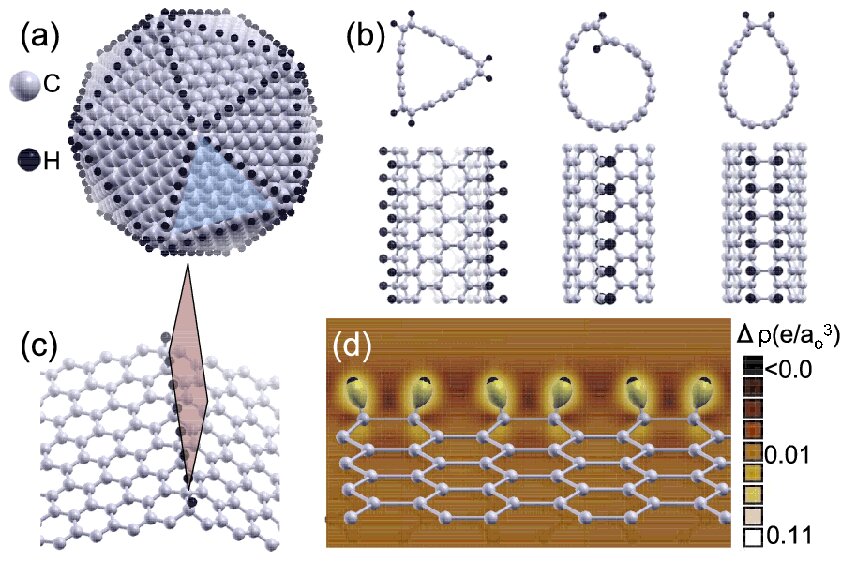 Figure 1
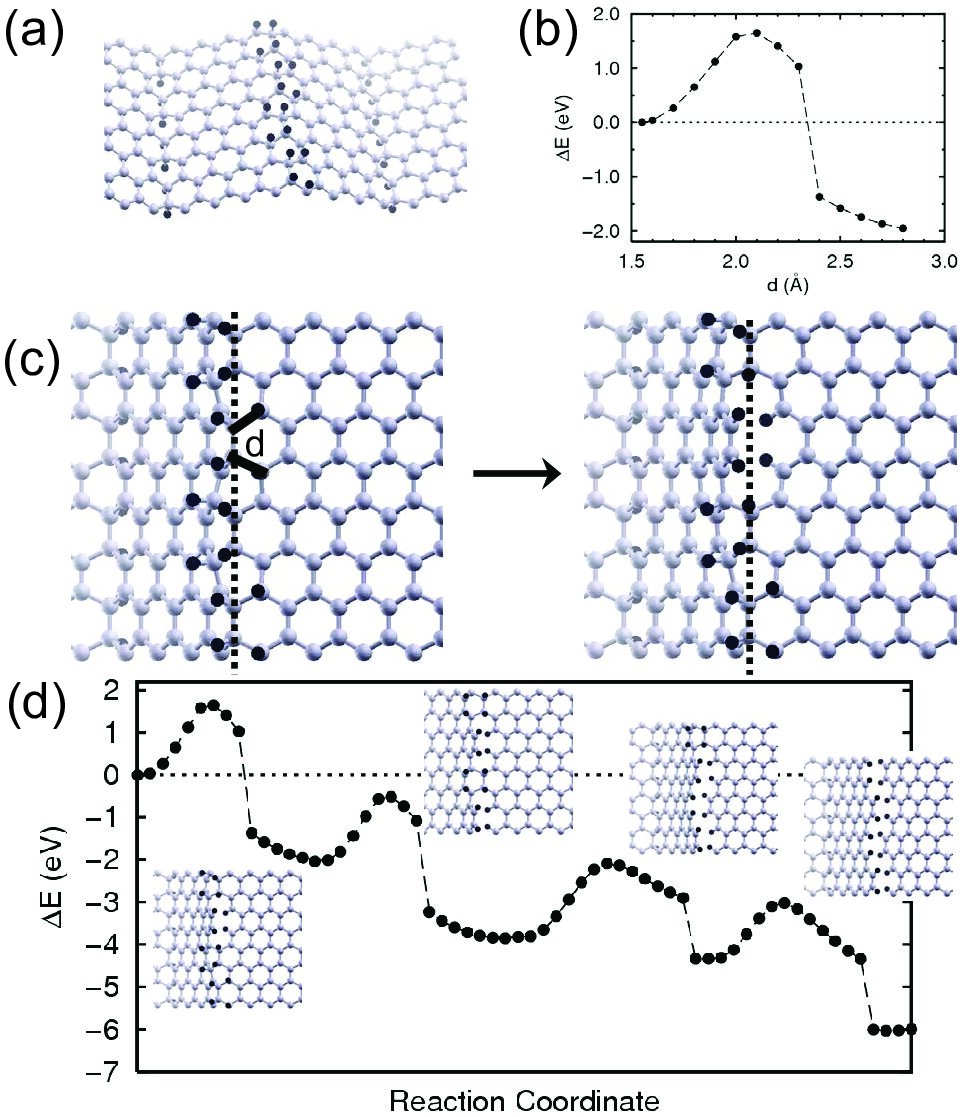 Figure 2
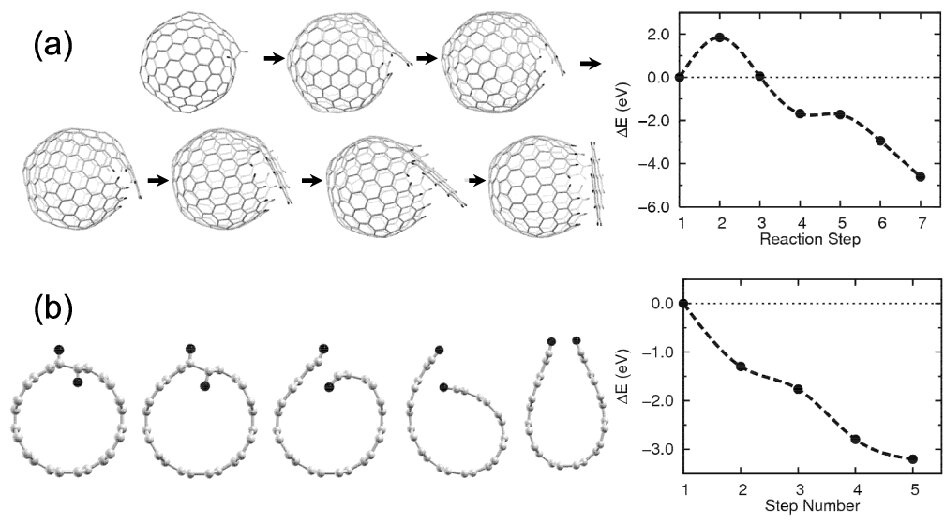 Figure 3
Peer Reviews
No public reviews on file for this paper yet. If you reviewed it on a platform where reviews are public (OpenReview, ICLR, NeurIPS, ICML), you can paste yours below so the community can read it here.
Videos
No videos yet. Explain this paper in a talk, walkthrough, or lecture? Add one.
Hydrogen-induced disintegration of fullerenes and nanotubes:
An ab initio study
Savas Berber
Physics and Astronomy Department, Michigan State University, East Lansing, Michigan 48824-2320, USA
Physics Department, Gebze Institute of Technology, Gebze, Kocaeli 41400, Turkey
David Tománek
Physics and Astronomy Department, Michigan State University, East Lansing, Michigan 48824-2320, USA
Abstract
We use ab initio density functional calculations to study hydrogen-induced disintegration of single- and multi-wall carbon fullerenes and nanotubes. Our results indicate that hydrogen atoms preferentially chemisorb along lines in sp2 bonded carbon nanostructures, locally weakening the carbon bonds and releasing stress. For particular structural arrangements, hydrogen helps to relieve the accumulated stress by inducing step-wise local cleavage leading to disintegration of the outermost wall.
pacs:
81.05.Tp, 64.70.Nd, 61.48.De, 68.65.-k
Exposure to hydrogen is known to cause embrittlement in metalsZhong et al. (1993), a major concern in materials science. It is an intriguing question, whether local decohesion due to chemisorbed hydrogen may cause similar damage in sp2 bonded carbon nanostructures, such as fullerenes and nanotubesDresselhaus et al. (1996), and whether it may have helped to efficiently cleave grapheneLi et al. (2008). So far, past research has focussed on beneficial side-effects of the interaction of hydrogen with nanocarbons, including easier separation/debundling and the prospect of reversible hydrogen storageDresselhaus et al. (1996); Jorio et al. (2008). Since both fullerenes and nanotubes are under internal stress due to the local curvature, hydrogen-induced local decohesion may facilitate fracture and cause irreversible damage in nanocarbons as it does in metalsZhong et al. (1993).
Here we present an ab initio density functional study of bonding and structural changes in sp2 carbon nanostructures exposed to hydrogen. Our results indicate that hydrogen atoms preferentially chemisorb along lines on the outermost wall of single- and multi-wall carbon fullerenes and nanotubes, locally weakening the carbon bonds and releasing stress. For particular arrangements of adsorbed hydrogen atoms, we identify the microscopic process of step-wise local cleavage leading to the disintegration of the outermost wall as a way to release the accumulated stress.
To gain fundamental insight into the effect of hydrogen on the structural integrity of sp2 bonded carbon nanostructures, we studied the total energy and optimum structure of pristine and hydrogenated fullerenes and nanotubes. Our results are based on the density functional theory (DFT) within the local density approximation (LDA) and first-principles pseudopotentials. We used primarily the SIESTASoler et al. (2002) code with a double- basis set with polarization orbitals, the Perdew-ZungerPerdew and Zunger (1981) parametrization of the exchange-correlation functional, and norm-conserving ab initio pseudopotentialsTroullier and Martins (1991) in their fully separable formKleinman and Bylander (1982). The accuracy of our results was verified using the PWSCF plane-wave code with ultrasoft pseudopotentials. We used eV/Å as a strict gradient convergence criterion when determining optimum geometries. Constrained structure optimization has been used to investigate energy barriers, transition states, and generally to identify the optimum reaction pathway.
Published theoretical results include studies of the bonding character of isolated H atoms on graphite flakes, nanotubes and fullerenesJeloaica and Sidis (1999); Miller et al. (2008); Kim et al. (2008) and the preferential arrangement of hydrogen pairs on a graphene layerAllouche et al. (2006); Roman et al. (2007); Hornekaer et al. (2006). Other investigations address the relative stability of hydrogen pairs for different adsorption geometries Stojkovic et al. (2003) and coveragesAllouche and Ferro (2006) of hydrogen on graphene. Theoretical studies of hydrogen-covered nanotubes focussed on adsorbate-related electronic structure changesGülseren et al. (2002) and the relative stability of different adsorption arrangementsYildirim et al. (2001); Arellano et al. (2002); Stojkovic et al. (2003); Miller et al. (2008); Gülseren et al. (2003). More recent studies considered the possibility of axial cleavage in nanotubes in the presence of exohedrally adsorbed H atomsLu et al. (2003); Arellano et al. (2002); Miller et al. (2008). No results have been reported so far about the origin of hydrogen-induced structural damage in fullerene-like structures and its relation to stress-induced cleavage of nanotubes.
Same as in graphene, each carbon atom in fullerenes and nanotubes has three neighbors to form very stable sp2 bonds. Unlike in planar graphene, the most stable sp2 carbon allotrope, stress is associated with the nonzero local curvature in fullerenes and nanotubes. The small fullerenes C20 and C60 are spherical, with all atoms equivalent and subject to the same stress. With increasing size, however, free-standing fullerenes start resembling icosahedra, with twenty near-planar triangular facets spanning the surface. In these structures, stress associated with higher local curvature concentrates near the thirty edges connecting adjacent pentagons. In carbon nanotubes, on the other hand, all atoms are equivalent and the stress associated with local curvature is distributed uniformly throughout the structure.
Even though fullerenes with more than 100 atoms have not been observed, large icosahedral shells are believed to form the outermost shell of multi-wall fullerenes, called bucky onionsUgarte (1992). Focussing on the faceted C960 hollow shell structure in Fig. 1(a), increased stress makes edge atoms more reactive and prone to bind hydrogen. Molecular hydrogen does not dissociate on planar graphene, but does so with an energy gain on fullerenes, with the dissociated hydrogen pair preferentially binding on top of adjacent carbon atoms. In the following, we will define adsorption energies per hydrogen pair, related to the free H2 molecule. As expected, the energy gain depends on the local stress in the substrate, with values ranging from eV at the twelve pentagonal corners to eV at the edge sites and eV on the facets of the C960 fullerene.
Calculations at higher coverages suggest that after the first two atoms are adsorbed, additional hydrogens should preferentially adsorb along straight lines on the substrateMiller et al. (2008). We believe that formation of this energetically preferred adsorption pattern can be achieved by surface diffusion of hydrogen atoms at temperatures found during many hydrogenation reactions, since the activation barrier for sigmatropic rearrangement of chemisorbed hydrogen atoms is only eVMiller et al. (2008). As suggested earlier and illustrated in Fig. 1(c), carbon atoms at icosahedral edges in large fullerene cages are more reactive than the facet sites. Since the dissociative chemisorption energy of hydrogen along the edges exceeds that on fullerene facets by eV per H2 molecule, we expect hydrogen atoms to adsorb preferentially along lines connecting pentagon corners.
Even though there are no preferential adsorption sites on a carbon nanotube, atomic hydrogen is believed to adsorb preferentially along lines parallel to the tube axisLu et al. (2003); Arellano et al. (2002); Miller et al. (2008) to release stress. Possible initial adsorption geometries for hydrogen on the carbon nanotube are shown in Fig. 1(b). In the left panel, we depict the optimum nanotube geometry following hydrogen adsorption along three zigzag lines parallel to the axis. The calculated binding energy of 0.54 eV per hydrogen pair reflects also the energy associated with the tube relaxation to a triangular cross-section. Presence of hydrogen apparently locally reduces the flexural rigidity of the nanotube wall, converting its circular cross-section into a triangle.
Other favorable local adsorption patterns include exo- or endohedrally adsorbed hydrogens forming double-lines along the nanotube axis. The initial geometry of such a combined exo/endohedral adsorption arrangement is shown in the middle panel, and an exohedral double-line arrangement of hydrogens is shown in the right panel of Fig. 1(b). As we discuss later on, hydrogen-induced local decohesion causes significant structural rearrangements in both cases. The energy gain associated with hydrogen chemisorption was found to be eV per hydrogen pair in this case.
To obtain fundamental insight into the origin of hydrogen-induced local decohesion that is general and independent of a particular graphitic structure, we studied the effect of a line of chemisorbed hydrogen atoms on the structure and bonding in a graphene layer, as shown in Fig. 1(c). Hydrogen atoms bind preferentially on top of carbon atoms, causing a local buckling. A line of chemisorbed hydrogen atoms is expected to form a crease in the initially planar grapheneLi et al. (2008). In Fig. 1(c) we constrained the crease angle to equal that between adjacent facets on the icosahedron in Fig. 1(a). To get insight into the nature of the adsorption bond, we inspected the charge density difference , representing the charge redistribution in the system upon hydrogen adsorption. The spatial distribution of is shown in Fig. 1(d) in the plane schematically indicated in Fig. 1(c). Hydrogen adsorption causes only local charge rearrangement leading to a charge accumulation in the H-C bonds, depleting the charge in the local C-C bond region, as expected in case of sp3 bonding. Both the charge rearrangement and the local buckling are strong indicators for a local spsp3 transition. As suggested above, hydrogen pairs bind preferentially to neighboring carbon atoms, thereby changing an initially strong sp2 bond to a weaker, strained sp3 bond. This local decohesion resembles to some degree the microscopic mechanism of hydrogen embrittlement in some metalsZhong et al. (1993).
Besides decohesion, local change from sp2 to sp3 bonding is also associated with a net increase in the C-C bond length by typically 8%. In partially hydrogen-covered systems, carbon atoms connected to lines of hydrogen are under stress. The consequences can be best illustrated in the fullerene structure shown in Fig. 1(a), where hydrogen only attaches to the edges. The hydrogen-free planar facets can be thought as incompressible, same as small graphene flakes. Since the corners of the triangular facets determine the edge length, sp3 bonded carbon atoms along the edges are prevented from increasing their interatomic distance, subjecting the edges to stress. The energy associated with accumulated stress increases linearly with the edge length . For a critical value , this energy will exceed the activation barrier to break a C-C bond as a first step to initiating a cleavage that eventually causes the disintegration of the structure.
As we show later on, we find that eV. This amount of stress energy is accumulated in a hydrogenated fullerene edge of critical length nm. We thus expect hydrogen-induced cleavage to occur only in fullerenes with nm, with a diameter exceeding nm and containing more than C atoms. Such large fullerenes never occur as single-wall structures, but may form the outermost wall of a multi-wall bucky onion. In large bucky onions, the spherical walls inside exert radial pressure on the outermost wall, thus enhancing the hydrogen-induced stress and reducing the critical diameter for disintegration of the outermost wall. We expect that multi-wall fullerenes exposed to hydrogen should peel layer-by-layer from the outside in a process appearing as exfoliation.
In the following, we study the microscopic mechanism leading to cleavage at the minimum energy cost. To obtain a general understanding of the fracture process that does not depend on a particular system, we created generic creases by placing a periodic array of hydrogen lines along the armchair direction on alternating sides of an infinite graphene monolayer, as seen in Fig. 2(a). The energetics and atomic arrangement during the initial cleavage are depicted in Figs. 2(b) and 2(c). Cleavage at the crease is caused by locally weakening the affected bonds. We found that this is best achieved by adsorbing additional hydrogen atom pairs on both sides of the initial hydrogen line, as shown in the left panel of Fig. 2(c). Such a local arrangement of adsorbed hydrogens is a favorable prerequisite to cleave an edge segment. We found that the energy needed to break one bond is larger than the energy to break two adjacent bonds, shown in a dark color in the left panel of Fig. 2(c). Continuing this concerted bond breaking mechanism should cleave the edge, causing the structure to disintegrate.
The energetics of cleavage in Fig. 2(b) shows the total energy change with respect to the initial structure as a function of the bond length across the crack, which we use as the reaction coordinate. We consider the full range of values occurring during the cleavage reaction and, for each value of , we globally optimize the structure. Consequently, the calculated transition paths for the disintegration of hydrogenated fullerenes and nanotubes represent the optimum cleavage path in unconstrained systems. Following an initial energy investment of eV, the bonds break abruptly, leading to the final structure depicted in the right panel of Fig. 2(c). There is a net energy gain of eV associated with the bond breaking, caused by releasing the accumulated stress. The initially stressed sp3 bonded crease segment converts into a pair of more stable sp2 bonded, hydrogen terminated graphene edges.
We next calculated the energy barriers associated with breaking specific bonds in search of the optimum pathway to complete the crease cleavage after it was initiated. The optimum sequence of bonds to break, along with the intermediate structures and the energetics of the process, is depicted in Fig. 2(d). Interestingly, the smallest energy investment to propagate the fracture following the first step in Fig. 2(b) does not involve the neighboring pair of C-C bonds on the opposite side of the ridge, but rather the more distant pair of C-C bonds on the same side of the ridge. Our results indicate that the energy barrier to propagate the fracture decreases at successive steps. As a matter of fact, it may be reasonable to assume that the energy released following the initial step may activate the zipper-like cleavage at the crease without further energy investment. Once cleavage is initiated, the unzipping process transforms the stressed crease into two overlapping graphene edges in an exothermic reaction.
Having studied the microscopic cleavage process in the warped graphene model, we next turn to hydrogen-induced disintegration of specific fullerene and nanotube structures. As we discussed above, we expect hydrogen-induced disintegration to proceed spontaneously only in very large fullerenes, which are typically multi-wall structures. In the smaller C240 fullerene, we find this reaction to be energetically activated. The energetics of the C240 disintegration process, induced by hydrogen adsorption along the icosahedral edges, is shown in Fig. 3(a) along with snap-shots of intermediate structures. Unlike in the model system addressed in Fig. 2, the hydrogen coverage has been gradually increased as the cleavage progressed, as an alternative scenario to initiating unzipping. Both in the warped graphene model and in the C240 fullerene, we find the disintegration process to be exothermic, following an initial energy investment of eV.
Whereas large fullerenes are more susceptible to hydrogen-induced fracture due to the stress build-up in the hydrogenated edges, we find nanotubes that are narrow to be more susceptible to fracture due to the stress caused by their high uniform curvature. Both in fullerenes and nanotubes with multiple walls, hydrogen will first adsorb on the outermost wall, causing local decohesion leading to bond breaking and eventual disintegration of the outermost wall. Continuing exposure to hydrogen will cause a layer-by-layer peeling that will appear as exfoliation.
As suggested by our results in Fig. 1(b), hydrogen adsorption concentrates the deformation along lines parallel to the tube axis, reducing the flexural stress in the hydrogen-free region. The right panels of Fig. 1(b), depicting hydrogen covered nanotubes, illustrate how hydrogen-induced decohesion along adsorption lines may cause large structural changes. The detailed cleavage process of an infinitely long carbon nanotube, covered by a complete chain of hydrogens adsorbed exohedrally and a neighboring chain adsorbed endohedrally, is described in Fig. 3(b). The sequence of snap shots, presented in an end-on view, depicts intermediate structures, including a scrollLavin et al. (2002), encountered during a conjugate gradient optimization from an unrelaxed initial structure. This process is only spontaneous if all hydrogens adsorb in the optimum way to form completely filled lines of adsorbed hydrogen, and is activated otherwise. The final structure with a horseshoe-like cross-section, stabilized by the attraction of the hydrogenated zigzag edges, may furthermore undergo an activated conversion to a planar graphene strip with hydrogen-terminated edges.
In conclusion, we used ab initio density functional calculations to study hydrogen-induced disintegration of single- and multi-wall carbon fullerenes and nanotubes. Our results indicate that hydrogen atoms preferentially chemisorb along lines in sp2 bonded carbon nanostructures, locally weakening the carbon bonds and releasing stress. Contrary to common belief that chemisorbed hydrogen causes no harm to carbon nanostructures, we show that irreversible structural changes may be caused by chemisorbed hydrogen that can initiate local cleavage leading to the disintegration of the outermost wall. In experimental observations of multi-wall structures, this could be interpreted as hydrogen-induced exfoliation.
We thank Glen P. Miller for inspiring this study by his experimental observations in bucky onions. This work was funded by the National Science Foundation under NSF-NSEC Grant No. 425826 and NSF-NIRT Grant No. ECS-0506309. Computational resources have been provided by the Michigan State University High Performance Computing Center.
The reference list from the paper itself. Each links out to its DOI / PubMed record.
- 1Zhong et al. (1993) W. Zhong, Y. Cai, and D. Tomanek, Nature 362 , 435 (1993).
- 2Dresselhaus et al. (1996) M. Dresselhaus, G. Dresselhaus, and P. Eklund, Science of Fullerenes and Carbon Nanotubes (Academic Press, San Diego, 1996).
- 3Li et al. (2008) X. Li, X. Wang, L. Zhang, S. Lee, and H. Dai, Science 319 , 1229 (2008).
- 4Jorio et al. (2008) A. Jorio, M. Dresselhaus, and G. E. Dresselhaus, Carbon Nanotubes: Advanced Topics in the Synthesis, Structure, Properties and Applications, Topics in Applied Physics, Vol. 111 (Springer, 2008).
- 5Soler et al. (2002) J. M. Soler, E. Artacho, J. D. Gale, A. García, J. Junquera, P. Ordejón, and D. Sánchez-Portal, J. Phys: Cond. Mat. 14 , 2745 (2002).
- 6Perdew and Zunger (1981) J. P. Perdew and A. Zunger, Phys. Rev. B 23 , 5048 (1981).
- 7Troullier and Martins (1991) N. Troullier and J. L. Martins, Phys. Rev. B 43 , 1993 (1991).
- 8Kleinman and Bylander (1982) L. Kleinman and D. M. Bylander, Phys. Rev. Lett. 48 , 1425 (1982).