Decays Z --> g g gamma and Z-prime --> g g gamma in the minimal 331 model
A. Flores-Tlalpa, J. Montano, F. Ramirez-Zavaleta, J. J. Toscano

TL;DR
This paper investigates rare one-loop decays of Z and Z-prime bosons into gluon pairs and a photon within the minimal 331 model, highlighting the dominant role of exotic quarks in Z-prime decay.
Contribution
It provides the first detailed analysis of Z and Z-prime decays into g g gamma in the minimal 331 model, emphasizing the impact of exotic quarks on Z-prime decay rates.
Findings
Z --> g g gamma decay is unaffected by exotic quarks.
Z-prime --> g g gamma decay is dominated by exotic quarks.
Z-prime decay rate into g g gamma exceeds that into g g g for heavy Z-prime.
Abstract
The one-loop induced Z --> g g gamma and Z-prime --> g g gamma decays are studied within the context of the minimal 331 model, which predicts the existence of new gauge bosons and three exotic quarks. It is found that the Z --> g g gamma decay is insensitive to the presence of the exotic quarks, as it is essentially governed by the first two families of known quarks. As to the Z-prime --> g g gamma decay, it is found that the exotic quark contribution dominates and that for a heavy Z-prime boson it leads to a Gamma(Z-prime --> g g gamma) that is more than one order of magnitude larger than that associated with Gamma(Z-prime --> g g g).
Click any figure to enlarge with its caption.
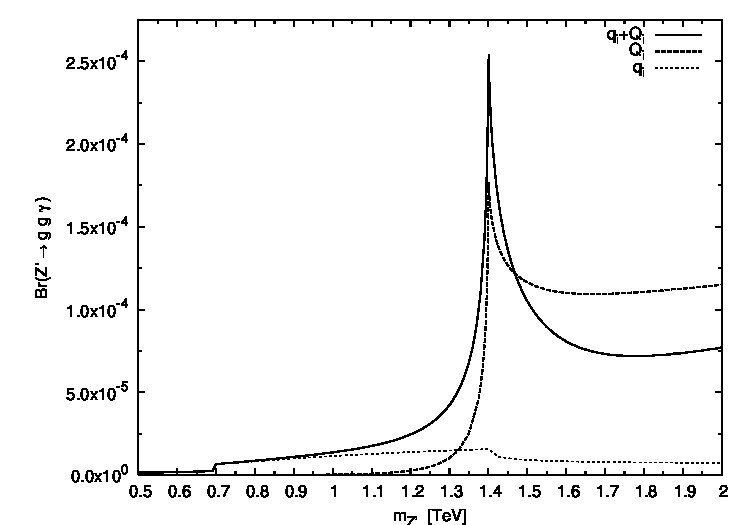 Figure 1
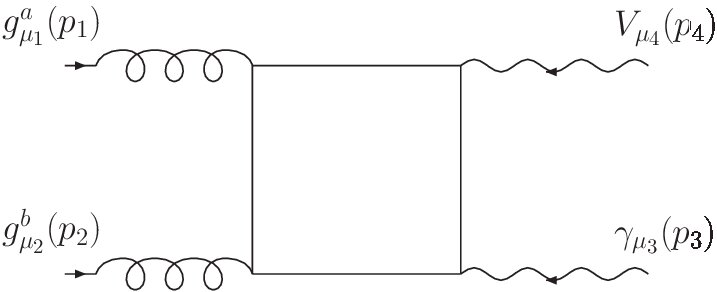 Figure 2
| Family | [GeV] | [GeV] | [GeV] | [GeV] | [GeV] |
|---|---|---|---|---|---|
| - | - | - | - | ||
| - | - | - | - | ||
| - | - | - | - | ||
| Total |
| Family | [GeV] | [GeV] | [GeV] | [GeV] | [GeV] | [GeV] |
| - | - | - | - | |||
| - | - | - | - | |||
| - | - | - | - | |||
| Total |
| Quark | [GeV] |
|---|---|
Peer Reviews
No public reviews on file for this paper yet. If you reviewed it on a platform where reviews are public (OpenReview, ICLR, NeurIPS, ICML), you can paste yours below so the community can read it here.
Videos
No videos yet. Explain this paper in a talk, walkthrough, or lecture? Add one.
Decays and in the minimal model
A. Flores-Tlalpa, J. Montaño, F. Ramírez-Zavaleta, and J. J. Toscano
Facultad de Ciencias Físico Matemáticas, Benemérita Universidad Autónoma de Puebla, Apartado Postal 1152, Puebla, Puebla, México.
Abstract
The one-loop induced and decays are studied within the context of the minimal model, which predicts the existence of new gauge bosons and three exotic quarks. It is found that the decay is insensitive to the presence of the exotic quarks, as it is essentially governed by the first two families of known quarks. As to the decay, it is found that the exotic quark contribution dominates and that for a heavy boson it leads to a that is more than one order of magnitude larger than that associated with .
pacs:
13.38.Dg, 12.60.Cn, 14.70.Dj
In a recent communication OP , we presented a comprehensive study on the and PTT decays within the context of the minimal model 331-1 ; 331-2 . This model, which is based in the gauge group, has the peculiarity of predicting new physics effects at the TeV scale 331-2 ; Ng331 . In the gauge sector, the model predicts the existence of a new gauge boson as well as two doubly charged and two simply charged gauge bosons, that arise in the first stage of spontaneous symmetry breaking (SSB) when is broken into TT . These charged gauge bosons, which arise as a doublet of the group TT , are known as bileptons because they carry two units of lepton number. In this model, the lepton spectrum is the same111 It should be mentioned that there is a different version of this model PT which introduces exotic leptons but with the same quark sector. as in the standard model (SM), but three new exotic quarks are needed in order to cancel anomalies 331-2 ; TT ; Zp331 . To endow with mass the spectrum of particles, the model requires of a Higgs sector composed of three triplets and one sextet of Ng331 ; TT . Interestingly, the new gauge boson masses are bounded from above 331-2 ; Ng331 ; Zp331 due to the theoretical constraint which yields 331-2 ; Ng331 . The fact that the value of is very close to at the scale leads to an upper bound on the scale associated with the first stage of SSB, which translates directly into a bound on the mass given by TeV Ng331 , which in turns implies that the bilepton masses cannot be heavier than Ng331 . It turns out that when the coupling constant associated with the group becomes infinite and a Landau pole arises LP .
In this brief report, we present results for the and decays within the context of the model. These decays receive contributions from both the known quarks and the exotic quarks ( and with charge in units of the positron charge, and with charge ). It turns out that the amplitude for the vertex, with , can be obtained as a particular case of the amplitude for the vertex, whose exact expression is listed in Ref. OP . As it is pointed out in Refs. OP ; Bij , the amplitude for the vertex is composed by the vector amplitude and the axial vector amplitude, which are finite and gauge invariant by themselves and do not interfere among themselves, as they are proportional to the color structures and , respectively. However, due to the Abelian character of the photon, there is no contribution of axial vector type to the vertex, the contribution is only of vector type and arises from box diagrams of the type shown in Fig. 1. Using the notation and conventions shown in this figure, the amplitude for the decay can be written as
[TABLE]
where
[TABLE]
with representing the electric charge in units of the positron charge. The form factors and the gauge structures appearing in the above expression are given in Ref. OP . As it is shown in this reference, these form factors are free of ultraviolet divergences, whereas the gauge structures satisfy the transversality conditions:
[TABLE]
On the other hand, the decay width can be written as follows:
[TABLE]
where
[TABLE]
We now turn to discuss our results. As already discussed in Ref. OP , the behavior of the amplitude associated with this class of four vector couplings is of decoupling nature when considered as a function of the internal mass quark, but it is nondecoupling when evaluated with respect to the mass difference of the members of the doublets of the SM quarks. This behavior was discussed in detail in Ref. OP and we will refrain from presenting here. Since the only difference between the vector amplitudes for the and couplings comes from coupling constants, color factors, and statistical factors, roughly one can to expect that the decay width for the transition is suppressed with respect to the one associated with the process by a factor of , which is always lower than the unity still for exotic quarks. Although this is the case for the decay, we will see below that the exotic quark contribution to the transition leads to a width decay which can be one order of magnitude or larger than that associated with the transition. The reason for this behavior is due to a constructive interference effect among the exotic quarks.
The decay has already been calculated in the SM ZSM . Here, we present complete numerical results in the context of the minimal model, which include the contributions induced by the exotic quarks, for whose masses we will use values that are consistent with current bounds estimated in the literature EQMass . Following Ref. OP , we write the decay width of the transition as the sum of three partial widths:
[TABLE]
where , , and are the contributions of the SM quarks, the exotic quarks, and the interference between these contributions, respectively. In Table 1, the contributions to the decay width of the transition induced by the three known families and the exotic quarks, which are computed with a degenerate mass of GeV, are shown. From this table, it can be appreciated that the decay width is determined essentially by the first two families and a constructive interference effect. As it can be appreciated from this table, the contribution induced by the exotic quark is completely marginal. Using the value for the total decay width reported by The Particle Data Group PDG , one obtains the following branching ratio
[TABLE]
We now turn to discuss the decay. In Table 2, the contribution of the SM quarks to is shown for GeV and TeV. These values for the mass are consistent with the corresponding bounds given in the literature ZpMass . It can be appreciated from these tables that the main contribution arises from the third family, but that those contributions coming from the first and second families are also relevant, as they are lower than that of the third family by less than one order of magnitude. It is also important to notice that the interference effect among families is in magnitude as important as the contribution of the third family. This effect is destructive for relatively light gauge boson, but it is constructive for a heavier boson. As it can be appreciated from these tables, the SM quarks contribution to the decay width for TeV is almost one order of magnitude larger than for GeV. On the other hand, the contribution of the exotic quarks to is shown in Table 3 for the scenario . It can be appreciated from this table that the exotic quark contributions are about of one order of magnitude larger than those induced by the SM quarks. It is also interesting to notice that the quark interferes constructively with the other two exotic quarks, in contrast with the case of the corresponding decay into three gluons, in which this interference effect is of destructive nature OP . This effect is due to the fact that the amplitude is proportional to and , but . This arises as a consequence of the fact that appears as a component of an antitriplet of , whereas and arise as components of triplets of the same group. As it shown in Table VIII of Ref. OP , the destructive nature of the interference effect considerably reduces the contribution of the exotic quarks to the decay into three gluons. In our case, the constructive nature of this effect leads to a contribution to that is more than one order of magnitude larger than that associated with . This behavior can clearly be appreciated from Fig. 2, where the contributions to of standard and exotic quarks are shown separately.
Using for the total decay width of the boson the results given in Ref. Zp331 , the branching ratio for the scenario is given by
[TABLE]
which is determined essentially by the SM quarks. On the other hand, the corresponding branching ratio for the scenario is given by
[TABLE]
In this case, the contribution induced by the SM quarks is marginal.
In conclusion, in this paper the rare and decays were studied in the context of the minimal model. Numerical results for the corresponding decay widths and branching ratios were obtained from exact analytical expressions given in Ref. OP . The relative importance of the contributions induced by the known quarks and the exotic ones predicted by the model was analyzed. It was found that the decay is dominated by the first two families, being insensitive to the presence of exotic quarks. As to the decay, it was found that this process is very sensitive to the exotic quark presence and its decay width can be more than one order of magnitude larger than that associated with the decay.
Acknowledgements.
We acknowledge financial support from CONACYT and SNI (México).
The reference list from the paper itself. Each links out to its DOI / PubMed record.
- 1(1) A. Flores-Tlalpa, J. Montaño, F. Ramírez-Zavaleta, and J. J. Toscano, Phys. Rev. D 80 , 033006 (2009).
- 2(2) For some reviews on rare Z 𝑍 Z decays, see E. W. N. Glover and J. J. van der Bij, in Z 𝑍 Z Physics at LEP-1, edited by G. Altarelli et al. (CERN yellow report No. 89-08, 1989); M. A. Pérez, G. Tavares-Velasco, and J. J. Toscano, Int. J. Mod. Phys. A 19 , 159 (2004).
- 3(3) F. Pisano and V. Pleitez, Phys. Rev. D 46 , 410 (1992).
- 4(4) P. H. Frampton, Phys. Rev. Lett. 69 , 2889 (1992).
- 5(5) D. Ng, Phys. Rev. D 49 , 4805 (1994); J. T. Liu and D. Ng, Z. Phys. C 62 , 693 (1994).
- 6(6) G. Tavares-Velasco and J. J. Toscano, Phys. Rev. D 65 , 013005 (2001).
- 7(7) V. Pleitez and M. D. Tonasse, Phys. Rev. D 48 , 2353 (1993).
- 8(8) M. A. Pérez, G. Tavares-Velasco, and J. J. Toscano, Phys. Rev. D 69 , 115004 (2004).