Theoretical Status of Higgs Production at Hadron Colliders in the SM
Radja Boughezal

TL;DR
This paper reviews the current theoretical understanding of Higgs boson production mechanisms and decay modes at hadron colliders like the Tevatron and LHC within the Standard Model.
Contribution
It provides a concise overview of the theoretical calculations and status of Higgs production and decay processes at major hadron colliders.
Findings
Summarizes the main production mechanisms at Tevatron and LHC.
Highlights the theoretical precision of Higgs production calculations.
Discusses decay modes relevant for experimental searches.
Abstract
We briefly review the current status of theoretical calculations for Higgs production at hadron colliders within the Standard Model. We focus on the main production mechanisms and decay modes at the Tevatron and the LHC.
Click any figure to enlarge with its caption.
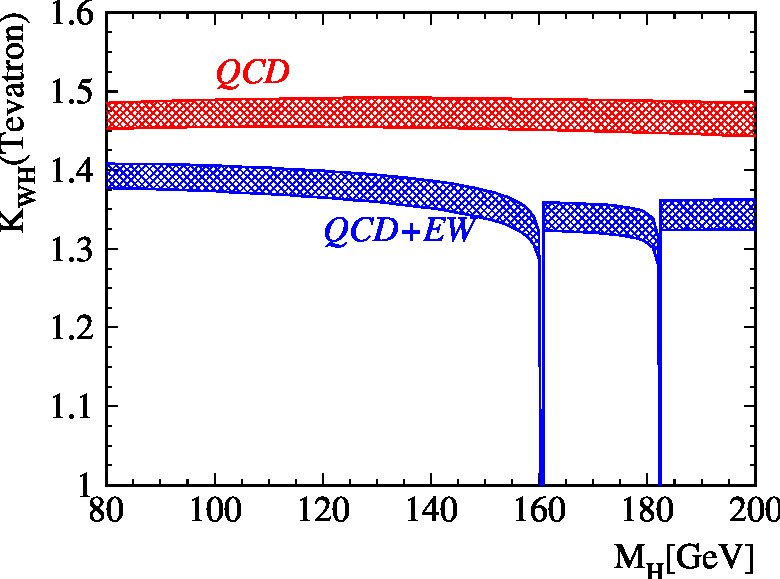 Figure 1
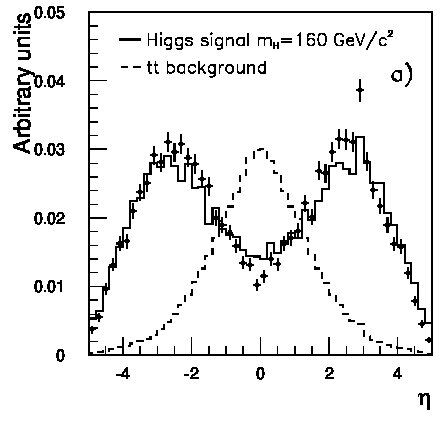 Figure 1
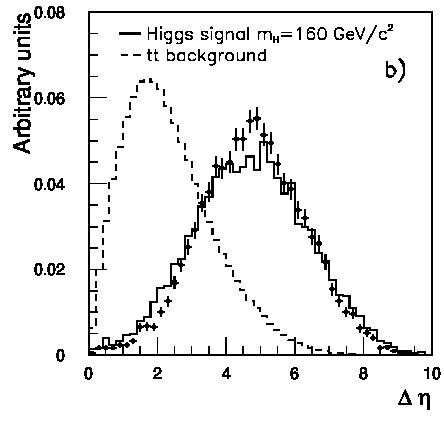 Figure 1
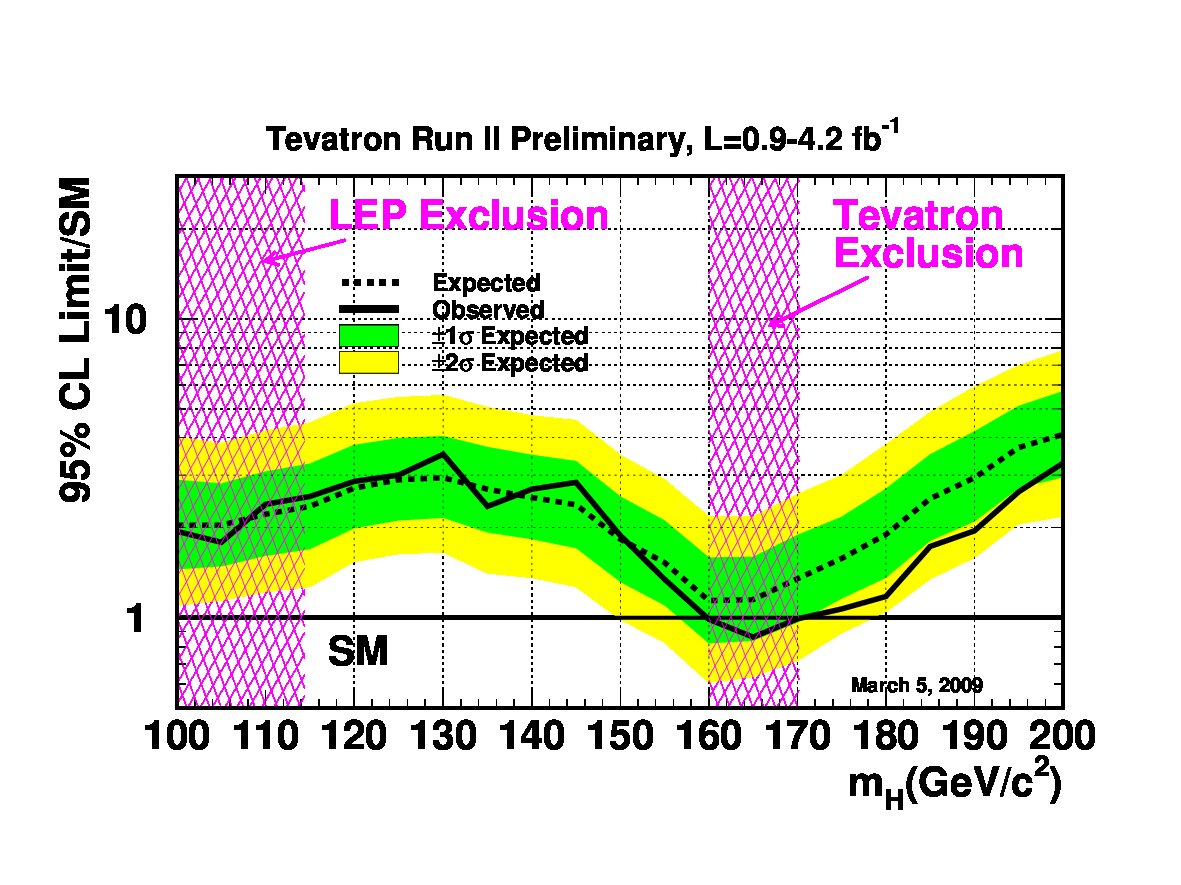 Figure 4
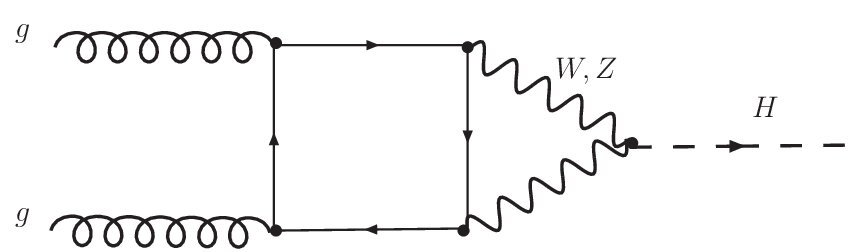 Figure 5
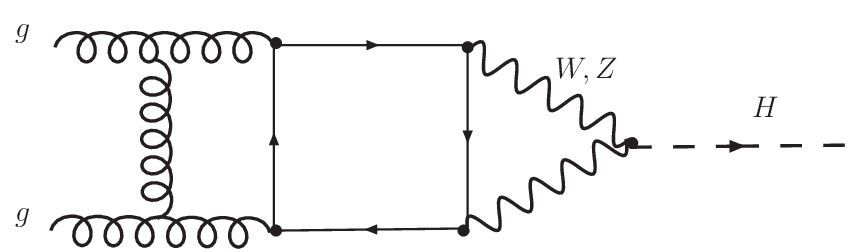 Figure 6
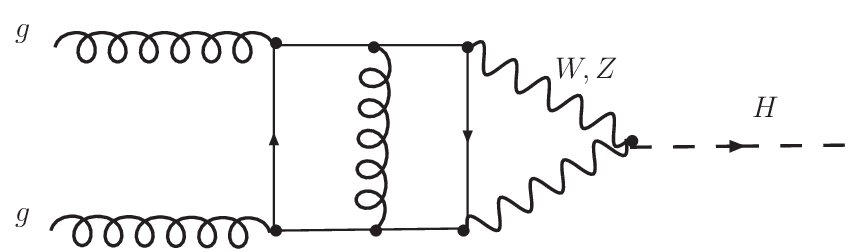 Figure 7
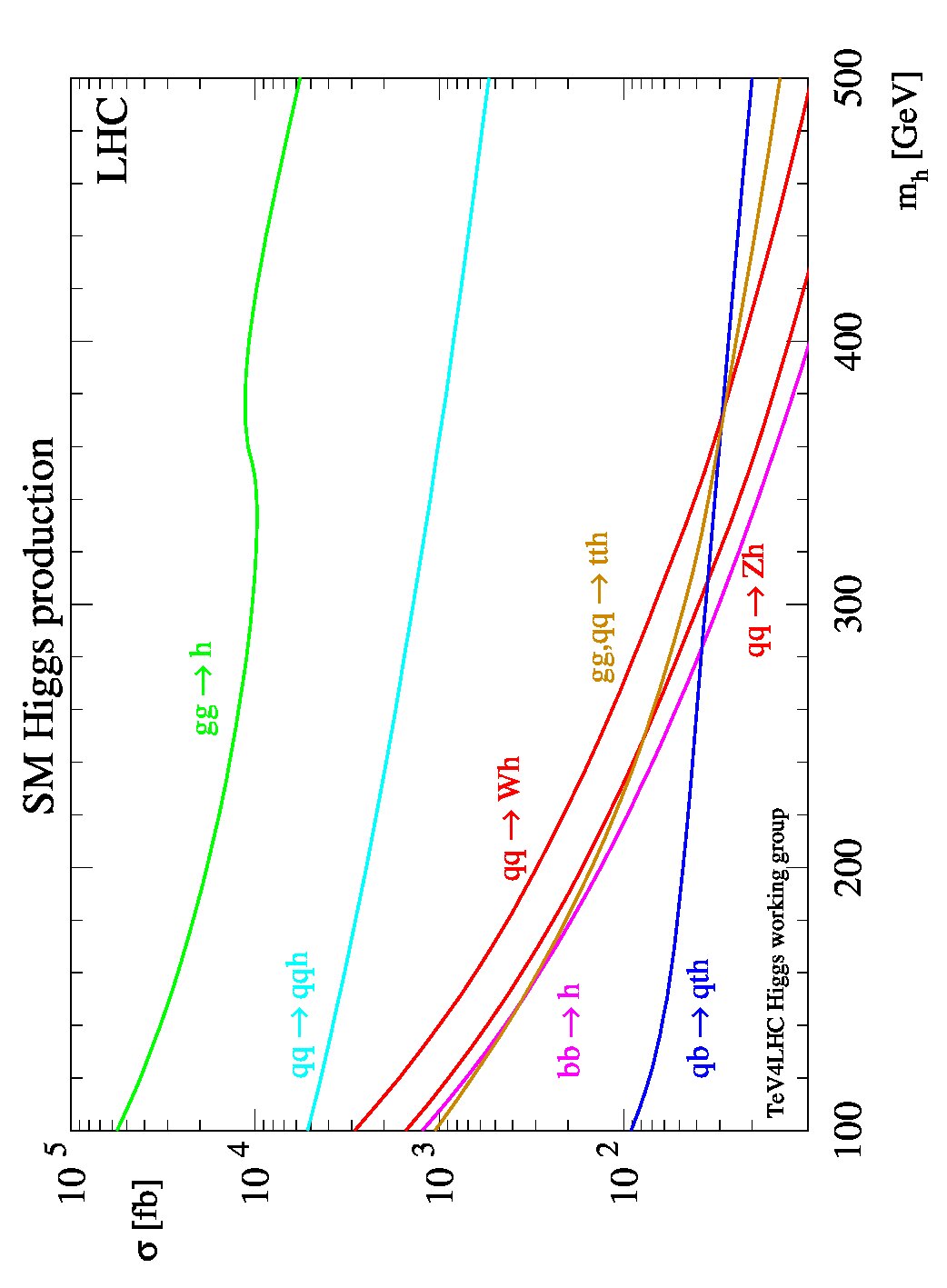 Figure 8
| [GeV] | [pb] | [GeV] | [pb] |
|---|---|---|---|
| 110 | 1.417 ( pdf) | 160 | 0.4344 ( pdf) |
| 115 | 1.243 ( pdf) | 165 | 0.3854 ( pdf) |
| 120 | 1.094 ( pdf) | 170 | 0.3444 ( pdf) |
| 125 | 0.9669 ( pdf) | 175 | 0.3097 ( pdf) |
| 130 | 0.8570 ( pdf) | 180 | 0.2788 ( pdf) |
| 135 | 0.7620 ( pdf) | 185 | 0.2510 ( pdf) |
| 140 | 0.6794 ( pdf) | 190 | 0.2266 ( pdf) |
| 145 | 0.6073 ( pdf) | 195 | 0.2057 ( pdf) |
| 150 | 0.5439 ( pdf) | 200 | 0.1874 ( pdf) |
| 155 | 0.4876 ( pdf) |
| LO | NLO | NNLO | |
|---|---|---|---|
Peer Reviews
No public reviews on file for this paper yet. If you reviewed it on a platform where reviews are public (OpenReview, ICLR, NeurIPS, ICML), you can paste yours below so the community can read it here.
Videos
No videos yet. Explain this paper in a talk, walkthrough, or lecture? Add one.
Taxonomy
TopicsParticle physics theoretical and experimental studies · High-Energy Particle Collisions Research · Particle Detector Development and Performance
Theoretical Status of Higgs Production at Hadron Colliders in
the Standard Model
Radja Boughezal
Institut für Theoretische Physik, Universität Zürich,
Winterthurerstr. 190, 8057 Zürich, Switzerland
Abstract
We briefly review the current status of theoretical calculations for Higgs production at hadron colliders within the Standard Model. We focus on the main production mechanisms and decay modes at the Tevatron and the LHC.
I Introduction
The search for the Higgs boson, the last missing particle in the Standard Model (SM) responsible for the electroweak symmetry breaking, is a primary goal of the CERN Large Hadron Collider (LHC), and is a central part of Fermilab’s Tevatron program. In the Standard Model, mass generation is triggered by the Higgs mechanism, which predicts the existence of one scalar particle, the Higgs boson Higgs:1964pj . The coupling of the Higgs to fermions and gauge bosons is predicted by the model. The only unknown parameter is the Higgs boson mass. Direct searches at LEP restrict the Higgs boson mass to be greater than 114.4 GeV (at 95 CL) Barate:2003sz , while precision measurements point to a rather light Higgs, GeV ( CL) which increases to GeV when including the LEPII direct search limit of GeV (see LEPweb for regular updates). Recently, the Tevatron collaborations, CDF and D0, reported a CL exclusion of a Standard Model Higgs boson mass in the range GeV :2009pt .
The Standard Model Higgs coupling is strongest to the heaviest particles. Therefore, we distinguish three types of decays: into fermions, into massive gauge bosons and loop-induced decays through a massive loop of quarks or gauge bosons. Since the LHC will be able to find the Higgs, if it exists, and can provide a measurement of its couplings at the level Duhrssen:2004cv ; Lafaye:2009vr , precise theoretical predictions of these decays are needed.
Understanding the theoretical prediction is crucial to both the search for and exclusion of the Standard Model Higgs boson. Backgrounds to the Higgs signal are severe in many channels, particularly when a mass peak cannot be reconstructed such as in , and knowledge of the signal shape and normalization is needed to optimize experimental searches. Signal and background cross sections must be, therefore, predicted as accurately as can be achieved.
Higgs production at both hadron colliders, Tevatron and LHC, is dominated by gluon fusion, where two incoming gluons produce a Higgs boson via a virtual top quark loop. This is followed by vector boson fusion (VBF), where the incoming protons radiate a W or a Z boson, which subsequently interact weakly and fuse into a Higgs boson. The Higgs can also be produced in association with a pair of top quarks or through Higgs strahlung (associated WH or ZH production).
In this short review, we summarize the status of theoretical predictions for signal and background processes at hadron colliders. Readers who are interested in more details should refer to several reviews in the literature, for example Djouadi:2005gi ; Harlander:2007zz .
II Higgs Decay Modes
Depending on the Higgs boson mass, different decay channels open up as shown in Fig. 1. The main decay modes are summarized below.
: at low Higgs mass ( GeV), the decay to is dominant with a branching ratio (BR) of roughly for Higgs masses lower than GeV. Electroweak corrections to this decay were calculated at the one- and two-loop level in Fleischer:1980ub ; Kniehl:1991ze ; Dabelstein:1991ky ; Djouadi:1997rj . The one-loop correction grows like and has an impact of with respect to the LO. Mixed QCD-electroweak corrections of order and were provided in Kwiatkowski:1994cu ; Kniehl:1994ju ; Kniehl:1995at ; Kniehl:1995br ; Chetyrkin:1996ke ; Chetyrkin:1996wr . They were found to be very small, roughly at . Pure QCD corrections to decays into quarks were considered up to and are presented in Baikov:2005rw . They increase the leading order by .
: this is the second important decay at low Higgs mass after the H with a branching ratio of roughly . The CDF collaboration conducted recently a search for the Higgs using this decay mode CDF:08 ; Duperrin:2008in . Several processes have been considered: Higgs production in association with a vector boson (W/Z) with the vector boson decaying into two jets, vector boson fusion production in which the two jets coming from the proton and antiproton tend to have a large rapidity value, and gluon fusion production. This decay is, for the first time, included in the Tevatron combined results shown in Group:2008ds .
: with increasing mass, the Higgs boson decays preferably to the heaviest particles, mainly to and ZZ pairs around their thresholds (BR around GeV for the WW). In the range GeV, the decay is the most important. Because of the missing energy, the mass of the Higgs can not be directly reconstructed and a mass peak is absent. The charged leptons, however, have a strong angular correlation.
Radiative corrections of the strong and electroweak interactions at NLO were calculated for the Higgs boson decay with semi-leptonic or hadronic four-fermion final states in Bredenstein:2006ha , whereas the pure leptonic final state was considered in Bredenstein:2006rh . The electroweak corrections are similar for all four-fermion final states and reach at GeV. The QCD corrections to the partial decay widths are for semi-leptonic and for hadronic final states.
The impact of higher-order corrections on the Higgs signal is strongly reduced by the selection cuts that are imposed to suppress the background Anastasiou:2007mz ; Grazzini:2008tf ; Anastasiou:2008ik . We will comment on this in more detail in section (III.1).
The is considered to be one of the most promising channels for an early discovery Davatz:2004zg , but at the same time a very challenging one due to the background. Therefore, a precise knowledge of the background distributions is crucial. The irreducible and backgrounds are known at including spin correlations Dixon:1999di ; Campbell:1999ah . In the case, NLO predictions were consistently combined with soft-gluon resummation that is valid at small transverse momenta of the WW pair Grazzini:2005vw , whereas for ZZ, soft-gluon effects on signal and background were studied recently in Frederix:2008vb . The background, including spin correlations Bernreuther:2001rq , is known up to NLO in the QCD coupling. The background from leptons is known at Binoth:2005ua (note that this is NLO precision as the leading order process is already one loop) and was found to increase the theoretical background estimate by almost . The was considered in Binoth:2008pr . In Chachamis:2008yb , the two-loop and the one-loop squared virtual QCD corrections to the W boson pair production in the channel in the limit where all kinematical invariants are large compared to the mass of the W boson are presented.
The leptons decay is the ‘golden channel’ for observing a Higgs boson as a clear peak on top of a smooth background nisati:09 . Its branching ratio is roughly half the one for the W-pair as can be seen from Fig. 1. The advantage of this channel over the WW one, is that the invariant mass of the leptons can be reconstructed, allowing a measurement of the background from the data.
: for low Higgs masses, the dominant decay mode is swamped by a large QCD background and the Higgs boson can be searched for through loop induced decays. The is the most important one and is mediated by loops of massive quarks as well as massive vector bosons. The QCD corrections to this decay are known for arbitrary quark masses Djouadi:1993ji ; Fleischer:2004vb ; Harlander:2005rq ; Passarino:2007fp ,and do not exceed . The term is known as an expansion in from the work of Steinhauser:1996wy . Finally, electroweak corrections to this decay were evaluated in Fugel:2004ug ; Degrassi:2005mc ; Passarino:2007fp . They were found to be below .
III Higgs Production Modes
III.1 Gluon Fusion
The dominant production mode of the Standard Model Higgs boson at the Tevatron and LHC is gluon fusion, mediated by a heavy-quark loop, with a cross section that is a factor of larger than all other production modes cross sections (see Fig. (1)). Radiative QCD corrections to this process turned out to be very important. At the NLO level, they were found to increase the LO cross section by about Dawson:1990zj ; Djouadi:1991tka ; Spira:1995rr . The gluon-Higgs interaction seems to be very well approximated by an effective Lagrangian obtained by decoupling the top quark Kramer:1996iq
[TABLE]
if the exact Born cross section with the full dependence on the top and bottom quark masses is used to normalize the result. The difference between the exact and the approximate NLO cross sections is less than for Higgs masses up to GeV, and does not exceed even for Higgs masses up to TeV, well far away from its formal range of validity . In equation (1), is the vacuum expectation value of the Higgs field, GeV, and is the Wilson coefficient, currently known through Schroder:2005hy ; Chetyrkin:2005ia . In this large limit, the NNLO QCD corrections were computed in Harlander:2002wh ; Anastasiou:2002yz ; Ravindran:2003um , leading to an additional increase of the cross section of roughly , and showing a good convergence of the perturbative series. Very recently, the three-loop virtual corrections to this process, where finite top quark mass effects are taken into account, were presented in Harlander:2009bw ; Pak:2009bx .
A further increase in the cross section of about was obtained by doing soft-gluon resummation Catani:2003zt . This result was nicely confirmed through the leading soft contributions at Moch:2005ky ; Laenen:2005uz ; Idilbi:2005ni . Taking all the perturbative effects into account, the inclusive result of the cross section increases by a factor of at LHC and at Tevatron. The theoretical uncertainty from effects beyond NNLO is estimated to be about by varying the renormalization and factorization scales.
The largeness of the K-factors at both colliders is an open question. In Ahrens:2008nc , the authors argue that this is due to enhanced contributions of the form , coming from the analytic continuation of the gluon form factor to time-like momentum transfer, with being the number of loops. A resummation of these terms using soft collinear effective theory (SCET) leads to smaller values of the K-factors; in fact at the LHC, the K-factor for small values of is close to .
The importance and success in taming the QCD corrections to Higgs production have shifted attention to electroweak corrections to the Higgs signal. The authors of Refs. Aglietti:2004nj ; Aglietti:2006yd pointed out important 2-loop light-quark effects; these are pictured in Fig. (2) and involve the Higgs coupling to - or -bosons which then couple to gluons through a light-quark loop. These terms are not suppressed by light-quark Yukawa couplings, and receive a multiplicity enhancement from summing over the quarks. A careful study of the full 2-loop electroweak effects was performed in Ref. Actis:2008ug . They increase the leading-order cross section by up to for relevant Higgs masses.
The leading order of the mixed QCD-electroweak corrections, due to diagrams containing light quarks, was calculated in Anastasiou:2008tj , using an effective field theory approach where the W boson is integrated out. Sample diagrams involved in this calculation are shown in Fig. (3).
This work allowed to check the complete factorization hypothesis of QCD and electroweak corrections proposed in Ref. Aglietti:2006yd ; Actis:2008ug . The result shows that, despite the large violation of the factorization assumption, a significant numerical difference from the prediction of this hypothesis is not observed in the cross section, due to the dominant QCD corrections. The end effect on the cross section is an additional enhancement of up to from the terms.
In addition to the previous results, the authors of Anastasiou:2008tj provided a new prediction for the inclusive cross section of the gluon fusion process. This updated result takes into account all the new theoretical calculations: the 2-loop light-quark diagrams based on the complex-mass scheme for the - and -bosons Actis:2008ug , the new 3-loop correction, the contributions from top and bottom quarks with the exact NLO K-factors and the newest parton distribution functions (PDF) by the MSTW group Martin:2009iq ; Martin:2009bu ; Thorne:2009ky . The updated numerical values of the cross section are lower than the old prediction Catani:2003zt that was used in an earlier exclusion of a SM Higgs boson mass of GeV by the Tevatron. Numerical values for the new prediction are shown in Table (1). We note that similar results were obtained in deFlorian:2009hc . The new prediction, together with new data collected by the Tevatron collaborations, were used to provide a new excluded range of Higgs masses, namely GeV mass range with CL :2009pt . See Fig. (4).
The calculations mentioned above refer to the inclusive cross section, which means no experimental cuts were imposed. It was shown in a previous work Anastasiou:2007mz that the impact of higher order corrections on the rate and shape of the corresponding distributions may be strongly dependent on the chosen cuts. The most general higher order prediction for gluon fusion process is available on the form of partonic NNLO Monte Carlo programs Anastasiou:2005qj ; Catani:2007vq which use the large- limit and vanishing b-quark mass. In Anastasiou:2007mz , the authors have shown that, while for the process , radiative corrections are only slightly affected by the signal cuts, the process is strongly affected by these cuts which take away most of the increase observed in the inclusive cross section. The numbers in tables Table (2) and Table (3) reflect that.
Very recently, finite top- and bottom-quark mass effects and electroweak contributions to the Higgs boson transverse momentum spectrum (-spectrum) at the NLO level were presented in Keung:2009bs ; Anastasiou:2009kn .
III.2 Vector Boson Fusion
This process is important for the discovery of the Higgs boson at the LHC for a wide range of Higgs masses Rainwater:1997dg ; Rainwater:1998kj ; Plehn:1999xi ; Eboli:2000ze . The vector boson fusion (VBF) cross section is one order of magnitude lower than the one for gluon fusion, but it is an attractive channel for measurements of the Higgs couplings and CP properties Zeppenfeld:2000td ; Belyaev:2002ua ; Duhrssen:2004cv ; Klamke:2007cu . In VBF, the Higgs is produced in association with two jets which are scattered into the forward direction. These two jets are not color connected at LO, which means that the hadronic activity in the rapidity region between these two jets is very small. On the other hand, the Higgs decay products are found at central rapidities, which allows to efficiently reduce the background if suitable cuts are chosen (see Fig. 5).
The NLO QCD corrections to the total cross section were computed a long time ago and found to be of the order Han:1992hr . These corrections have been implemented in fully differential partonic NLO Monte Carlo programs in Figy:2003nv ; Figy:2004pt ; Berger:2004pca .
The full electroweak and QCD corrections to this process have also been computed Ciccolini:2007jr ; Ciccolini:2007ec . Like other production modes, the VBF process suffers from a large background. The dominant one when trying to isolate the and couplings through VBF is the Higgs production plus two jets from gluon-gluon fusion. The LO contribution to this background is known keeping the full top-mass dependence DelDuca:2001fn . The authors have shown that the VBF cuts on the rapidity and the transverse momentum of the tagging jets work efficiently in this case. The NLO QCD corrections to in the large top quark mass limit are also known Campbell:2006xx , as well as parton shower effects on the azimuthal angle correlation of the two jets and the rapidity distribution of extra jets DelDuca:2006hk .
III.3 Higgs Strahlung
The associated production of a Higgs with a W or a Z boson is an important discovery channel at Tevatron for a low Higgs mass. It utilizes the decay mode and the leptonic decay of the vector boson to reject the background. It has a small cross section that ranges between pb and pb depending on the Higgs mass. A recent analysis has shown that a signal in this channel might be observable at the LHC despite the large backgrounds Butterworth:2008iy .
The NLO QCD corrections to this production mode are known Han:1991ia . They increase the cross section by about . The NNLO QCD results are also available and give a further enhancement of the cross section by about Brein:2003wg . These corrections lead to a reduction of the scale dependence of the cross section from at LO to at NLO, to when the NNLO result is included. At this level of precision, electroweak corrections become important to further improve the precision of the prediction. They were calculated at order in Ciccolini:2003jy and were found to decrease the cross section by to depending on the Higgs boson mass and the input parameters scheme. These two types of corrections were combined to produce an up-to-date cross section. The WH K-factor for the Tevatron is shown as an example in Fig. (6) Brein:2004ue .
III.4 Associated Production With a Pair
This channel offers the possibility of measuring the top Yukawa coupling Belyaev:2002ua ; Duhrssen:2004cv . It was initially thought to be an important discovery channel in the low Higgs mass region, by looking at the decay mode and triggering on the leptonic decay of one of the top quarks. The signature is four b-quarks in association with two W bosons. However, any Higgs decay product will essentially be present in the top decays, therefore, there are large backgrounds, particularly from and . A detailed analysis of the backgrounds together with a full detector simulation showed that it is very difficult to observe the Higgs in this channel Ball:2007zza .
The NLO QCD corrections to this decay are available from the work of two independent groups Beenakker:2001rj ; Beenakker:2002nc ; Dawson:2002tg ; Dawson:2003zu , and turned out to increase the signal cross section by almost at the central scale of . A significant reduction of the renormalization and factorization scales in the cross section was observed. The NLO QCD background is known from the work of Bredenstein:2009aj ; Bevilacqua:2009zn . These corrections significantly reduce the unphysical scale dependence of the leading-order cross section, and predict an enhancement of the production cross section by a K-factor of about .
III.5 Conclusions
The precision of theoretical calculations has reached an unprecedented accuracy. Together with the discovery potential of LHC for a SM Higgs boson, we are ready to observe a first evidence of a signal of this particle, should it exist at all. We have reviewed the current theoretical status of the most important production and decay modes of a Standard Model Higgs boson at hadron colliders. New theoretical calculations and predictions for production modes, in particular the gluon fusion process, were briefly discussed. Further more, new results for background processes to Higgs boson production, like the , were also sketched.
Acknowledgements.
This work is supported by the Swiss National Science Foundation under contract 200020-116756/2.
The reference list from the paper itself. Each links out to its DOI / PubMed record.
- 1(1) P. W. Higgs, Phys. Rev. Lett. 13 (1964) 508.
- 2(2) R. Barate et al. [LEP Working Group for Higgs boson searches and ALEPH Collaboration and and], Phys. Lett. B 565 (2003) 61 [ar Xiv:hep-ex/0306033].
- 3(3) Home page of LEP Electroweak Working Group: http://lepewwg.web.cern.ch/LEPEWWG/
- 4(4) [CDF Collaboration and D 0 Collaboration], ar Xiv:0903.4001 [hep-ex].
- 5(5) M. Duhrssen, S. Heinemeyer, H. Logan, D. Rainwater, G. Weiglein and D. Zeppenfeld, Phys. Rev. D 70 (2004) 113009 [ar Xiv:hep-ph/0406323].
- 6(6) R. Lafaye, T. Plehn, M. Rauch, D. Zerwas and M. Duhrssen, ar Xiv:0904.3866 [hep-ph].
- 7(7) A. Djouadi, Phys. Rept. 457 (2008) 1 [ar Xiv:hep-ph/0503172].
- 8(8) R. Harlander, J. Phys. G 35 (2008) 033001.