Elementary Transformations of Pfaffian Representations of Plane Curves
Anita Buckley

TL;DR
This paper studies elementary transformations of linear pfaffian representations of smooth plane curves, providing explicit constructions and applications to bundles and theta characteristics, showing all representations are interconnected through these transformations.
Contribution
It introduces explicit methods for elementary transformations of pfaffian representations and demonstrates their ability to connect any two such representations on a smooth curve.
Findings
Any two pfaffian representations of a smooth curve can be connected by elementary transformations.
Explicit constructions of pfaffian representations and transformations are provided.
Applications to Aronhold bundles and theta characteristics for quartic curves are discussed.
Abstract
Let be a smooth curve in given by an equation F=0 of degree . In this paper we consider elementary transformations of linear pfaffian representations of . Elementary transformations can be interpreted as actions on a rank 2 vector bundle on with canonical determinant and no sections, which corresponds to the cokernel of a pfaffian representation. Every two pfaffian representations of can be bridged by a finite sequence of elementary transformations. Pfaffian representations and elementary transformations are constructed explicitly. For a smooth quartic, applications to Aronhold bundles and theta characteristics are given.
Click any figure to enlarge with its caption.
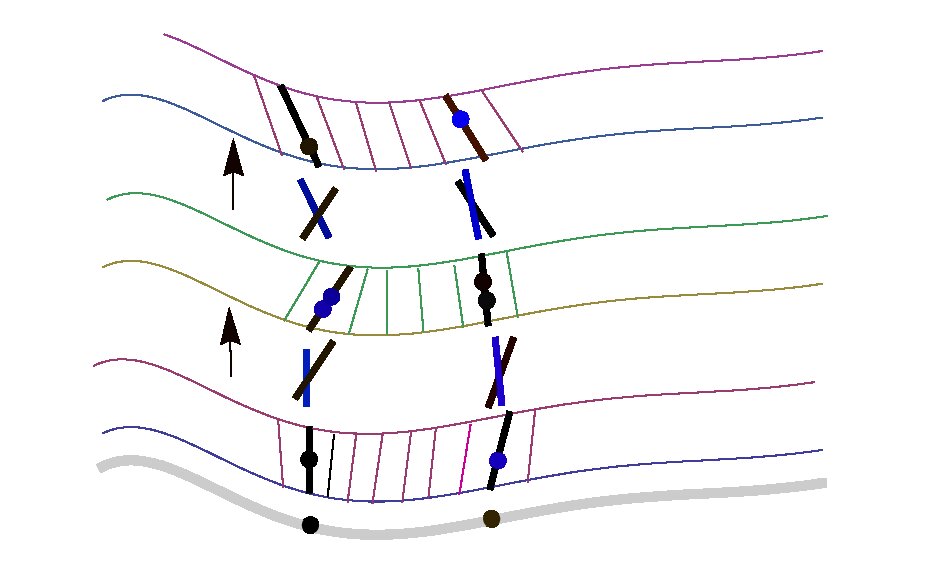 Figure 1
Peer Reviews
No public reviews on file for this paper yet. If you reviewed it on a platform where reviews are public (OpenReview, ICLR, NeurIPS, ICML), you can paste yours below so the community can read it here.
Videos
No videos yet. Explain this paper in a talk, walkthrough, or lecture? Add one.
Taxonomy
TopicsAlgebraic Geometry and Number Theory · Homotopy and Cohomology in Algebraic Topology · Geometric and Algebraic Topology
Elementary Transformations of Pfaffian Representations of Plane Curves
Anita Buckley
Department of Mathematics, University of Ljubljana, Jadranska 19, 1000 Ljubljana, Slovenia e-mail: [email protected]
Abstract.
Let be a smooth curve in given by an equation of degree . In this paper we consider elementary transformations of linear pfaffian representations of . Elementary transformations can be interpreted as actions on a rank 2 vector bundle on with canonical determinant and no sections, which corresponds to the cokernel of a pfaffian representation. Every two pfaffian representations of can be bridged by a finite sequence of elementary transformations. Pfaffian representations and elementary transformations are constructed explicitly. For a smooth quartic, applications to Aronhold bundles and theta characteristics are given.
1. Introduction
Let be an algebraically closed field and a nonsingular curve defined by an irreducible polynomial of degree in . A linear pfaffian representation of is a skew-symmetric matrix
[TABLE]
with linear forms such that
[TABLE]
Its cokernel is a rank 2 vector bundle on . Throughout the paper we equate the notion of vector bundles and locally free sheaves.
Two pfaffian representations and are equivalent if there exists such that
[TABLE]
There is a one to one correspondence between linear pfaffian representations (up to equivalence) of and rank 2 vector bundles (up to isomorphism) on with certain properties. This well known result is summed up in the following theorem of Beauville [3, Corollary 2.4].
Theorem 1.1**.**
Let be a smooth plane curve defined by a polynomial of degree and let be a rank 2 bundle on with determinant and . Then there exists a skew-symmetric linear matrix with and an exact sequence
[TABLE]
Conversely, let be a linear skew-symmetric matrix with . Then its cokernel is a a rank 2 bundle with and .
Using this, in [5] all linear pfaffian representations of (up to equivalence) were found and related to the moduli space of semistable rank vector bundles on with canonical determinant. In particular, pfaffian representations of can be parametrised by the open set . The properties of the moduli space were extensively studied in [18], [22] and [21]; for example it is an irreducible, normal projective variety and for of genus it has dimension .
Study of pfaffian representations is strongly related to and motivated by determinantal representations. A linear determinantal representation of is a matrix of linear forms such that
[TABLE]
Determinantal representations and are equivalent if there exists such that
[TABLE]
By [25] all linear determinantal representations of (up to equivalence) can be parametrised by the open set in the Jacobian variety
[TABLE]
Determinantal representations can be seen as a special case of pfaffian representations. Indeed, every determinantal representation induces a * decomposable pfaffian representation*
[TABLE]
The corresponding cokernel equals as described in [5] and [7]. In the moduli space, decomposable pfaffian representations correspond to an open subset of the singular locus of . Note that the equivalence relation is also well defined since
[TABLE]
Elementary transformations of determinantal representations were introduced by M. S. Livsic and Kravitsky in operator theory. Vinnikov et al generalised these ideas in [23], [2] using notions of vessels and Cauchy kernels. An explicit and complete description of elementary transformations of determinantal representations can be found in [24]. Elementary transformations of vector bundles are due to Maruyama [16]. For a modern exposition and proofs we refer to Abe [1]. The most traditional example of elementary transformations is that of ruled surfaces (i.e., of rank 2 bundles). A good reference on ruled surfaces is [11, Chapter V. 2].
Throughout the paper we will be using the following properties of the wedge product. It is well known that can be identified with skew-symmetric matrices. Let denote the set of vectors in , where
. Elements of are said to have irreducible length since they can be written as a sum of and not less than pure nonzero products. In [26] it is shown that is isomorphic to the set of all rank skew-symmetric matrices. The isomorphism equals
[TABLE]
where is the standard basis for and is the standard basis for matrices. Note that these are the Plücker coordinates in Gr.
A brief outline of the paper is the following. In section 2 we present pfaffian representations in canonical forms. This enables us to write an algorithm which computes all the pfaffian representations of and thus gives a description of . For suitable choices of vectors in the cokernel bundles discussed in Section 3, we define elementary transformations of pfaffian representations in Section 4. In Section 6 elementary transformations of pfaffian representations are related to elementary transformations of vector bundles. The main Theorem 7.3 in Section 7 proves that any two pfaffian representations can be bridged by a finite sequence of elementary transformations of Type I and II. In other words, we can explicitly construct all pfaffian representations of from a given one (for example, from a decomposable representation with symmetric blocks induced by one of the even theta characteristics). Section 8 is an exposition on plane quartics. Concrete examples and algorithms for computing Aronhold bundles and theta characteristics are given.
2. The Canonical Form
Canonical forms play an important role in explicit descriptions of the moduli space . In the sequel we outline an algorithm for such computation.
Let be a representation of . We can always assume that after a projective change of coordinates intersects the line in distinct points . We will prove that is equivalent to a representation in the canonical form.
Proposition 2.1**.**
For every pfaffian representation of there exists a basis of in which has the canonical form
[TABLE]
where
[TABLE]
Proof.
As above, let be distinct points in the intersection of with the line . By restricting to , we obtain the pencil of skew-symmetric matrices
[TABLE]
with . Since all the matrices in the representation are skew-symmetric, and define the same rank 2 vector bundle . Note that is the kernel of . Thus are -dimensional subspaces in . In the proof of [5, Proposition 3.4] we showed that implies the following important fact: the union of bases of the vector spaces span the whole space . In this basis is equivalent to
[TABLE]
where
[TABLE]
No block is identically equal to [math], otherwise the rank of at would be at most . ∎
Let be a representation of and its cokernel. Choose the basis of
[TABLE]
and denote by the change of basis matrix. Then acts on the representation by . Thus is equivalent to a representation in the canonical form by Proposition 2.1.
In [5] we established a one to one correspondence between the pfaffian representations (up to equivalence) of and the open set
[TABLE]
It thus suffices to find all pfaffian representations of in the canonical form, which will yield a set of equations describing the open subset (5) in the moduli space.
There are parameters in the representation (4), namely the entries of the skew-symmetric matrix . Since equals , we get relations among . Indeed, every monomial in gives one equation. By the implicit function theorem we are left with parameters . Recall that pfaffian representations are equivalent under the action
[TABLE]
By a suitable we can further reduce the number of parameters in . Of course we only consider whose action preserves the canonical form. This way we will reduce the number of equivalent representations in each equivalence class to 1. The following lemma is an elementary exercise in linear algebra.
Lemma 2.2**.**
The action preserves the canonical form of the first two matrices in the representation if and only if equals
[TABLE]
where every is an invertible matrix with determinant 1.
Matrix in Lemma 2.2 acts on the third matrix in the representation by
[TABLE]
In other words, view as matrix of blocks. Then acts on th block by . In every we have a choice of 3 independent parameters since its determinant is 1. Thus each reduces the number of ’s by 3.
For a general this sequence of reductions can be performed explicitly. We are left with
- [number of parameters in in the canonical form]
- [relations since ]
- [parameters reduced by the action of equivalence relation ]
independent variables . As expected, this represents the open subset (5) of the moduli space in .
Remark 2.3**.**
In the above considerations we could take any other canonical form of the matrix pair . For example, the equivalence relation action of
[TABLE]
brings the first two matrices in (4) into
[TABLE]
where is the diagonal matrix . This canonical form is particularly useful since it naturally includes all the decomposable representations (2). The same canonical form was obtained in [12] , where canonical forms for matrix pairs were classified purely by the methods of linear algebra.
3. Tangents
In this section we explain how tangents or lines through two points on can be read from pfaffian representations. Moreover, for any pfaffian representation we relate vectors in and .
Since our aim is to do concrete calculations, we describe the correspondence in Theorem 1.1 explicitly: Denote by the pfaffian of the skew-symmetric matrix obtained by removing the th and th rows and columns from . It is easy to prove the following analogue of the Jacobi’s formula for the derivative of determinants:
[TABLE]
If for some all pfaffian minors vanish, then must be a singular point of . By our assumption is smooth, thus for all . Rank of skew-symmetric matrices is even and thus equality holds. Therefore defines a bundle over . Define the pfaffian adjoint of to be the skew-symmetric matrix
[TABLE]
Again, by analogy with determinants, the following holds
[TABLE]
More properties and linear algebra of pfaffians can be found in [10, Appendix D].
Since , the cokernel can be obtained from by using (8). Indeed, for any point every column (or row) of is in . Since is a skew-symmetric matrix with linear entries, we have
[TABLE]
which we denote by . We will often view as a –bundle, or equivalently as a ruled surface .
Lemma 3.1**.**
Every representation of yields tangents and lines through in the following way:
- •
Let be independent vectors. Then is either identically [math] or defines a line through and .
- •
Let . Then is an equation of the tangent line at .
- •
Analogously, for the equation defines the tangent at .
Proof.
The first assertion is obvious as is linear and equals [math] at the points and .
By (8), is a rank 2 skew-symmetric matrix at the points of . Using the Plücker coordinates in (3), equals to a multiple of . Then by (7)
[TABLE]
which equals to a nonzero multiple of In particular we proved that is not identically [math].
The same way we obtain the tangent to at . ∎
can be viewed as pairs of independent vectors modulo right–hand–side multiplications by invertible matrices. Then can be chosen so that
[TABLE]
equals either
[TABLE]
This enables us to relate points on . A distinct pair of points on with respect to representation is either:
- •
inadmissible if on for all ;
- •
semiadmissible if there exists a unique pair of vectors such that and for all ;
- •
admissible if for every there exists exactly one for which on the whole .
For admissible we thus obtain a one to one correspondence between vectors in and . Namely, corresponds to iff . Consider next a semiadmissible pair and . We claim that if and only if either or . Indeed, assume that , then by linearity for any . Thus by uniqueness in the definition .
In the proof of Lemma 3.1 we showed
Corollary 3.2**.**
A bitangent line through is defined by either , or .
Corollary 3.3**.**
Let . Then if and only if .
This means that can be always considered as an admissible pair of points on .
4. Elementary Transformations
In this section we define elementary transformations of pfaffian representations of the curve in , which is not necessarily smooth or irreducible. The standard notation of vessels [2] will be used.
Choose the coordinates of so that the line and the curve intersect in distinct smooth points. For the sake of clearer notation we move to the affine plane. Consider a linear pfaffian representation
[TABLE]
where are the affine coordinates and are skew-symmetric matrices. Denote
[TABLE]
by .
Pick distinct regular affine points and on . Then each is a 2 dimensional vector space in . For all
[TABLE]
and
[TABLE]
hold. Thus
[TABLE]
which implies
[TABLE]
In other words, for any pair of complex parameters ,
[TABLE]
is constant whenever the denominator is nonzero. Denote this constant by .
The pair of vectors is called admissible if is not 0. Define
[TABLE]
and
[TABLE]
where and are rank 1 matrices and is an arbitrary constant. It is obvious that and are skew-symmetric.
In the sequel the following properties of the wedge product will be useful: for any skew-symmetric matrix and vectors holds and .
Using the above, rewrites into
[TABLE]
and rewrites into
[TABLE]
Theorem 4.1**.**
Let be a representation of and its cokernel. Choose such that . Then and are pfaffian representations of since
[TABLE]
Proof.
For any and skew-symmetric holds
[TABLE]
by [10, Appendix D]. Recall also that for any two square matrices
[TABLE]
Therefore proving the equality
[TABLE]
will imply the first statement. (15) equals
[TABLE]
From (12) we obtain that
[TABLE]
Analogously
[TABLE]
Together with (10) this implies
[TABLE]
and
[TABLE]
In other words, and , where .
Now it is easy to verify that
[TABLE]
which together with (10) and (17) finishes the proof of (15).
The second statement will be proved if we show
[TABLE]
Note that
[TABLE]
implies
[TABLE]
This means that , where denotes the cokernel of .
The above and the obvious equality
[TABLE]
finish the proof of (18). ∎
By performing elementary transformations of , we constructed new pfaffian representations of :
Definition 4.2**.**
The Type I elementary transformation based on the admissible vectors ,
The Type II elementary transformation based on and the constant .
The fact that and implies the following
Corollary 4.3**.**
The Type I elementary transformation of based on brings us back to . The same way the Type II elementary transformation of based on and brings us back to .
It can be easily seen that the Type I and II elementary transformations are special rank 2 cases of ”the concrete interpolation problem for meromorphic bundle maps” studied in [2]: For a given array of constants , distinct points and vectors define the Type CONINT elementary transformation of by
[TABLE]
where and equals the symmetric matrix with ’s along the diagonal and at the –th position. Then is indeed a pfaffian representation of since for
[TABLE]
An easy exercise in linear algebra shows that
[TABLE]
and . Observe that the only condition for to exist is that is invertible.
In Section 7 we will show that any two pfaffian representations of can be bridged by a finite sequence of Type I and Type II elementary transformations. Thus it is enough to restrict our study to these two types.
5. Admissible arrays
We briefly relate the definitions of admissible pairs of points and admissible pairs of vectors. Let
[TABLE]
be a representation of with the cokernel . As before, let for distinct . We claim that
[TABLE]
Indeed, implies