SUSY radiative corrections on mu-tau neutrino refraction including possible R-parity breaking interactions
J. Gava, C.-C. Jean-Louis

TL;DR
This study explores one-loop radiative corrections to neutrino refraction indices within supersymmetric models, especially NMSSM, highlighting the impact of R-parity breaking and CP-violation on supernova neutrino fluxes.
Contribution
It provides a detailed analysis of SUSY parameter space effects on neutrino refraction, emphasizing differences between R-parity conserved and broken scenarios, and links CP-violation to supernova neutrino observations.
Findings
R-parity breaking significantly alters SUSY contributions to neutrino refraction.
Certain SUSY parameter regions yield notable V_{mu tau} values.
CP-violation effects are analytically connected to V_{mu tau} in supernova neutrino fluxes.
Abstract
In this paper we investigate the one-loop radiative corrections to the neutrino indices of refraction from supersymmetric models. We consider the Next-to Minimal Supersymmetric extension of the Standard Model (NMSSM) which happens to be a better supersymmetric candidate than the MSSM for both theoretical and experimental reasons. We scan the relevant SUSY parameters and identify regions in the parameter space which yield interesting values for V_{mu tau}. If R-parity is broken there are significant differences between MSSM and NMSSM contributions contrary to the R-parity conserved case. Finally, for a non-zero CP-violating phase, we show analytically that the presence of V_{mu tau} will explicitly imply CP-violation effects on the supernova electron (anti-) neutrino fluxes.
Click any figure to enlarge with its caption.
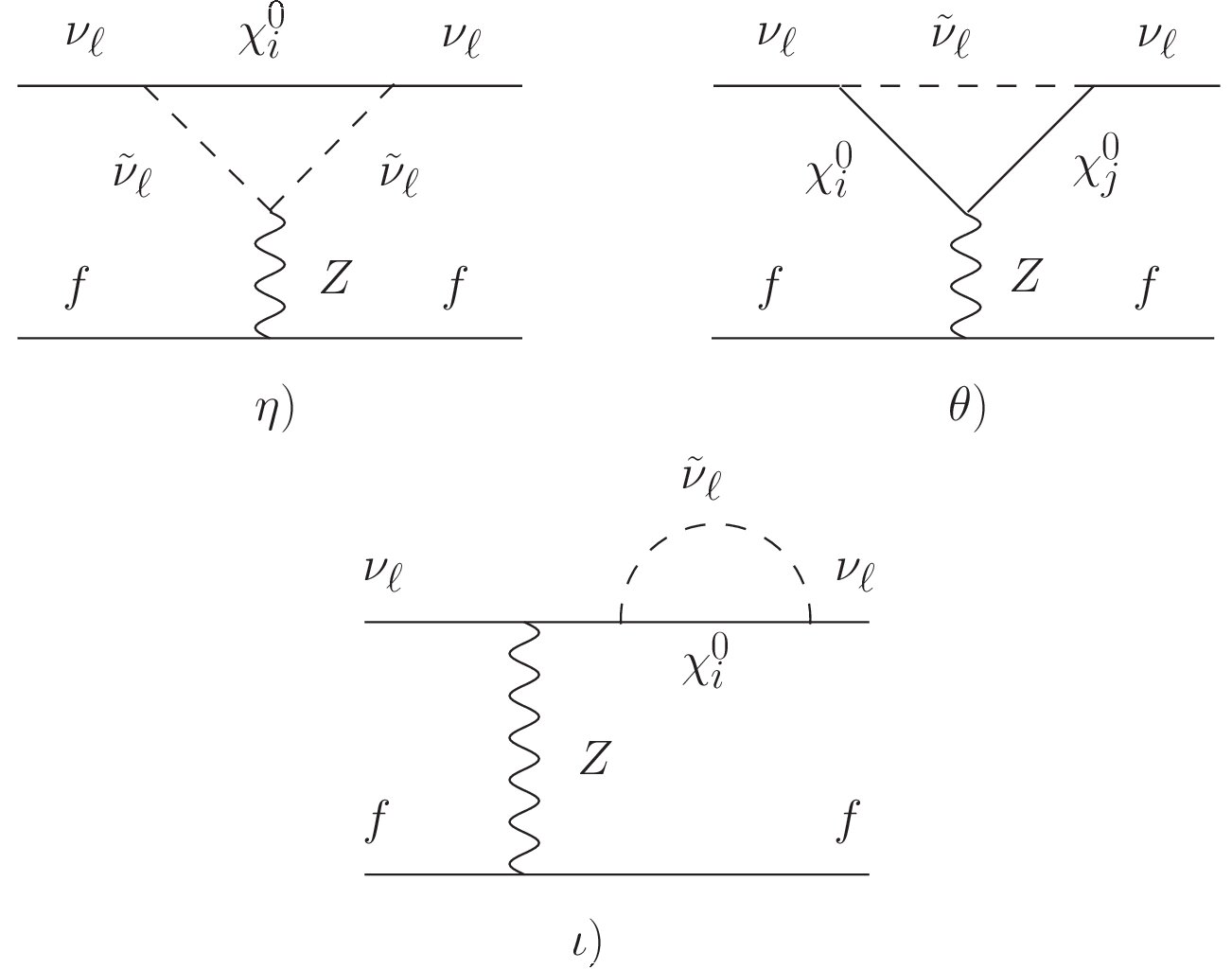 Figure 1
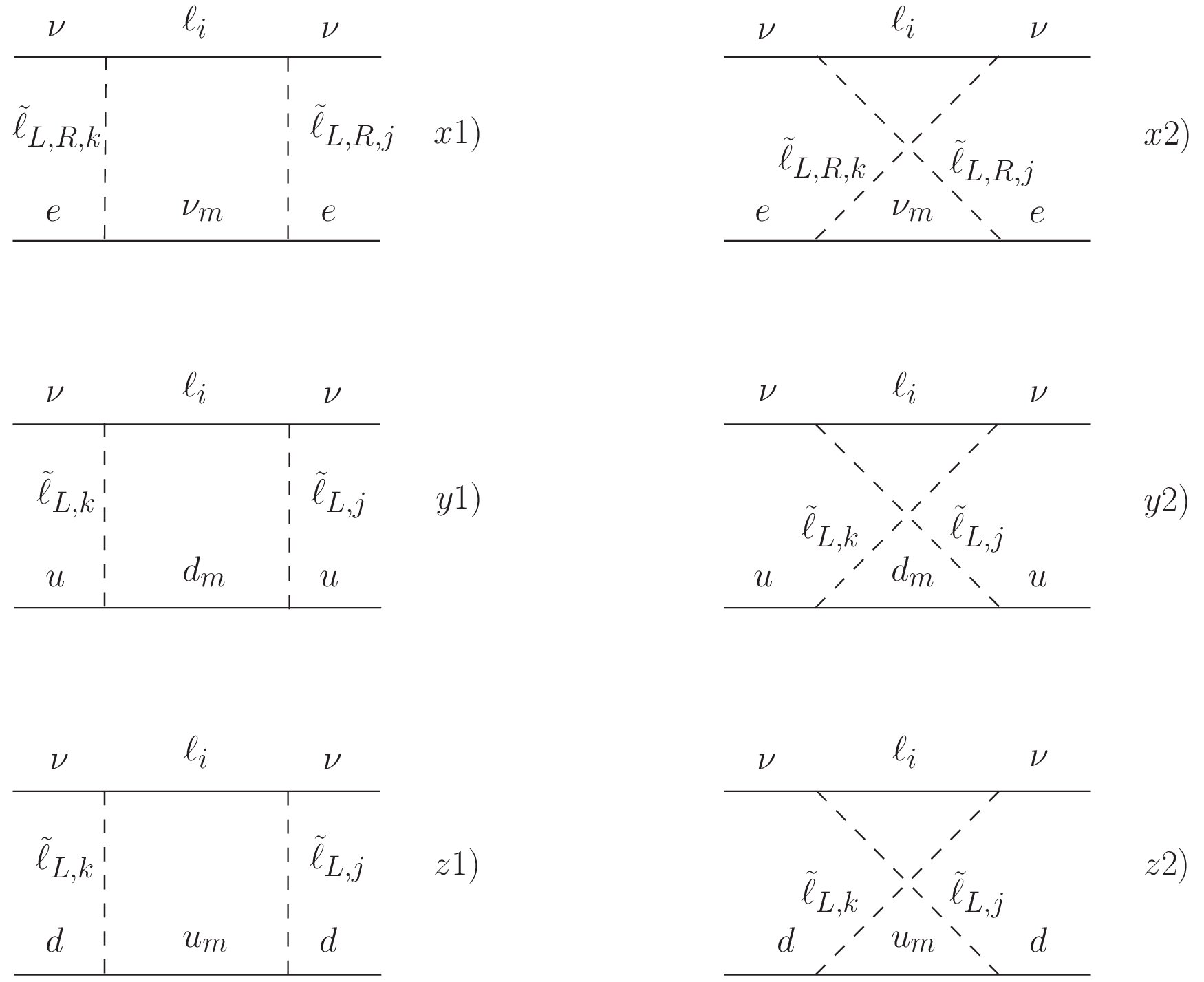 Figure 2
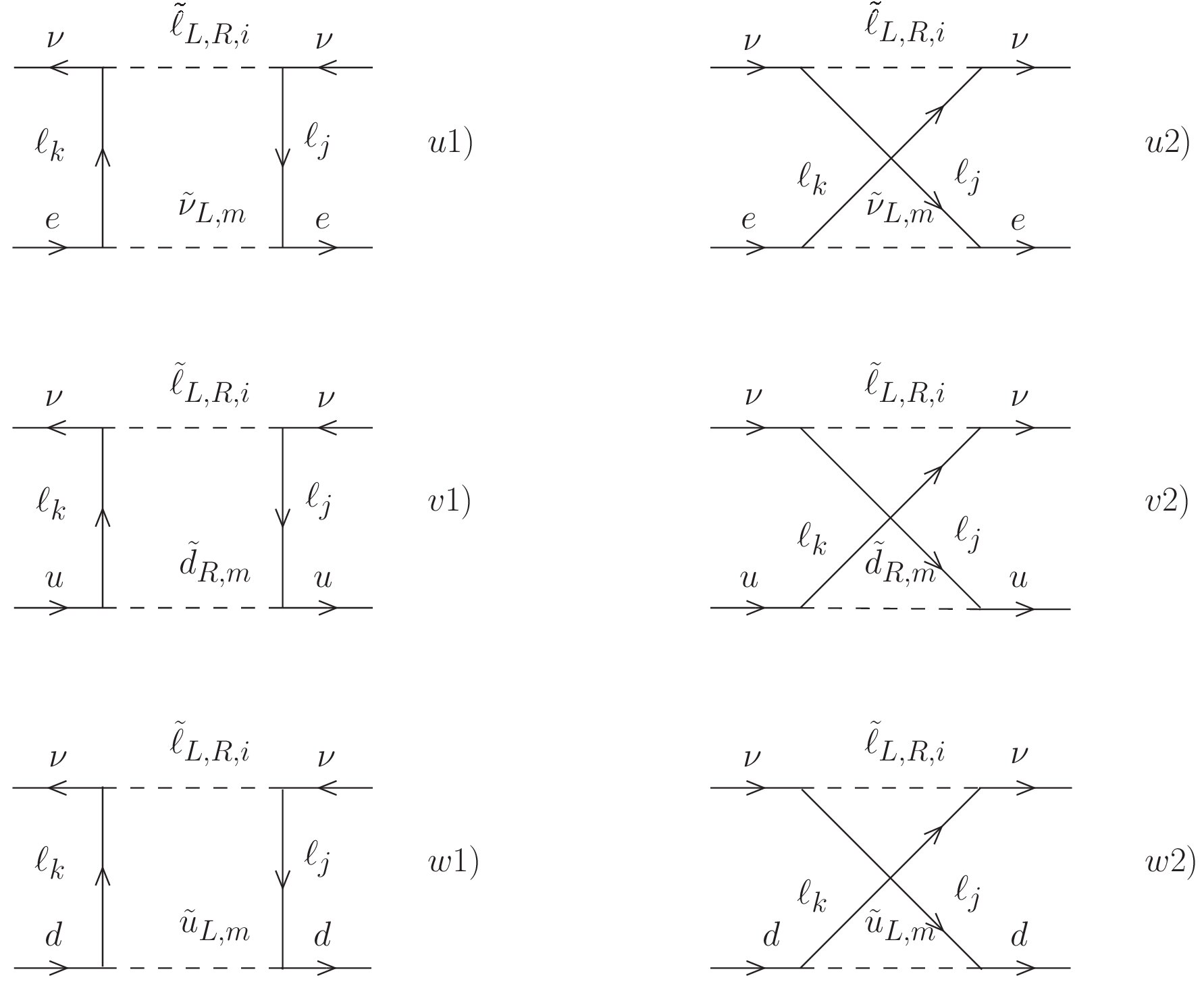 Figure 3
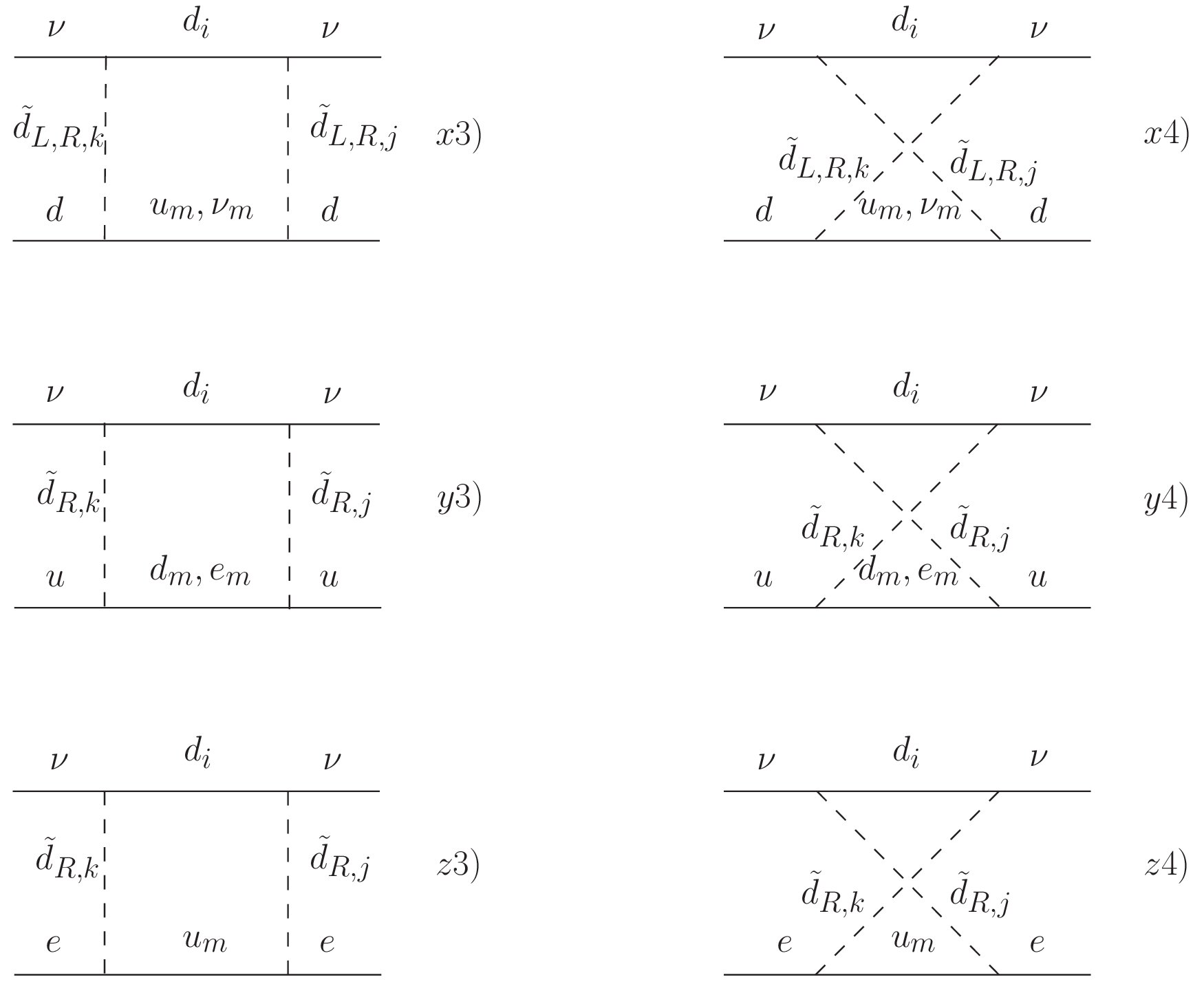 Figure 4
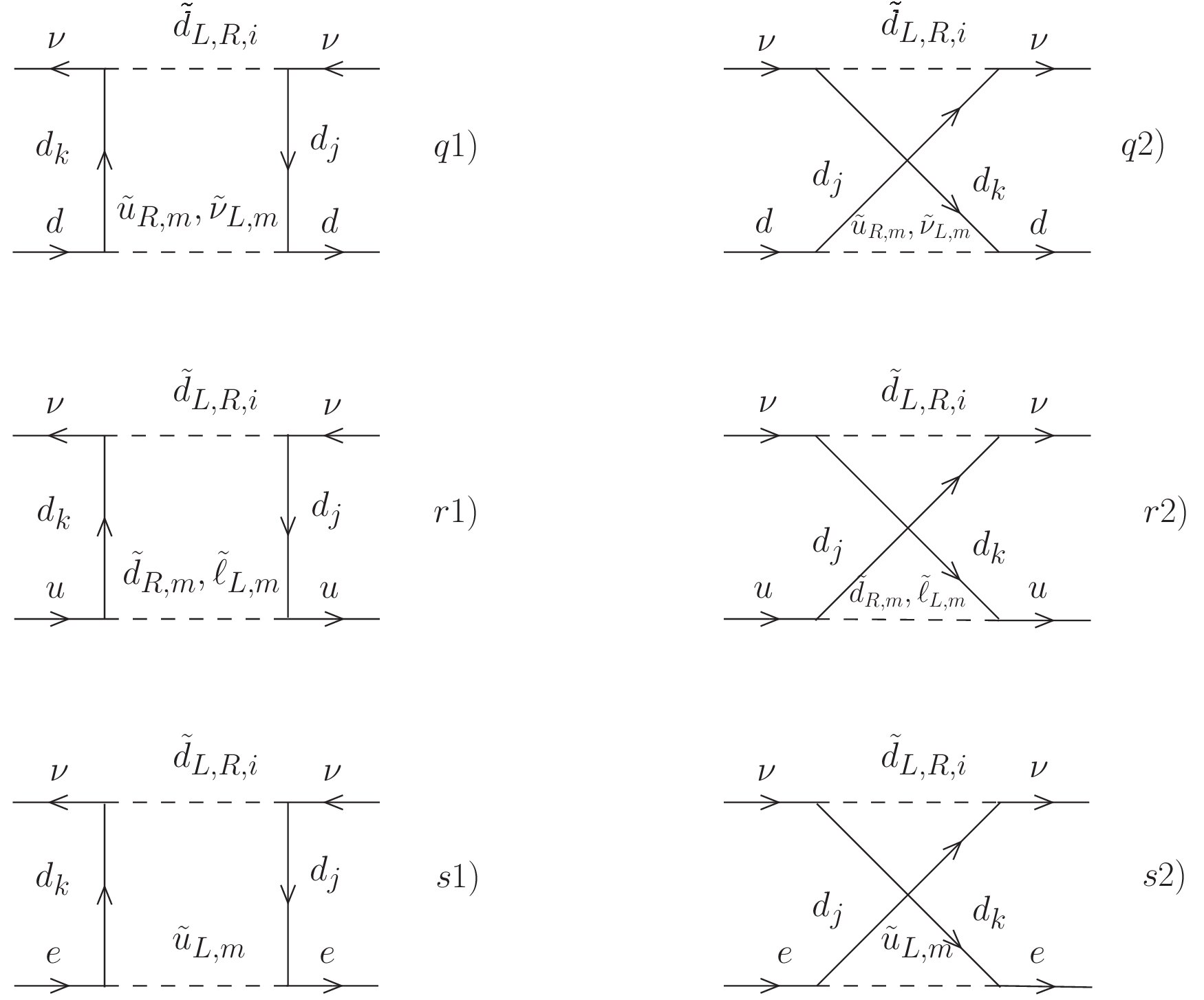 Figure 5
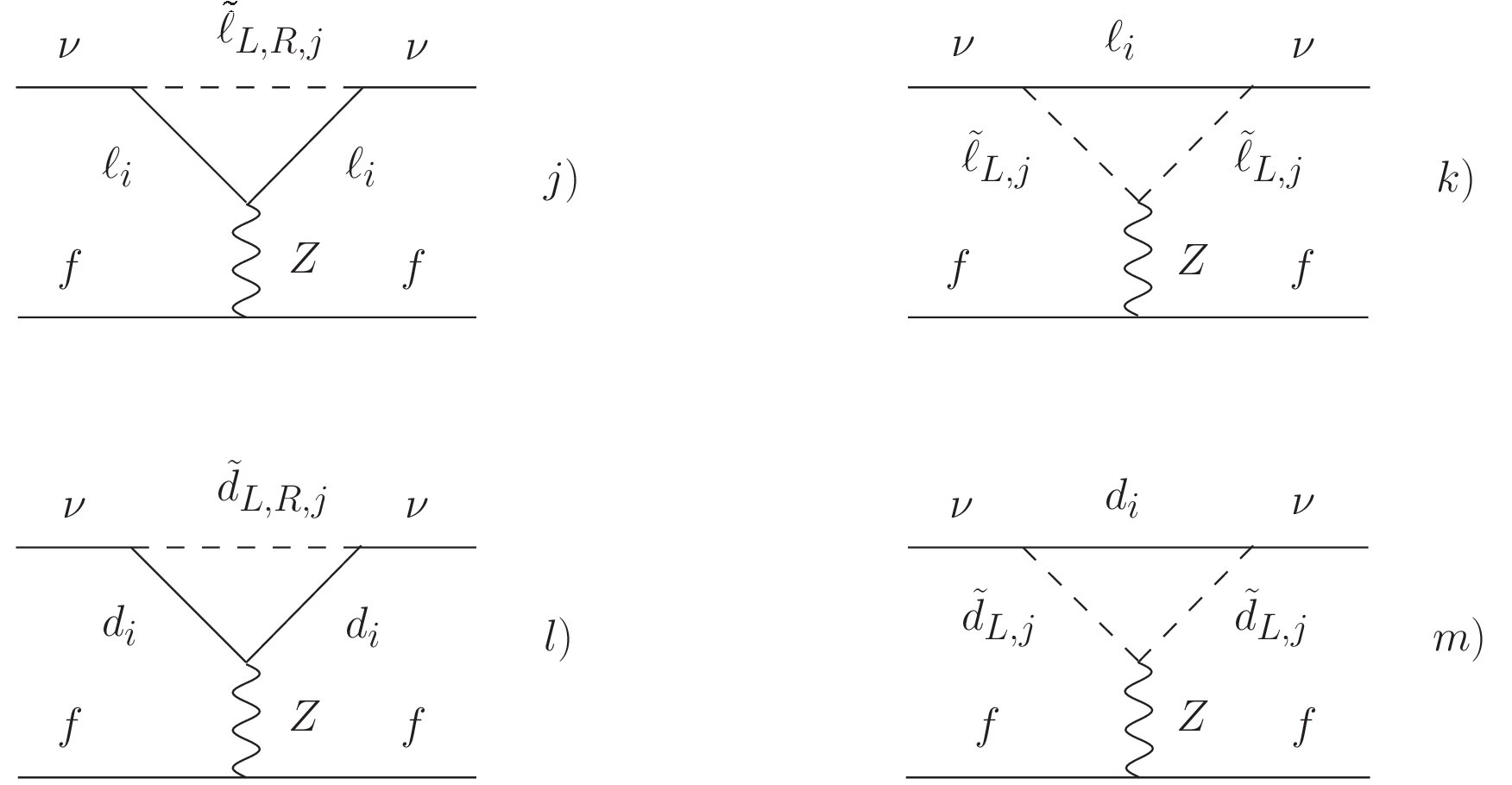 Figure 6
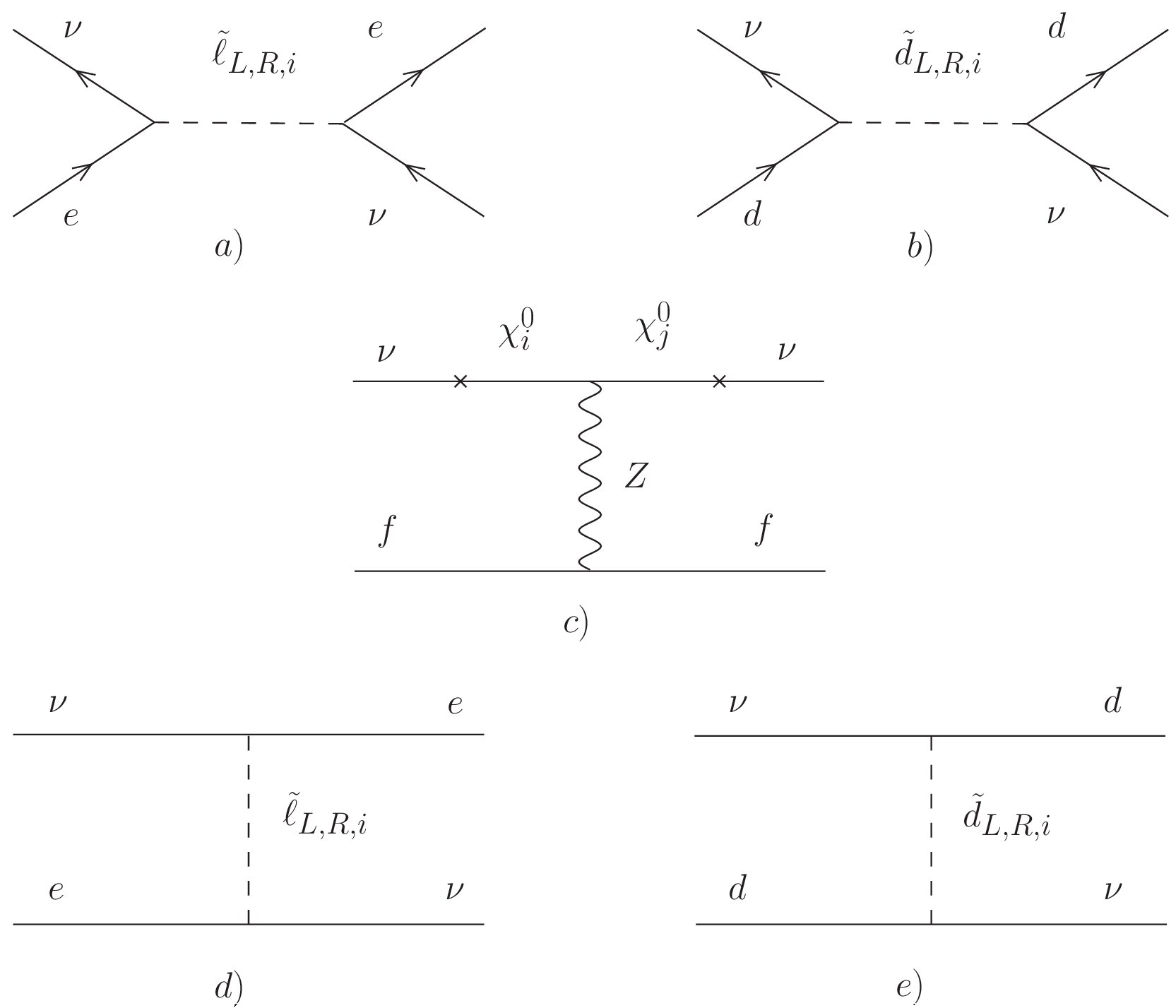 Figure 7
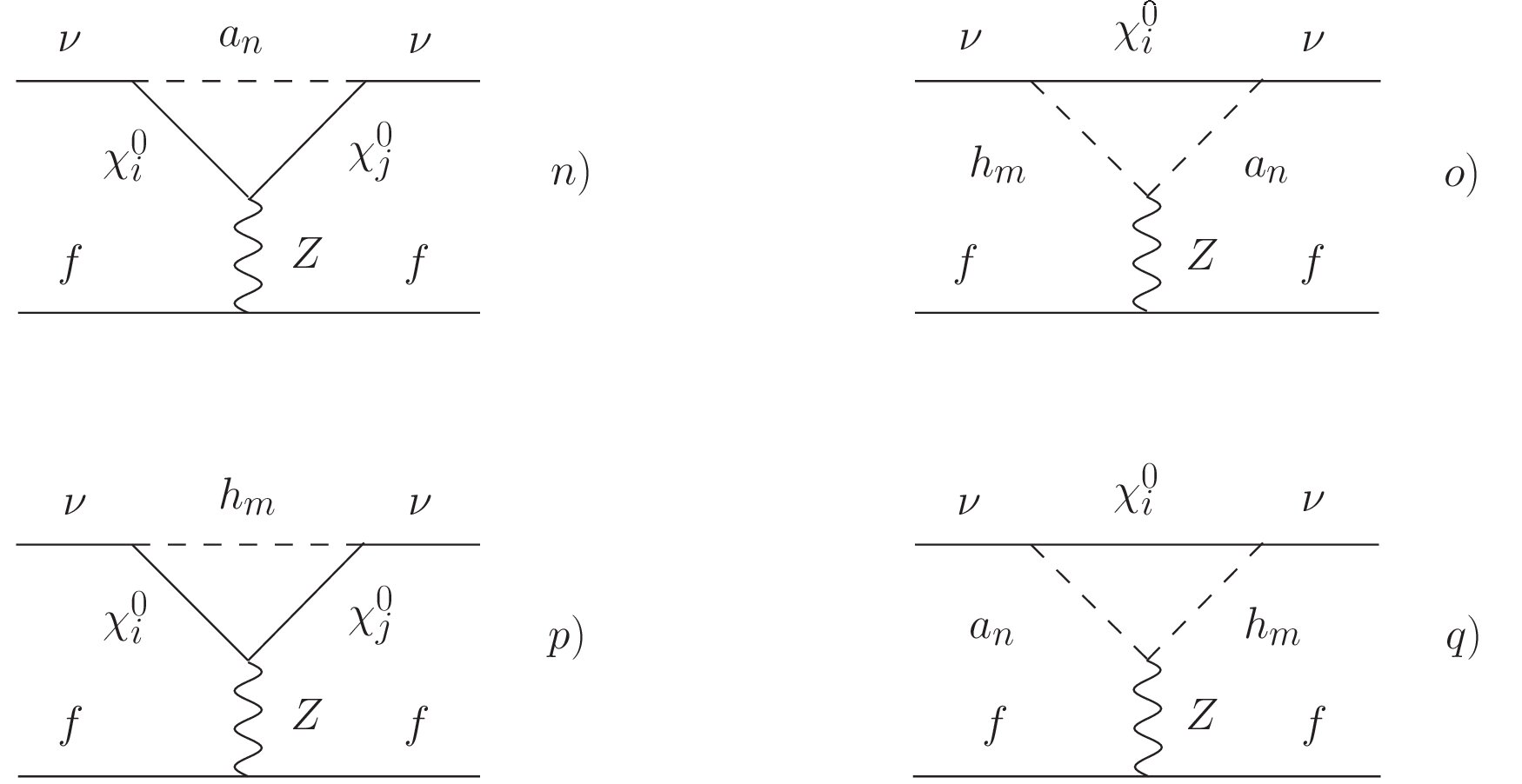 Figure 8
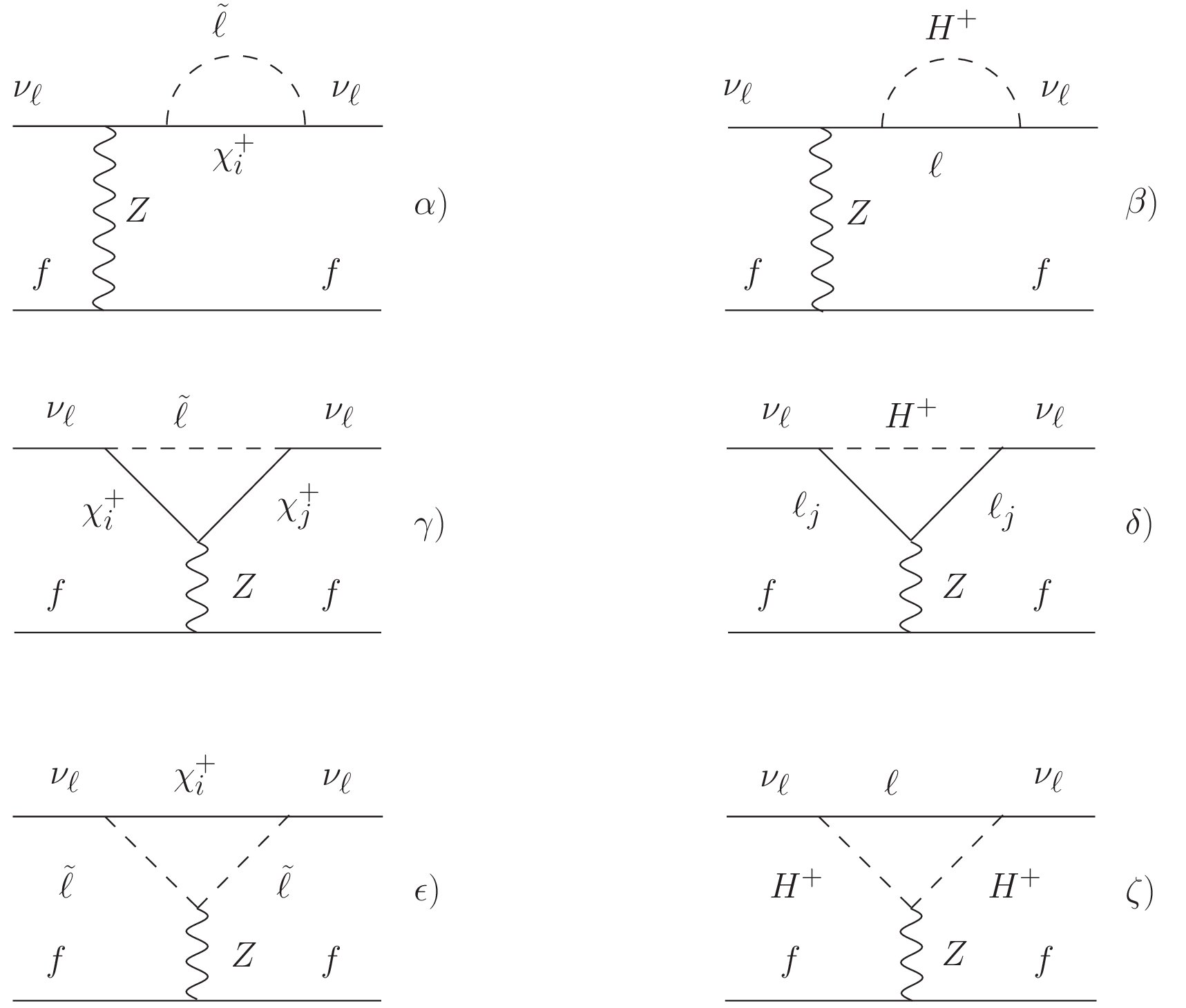 Figure 9
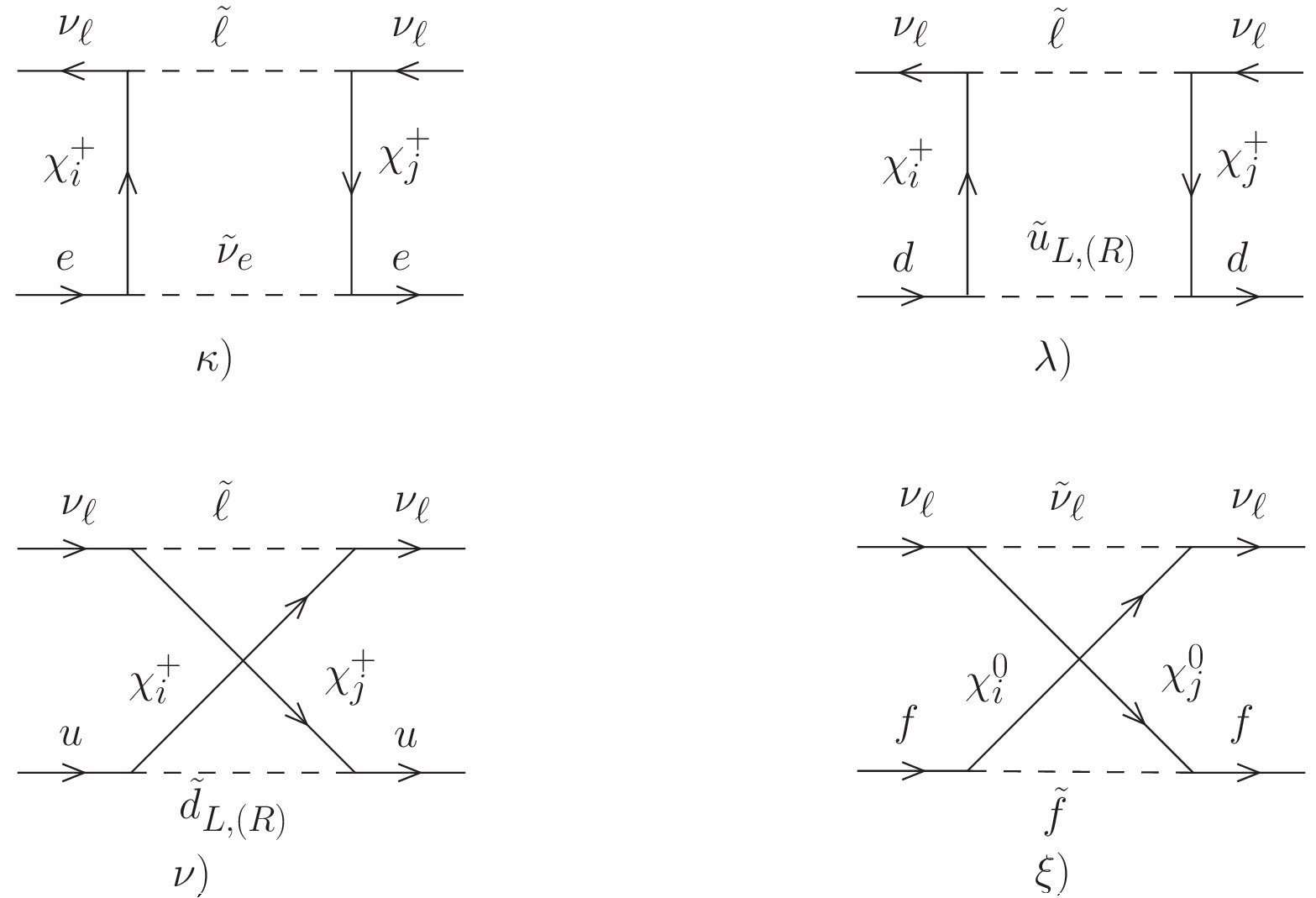 Figure 10
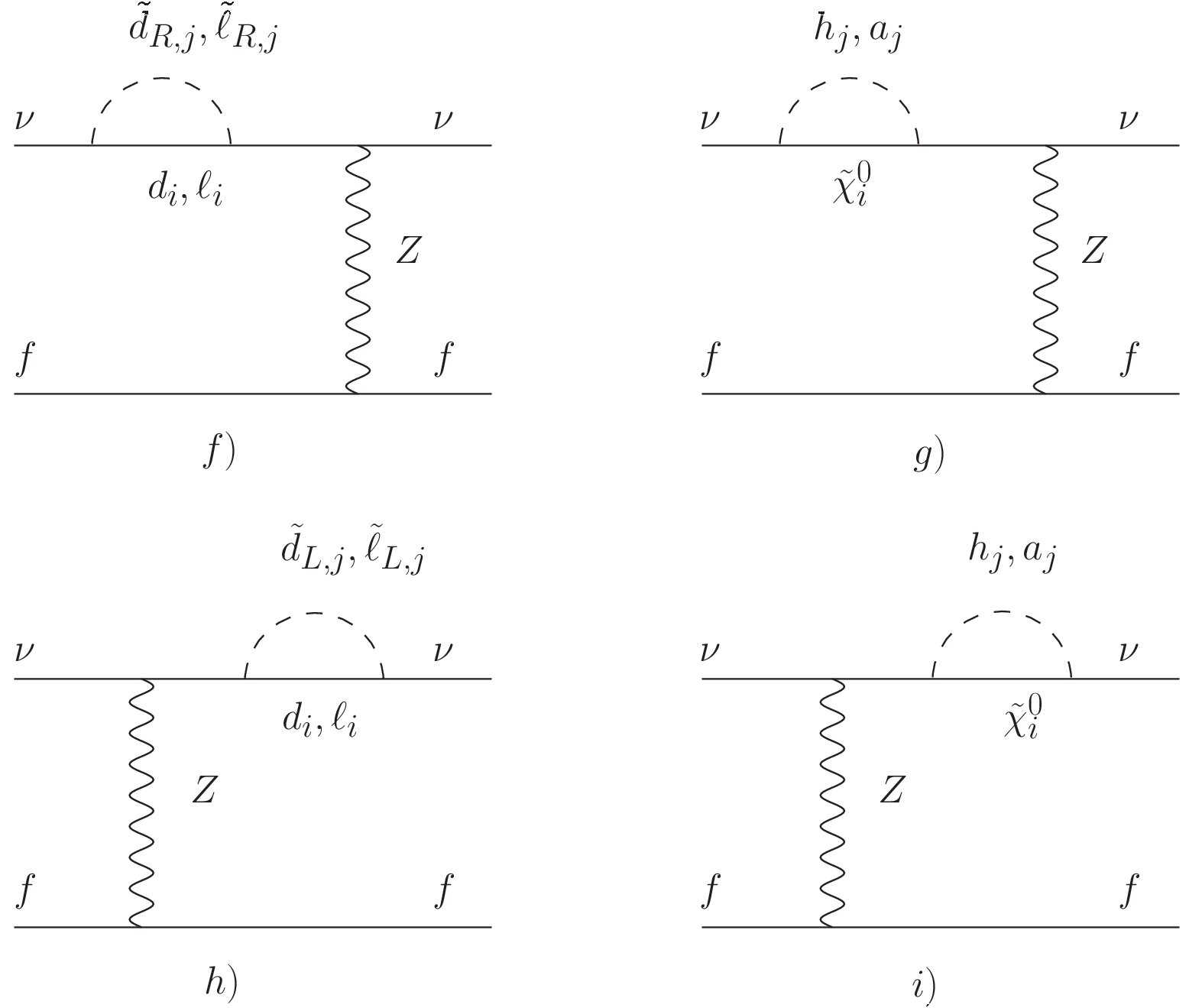 Figure 11
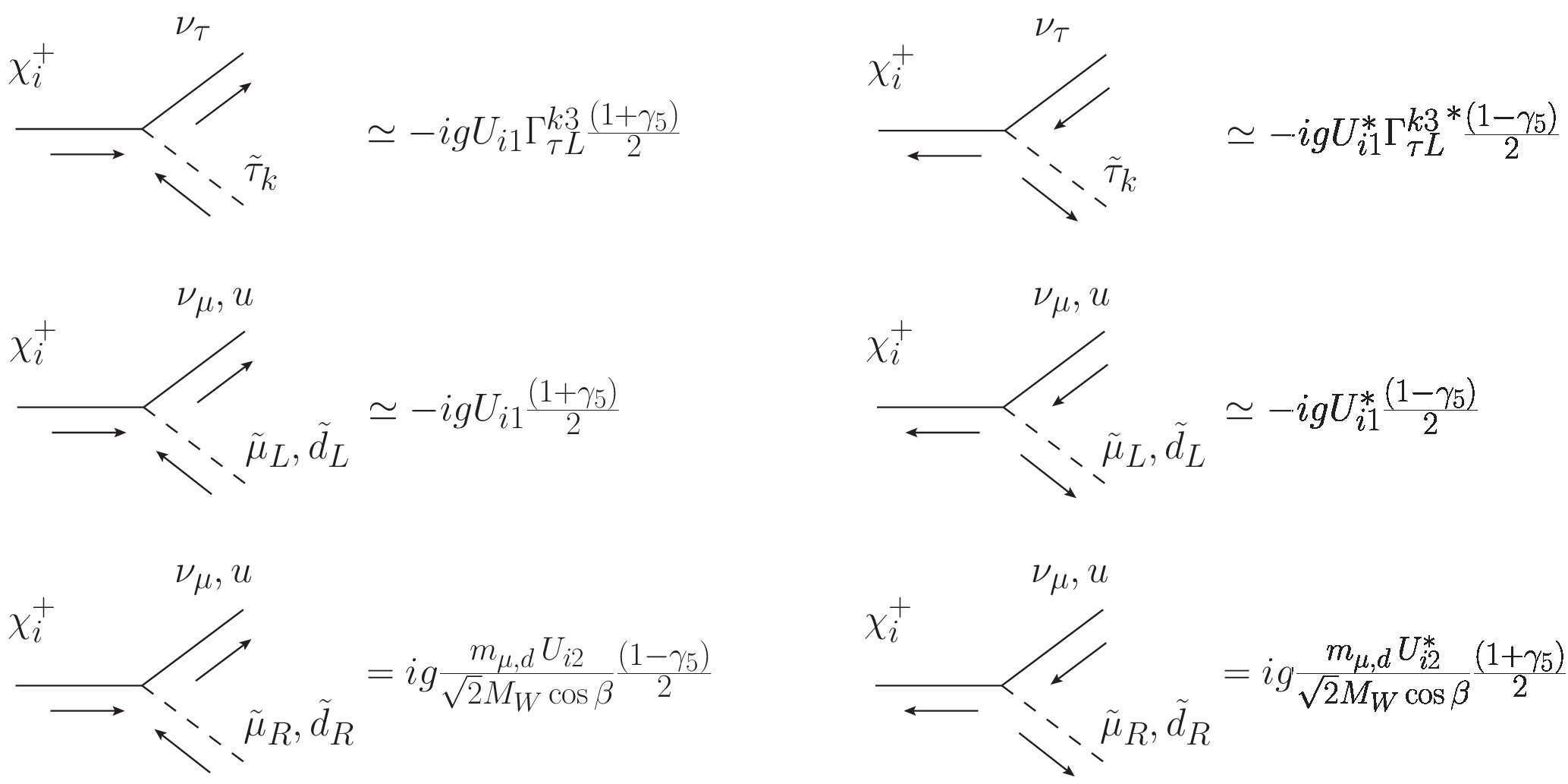 Figure 12
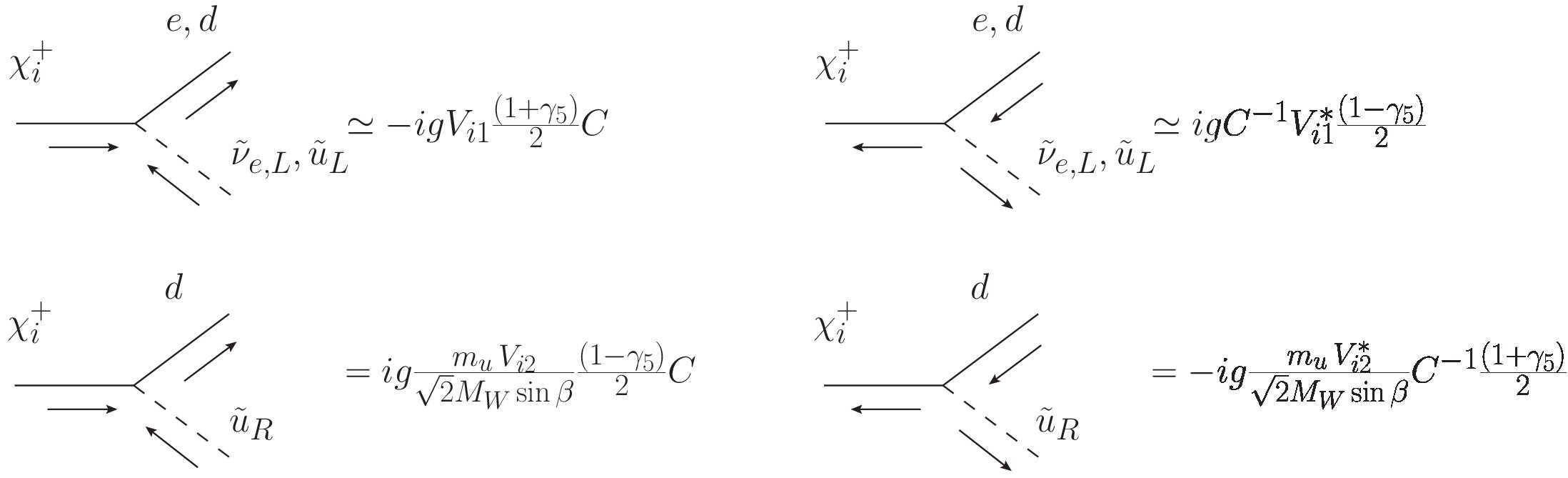 Figure 13
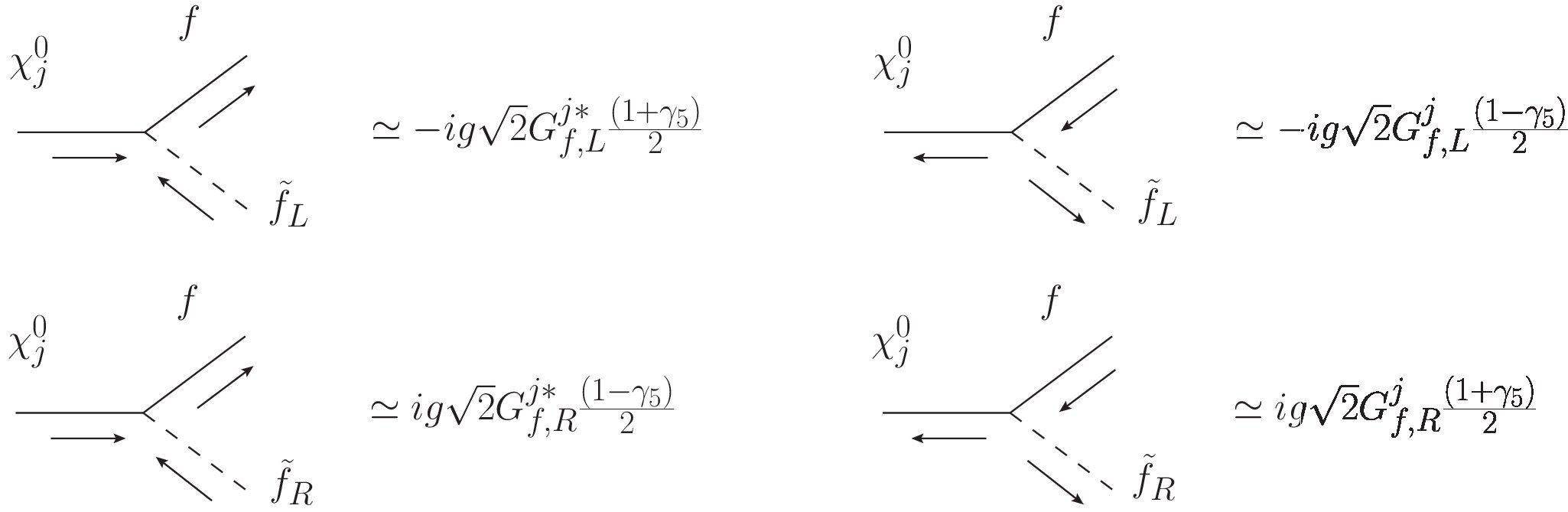 Figure 14
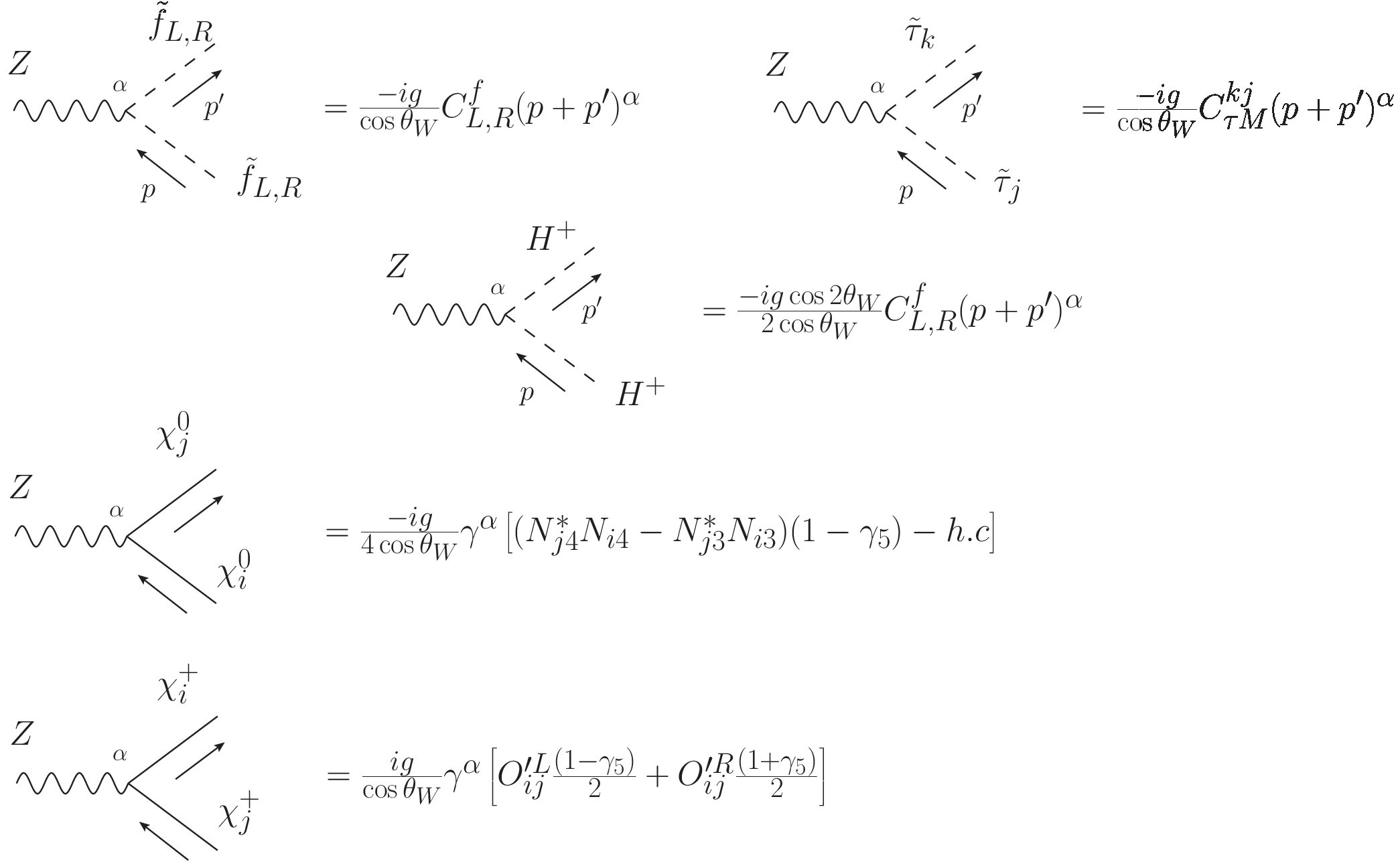 Figure 15
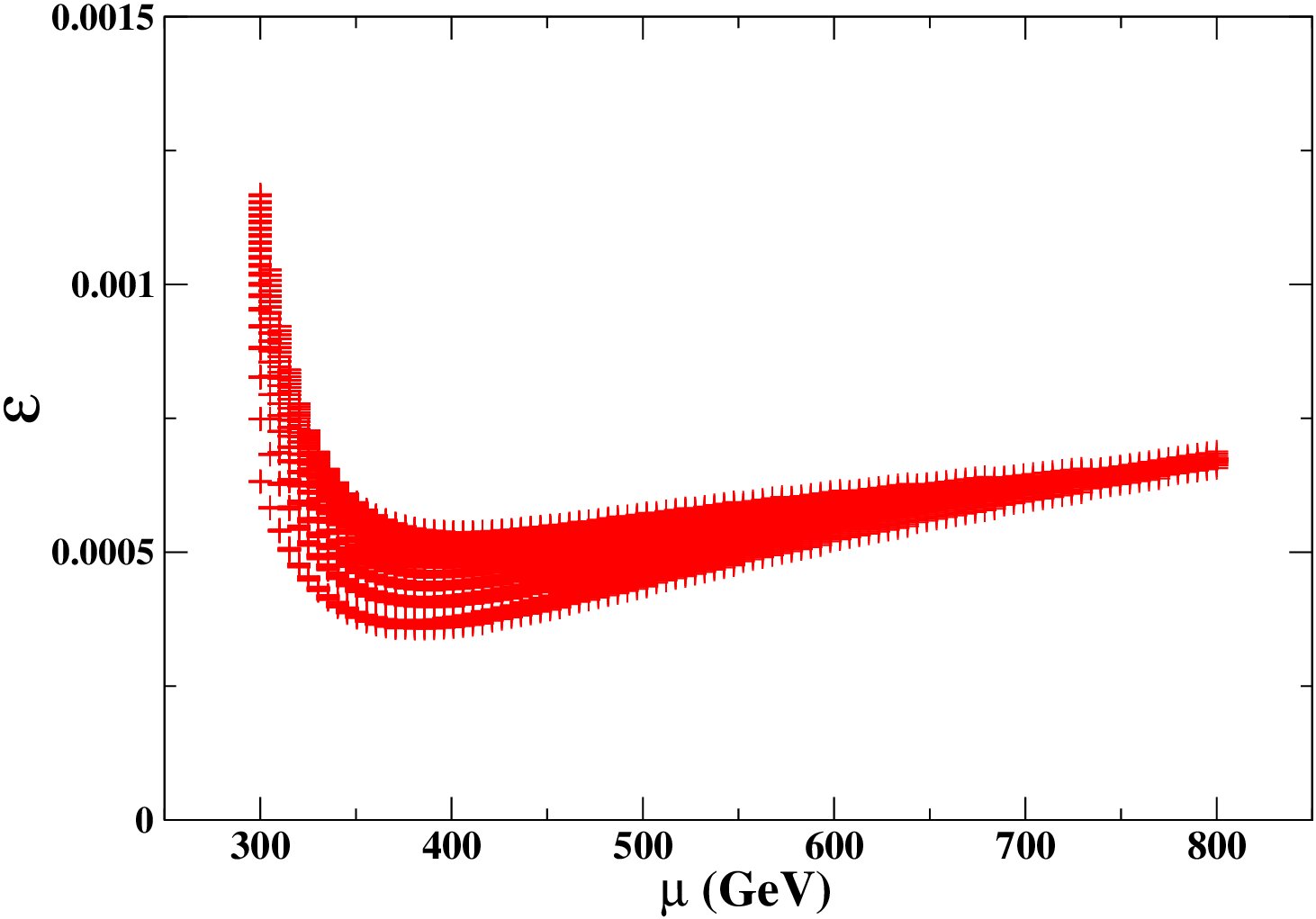 Figure 16
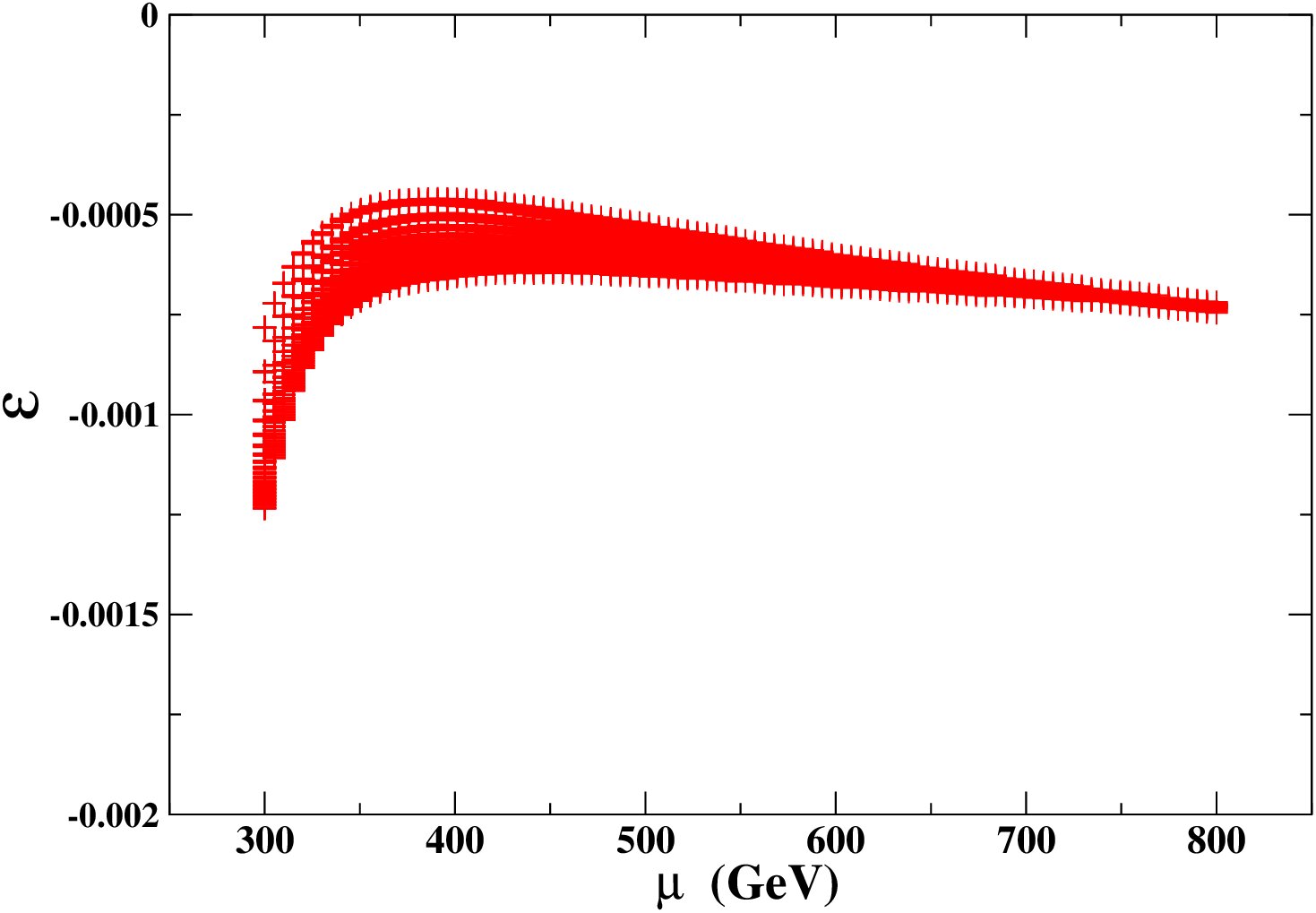 Figure 17
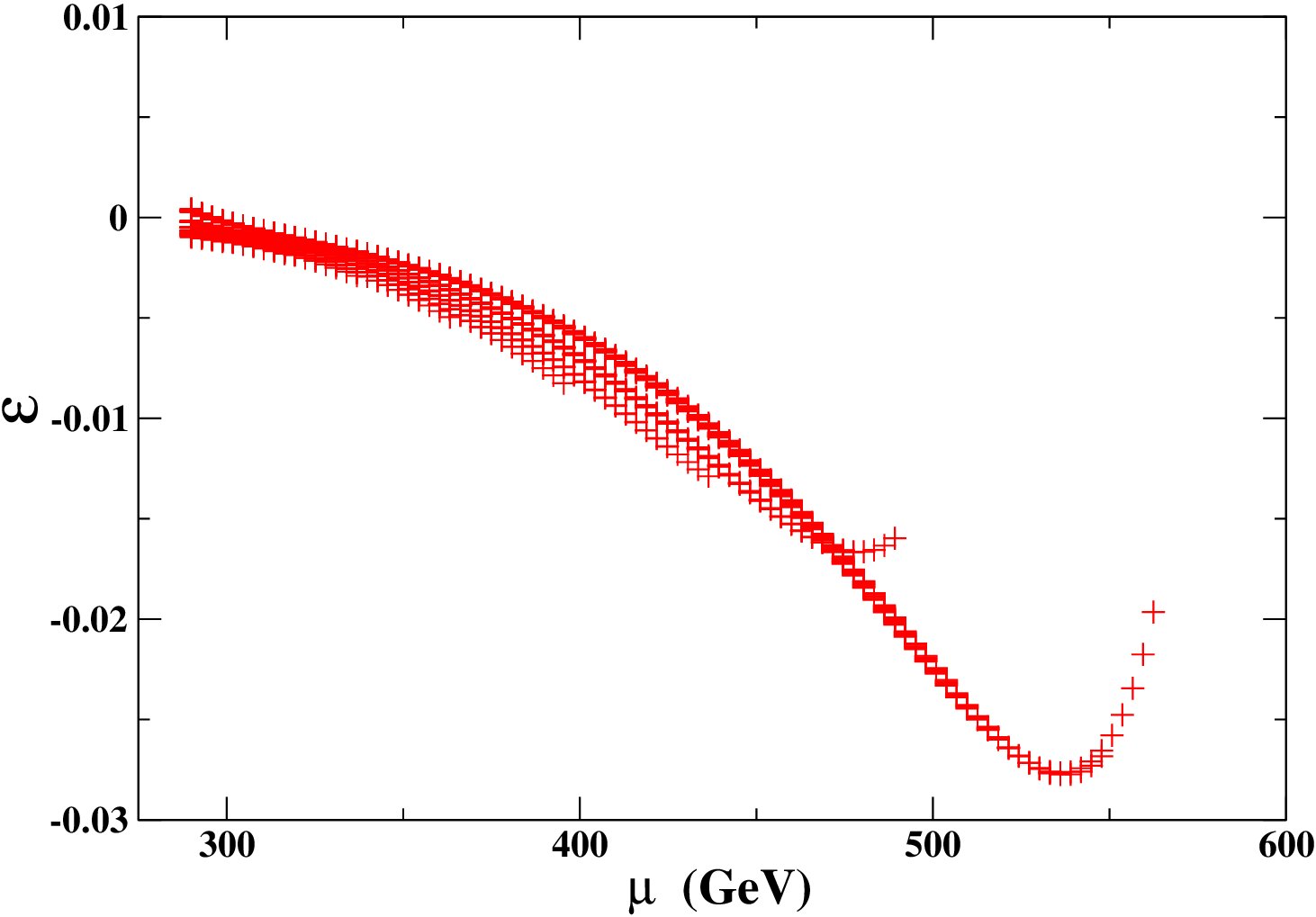 Figure 18
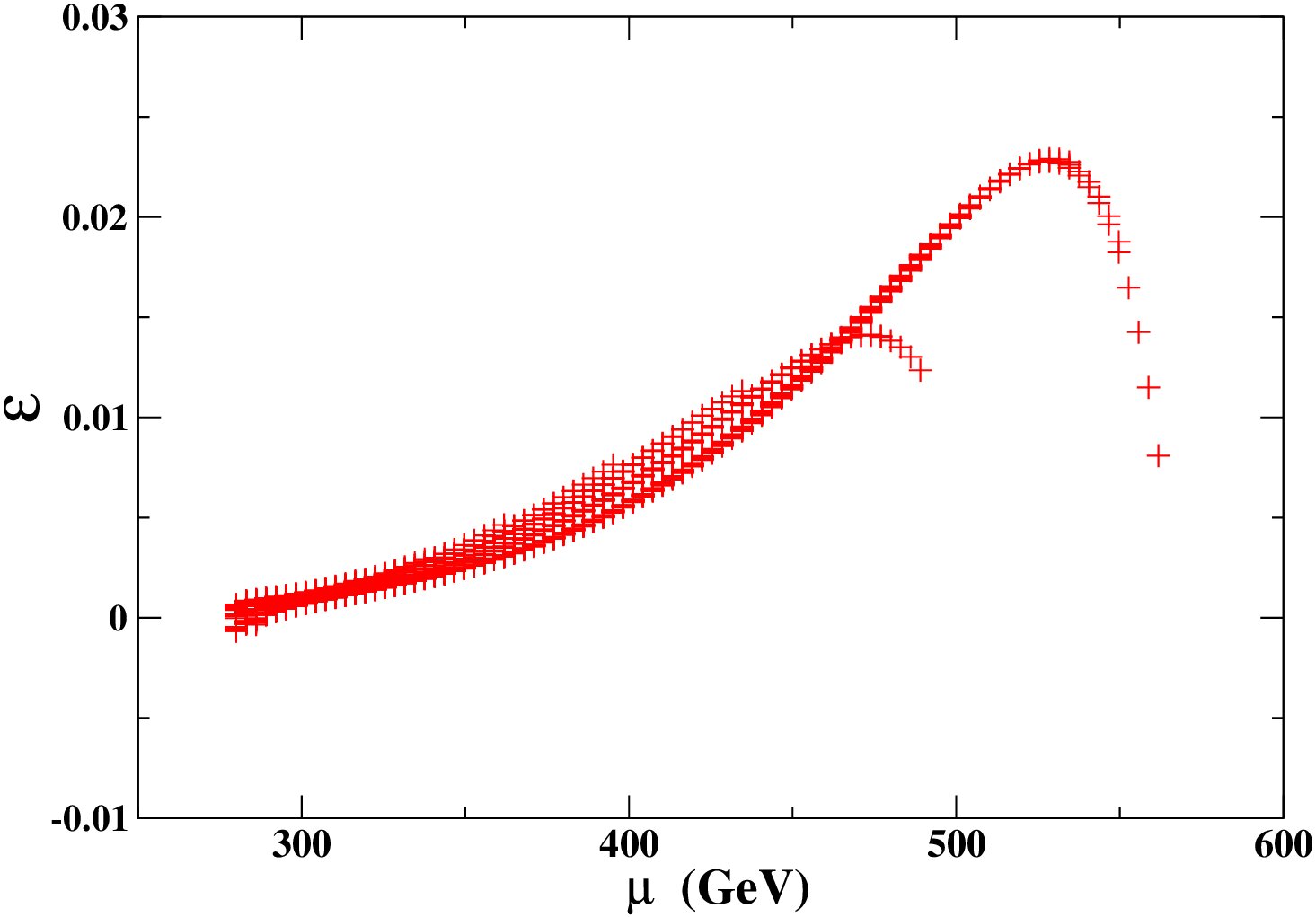 Figure 19
Peer Reviews
No public reviews on file for this paper yet. If you reviewed it on a platform where reviews are public (OpenReview, ICLR, NeurIPS, ICML), you can paste yours below so the community can read it here.
Videos
No videos yet. Explain this paper in a talk, walkthrough, or lecture? Add one.
SUSY radiative corrections on neutrino refraction including possible R-parity breaking interactions
J. Gava
Institut de Physique Nucléaire, CNRS/IN2P3 UMR 8608 and Université Paris-Sud 11, Bât. 100,
F-91406 Orsay cedex, France
C.-C. Jean-Louis
Laboratoire de Physique Théorique, CNRS UMR 8627, Bât. 210, Université Paris-Sud 11, 91405 Orsay Cedex, France
(22th July 2009)
Abstract
In this paper we investigate the one-loop radiative corrections to the neutrino indices of refraction from supersymmetric models. We consider the Next-to Minimal Supersymmetric extension of the Standard Model (NMSSM) which happens to be a better supersymmetric candidate than the MSSM for both theoretical and experimental reasons. We scan the relevant SUSY parameters and identify regions in the parameter space which yield interesting values for . If R-parity is broken there are significant differences between MSSM and NMSSM contributions contrary to the R-parity conserved case. Finally, for a non-zero CP-violating phase, we show analytically that the presence of will explicitly imply CP-violation effects on the supernova electron (anti-) neutrino fluxes.
Core-collapse Supernova, Neutrino Physics, Supersymmetry, R-parity violation
pacs:
14.60.Pq, 11.30.Pb, 97.60.Bw, 11.30.Er, 11.30.Fs
I Introduction
The charged current interaction between neutrinos and their associated leptons in medium give an effective matter potential which can lead to a resonant flavour conversion called the Mikheyev-Smirnov-Wolfenstein (MSW) effect Wolfenstein:1977ue ; Mikheev:1986wj . Such behaviour solves elegantly the solar neutrino deficit problem first pointed out by pioneering experiment of R. Davis in the 60’s Davis:1964aa . Such phenomenon is of crucial importance for the propagation of neutrinos in the supernova environment whose flux detection could yield precious information concerning the dynamics of the density profile or fundamental neutrinos properties like the hierarchy or the value of the third mixing angle. In supernovae, depending on the mass hierarchy, the electron neutrino may encounter one or two resonances via charged current, while the muon or tau neutrinos will only interact via neutral current, indistinguishably at the tree level in the Standard Model (SM). Indeed, due to the absence of muon or tau particle in such environment, coherent forward scattering may only intervene via neutral current to which all flavours are sensitive. Considering that matter interaction can also be seen as neutrino index of refraction Langacker:1983bc ; Lewis:1980ab , Botella et al. Botella:1986wy , after showing that correction at were negligible in the case of a neutral medium Sehgal:1985bc , proved that differences at one-loop in the neutrino index of refraction could arise for muon and tau neutrinos at order . Later, supersymmetric radiative corrections, in the case of the minimal supersymmetric model (MSSM) has been partially calculated Roulet:1995ef showing that it could give potentially much larger radiative effects than in the SM. It is interesting to note that such radiative corrections have been for a longtime considered as negligible or without observable consequences for the supernova environment. Such consideration was probably true when not taking into account the neutrino-neutrino interaction which has dramatically changed the vision we have of neutrino propagating in an exploding star and which has gone through an intense investigation Pantaleone:1992eq ; Sigl:1992fn ; Samuel:1993uw ; Qian:1994wh ; Sigl:1994hc ; Pastor:2001iu ; Pastor:2002we ; Balantekin:2004ug ; Duan:2005cp ; Duan:2006an ; Hannestad:2006nj ; Balantekin:2006tg ; Duan:2006jv ; Fogli:2007bk ; Raffelt:2007cb ; Raffelt:2007xt ; EstebanPretel:2007yq ; Gava:2008rp ; EstebanPretel:2007ec ; Duan:2007sh ; Duan:2008za ; Dasgupta:2007ws ; EstebanPretel:2008ni ; Gava:2009pj ; Galais:2009wi . Actually few papers have shown the importance of the one-loop correction in addition with the neutrino-neutrino interaction. First it has been shown that for early time after post-bounce when the matter density profile is very high, neutrinos can encounter the resonance and possibly modify the flux EstebanPretel:2007yq ; Duan:2008za . Unfortunately, it has also been shown that in such case the high density in addition with a multi-angle neutrino-neutrino interaction would make those effects vanish EstebanPretel:2008ni . Besides those works, only one paper111In Duan:2008za , it was noted that the CP-violating phase could influence sensibly the and neutrino flavor. Gava:2008rp has shown the importance of via the influence of the CP-violating phase contained in the MNSP matrix and whose value is still unknown. Such term induces effects of a non-zero CP-violating phase on the electron neutrino fluxes inside and outside the supernova.
The goal of this paper is to calculate such corrections in the SUSY framework with and without taking into account R-parity breaking interactions. It is organized as follows: Sec.2 introduces the theoretical framework where we briefly remember how to calculate radiative corrections in this context and more importantly where we introduce the supersymmetric framework. The corrections with R-parity conservation are calculated in Sec.3 and Sec.4 is dedicated to the case where the R-parity is broken. Before concluding, we explicitly demonstrate in Sec.5 the influence of on the flux when the CP-violating phase is non-zero.
II Theoretical framework
II.1 The calculations of the radiative corrections
Neutrinos interaction through matter can be described using indices of refraction and in this case, the evolution equation of neutrinos with matter, omitting the neutrino-neutrino interaction is:
[TABLE]
where is the MNSP matrix, the neutrino momentum, and .
To size the effect of such radiative correction on the neutrino propagation, we study the one-loop effect on the scattering amplitude matrix which describes the interaction of neutrinos with matter:
[TABLE]
In the calculations we will use the same approximations as in Botella:1986wy and Roulet:1995ef i.e, neutrinos are propagating though an unpolarized medium at rest. Consequently, the neutrino index of refraction can be written as:
[TABLE]
where is the number density of fermion in the medium. Therefore, the interesting parameter to study in order to size the radiative correction to matter interaction is which is defined at the tree-level by
[TABLE]
with , while and are respectively the electric charge and the third component of the weak isospin of the fermion . To parametrize the loop corrections to Botella et al. Botella:1986wy have defined in some kind of an arbitrary but convenient way a new by
[TABLE]
for where the includes the f-dependent (box) diagrams contributions. Since the are chosen to be independent of the , in a electrically neutral medium, they will not contribute to . Consequently, will only be sensitive to . Note that we are only interested about the difference between and indices of refraction because the loop correction to will be negligible since electron neutrinos already encounter charged current interactions with matter. In the SM, the correction have been calculated and are found to be small :
[TABLE]
where is the effective matter potential to tau neutrinos due to one-loop corrections and the ratio between the and which yields the size of the loop correction in comparison with the charged-current matter potential for electron neutrinos .
II.2 The supersymmetric framework
The most significant theoretical issues of the Standard Model (SM) are the hierarchy problem for the Higgs mass and the non-unification of the gauge couplings . Supersymmetry allows us to address these problems and is an attractive candidate for new physics beyond the Standard Model (SM). In this theory a supersymmetric particle called LSP (Lightest Supersymmetric Particle) is a natural candidate for dark matter. Among various supersymmetric models the most extensively studied is the minimal supersymmetric model (MSSM).
The MSSM contains the minimum number of fields to describe the known SM particles and their superpartners. These fields can be gathered into chiral superfiels and vector superfields. A chiral superfield is a multiplet which contains a scalar field (), a fermionic field () and an auxiliary field (): = (, , ). A vector superfield is a multiplet which contains a bosonic field (), a fermionic field () and an auxiliary field (): = (, , ). and are auxiliary fields, they do not have kinetic terms. They are eliminated by the minimization equations of the Lagragian. To SM fermionic fields (leptons, quarks), we have supersymmetric scalar fields (sleptons, squarks) associated. Concerning SM vector bosons (, , gauge bosons), fermionic fields called gauginos (bino, winos, gluinos) are associated to. Finally, we have fermionic fields called higgsinos associated to Higgs bosons. Higgsinos and gauginos will mix to generate neutralinos and charginos.
A superfield is a function of spacetime coordinates and so-called superspace coordinates which appear as anticommuting Grassman variables WessBagger . It can be expanded in terms of its component fields and these Grassman variables. Products of superfields can be developed resulting in products of individual particle and sparticle fields.
We call superpotential all the renormalizable products of chiral superfields in a given supersymmetric model. The MSSM’s superpotential is:
[TABLE]
where are chiral superfields. The fermionic part of the supersymmetric lagrangian is obtained through a procedure where the superfields of the superpotential are expanded in terms of component fields and then the superspace coordinates of the result are integrated out:
[TABLE]
In Supersymmetry, we need two Higgs bosons to give masses to the other particles.
Despite its simplicity, there are two unexplained hierarchies, within the MSSM:
the so-called -problem KimNilles . It arises from the presence of a mass -term for the Higgs fields in the superpotential. The only two theoretical natural values for this parameter are either zero or the Planck energy scale. However, we need to satisfy LEP constraints on the chargino masses and for a destabilization of the Higgs potential in order to have non-vanishing v.e.v. for the scalar Higgs fields ()
- -
The other hierarchy with an unknown origin is the one existing between the small neutrino masses (smaller than the eV scale) and the electroweak symmetry breaking scale ().
In this paper, our framework is the Next-to Minimal Supersymmetric extension of the Standard Model (NMSSM) NMSSM . This model provides an elegant solution to the -problem via the introduction of a new gauge-singlet superfield that acquires naturally a v.e.v. of the order of the supersymmetry breaking scale, generating an effective parameter () of order of the electroweak scale. Furthermore, this model explains the second hierarchy by generating two neutrino masses at tree level through R-parity breaking GregAsmaa:2006 as we will see below.
The NMSSM’s superpotential is:
[TABLE]
Then, the fermionic part of the NMSSM lagrangian is:
[TABLE]
The NMSSM contains the following particles:
- .
Standard Model fermions and their left and right scalar supersymmetric partners (sfermions)
- .
Standard Model gauge bosons
- .
3 neutral scalar Higgs (, , )
- .
2 neutral pseudo-scalar Higgs (, )
- .
1charged Higgs ()
- .
2 charginos () originally from mixing between charged fermionic superpartners of the gauge bosons (gauginos) and charged fermionic superpartners of Higgs bosons (higgsinos)
- .
5 neutralinos () of which the lighest called lighest supersymmetric particle (LSP) is gererally stable and is thence a natural candidate for Dark Matter. They come from the mixing between neutral gauginos et neutral higgsinos.
The NMSSM phenomenology contains the MSSM phenomenology if we take , by keeping of the order of .
Experimental limits on supersymmetric particle masses obviously show that SUSY has to be broken. Thus, the supersymmetric particle masses will be different from Standard Model particle masses. The soft SUSY breaking terms in the NMSSM are:
- a)
mass terms for scalar particles:
[TABLE]
where all the fields are scalar fields,
- b)
mass terms for gauginos:
[TABLE]
- c)
soft terms associated to the superpotential:
[TABLE]
where all fields are scalar fields.
III R-parity conserved SUSY corrections
In Supersymmetry, one usually considers all sfermions to be exactly degenerate at the GUT scale, and obtain their low energy splittings from the renormalization group evolution of the soft parameters and from terms arising after the electroweak symmetry breaking. In this way, although squarks become significantly split from sleptons, the splittings among the masses of different slepton generations are only due to the small -Yukawa coupling. This usually implies that is , and hence the radiative effects on the indices of refraction are, in this case, not larger than the SM ones. In the following, we shall consider in the following a large – mixing. This occurs for large values of the effective parameter and tan, or for large values of the parameter of the trilinear soft terms, in which case the splitting can be )] as we can see below.
We give here the stau and smuon mass-squared matrices where we neglect splittings due to -terms among charged and neutral sleptons or among and . The diagonal terms are respectively the and mass-squared terms.
For tau sleptons:
[TABLE]
and for muon sleptons:
[TABLE]
where
, , and are of the order of ,
- -
(), () are of the order of ,
- -
, .
In the generation case, we can neglect the mixing between and because the off-diagonal terms are negligible w.r.t. the diagonal terms. But in the third generation, we have to consider , instead of , .
The SUSY contribution to can then be larger than the SM one.
In the following, to calculate the loop diagrams contributions we will use the dimensional regularization method and the vanishing external legs approximation Botella:1986wy ; Roulet:1995ef which turns out to be legitimate because of the low masses and energy of the fermions with respect to the electro-weak () and SUSY () breaking scales. When one does not use this approximation, the loop integrals to perform will have several different mass scales. Such calculations are much more complicated and need advanced mathematical methods as in Friot:2005cu . In this framework, some specific functions will appear:
For the self-energies and the penguin:
[TABLE]
[TABLE]
- -
For the box diagrams:
[TABLE]
[TABLE]
III.1 Vertices
Following the notation of haber ; nmssmtools1 , we denote by by where , and are the matrices required for the diagonalization of the chargino mass matrix.
We see in Fig.(1) and (2) that vertices between chargino , a fermion and the right scalar partner are negligible w.r.t. vertices between chargino , a fermion and the left scalar partner because for . We will neglect the loops including the primary vertices below.
The coupling of one neutralino to one fermion and the associated left (right) scalar partner is:
[TABLE]
where .
[TABLE]
where .
The coupling of left (right) scalar partners to the -boson is:
[TABLE]
The coupling of scalar partners in their mass basis to the -boson be91 is:
[TABLE]
where . The coupling of charginos to the -boson be91 ; rosiek , is:
[TABLE]
and
[TABLE]
We will assume below that all the parameters are real.
III.2 Self-energy diagrams
The computation of the supersymmetric contribution to requires the evaluation of the Feynman diagrams.
The self-energy, penguin and box contributions to can be written as
[TABLE]
We consider here the contributions to neutrino and antineutrino scattering involving self-energy diagrams.
The first contribution implies a slepton-chargino loop (Fig.5). We diagonalize the stau mass matrix and use the vertices of Fig.(1). We neglect the contribution.
[TABLE]
where . Then, we have a neutralino-sneutrino loop (Fig.6).
[TABLE]
III.3 penguin diagrams
We consider here the contributions to (anti)neutrino scattering involving penguins. We use the vertices of Fig.(4).
implies a chargino-slepton loop in which the slepton couples to the -boson (Fig.5). In , the chargino couples to the -boson (Fig.5). implies a neutralino-sneutrino loop in which the sneutrino couples to the -boson (Fig.6) and in the neutralino couples to -boson (Fig.6).
[TABLE]
[TABLE]
[TABLE]
[TABLE]
We have neglected the loops involving .
When we sum all the contributions (Fig.5, 5, 5) involving the charged Higgs boson Roulet:1995ef , we find:
[TABLE]
III.4 Box diagrams
The charge conjugation operators in the vertices of Fig.(2) imply that all box diagrams involving charginos induce radiative corrections to neutrino scattering only, despite the fact that the neutrino fermionic lines of Fig.(7) and Fif.(7) are oriented on the left. As we did before, we diagonalize the stau mass matrix and we neglect the contribution. The box diagrams involving charginos (resp. Fig.7, 7, 7) are:
[TABLE]
[TABLE]
[TABLE]
The box diagrams involving neutralinos with crossed fermionic lines will only contribute to neurino scattering because the neutrino fermionic lines are oriented on the right. Here, contributions are non-negligible.
We consider here the box diagrams involving neutralinos for neutrino scattering (Fig.7):
- .
with left sfermions (, , ):
[TABLE]
- .
with right sfermions (, , ):
[TABLE]
Note that the contributions from all box diagrams involving antineutrino scattering are identical to the previous contributions, only the forms of the boxes will be different. For instance if a ladder box was contributing to antineutrinos then the corresponding box for neutrinos will have crossed fermionic lines and vice-versa.
III.5 Numerical results
We make here a low-energy study where we take first generation sleptons degenerate with the second generation ones, and only allow the third generation sleptons to have a different mass. It is a possibility that sfermion masses may dynamically align along the directions, in flavour space, of the fermion masses, suppressing FCNC but allowing large mass splittings di95 .
We consider two experimentally allowed cases for the sleptons with a splitting between the third and the second generation:
- .
and (normal supersymmetric hierarchy)
- .
and (inverted supersymmetric hierarchy)
We also assume that squarks are much heavier than sleptons: . These are the effects of gluino masses in the renormalization group evolution of scalar masses.
The splitting among the sleptons of the second and third generations is mainly responsible for the size of .
The purpose of this Section is the investigation of the supersymmetric parameter space in some specific cases. To this end we made a subroutine to the Fortran code NMHDECAY, which is available on the NMSSMTools web page nmssmtools1 , nmssmtools2 , nmssmtools3 . This subroutine computes the different R-parity conserved supersymmetric contributions to . Note that is the same for antineutrinos, as in the SM.
By making scans over the supersymmetric parameter space, we can obtain, in some regions of the parameter space, divergences for either , or . This is because we assume vanishing external legs.
In supersymmetry, there are many parameters. doesn’t depend very much on and so we fix them as we usually do in supersymmetry: and . We allow some other parameters to vary: , and .
is the ratio where and are the v.e.v. of the scalar Higgs fields and . is an effective supersymmetric parameter somewhat equivalent to the second pseudoscalar Higgs mass in our regions of the parameter space.
We show two different illustrative situations motivated by high-energy models for the gaugino masses:
- .
, and (cf Fig.(8))
- .
, and (cf Fig.(9))
In Fig.(8), varies between 2 and 15, varies between 579 and 2000 GeV, varies between 300 and 800 GeV. We see in Fig.(8) that contrary to the SM case, can be either positive or negative.
In Fig.(9), varies between 2 and 18 (for the figure on the left) and between 2 and 9.6 (for the figure on the right), varies between 500 and 1000 GeV, varies between 200 and 564 GeV.
On the other hand, as we can see in the Fig.(9), can go up to in this region of the parameter space. The sign of does not have an important impact on the maximal value that can reach.
We finally mention that other extensions of the SM may also lead to sizable effects upon . In the next section, we will consider supersymmetric -parity violating interactions which can have important effects on the neutrino indices of refraction already at the tree-level ro91 .
IV R-parity breaking SUSY corrections
IV.1 Introduction
The superpotential is not the most general superpotential we wan write because there exist some other gauge invariant couplings that we didn’t take into account. These new couplings break a discrete symmetry called R-parity. This symmetry requires that an interaction must have an even number of SUSY particles. If R-parity is broken, the LSP will no longer be stable CCGreg . R-parity violating interactions also violate lepton number () or baryon number (). To be as general as possible, the superpotential has to contain the following terms:
[TABLE]
The lagrangian can be derived using the common procedure Chemtob ; GregAsmaa:2006 .
If we consider this part of the superpotential:
[TABLE]
we can generate two neutrino masses at tree-level GregAsmaa:2006 by mixing neutrinos and neutralinos. By considering a See-Saw-like mechanism, the mass matrix is:
[TABLE]
where is the R-parity conserved neutralino mass matrix and is the part of the mass matrix induced by R-parity violation which mix neutralinos and neutrinos. We will assume here: , and in order to reproduce the neutrino phenomenology. are the v.e.v. of the sneutrinos.
This model is self-consistent because we give here a way to generate the neutrino masses contrary to many other scenarios of radiative corrections on neutrino indices of refraction.
In the following, where , and . , and represent the neutrinos in their flavour basis, represent the neutrinos in their mass basis. where and . are the five NMSSM’s neutralinos.
IV.2 Tree-level corrections
Because of R-parity breaking, new interactions are possible between SUSY particles. This yields new one-loop corrections but also tree level corrections contrary to the R-parity conserved case. Such tree level corrections in the Supernova context have been partially studied in Amanik:2004vm ; ro91 . Since this work focuses on , we only concentrate on graphs involving and neutrinos. Moreover, we only consider neutrinos which do not change of flavour after the R-parity breaking interaction, therefore we are not concerned by off-diagonal term in the matter Hamiltonian.
Here, we give a specific contribution to antineutrino scattering (Fig.10a) with left sleptons :
[TABLE]
With left down squarks (Fig.10b):
[TABLE]
The right sleptons and the right down squarks do not contribute.
The following contributions induce corrections to both neutrino and antineutrino scattering:
for diagram (Fig.10c):
[TABLE]
for diagram (Fig.10d):
[TABLE]
for diagram (Fig.10e):
[TABLE]
For (Fig.10d) and (Fig.10e), the right sleptons and the right down squarks do not contribute.
IV.3 Self-energy corrections
We willingly leave certain factors not simplified to be able to compare with other corrections more rapidly. All the contributions will be equal for neutrino and antineutrino scattering.
For Fig.(11f):
[TABLE]
[TABLE]
For Fig.(11h):
[TABLE]
[TABLE]
In the R-parity breaking scenario, there are NMSSM specific self-energies due to the term