Exciton energy transfer in nanotube bundles
P. H. Tan, A. G. Rozhin, T. Hasan, P. Hu, V. Scardaci, W. I. Milne, A., C. Ferrari
TL;DR
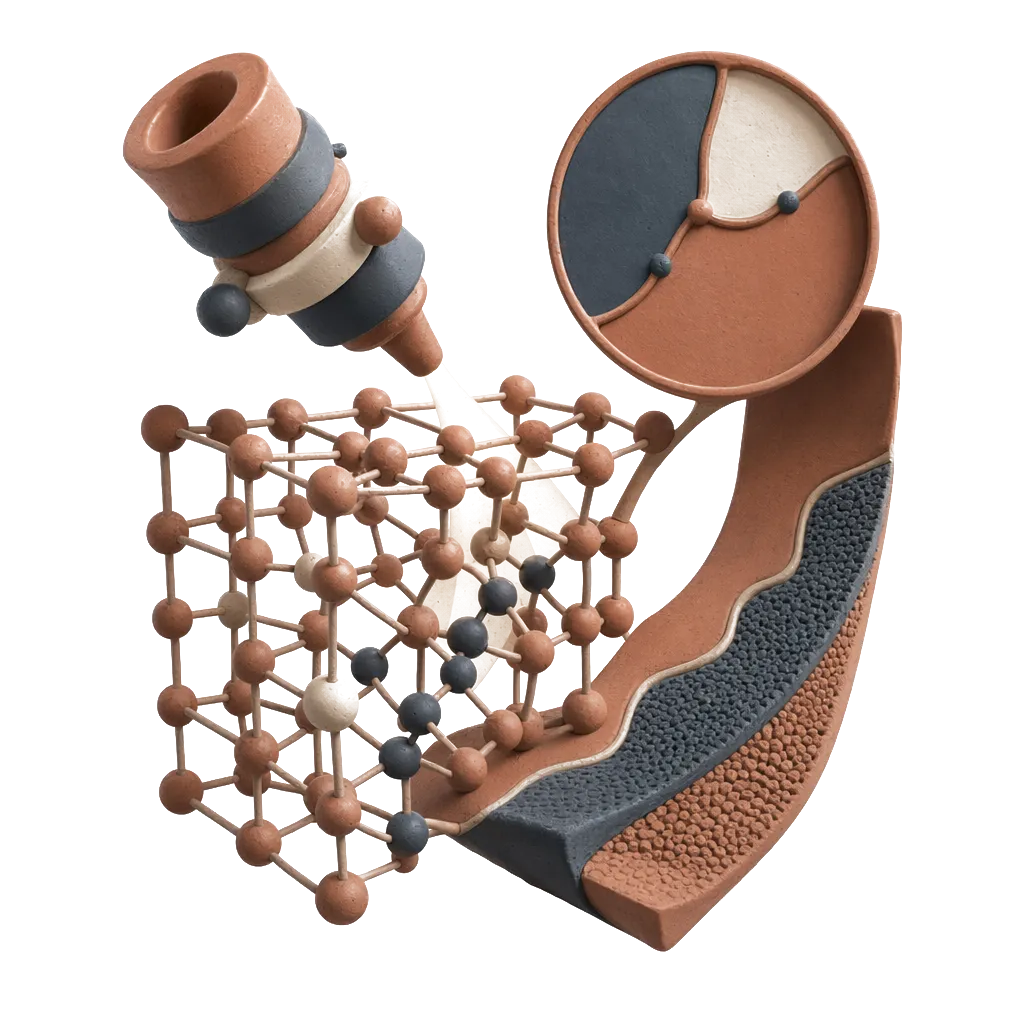
This paper investigates how exciton energy transfer in nanotube bundles affects their photoluminescence, revealing a mechanism that enhances emission and can be used to optimize optoelectronic applications.
Contribution
It demonstrates that exciton energy transfer explains complex photoluminescence spectra in nanotube bundles, providing insights for their optical property manipulation.
Findings
Exciton energy transfer explains complex spectra in nanotube bundles.
Energy transfer enhances photoluminescence of acceptor tubes.
The process can be used to optimize nanotube bundles for optoelectronics.
Abstract
Photoluminescence is commonly used to identify the electronic structure of individual nanotubes. But, nanotubes naturally occur in bundles. Thus, we investigate photoluminescence of nanotube bundles. We show that their complex spectra are simply explained by exciton energy transfer between adjacent tubes, whereby excitation of large gap tubes induces emission from smaller gap ones via Forster interaction between excitons. The consequent relaxation rate is faster than non-radiative recombination, leading to enhanced photoluminescence of acceptor tubes. This fingerprints bundles with different compositions and opens opportunities to optimize them for opto-electronics.
Peer Reviews
No public reviews on file for this paper yet. If you reviewed it on a platform where reviews are public (OpenReview, ICLR, NeurIPS, ICML), you can paste yours below so the community can read it here.
Videos
No videos yet. Explain this paper in a talk, walkthrough, or lecture? Add one.
The reference list from the paper itself. Each links out to its DOI / PubMed record.
- 1(1) S. Reich, C. Thomsen, J. Maultzsch, Carbon nanotubes (Wiley, Weinheim),(2004).
- 2(2) M. J. O’Connell et al., Science 297, 593 (2002).
- 3(3) S. M. Bachilo et al., Science 298, 2361 (2002).
- 4(4) T. Hertel, R. E. Walkup, P. Avouris, Phys. Rev. B 58, 13870 (1998).
- 5(5) F. Wang et al., Science 308, 838 (2005).
- 6(6) J. Maultzsch et al., Phys. Rev. B 72, 241402(R) (2005).
- 7(7) V. Perebeinos, J. Tersoff, P. Avouris, Phys. Rev. Lett. 92, 257402 (2004).
- 8(8) Y. Z. Ma et al., Phys. Rev. Lett. 94, 157402 (2005).