A Tight-Binding Grand Canonical Monte Carlo Study of the Catalytic Growth of Carbon Nanotubes
Hakim Amara (LPS, PCPM, CERMIN), Christophe Bichara (CRMCN),, Fran\c{c}ois Ducastelle (LEM)
TL;DR
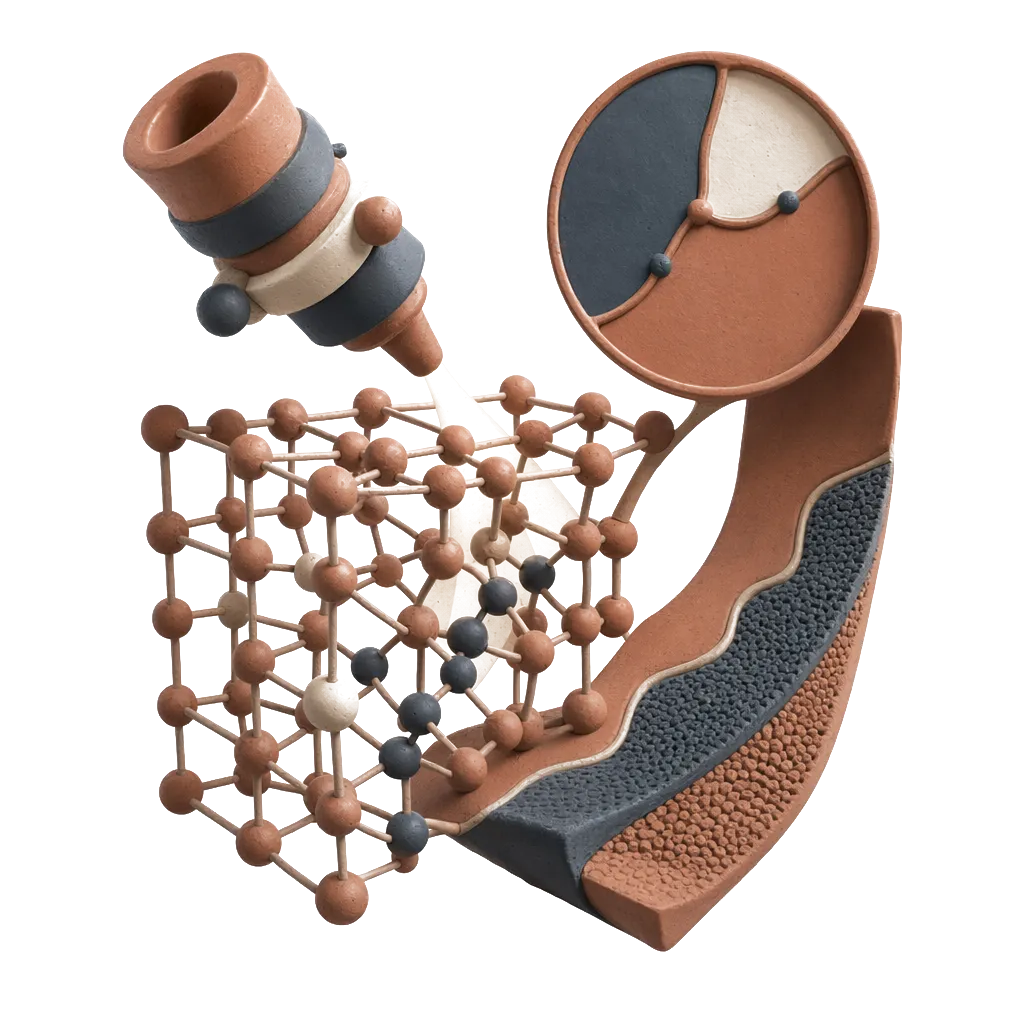
This study uses a tight-binding grand canonical Monte Carlo approach to investigate how catalyst particle size and structure influence carbon nanotube nucleation and cap formation during chemical vapor deposition.
Contribution
It introduces a combined tight-binding and grand canonical Monte Carlo method to simulate nanotube nucleation under realistic synthesis conditions.
Findings
Catalyst size and structure significantly affect cap formation.
Carbon presence varies between surface and subsurface layers.
Parameters influence nanotube structural control.
Abstract
The nucleation of carbon nanotubes on small nickel clusters is studied using a tight binding model coupled to grand canonical Monte Carlo simulations. This technique closely follows the conditions of the synthesis of carbon nanotubes by chemical vapor deposition. The possible formation of a carbon cap on the catalyst particle is studied as a function of the carbon chemical potential, for particles of different size, either crystalline or disordered. We show that these parameters strongly influence the structure of the cap/particle interface which in turn will have a strong effect on the control of the structure of the nanotube. In particular, we discuss the presence of carbon on surface or in subsurface layers.
Peer Reviews
No public reviews on file for this paper yet. If you reviewed it on a platform where reviews are public (OpenReview, ICLR, NeurIPS, ICML), you can paste yours below so the community can read it here.
Videos
No videos yet. Explain this paper in a talk, walkthrough, or lecture? Add one.
Taxonomy
TopicsCatalysis and Oxidation Reactions · Advanced Physical and Chemical Molecular Interactions · Zeolite Catalysis and Synthesis
The reference list from the paper itself. Each links out to its DOI / PubMed record.
- 1(1) Carbon Nanotubes: Synthesis, Structure, Properties and Applications , edited by M. S. Dresselhaus, G. Dresselhaus, and P. Avouris (Springer, Berlin, 2001).
- 2(2) A. G. Nasibulin, P. V. Pikhitsa, and Hua Jiang, E. I. Kauppinen, Carbon 43 , 2251–2257 (2005).
- 3(3) S.M. Bachilo, L. Balzano, J. E. Herrera, F. Pompeo, D. E. Resasco, and R. B. Weisman, J. Am. Chem. Soc., 125 , 11186–7 (2003).
- 4(4) S. Reich, L. Li, and J. Robertson, Chem. Phys. Lett. 421 , 469–72 (2006).
- 5(5) G. Lolli, L. Zhang, L. Balzano, N. Sakulchaicharoen, Y. Tan, and D. E. Resasco, J. Phys. Chem. B, 110 , 2108–2115 (2006).
- 6(6) S. Helveg, C. Lopez-Cartes, J. Sehested, P. L. Hansen, B. S. Clausen, J. R. Rostrup-Nielsen, F. Abild-Pedersen, and J. K. Nørskov, Nature, 427 , 6973, 426–9 (2004).
- 7(7) H. Zhu, K. Suenaga, A. Hashimoto, K. Urita, K. Hata, and S. Iijima, Small 1 , 12, 1180–3 (2005).
- 8(8) S. Hofmann, R. Sharma, C. Ducati, G. Du, C. Mattevi, C. Cepek, M. Cantoro, S. Pisana, A. Parvez, F. Cervantes-Sodi, A. C. Ferrari, R. Dunin-Borkowski, S. Lizzit, L. Petaccia, A. Goldoni, and J. Robertson, Nano Letters, 7 , 602–8 (2007).