The Realm of the First Quasars in the Universe: the X-ray View
C. Vignali (1), W.N. Brandt (2), O. Shemmer (2), A. Steffen (2), D.P., Schneider (2), S. Kaspi (3,4) (Dipartimento di Astronomia, Universita' di, Bologna, Italy; (2) Department of Astronomy, Astrophysics, Pennsylvania, State University, University Park, USA; (3) Wise Observatory

TL;DR
This paper reviews X-ray observations of high-redshift quasars, highlighting their similar properties to local quasars and suggesting that their small-scale X-ray emission regions are unaffected by cosmic evolution.
Contribution
It provides a comprehensive review of X-ray properties of z>4 quasars, emphasizing the consistency across cosmic time and the implications for AGN emission regions.
Findings
X-ray properties of high-redshift quasars are similar to local ones
Small-scale X-ray emission regions are insensitive to cosmic evolution
Supports the universality of AGN X-ray emission mechanisms
Abstract
We review the X-ray studies of the highest redshift quasars, focusing on the results obtained with Chandra and XMM-Newton. Overall, the X-ray and broad-band properties of z>4 quasars and local quasars are similar, suggesting that the small-scale X-ray emission regions of AGN are insensitive to the significant changes occurring at z=0-6.
Click any figure to enlarge with its caption.
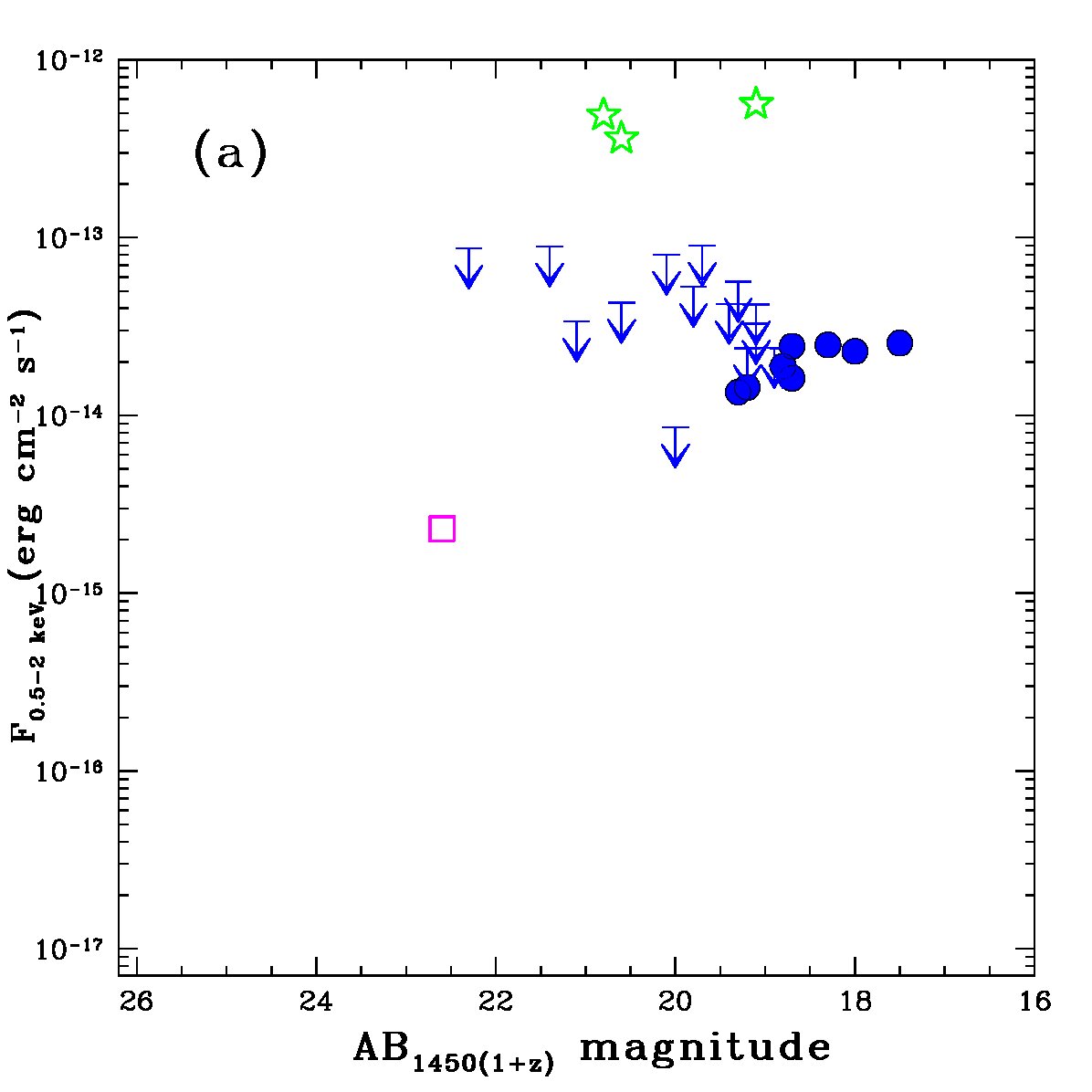 Figure 1
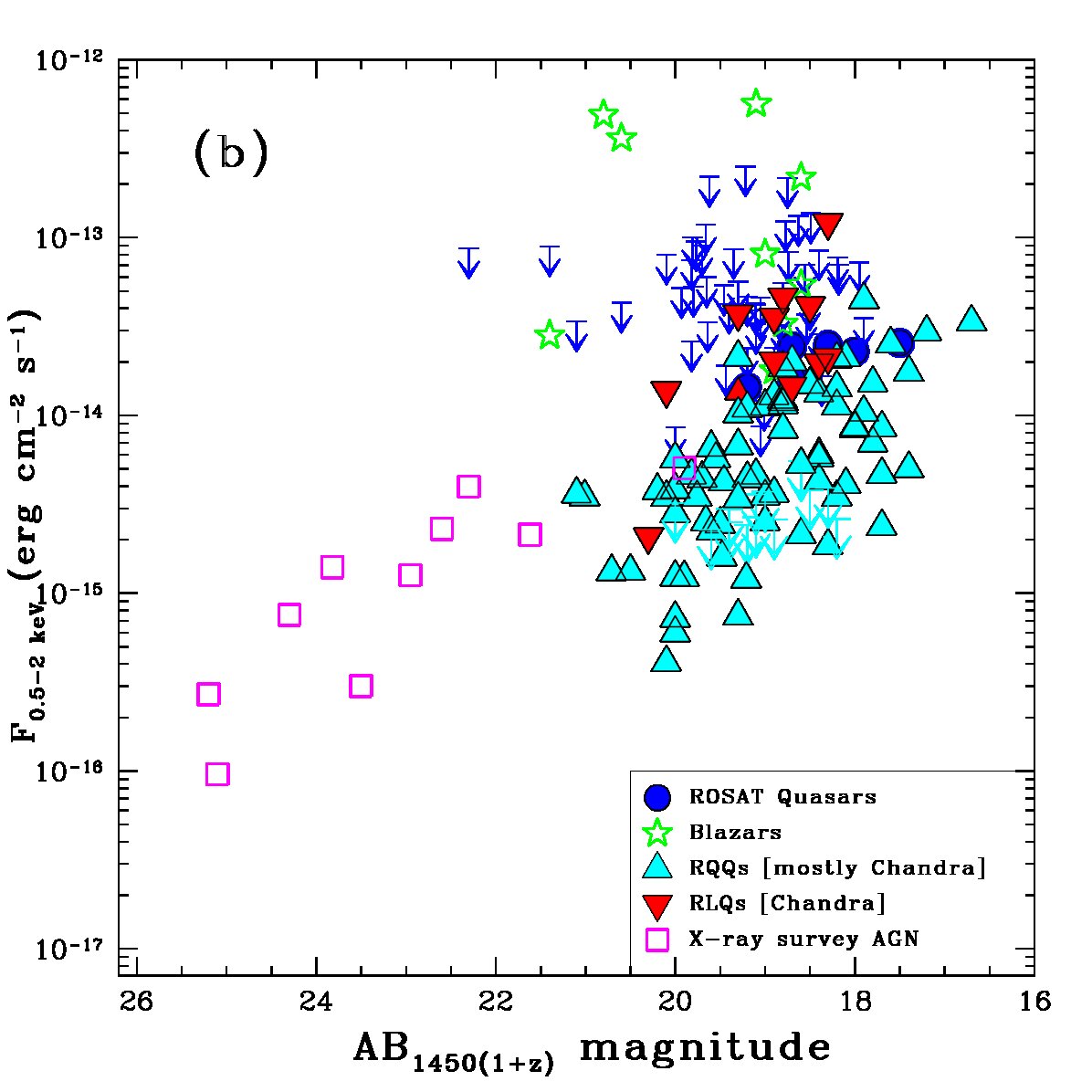 Figure 1
Peer Reviews
No public reviews on file for this paper yet. If you reviewed it on a platform where reviews are public (OpenReview, ICLR, NeurIPS, ICML), you can paste yours below so the community can read it here.
Videos
No videos yet. Explain this paper in a talk, walkthrough, or lecture? Add one.
Taxonomy
TopicsGalaxies: Formation, Evolution, Phenomena · Astronomy and Astrophysical Research · Cosmology and Gravitation Theories
The Realm of the First Quasars in the Universe:
the X-ray View
C. Vignali (1), W.N. Brandt (2), O. Shemmer (2), A. Steffen (2), D.P. Schneider (2), S. Kaspi (3,4)
Abstract
We review the X-ray studies of the highest redshift quasars, focusing on the results obtained with Chandra and XMM-Newton. Overall, the X-ray and broad-band properties of quasars and local quasars are similar, suggesting that the small-scale X-ray emission regions of AGN are insensitive to the significant changes occurring at z$$\approx0–6.
(1) Dipartimento di Astronomia, Università degli Studi di Bologna, Italy; (2) Department of Astronomy & Astrophysics, Pennsylvania State University, University Park, USA; (3) Wise Observatory, Tel Aviv University, Israel; (4) Physics Department, Technion, Haifa, Israel.
1. Introduction
In recent years, optical surveys (e.g, the Sloan Digital Sky Survey and the Digital Palomar Sky Survey) have discovered a large number ( 1000) of quasars at . From the pioneering study of Kaspi et al. (2000; see Fig. 1a), the number of X-ray detected AGN at has increased to more than 110 (Fig. 1b), mostly thanks to exploratory observations with Chandra (e.g., Vignali et al. 2001, 2005; Brandt et al. 2002; Bassett et al. 2004; Lopez et al. 2006; Shemmer et al. 2006a) and longer exposures with XMM-Newton (e.g., Shemmer et al. 2005). At the very faint X-ray fluxes, X-ray surveys have provided detection of several AGN and quasars (e.g., Schneider et al. 1998; Silverman et al. 2002; Vignali et al. 2002).
Here we provide a summary of some of the main recent results:
X-ray emission is a universal property of AGN. The X-ray properties of high-redshift AGN and quasars (derived from either stacked or individual X-ray spectra) are similar to those of local quasars, with no evidence for widespread absorption. For radio-quiet quasars (RQQs), a photon index of 1.9–2.0 is obtained (e.g., Vignali et al. 2005; Shemmer et al. 2005), also at (Shemmer et al. 2006a), while for “moderate” radio-loud quasars (RLQs) and blazars, 1.7 and 1.5 are obtained (Lopez et al. 2006), respectively.
The comparison with the lower redshift (luminosity) Palomar-Green quasars observed by XMM-Newton (Piconcelli et al. 2005) indicates that the photon index does not vary significantly with redshift and luminosity, but seems to depend primarily on the accretion rate (i.e., steeper X-ray slopes are associated with higher Eddington ratio sources; Shemmer et al. 2006b).
Following X-ray studies of early ’80 and ’90, the relation between X-ray and longer wavelength emission has been investigated by means of the point-to-point spectral slope between 2500 Å and 2 keV in the source rest frame (). Any changes in the accretion rate over cosmic time might lead to changes in the fraction of total power emitted as X-rays. Using 333 AGN at z$$\approx0–6.3 (88% X-ray detections), Steffen et al. (2006) confirmed that correlates with with an index , and depends upon (with the slope perhaps depending on ).
The research field related to AGN still offers plenty of opportunities. In particular, the detection of X-ray variability in some quasars over time scales of month-year (Shemmer et al. 2005) needs further investigations to check the possibility that quasars are more variable in the early Universe. Furthermore, detailed X-ray spectra of RLQs filling the observational gap between “moderate” RLQs and blazars are still needed, as well as studies of “peculiar” quasars and faint AGN population at the highest redshifts.
The reference list from the paper itself. Each links out to its DOI / PubMed record.
- 1(1) Bassett, L.C., et al. 2004, AJ, 128, 523
- 2(2) Brandt, W.N., et al. 2002, Ap J, 569, L 5
- 3(3) Kaspi, S., Brandt, W.N., & Schneider, D.P. 2000, AJ, 119, 2031
- 4(4) Lopez, L.A., et al. 2006, AJ, 131, 1914
- 5(5) Piconcelli, E., et al. 2005, A&A, 432, 15
- 6(6) Schneider, D.P., et al. 1998, AJ, 115, 1230
- 7(7) Shemmer, O., et al. 2005, Ap J, 630, 729
- 8(8) Shemmer, O., et al. 2006 a, Ap J, 644, 86