Fermionic Collective Modes in QGP near Critical Temperatures
Yukio Nemoto, Masakiyo Kitazawa, Tomoi Koide, Teiji Kunihiro

TL;DR
This paper explores how collective excitations in quark-gluon plasma near phase transitions lead to non-Fermi liquid behavior, pseudogaps, and novel excitations, revealing complex spectral features close to critical temperatures.
Contribution
It uncovers new collective modes and spectral phenomena in quark-gluon plasma near phase transitions, highlighting the impact of soft modes on quark spectra.
Findings
Non-Fermi liquid behavior near color superconducting transition
Pseudogap formation in quark density of states
Emergence of three collective excitations in chiral transition
Abstract
We investigate the quark spectrum in the quark-gluon plasma phase near color superconducting (CS) and chiral phase transitions. Owing to the precursory soft modes of the phase transitions, there appear novel excitaion spectra: In the CS transition, the quark matter shows non-Fermi liquid behavior and leads to the pseudogap in the density of states of quarks. In the chiral transition, three collective excitations appear in the quark spectrum.
Click any figure to enlarge with its caption.
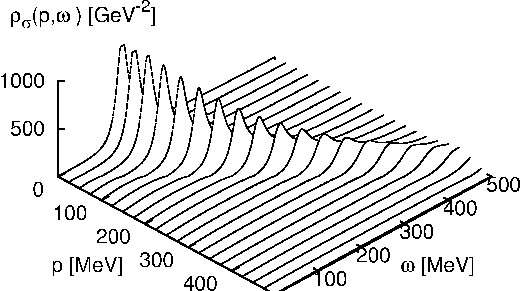 Figure 1
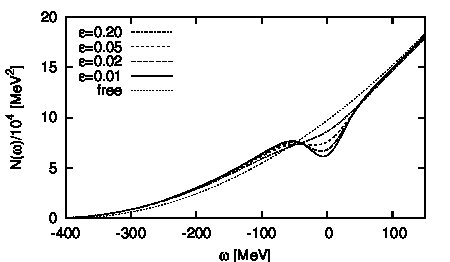 Figure 2
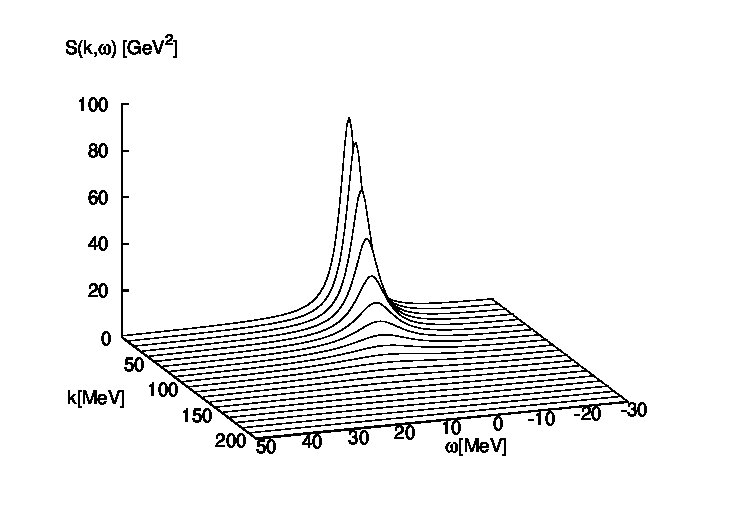 Figure 3
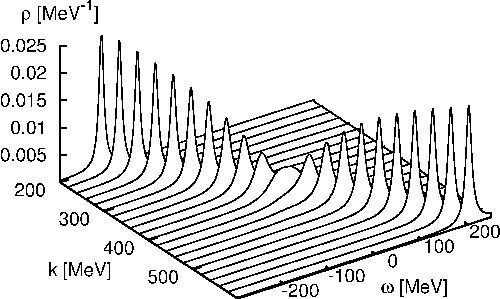 Figure 4
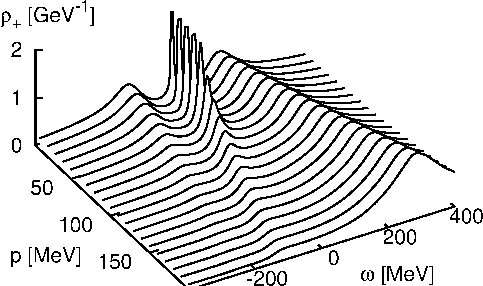 Figure 5
Peer Reviews
No public reviews on file for this paper yet. If you reviewed it on a platform where reviews are public (OpenReview, ICLR, NeurIPS, ICML), you can paste yours below so the community can read it here.
Videos
No videos yet. Explain this paper in a talk, walkthrough, or lecture? Add one.
\notypesetlogo
Fermionic Collective Modes in QGP near Critical Temperatures
Yukio Nemoto*1,*111 e-mail address: [email protected]
Masakiyo Kitazawa*2,*222 e-mail address: [email protected]
Tomoi Koide3,333 e-mail address: [email protected] and Teiji Kunihiro4,444 e-mail address: [email protected] 1 Department of Physics1 Department of Physics Nagoya University Nagoya University Nagoya 464-8602 Nagoya 464-8602 Japan
2 RIKEN-BNL Reseach Center Japan
2 RIKEN-BNL Reseach Center Brookhaven National Laboratory Brookhaven National Laboratory Upton Upton NY 11973 NY 11973 USA
3 Instituto de Física USA
3 Instituto de Física Universidade Federal do Rio de Janeiro Universidade Federal do Rio de Janeiro C. P. 68528 C. P. 68528 21945-970 21945-970 Rio de Janeiro Rio de Janeiro Brasil
4 Yukawa Institute for Theoretical Physics Brasil
4 Yukawa Institute for Theoretical Physics Kyoto University Kyoto University Kyoto 606–8502 Kyoto 606–8502 Japan
Japan
Abstract
We investigate the quark spectrum in the quark-gluon plasma phase near color superconducting (CS) and chiral phase transitions. Owing to the precursory soft modes of the phase transitions, there appear novel excitaion spectra: In the CS transition, the quark matter shows non-Fermi liquid behavior and leads to the pseudogap in the density of states of quarks. In the chiral transition, three collective excitations appear in the quark spectrum.
1 Introduction
Recently, the quark-gluon plasma (QGP) just above the chiral and deconfinement phase transition is believed to be an unexpectedly strongly interacting system, which is based on the facts that the created matter at RHIC behaves like a perfect fluid and that some hadronic bound states of heavy quarks can survive above the critical temperature () from Lattice QCD. Because the fundamental degrees of freedom in QGP are quarks and gluons, it is also important to study their properties in such a strongly interacting system. Here, we investigate the quark spectrum just above of the chiral transition at zero density, and the color superconducting (CS) transition around GeV with being the baryon number density, focusing on the precursory soft modes of these transitions. It is known that these soft modes exist over a wide range of temperature above owing to a strong coupling nature between quarks.[1, 2] In this paper, we show that they affect the quark spectrum significantly in a region just above .
2 Precursory soft modes
To describe the quark matter near , we employ the two-flavor Nambu–Jona-Lasinio type interaction with the scalar diquark correlation included, with and being the charge conjugation operator. The matrices and are the antisymmetric components of the Pauli and Gell-Mann matrices for the flavor and color , respectively. The coupling constants, and , and the three-momentum cutoff, , are taken from Refs. \citenHatsuda:1985eb and \citenSchwarz:1999dj.
The fluctuations of the diquark (chiral) condensate are described by the diquark (quark-antiquark) Green function in the random phase approximation, {\cal D}_{C,S}(\mbox{\boldmathp},\nu_{n})=-[1/2G_{C,S}+{\cal Q}_{C,S}(\mbox{\boldmathp},\nu_{n})]^{-1}, where the subscript denotes the diquark (quark-antiquark) sector. is the Matsubara frequency for bosons and {\cal Q}_{C,S}(\mbox{\boldmathp},\nu_{n}) is the undressed quark-antiquark (diquark) polarization function at one-loop. To evaluate strengths of the fluctuations, we employ the spectral function, , and the dynamic structure factor, , given by \rho_{C,S}(\mbox{\boldmathp},\omega)=-(1/\pi){\rm Im}{\cal D}_{C,S}(\mbox{\boldmathp},\nu_{n})|_{i\nu_{n}=i\omega+i\eta} and S_{C,S}(\mbox{\boldmathp},\omega)=\rho_{C,S}(\mbox{\boldmathp},\omega)/(1-e^{-\omega/T}), respectively.
S_{C}(\mbox{\boldmathp},\omega) for the diquark mode and \rho_{S}(\mbox{\boldmathp},\omega) for the quark-antiquark mode near are plotted in Fig. 1. One can see that there appear pronounced peaks which denote the precursory soft modes.[1, 2] The peak positions of these modes are approximately expressed as \omega_{C}\simeq\mbox{\boldmathp}^{2} for the diquark mode, and \omega_{S}\simeq\pm\sqrt{m_{\sigma}^{*}(T)^{2}+\mbox{\boldmathp}^{2}} for the quark-antiquark mode. A -dependent ‘mass’ becomes smaller as approaches , which means the softening at . As will be seen in Sec.3, the difference between and leads to a quite different quark spectrum.
3 Quark spectrum near the phase transitions
The effect of the soft modes on the quark spectrum is incorporated in the quark self-energy in the non-selfconsistent way, \tilde{\Sigma}_{C,S}(\mbox{\boldmathp},\omega_{n})=-4T\sum_{m}\int\frac{d^{3}q}{(2\pi)^{3}}{\cal D}_{C,S}(\mbox{\boldmathp}-\mbox{\boldmathq},\omega_{n}-\omega_{m}){\cal G}_{0}(\mbox{\boldmathq},\omega_{m}), where {\cal G}_{0}(\mbox{\boldmathq},\omega_{m}) is the free quark propagator with being the Matsubara frequency for fermions. The quasi-quark and quasi-antiquark spectral functions, \rho_{\pm}(\mbox{\boldmathp},\omega), are obtained from the retarded self-energies, \Sigma^{R}_{\pm}(\mbox{\boldmathp},\omega)=(1/2){\rm Tr}[\Sigma^{R}\gamma^{0}\Lambda_{\pm}], respectively, i.e. \rho_{\pm}=-(1/\pi){\rm Im}[\omega+\mu\mp|\mbox{\boldmathp}|-\Sigma^{R}_{\pm}]^{-1}, with the analytic continuation \Sigma^{R}(\mbox{\boldmathp},\omega)=\tilde{\Sigma}(\mbox{\boldmathp},\omega_{n})|_{i\omega_{n}=\omega+i\eta} and the projection operators \Lambda_{\pm}=(1\pm\gamma^{0}\mbox{\boldmath\gamma}\cdot\mbox{\boldmathp}/|\mbox{\boldmathp}|)/2. In the following, we show the quark spectral function obtained from the self-energy for the CS (chiral) transition.
3.1 Color superconducting transition
The quasi-quark spectral function for MeV and is plotted in the left panel of Fig. 2. We see that the peak has a clear depression around the Fermi energy, .[4] Owing to the softening of the soft mode near , a quark near the Fermi energy is scattered by the soft mode and create a hole, while a hole can create a quark by absorbing the soft mode. Then, the incident quark and a quark near the Fermi surface make a resonant scattering to form the soft mode and vice versa. This resonant processes induce a virtual mixing between quarks and holes, which leads to the level repulsion of the energy spectrum near the Fermi energy, making the gap-like structure as shown in the left panel of Fig. 2. This behavior, which is quite different from the conventional Fermi liquid, is due to the strong coupling nature between quarks. In fact, we see that the depression is more significant as the diquark coupling becomes larger.[5]
This depression leads to a depression in the density of states (DOS) of quarks around the Fermi energy, as shown in Fig. 3. Thus, we see a gap-like structure in DOS even above , which we call the pseudogap.[4] The non-Fermi liquid behavior is essential for the formation of the pseudogap, which is analogous to high- superconductors, although the origin of the pseudogap of the latter is not known precisely.
3.2 Chiral transition
The quasi-quark spectral function for MeV and is plotted in the right panel of Fig. 2. We see a clear three-peak structure at low momentum, which exists even at .[6] Although not shown in the figure, the quasi-antiquark spectrum, , has also a three-peak structure for a relation, \rho_{-}(\mbox{\boldmathp},\omega)=\rho_{+}(\mbox{\boldmathp},-\omega). The mechanism of the appearance of the three-peak structure in is as follows: The imaginary part of \Sigma^{R}_{+}(\mbox{\boldmath0},\omega) has two peaks at nonzero values of , which means that there exist two large damping modes of the quasi-quark there. From a kinematical consideration, we see that one is a collision of a thermally excited antiquark and the quasi-quark creating the soft mode, and the other is a collision of the quasi-quark and the soft mode creating an on-shell quark. Both the processes are interpreted as a Landau damping of the quasi-quark. The point is that the quasi-quark is a mixed state between quarks and ‘antiquark-holes’ which are annihilation of thermally excited antiquarks and have the positive quark number. Then, these damping modes cause a mixing between quarks and antiquark-holes. This mixing mechanism can be described in terms of the resonant scattering as in the case of the color superconductivity, although a crucial difference arises owing to the different nature of the soft modes. We can show that a coupling with the soft mode with a nonzero mass is essential for the appearance of the three-peak structure in the quark spectrum.
In fact, we have investigated the quark spectrum in Yukawa models with a massive scalar (pseudo-scalar) and vector (axial-vector) boson of a nonzero mass , and find that there appears a three-peak structure in the quark spectral function with a collective nature when temperature is compatible with .[7] Because the employed Yukawa models are rather generic, the findings may represent a universal phenomenon for fermions coupled with a massive bosonic excitation with a vanishing or small width.
4 Conclusions
We have investigated the quark spectrum near the CS and chiral transitions taking into account the fluctuating soft modes. We have shown that the quark spectrum shows a non-Fermi liquid behavior leading to the pseudogap in the density of states above the CS transition, and a clear three-peak structure above the chiral transition. The gap-like structure in the spectral function near both the transitions can be uderstood in terms of the resonant scattering of each soft mode.
The reference list from the paper itself. Each links out to its DOI / PubMed record.
- 1[1] T. Hatsuda and T. Kunihiro, Phys. Rev. Lett. 55 (1985), 158.
- 2[2] M. Kitazawa, T. Koide, T. Kunihiro and Y. Nemoto, Phys. Rev. D 65 (2002), 091504.
- 3[3] T. M. Schwarz, S. P. Klevansky and G. Papp, Phys. Rev. C 60 (1999), 055205.
- 4[4] M. Kitazawa, T. Koide, T. Kunihiro and Y. Nemoto, Phys. Rev. D 70 (2004), 056003. M. Kitazawa, T. Koide, T. Kunihiro and Y. Nemoto, Prog. Theor. Phys. 114 (2005), 205.
- 5[5] M. Kitazawa, T. Kunihiro and Y. Nemoto, Phys. Lett. B 631 (2005), 157.
- 6[6] M. Kitazawa, T. Kunihiro and Y. Nemoto, Phys. Lett. B 633 (2006), 269.
- 7[7] M. Kitazawa, T. Kunihiro and Y. Nemoto, Prog. Theor. Phys. 117 (2007), 103.