Confirmation of Cylindrical Perfect Invisibility Cloak Using Fourier-Bessel Analysis
Zhichao Ruan, Min Yan, Curtis W. Neff, and Min Qiu

TL;DR
This paper develops a Fourier-Bessel analysis method to confirm that an ideal cylindrical invisibility cloak achieves perfect invisibility, while highlighting the sensitivity of the cloak to small perturbations affecting its scattering properties.
Contribution
The paper introduces a cylindrical wave expansion approach to analyze and confirm the perfect invisibility of an ideal cylindrical cloak, addressing boundary conditions and scattering coefficients.
Findings
Ideal cloak achieves perfect invisibility with zero scattering.
Small perturbations cause noticeable scattering and field penetration.
Zero-th order scattering coefficient convergence is slow, affecting robustness.
Abstract
A cylindrical wave expansion method is developed to obtain the scattering field for an ideal two-dimensional cylindrical invisibility cloak. A near-ideal model of the invisibility cloak is set up to solve the boundary problem at the inner boundary of the cloak shell. We confirm that a cloak with the ideal material parameters is a perfect invisibility cloak by systematically studying the change of the scattering coefficients from the near-ideal case to the ideal one. However, due to the slow convergence of the zero order scattering coefficients, a tiny perturbation on the cloak would induce a noticeable field scattering and penetration.
Click any figure to enlarge with its caption.
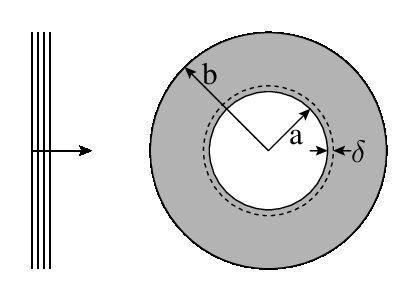 Figure 1
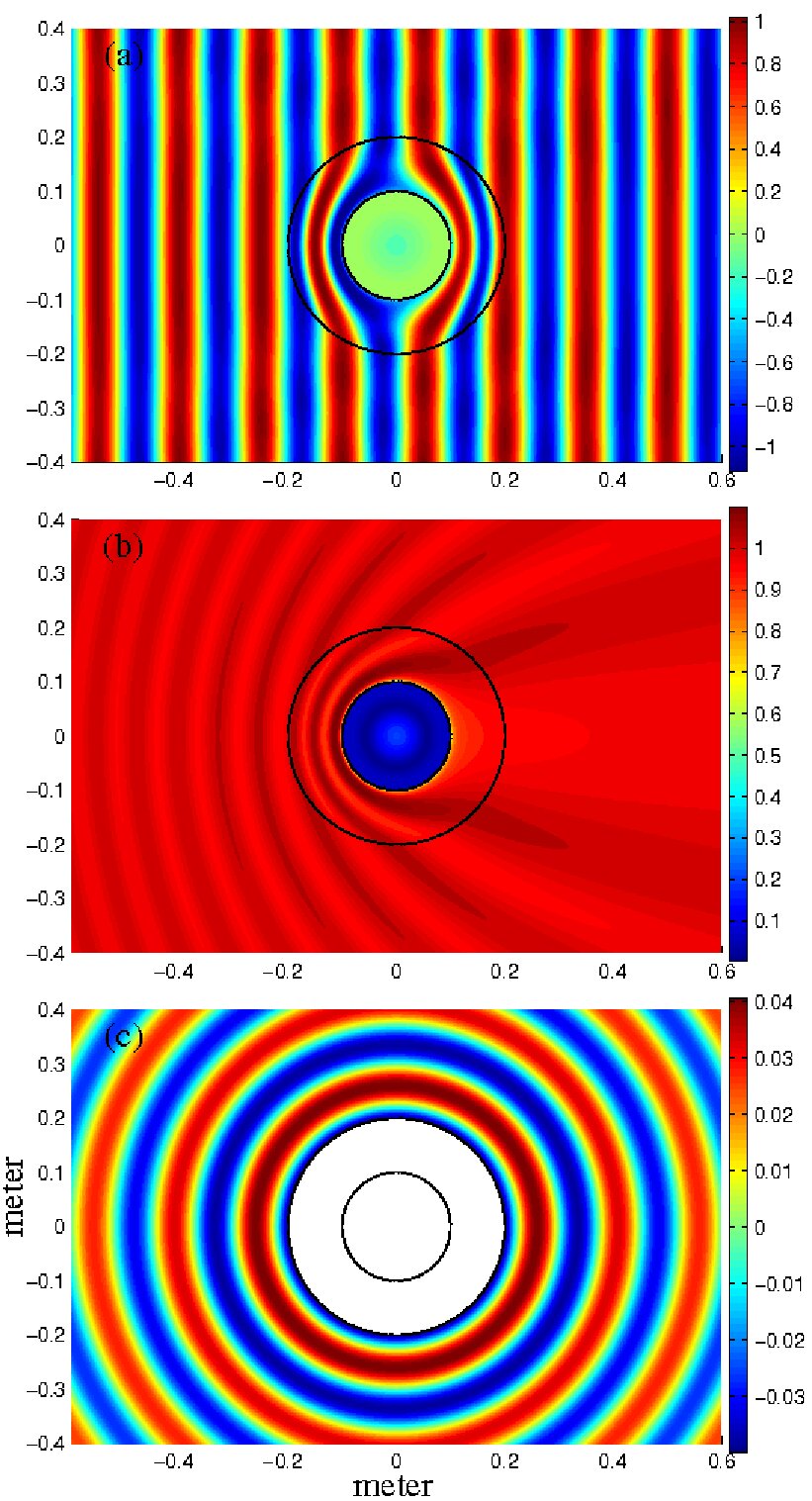 Figure 2
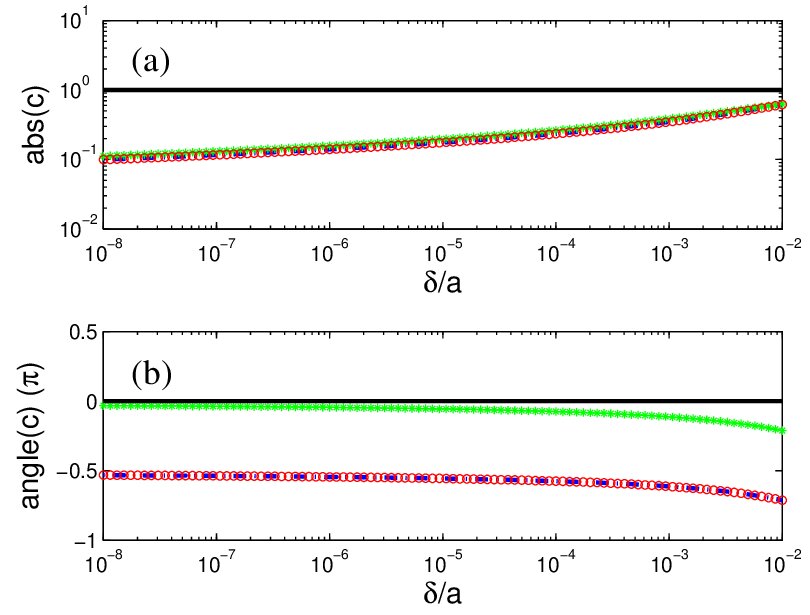 Figure 3
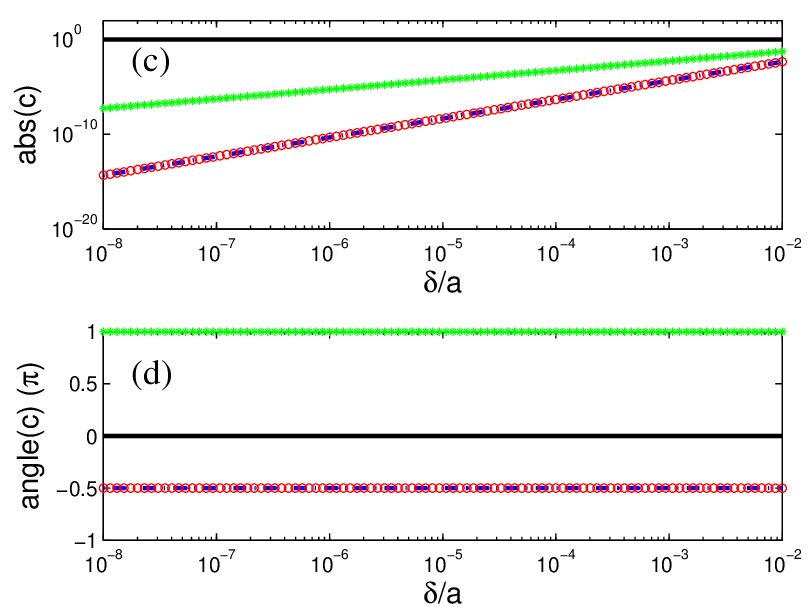 Figure 3
Peer Reviews
No public reviews on file for this paper yet. If you reviewed it on a platform where reviews are public (OpenReview, ICLR, NeurIPS, ICML), you can paste yours below so the community can read it here.
Videos
No videos yet. Explain this paper in a talk, walkthrough, or lecture? Add one.
Ideal cylindrical cloak: Perfect but sensitive to tiny perturbations
Zhichao Ruan111These authors contributed equally to this work.1,2, Min Yan*∗1*, Curtis W. Neff1, and Min Qiu1222Corresponding author. Electronic address: [email protected].
1Laboratory of Optics, Photonics and Quantum Electronics, Department of Microelectronics and Applied Physics, Royal Institute of Technology (KTH), Electrum 229, 16440 Kista, Sweden
2Joint Research Center of Photonics of the Royal Institute of Technology (Sweden) and Zhejiang University, Zhejiang University, Yu-Quan, 310027 Hangzhou, PR China
Abstract
A cylindrical wave expansion method is developed to obtain the scattering field for an ideal two-dimensional cylindrical invisibility cloak. A near-ideal model of the invisibility cloak is set up to solve the boundary problem at the inner boundary of the cloak shell. We confirm that a cloak with the ideal material parameters is a perfect invisibility cloak by systematically studying the change of the scattering coefficients from the near-ideal case to the ideal one. However, due to the slow convergence of the zeroth order scattering coefficients, a tiny perturbation on the cloak would induce a noticeable field scattering and penetration.
pacs:
41.20.-q, 42.25.Bs, 42.79.Wc
The exciting issue of exotic materials invisible to electromagnetic (EM) waves was discussed in recent works Pendry et al. (2006); Leonhardt (2006a); Alù and Engheta (2005); Miller (2006); Leonhardt (2006b); Cummer et al. (2006); Schurig et al. (2006); Milton et al. (2006); Zolla et al. (2007); Cai et al. (2007); Chen and Chan (2007). Based on a coordinate transformation of Maxwell’s equations, Pendry et al. first proposed an invisibility cloak, which can protect objects inside the cloak from detection Pendry et al. (2006): When EM waves pass through the invisibility cloak, the cloak will deflect the waves, guide them around the object, and return them to the original propagation direction without perturbing the exterior field. Numerical methods have been applied to solve the EM problem involving invisibility cloaks Cummer et al. (2006); Zolla et al. (2007), and an experimental result of the invisibility cloak using metamaterial with simplified material parameters has also recently been reported Schurig et al. (2006). Yet, the ideal invisibility cloak has not been confirmed as a perfect cloak, due to the extreme material parameters required (zero or infinity) in the ideal cloak when approaching the inner boundary. Also, numerical methods usually describe the material parameters discretely, which can be computationally intensive in extreme cases. Thus it is preferable to use an analytical or semi-analytical method whenever possible.
In this paper, we will study the scattering for an ideal invisibility cloak. We focus our analysis on the 2D cylindrical cloak, because the wave equation can be simplified in comparison with the 3D case, and a 2D invisibility cloak is more feasible to fabricate Schurig et al. (2006). Here we take advantage of the cylindrical geometry of the structure and use the cylindrical wave expansion method to study the device semi-analytically. To avoid extreme values (zeros or infinity) of material parameters at the cloak’s inner surface, we introduce a small perturbation into the ideal cloak, and allow the perturbation to approach zero to study the scattering problem for the ideal cloak. Such an asymptotic analysis not only can confirm whether the ideal cloak would be perfectly invisible or not, it also provides hints on how sensitive such a device is to finite perturbations. A sensitivity analysis of the invisibility cloak directly determines the possibility of its application. Our studies show that the cylindrical invisibility cloak is very sensitive to tiny perturbations of the material parameters.
First, let’s look at the wave equation inside a cylindrical cloak. According to Ref. Pendry et al. (2006), a simple transformation
[TABLE]
can compress space from the cylindrical region into the annular region , where is the inner radius of the cloak, is the outer radius of the cloak, and , and (, and ) are the radial, angular and vertical coordinates in the original (transformed) system, respectively. Following the approach in Ref. Pendry et al. (2006), the permittivity and permeability tensor components for the cloak shell can be given as
[TABLE]
and air is assumed for the ambient environment and the interior regions. In the following, the transverse-electric (TE) polarized electromagnetic field is considered (i.e. the electrical field only exists in the -direction) , however the transverse-magnetic derivation follows in similar manner. Throughout the paper, a time dependence is assumed. For the TE-polarized wave, only , , and are relevant to the following general wave equation governing the field in the cloak’s cylindrical coordinate
[TABLE]
where is the wave vector of light in vacuum. If we substitute Eq. LABEL:eq:paramater for , , and , we find
[TABLE]
Equation 4can be solved by a separation of variables and the introduction of a constant :
[TABLE]
[TABLE]
Equation 5 is the -order Bessel differential equation, and the general solution of Eq. 6 is . Therefore, there exists a simple set of solutions to in the cloak shell of the form
[TABLE]
where , is the -order Bessel function, and is an integer number as required by the rotational boundary condition.
Let us consider the scattering problem in which an arbitrary wave is incident on the cloak. According to the rigorous scattering theory van de Hulst (1981), the incident field in the 2D case can be expanded in the cloak’s coordinates with the following expression
[TABLE]
where is the -order Bessel function of the first kind. The scattering field can also be expanded as
[TABLE]
where is the -order Hankel function of the first kind.
We note that the scattering coefficients cannot be directly obtained for the ideal cloak since , , and when , and the Bessel function of the second kind in Eq. 7 has a singularity at . In order to circumvent this, we introduce a small perturbation to the ideal cloak which we refer to as the near-ideal cloak, see Fig. 1. We expand the inner boundary of the cloak shell slightly, so that it is located at , where is a very small positive number. However, the material parameters are still calculated according to Eq. LABEL:eq:paramater as if the inner boundary is unchanged. The outer boundary remains fixed at . When , our model will be equivalent to the ideal cloak. Now the electric-field in each region can be given by
[TABLE]
where are the expansion coefficients for the resulting field inside the cloak.
The tangential fields and (which can be obtained from ), should be continuous across the interfaces at and ; and the orthogonality of allows waves in each Bessel order to decouple. Thus, we can have the following four equations:
[TABLE]
which is a set of linear equations. Thus each order expansion coefficient in each material region can be exactly solved. In turn we can obtain the fields in each region.
As a direct result of this set linear equations, we can prove that when , , , and for any , i.e., the ideal cloak is a perfect invisibility cloak. Firstly, it can be assumed that must be finite. Otherwise, the scattering field would be infinite if the incident field has the order component. Secondly, due to and , when , Eq. 11a and 11c become and , respectively. Since can be arbitrary and the Bessel functions are not always zeros, and must be satisfied. Thirdly, from Eq. 11b, we can obtain the following inequality
[TABLE]
When , the right side of the above inequality approaches a finite value but approaches infinity on the left side. Thus, must approach zero. Finally, from Eq. 11b, we can also obtain that . While from Eq. 11d, we have
[TABLE]
Since and the right side of the above inequality approaches zero when , we obtain that . Consequently, this argument proves that the scattering field and the field in the interior region of the cloak are zero when , i.e., the ideal cloak is a perfect invisibility cloak.
Although we have just confirmed that the ideal cloak can provide perfect invisibility, further study the near-ideal cloak by the above analytical method illuminates how sensitive the parameter is to the performance of the cloak. As an example, we use the same material parameters in Ref. Cummer et al. (2006) where the inner radius of the cloak is m, the outer radius of the cloak is m, and the frequency of the incident plane wave is 2GHz. Similarly, we also consider a plane wave incident on the cloak, where the expansion coefficients in Eq. 8 are
[TABLE]
where is the coordinate of the phase reference point, is the amplitude of the plane wave, and is the incident angle Felbacq et al. (1994). Here the phase reference point is set at and , the amplitude is , and the incident angle is (i.e. the plane wave propagates from left to right). We use 31 Bessel terms () to calculate the scattering field for the near-ideal cloak with . The number of expansion terms is sufficient for convergence of the calculated fields. Figure 2 shows the snapshot of the resulting electric-field distribution (i.e. the real part of the electric-field phasor), and the corresponding norm in the vicinity of the cloaked object. The electric-field distribution clearly demonstrates the cloaking effect of the near-ideal cloak to the incident plane wave. However, the norm of the electric-field (Fig. 2 (b)) reveals that there is still a little bit of the field in the cloak interior and an obvious scattering ripple around the cloak. The amplitude of the resulting electric-field at the center is . The snapshot of the scattering field (Fig. 2 (c)) shows that it propagates almost isotropically in all angles. Even though the amplitude of the scattering field is much smaller than that of the incident plane wave, the interference of the incident plane wave and the scattering field creates the ripples in the norm (Fig. 2 (b)).
Since each order expansion coefficient of the scattering field is only relevant to each order expansion coefficient of the incident field (cf. Eq. 11d), we can define the scattering coefficient for each order as
[TABLE]
These coefficients for the field inside the cloak can also be defined in the same way. To study the ideal cloak, we more closer to [math]. The amplitude and the phase of these coefficients for are shown in Fig. 3, where (a)-(b) and (c)-(d) correspond to the cases of and , respectively.
From Fig. 3, it is clear that is always equal to for both cases. That is, the incident field propagates into the cloak without any reflection at the outer boundary, which coincides with the explanation of the cloaking effect from the coordination transformation approach Pendry et al. (2006). The same behavior for the scattering fields occurs at the outer boundary, where they propagate from inside to outside without any reflection, thus is always equal to .
Our computational results also confirm that both and approach zero when . In particular, compared with the case of , and for are much smaller, and approach zero more rapidly. This is also observed for the other higher order cases. Thus, in the case of the plane wave incident, where is the same for each order, the dominating term of the scattering field outside of the cloak is of the form of the zeroth-order Hankel function of the first kind. Meanwhile, the resulting field in the interior region has a dominating term of . This explains the near azimuthally invariable distribution of the field in the interior region (see Fig. 2(a)) and the scattering field outside the cloak (see Fig. 2(c)), which has also been mentioned in Ref. Cummer et al. (2006).
It is worth noting that the zeroth order scattering coefficients and decrease extremely slowly with reduced , e.g. when is decreased from to , decreased only from to . By utilizing the arbitrary calculation precision of the software MATHEMATICA, we found that the convergence of the limit is so slow that even for (i.e. , , and at the inner boundary in this case), . Therefore, we conclude that even though an cloak with the ideal material parameters in Ref. Pendry et al. (2006) is a perfect cloak, a non-ideal invisibility cloak does not provide a good enough cloaking effect due to the slow convergence of and .
In conclusion, we have used the cylindrical wave expansion method to study the electromagnetic scattering properties of a 2D invisibility cloak. A near-ideal model of the invisibility cloak is set up to solve the boundary problem at the inner boundary of the cloak shell. By systematically studying the change of the scattering coefficients from the near-ideal case to the ideal one, we confirm that the cloak with the ideal material parameter is a perfect invisibility cloak. But due to the slow convergence of the scattering coefficients, a tiny perturbation on the cloak would induce a noticeable field scattering and penetration. We also proved that the scattered and penetrated fields are dominated by zeroth-order cylindrical waves. Though our work has focused on the 2D cylindrical cloak, it can be reliably extended to the 3D spherical case. Our method and results are also useful for either designing or detecting this type of the invisibility cloak.
This work is supported by the Swedish Foundation for Strategic Research (SSF) through the INGVAR program, the SSF Strategic Research Center in Photonics, and the Swedish Research Council (VR). Z.C.R. acknowledges the partial support from the National Basic Research Program (973) of China under Project No. 2004CB719800.
The reference list from the paper itself. Each links out to its DOI / PubMed record.
- 1Pendry et al. (2006) J. B. Pendry, D. Schurig, and D. R. Smith, Science 312 , 1780 (2006).
- 2Leonhardt (2006 a) U. Leonhardt, Science 312 , 1777 (2006 a).
- 3Alù and Engheta (2005) A. Alù and N. Engheta, Phys. Rev. E 72 , 016623 (2005).
- 4Miller (2006) D. A. B. Miller, Optics Express 14 , 12457 (2006).
- 5Leonhardt (2006 b) U. Leonhardt, New J. Phys. 8 , 118 (2006 b).
- 6Cummer et al. (2006) S. A. Cummer, B. I. Popa, D. Schurig, D. R. Smith, and J. B. Pendry, Phys. Rev. E. 74 , 036621 (2006).
- 7Schurig et al. (2006) D. Schurig, J. J. Mock, B. J. Justice, S. A. Cummer, J. B. Pendry, A. F. Starr, and D. R. Smith, Science 314 , 977 (2006).
- 8Milton et al. (2006) G. W. Milton, M. Briane, and J. R. Willis, New J. Phys. 8 , 248 (2006).