Pulsating Front Speed-up and Quenching of Reaction by Fast Advection
Andrej Zlatos

TL;DR
This paper investigates how fast periodic incompressible flows with cellular structures can accelerate reaction fronts in reaction-diffusion equations, revealing that the flow geometry determines speed-up and quenching capabilities.
Contribution
It establishes that front speed-up depends solely on flow geometry and not on the reaction type, and characterizes flows capable of quenching ignition reactions.
Findings
Front speed-up occurs if and only if flow geometry allows it.
Speed-up is independent of the specific reaction function.
Flows capable of quenching ignition reactions are precisely those that speed up fronts.
Abstract
We consider reaction-diffusion equations with combustion-type non-linearities in two dimensions and study speed-up of their pulsating fronts by general periodic incompressible flows with a cellular structure. We show that the occurence of front speed-up in the sense , with the amplitude of the flow and the (minimal) front speed, only depends on the geometry of the flow and not on the reaction function. In particular, front speed-up happens for KPP reactions if and only if it does for ignition reactions. We also show that the flows which achieve this speed-up are precisely those which, when scaled properly, are able to quench any ignition reaction.
Click any figure to enlarge with its caption.
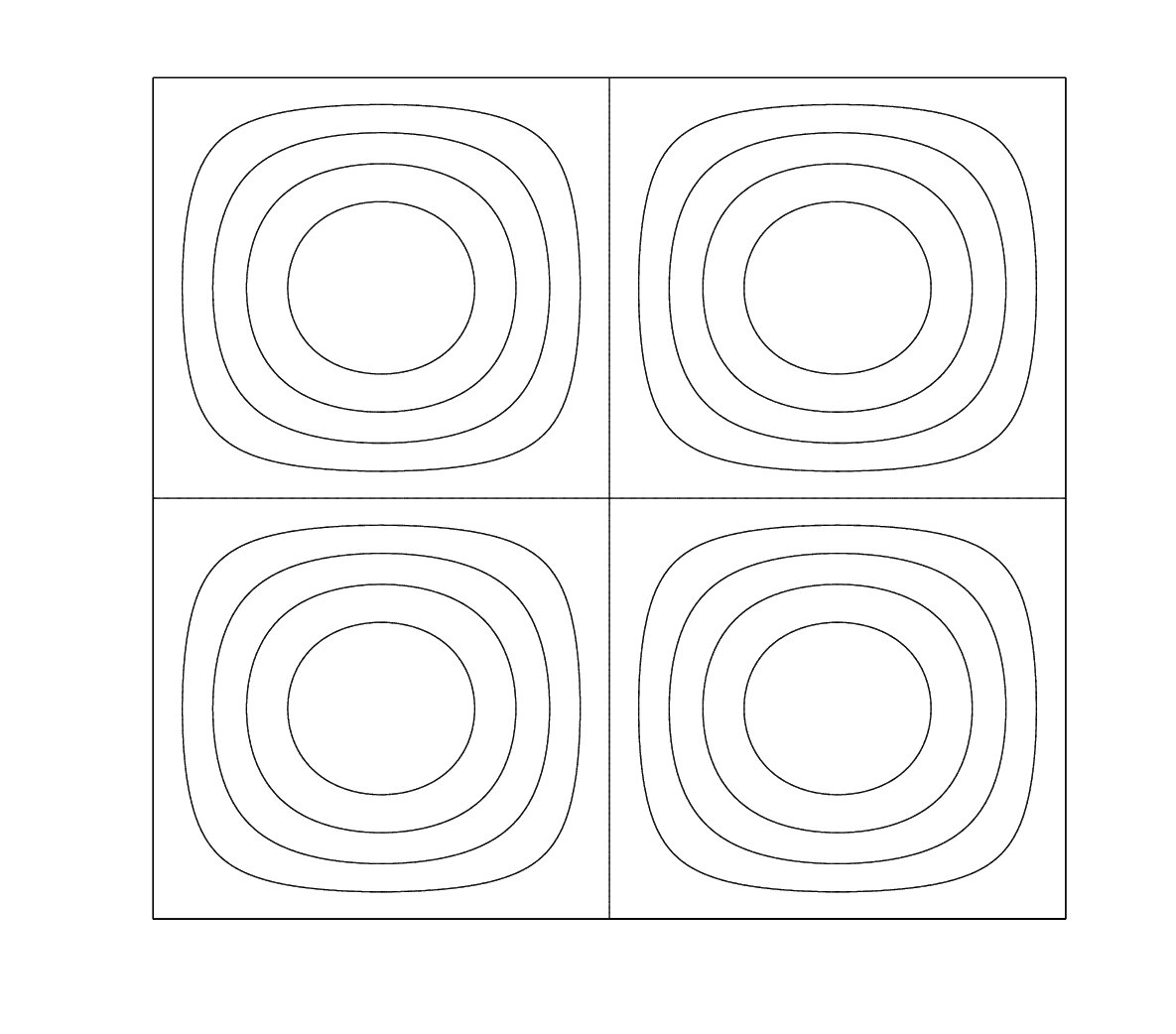 Figure 1
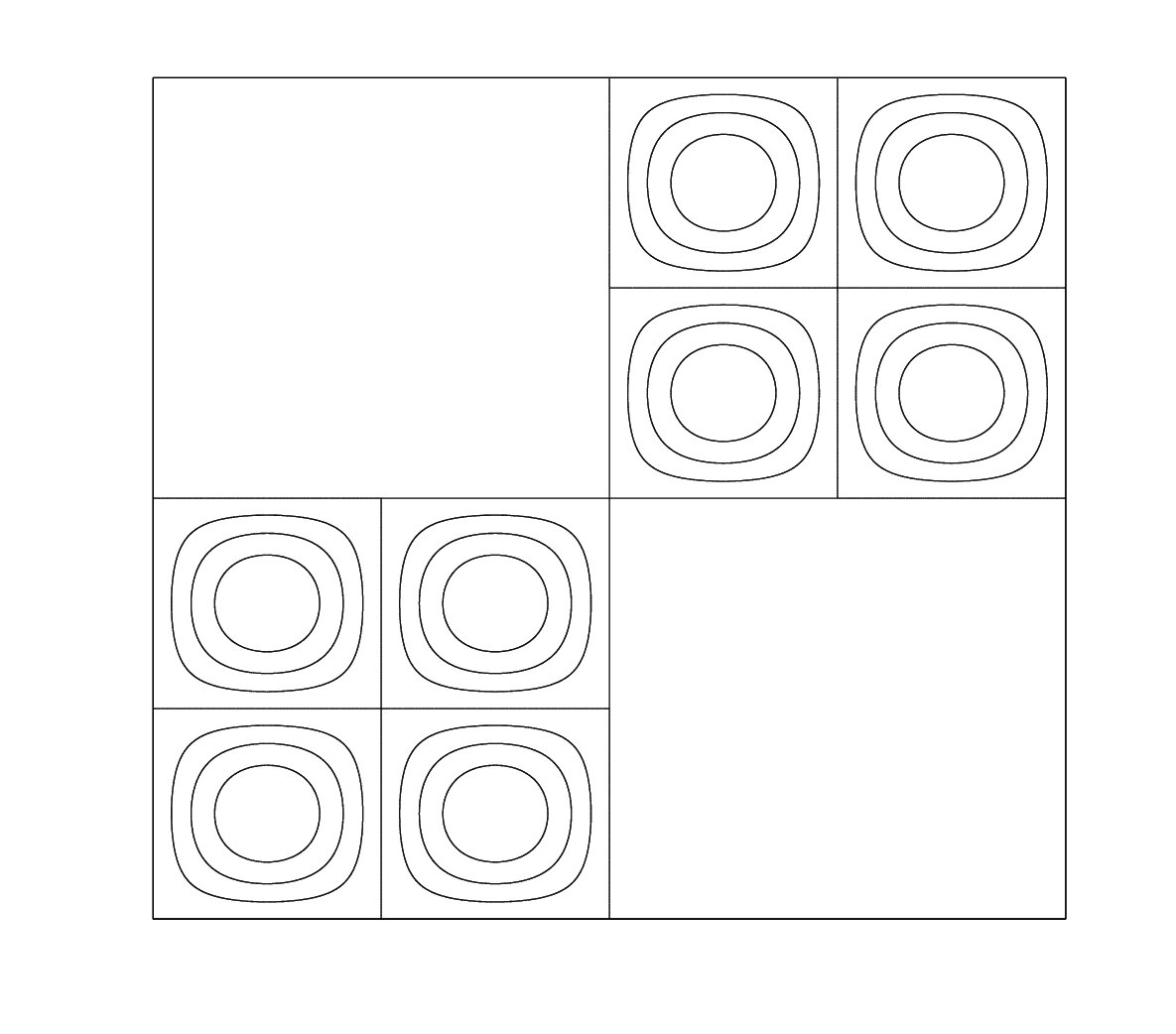 Figure 2
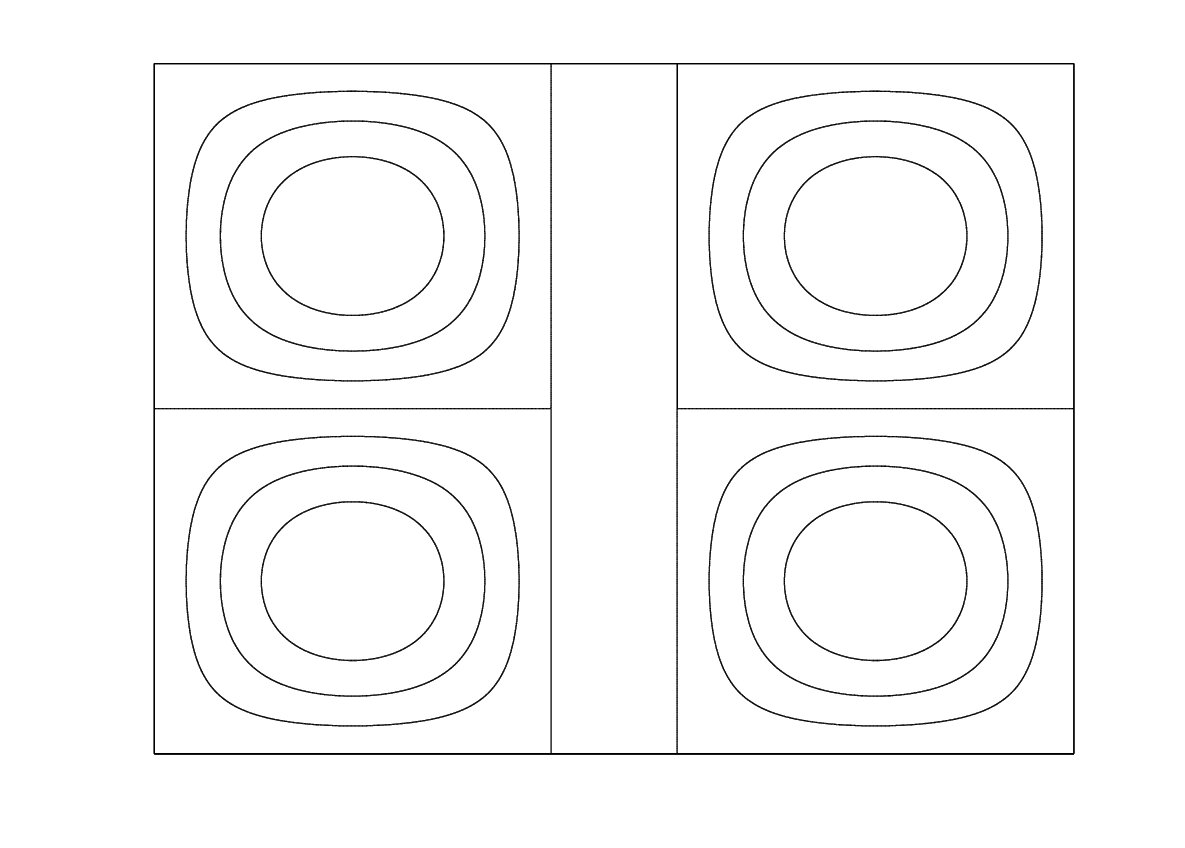 Figure 3
Peer Reviews
No public reviews on file for this paper yet. If you reviewed it on a platform where reviews are public (OpenReview, ICLR, NeurIPS, ICML), you can paste yours below so the community can read it here.
Videos
No videos yet. Explain this paper in a talk, walkthrough, or lecture? Add one.
Pulsating Front Speed-up and Quenching of Reaction
by Fast Advection
Andrej Zlatoš
Department of Mathematics
University of Chicago
Chicago, IL 60637, USA
Email: [email protected]
Abstract.
We consider reaction-diffusion equations with combustion-type non-linearities in two dimensions and study speed-up of their pulsating fronts by general periodic incompressible flows with a cellular structure. We show that the occurence of front speed-up in the sense , with the amplitude of the flow and the (minimal) front speed, only depends on the geometry of the flow and not on the reaction function. In particular, front speed-up occurs for KPP reactions if and only if it does for ignition reactions. We provide a sharp characterization of the periodic symmetric flows which achieve this speed-up and also show that these are precisely those which, when scaled properly, are able to quench any ignition reaction.
1. Introduction and Examples
In this paper we study the effects of strong incompressible advection on combustion. We consider the reaction-advection-diffusion equation
[TABLE]
on , with a prescribed flow profile and its amplitude. Here is the normalized temperature of a premixed combustible gas and is the burning rate.
We assume that is a periodic incompressible (i.e., ) vector field which is symmetric across the hyperplane . That is, where is the reflection across . If the period of in is , then this implies that is symmetric across each hyperplane , . Hence is a periodic symmetric flow of cellular type (since when ) with a cell of periodicity.
The reaction function is of combustion type. That is, there is such that for and for , and is non-increasing on for some . This includes the ignition reaction term with and positive reaction term with . In the latter case we single out the Kolmogorov-Petrovskii-Piskunov (KPP) reaction [13] with for all .
We will be interested in two effects of the strong flow on combustion: pulsating front speed enhancement and quenching of reaction. This problem has recently seen a flurry of activity — see [1, 3, 5, 6, 7, 8, 9, 10, 11, 12, 15, 18, 22, 23, 24]. A pulsating front is a solution of (1.1) of the form , with the front speed and periodic in (with period ) such that
[TABLE]
uniformly in . It is well known [4] that in the case of positive reaction there is , called the minimal pulsating front speed, such that pulsating fronts exist precisely for speeds . In the ignition reaction case the front speed is unique and we again denote it . In the present paper we will be interested in the enhancement of this (minimal) front speed by strong flows.
We say that the flow quenches (extinguishes) the initial “flame” if the solution of (1.1) satisfies as . Here one usually considers compactly supported initial data. The flow profile is said to be quenching for the reaction if for any compactly supported initial datum there is an amplitude such that is quenched by the flow whenever . We note that quenching never happens for KPP reactions — the solutions of (1.1) for compactly supported non-zero always propagate and the speed of their spreading equals [4, 20].
In this paper we characterize those periodic symmetric incompressible flows in two dimensions which achieve speed-up of fronts and, if scaled properly, quenching of any ignition reaction. For we denote by the interval with its ends identified, and we let be the scaled flow on (with cells of size ).
Theorem 1.1**.**
Let be a incompressible -periodic flow on which is symmetric across , and let be any combustion-type reaction.
- (i)
If the equation
[TABLE]
on has a solution , then
[TABLE]
and no is quenching for .
- (ii)
If (1.2) has no -solutions, then
[TABLE]
and if is of ignition type, then there is such that the flow on is quenching for when and not quenching when .
Remarks. 1. The proof shows that in (ii), for some -independent . It can also be showed that the claim in (ii) extends to some positive reactions that are weak at low temperatures (more precisely, for some and — see Corollary 4.4), in particular, the Arrhenius reaction , . On the other hand, if for some , , and all small , then for any [22].
-
We note that is impossible for cellular flows in two dimensions — see [23] which studies strongly quenching flows , that is, quenching for any ignition reaction and any .
-
Although we only consider periodic boundary conditions here, it is easy to see that Theorem 1.1 remains valid for (1.1) on with Neumann boundary conditions, provided when .
-
Although a part of our analysis — Sections 2 and 3 — is valid in any dimension, it remains an open quenstion whether Theorem 1.1 also extends beyond two dimensions.
Theorem 1.1 has the following corollary:
Corollary 1.2**.**
Let be a incompressible -periodic flow on which is symmetric across . Then speed-up of pulsating fronts by in the sense of (1.4) occurs for ignition reactions if and only if it occurs for KPP reactions.
Remark. Although speed-up of KPP fronts has been studied extensively (see, e.g., [3, 5, 6, 10, 11, 15, 18, 24]), rigorous results on ignition front speed-up have so far been established only in two dimensions for percolating flows and special cellular flows [11] (see below).
It is not surprising that the flows which achieve speed-up of fronts are precisely those which quench large initial data. Fast fronts are long, the latter being due to short time–long distance mixing by the underlying flow. Such mixing yields quenching, although possibly only away from regions where the flow is relatively still (e.g., the centers of the cells in Figure 1 below). If these regions are sufficiently small, for instance when the flow is scaled, then reaction cannot survive inside them and global quenching follows. This relation of front speed to flow mixing properties also illuminates Corollary 1.2.
Note that the above assumptions on exclude the class of percolating flows (in particular, shear flows ) which possess streamlines connecting and . In two dimensions, the conclusions of Theorem 1.1(ii) for these flows have been established in [6, 7, 11, 12, 18]. Moreover, results from [5, 24] can be used to prove linear pulsating front speed-up (namely, ) by percolating flows in the presence of KPP reactions in any dimension.
As for cellular flows in two dimensions (the kind we consider here), the claims about the front speed in Theorem 1.1 have been proved for KPP reactions in [18]. The special case of the flow with the stream function has been addressed in [9, 11, 15], which proved (1.4) for any reaction and quenching by for small enough and ignition reactions. The streamlines of this flow are depicted in Figure 1.
We note that it is easy to show that (1.2) has no -solutions in this case [18], and so one can recover these results from Theorem 1.1(ii). Our general method does not yield the more precise asymptotics in the KPP case [15] and in the ignition case [11] for this particular flow.
We conclude this introduction with two more examples of types of flows to which Theorem 1.1 applies.
Example 1.3**.**
Checkerboard flows. Consider the cellular flow above vanishing in every other cell as depicted in Figure 2, thus forming a checkerboard-like pattern. This flow is both periodic (with period 2) and symmetric but it is not . Let us remedy this problem by letting the stream function be with in the cells where does not vanish. Again, (1.2) has no -solutions [18], and so Theorem 1.1(ii) — speed-up of fronts and quenching by — holds. Moreover, the same conclusion is valid for other flows with this type of structure, even if the angle of contact of the “active” cells is .
Example 1.4**.**
Flows with gaps. Consider again the cellular flow above but with a vertical “gap” of width , in which the flow vanishes, inserted in place of each vertical segment , , such as shown in Figure 3. We again need to alter the stream function as we did in the previous example in order to make the flow . This time it is easy to see that (1.2) has -solutions [18], and so Theorem 1.1(i) — no speed-up of fronts and no quenching by — holds in this case. The same conclusion is valid for other flows with similar structures of streamlines, even when the gaps are replaced by channels in which the flow moves “along” the channel only (see [18] for more details).
We also note that Sections 2 and 3 below yield the conclusions of Theorem 1.1(i) for cellular flows with gaps in any dimension (using that gaps force Lemma 2.2(ii) to hold).
The rest of the paper consists of Section 2 where we prove a few preliminary lemmas, and Sections 3 and 4 which contain the proof of Theorem 1.1.
The author would like to thank Sasha Kiselev, Tom Kurtz, and Greg Lawler for useful discussions. Partial support by the NSF through the grant DMS-0632442 is also acknowledged.
2. Some Preliminaries
In this and the next two sections we will assume the hypotheses of Theorem 1.1 with the period — the general case is handled identically. This implies that is symmetric across each hyperplane , . The analysis in this section and the next applies to (1.1) on for any .
Let us consider the stochastic process starting at and satisfying the stochastic differential equation
[TABLE]
where is a normalized Brownian motion on . We note that by Lemma 7.8 in [16], we have that if
[TABLE]
then
[TABLE]
In particular, gives
[TABLE]
where we define for . Also notice that if , then by comparison theorems [19] for any ,
[TABLE]
Lemma 2.1**.**
- (i)
If and then the distribution of is symmetric across the hyperplane , that is,
[TABLE]
for each .
- (ii)
If and , then for any ,
[TABLE]
When , the inequality in (2.6) is reversed.
- (iii)
If , then
[TABLE]
Proof.
(i) and (ii) are obvious from the symmetry of across and from almost sure continuity of in . To show (iii), it is sufficient to consider . Applying (ii) with for , we see that
[TABLE]
The claim follows. ∎
Next we prove the following key dichotomy.
Lemma 2.2**.**
For any sequence one of the following holds.
- (i)
For any and there are such that
[TABLE]
- (ii)
For any there is such that for any ,
[TABLE]
Proof.
Let us first assume that there is such that for any and there are , such that
[TABLE]
Given any , , let be an integer and let be as in (2.10) with , . Notice that by periodicity of we can assume . For any we have
[TABLE]
The first term is smaller than by (2.10) and the second is at most by (2.7). This yields (i) for . On the other hand, if (i) does not hold for some , then there are such that for all ,
[TABLE]
Choose so that . It follows that
[TABLE]
for all . But this contradicts (i) for , which has just been proven. Therefore (i) holds for all under the hypothesis above.
Now assume the opposite case to the one above. Namely, that for each there are and such that for all , ,
[TABLE]
We will show that then (ii) holds, thus finishing the proof.
For each let
[TABLE]
Periodicity of guaranties that
[TABLE]
Notice that is non-increasing. Indeed, for and ,
[TABLE]
by (2.7), and so for any .
We will now show that for all . To this end assume for some . Let be large (to be chosen later), and let be such that
[TABLE]
Consider any , such that
[TABLE]
Such do exists because of . Then the set of Brownian paths for which there is such that has measure at least . Since
[TABLE]
by (2.12) and (2.13), this means
[TABLE]
Since , this is larger than when is large enough. This, however, contradicts (2.14). Therefore we must have for all , which is (ii). ∎
We will also need the following result which is essentially from [8].
Lemma 2.3**.**
For any , there is such that for any Lipschitz incompressible flow , any , and any , the solution of (2.2) on with Dirichlet boundary conditions on satisfies
[TABLE]
Proof.
The maximum principle implies that it is sufficient to show that there is such that
[TABLE]
uniformly in and . For incompressible flows on and mean-zero this follows from Lemma 5.6 in [8]. The proof extends without change to our case, the Dirichlet boundary condition replacing the mean-zero assumption when the Poincaré inequality is used. ∎
3. Proof of Theorem 1.1: Part I
Let us now assume that and are as in Theorem 1.1 and is such that Lemma 2.2(ii) holds. We will then show that the minimal front speeds are uniformly bounded and the flows do not quench large enough compactly supported initial data for (1.1). The analysis in this section applies to for any .
Lemma 3.1**.**
Consider the setting of Theorem 1.1 with , and let be such that Lemma 2.2(ii) holds. Then are uniformly bounded above.
Proof.
Choose that satisfies Lemma 2.2(ii) for and . Let be such that and consider from (2.1). Take and let be the first time such that (recall that ). We then have from (2.9) and (2.7),
[TABLE]
because implies . This means that for any large enough ,
[TABLE]
with as . We used here the fact that fewer than of the differences can exceed 1 in the second inequality, and Stirling’s formula in the fourth.
Let now be the solution of (1.1) with and . If solves (2.2) with and , then we have by (2.5) for ,
[TABLE]
as , provided is large enough. On the other hand, it is well known that as when [4, 20, 21]. This means and we are done. ∎
Lemma 3.2**.**
Consider the setting of Theorem 1.1 with , and let be such that Lemma 2.2(ii) holds. Then there is compactly supported such that the solution of (1.1) with does not quench for any .
Proof.
By comparison theorems, we only need to consider of ignition type — with . We again choose that satisfies Lemma 2.2(ii) for and . We next note that there is such that
[TABLE]
for all large enough and all and . Indeed, assume and (the general case follows immediately from this), and let , with from the proof of Lemma 3.1. Then that proof shows that for we have
[TABLE]
with if is large. On the other hand, symmetry of across each hyperplane shows that are iids with {\mathbb{P}}\big{(}Y_{j}=\pm L\big{)}=\frac{1}{2}. This gives
[TABLE]
for some by
[TABLE]
where we used Stirling’s formula again. This, the fact that (by the definition of and ), and (3.2) yield (3.1) for large enough (with a different ).
We will also need the conclusion of Lemma 3.1 in [9] which says that there is such that for any , , , incompressible , and we have
[TABLE]
We note that [9] only considers , but the general case is identical.
Let us now take non-negative such that
[TABLE]
Note that this means that is non-negative, symmetric, non-increasing on , and convex where . We then let
[TABLE]
with a large to be determined later. We will show using the properties of that if solves (1.1) with , then for we have
[TABLE]
(which gives the desired result by comparison theorems).
Let be such that and such that . Let be the solution of (2.2) with and assume first that . Let . Then by (2.3), monotonicity of on , and symmetry of ,
[TABLE]
We have
[TABLE]
and together with (3.1) implies that the sum of the terms in (3.5) is larger than . This and for yields
[TABLE]
where we also used that (3.3) gives
[TABLE]
Since , this means
[TABLE]
for some and any large enough .
The same argument applies for any (with a uniform ) in place of . This, Lemma 2.3, and the fact that varies on a scale on yield (3.6) for any , provided is large enough. If , then (3.6) follows in the same way because for . And if , then (3.6) is immediate from .
Symmetry and give (3.4) whenever , so let us now consider . As above we obtain for large ,
[TABLE]
where only depends on . We now choose a convex with for and for some and all . Define so that if and , then . Next let when and let satisfy and
[TABLE]
Notice that
[TABLE]
It is easy to show using that . It then follows that is a sub-solution of (1.1) with and as long as (so that ). Since , this is true for all by (3.8) and . But then , while large enough guarantees for ,
[TABLE]
So for these by (3.8),
[TABLE]
when is large. This is (3.4) and thus concludes the proof. ∎
4. Proof of Theorem 1.1: Part II
We now assume that and are as in Theorem 1.1 and is such that Lemma 2.2(i) holds. We will then show that , and that there is such that if is of ignition type with , then any compactly supported initial datum for (1.1) is quenched by some flow . The analysis in this section applies in two dimensions only, so we will consider and .
Lemma 4.1**.**
Consider the setting of Theorem 1.1 with and let be such that Lemma 2.2(i) holds. Then .
Proof.
Assume that for all and let be a pulsating front solution of (1.1) with and speed , that is,
[TABLE]
(recall that has period 1 in ). We note that [2] shows
[TABLE]
Integrating (1.1) over and using (4.1) and incompressibility of , we obtain
[TABLE]
Next we multiply (1.1) by and again integrate as above to get
[TABLE]
This means that for some (which we take to be 0 by translating in time),
[TABLE]
We will now show that (4.1)–(4.4) force the reaction zone (front width) to be bounded in the following sense. Let be the rightmost cell such that (i.e., is the largest integer for which this condition holds). We also let be the leftmost cell such that . Obviously . We will now show that for each small there is such that for each we have
[TABLE]
Assume for a moment that (4.5) holds. Periodicity and (2.8) tell us that there are and such that
[TABLE]
for . Since , symmetry of implies
[TABLE]
[TABLE]
if is small. This contradicts (4.2), so our assumption must be invalid. Thus the proof will be finished if we establish (4.5) for all small .
Let us consider an arbitrary small such that is bounded away from zero on and assume, towards contradiction, that for each there is such that
[TABLE]
Let ,
[TABLE]
and denote . Then (4.4) and Poincaré inequality (with constant ) imply that for each small and , at least of the cells , , satisfy
[TABLE]
Hence there are at least disjoint 5-tuples of consecutive cells satisfying (4.7). Then (4.3), bounded away from zero on , and decreasing in (by (4.2)) imply that for some we must have either (4.7) and for , or (4.7) and for (provided is small enough and large).
Let us assume the case for , . Then (4.2) and (4.6) say that there must be such that for ,
[TABLE]
Let be the square of a small side (to be chosen later) centered at and denote by the intersection of with the connected component of the set containing (recall that that ).
If has diameter less than (in particular, ), then for , all , and all ,
[TABLE]
by (4.1) and (4.2). It follows by comparison that where solves (2.2) on with Dirichlet boundary conditions and . But then the uniform bound in Lemma 2.3 and parabolic scaling in gives that for any there is small enough such that , and if is chosen small enough (and accordingly), then follows. This clearly contradicts (4.8).
If instead (for the chosen ) the set has diameter at least , then and imply that the second inequality in (4.7) must be violated for at least one of , provided is chosen small enough (depending on ). Indeed — if is small enough, then must be close to on some vertical line passing through , and then must be close to on most horizontal lines inside by the same argument. This contradicts .
Finally, if we instead assume for and for small , a similar argument again leads to contradiction. This means that (4.6) cannot hold for small and (4.5) follows. The proof is finished. ∎
Lemma 4.2**.**
Consider the setting of Theorem 1.1 with . There is such that if is of ignition type with and is such that Lemma 2.2(i) holds, then for any compactly supported there is such that the solution of (1.1) with quenches.
Remark. We note that is from Lemma 2.3 and can be easily evaluated from its proof.
Proof.
By comparison theorems, it is sufficient to consider initial data for all . Let be the solution of (2.2) with and initial datum . We first claim that for each there is and a continuous curve such that and , and for all and ,
[TABLE]
To this end we let be the solution of (2.2) with initial condition where . By periodicity of and (2.8), there must be (which will be kept constant from now on) and such that
[TABLE]
The maximum principle for (2.2) implies that the connected component of the set
[TABLE]
containing must intersect
[TABLE]
Since by symmetry for , this means that there is a curve joining and such that for each there is with
[TABLE]
Lemma 2.1(iii) and the definition of then mean that for all ,
[TABLE]
which is (4.9) (after reparametrization of and restriction to ).
Symmetry of and implies that (4.9) holds for extended to by . Finally, (4.9) applies to extended periodically (with period 2) onto . This last claim holds because when (and when ), which in turn follows because solves (2.2) with initial datum that is symmetric across and non-negative on (and hence stays such by the symmetry of ).
This means that where is the solution of (2.2) on with and for all and . Since the Poincaré inequality and the proof of Lemma 2.3 extend to this setting with the same universal constant , we obtain that . If now and are chosen small enough depending on (and accordingly), we obtain for some . The maximum principle then implies for any and quenching follows. ∎
The proof of Theorem 1.1 is now based on the last four lemmas and this result from [18]:
Lemma 4.3**.**
Assume the setting of Theorem 1.1 with a KPP nonlinearity and .
- (i)
If (1.2) on has a solution , then (1.3) holds.
- (ii)
If (1.2) has no -solutions, then (1.4) holds.
Proof of Theorem 1.1.
If (1.2) has a solution , then is bounded for any KPP and any , and so Lemma 4.1 gives Lemma 2.2(ii). Lemmas 3.1 and 3.2 now give (i) for any . Note that if each sequence does not quench some compactly supported initial datum for (1.1) with , then there is that is not quenched by any . This holds because if each is quenched by some , then this sequence would yield a contradiction.
If, on the other hand, (1.2) has no -solutions, then for any KPP and any , and so Lemma 3.1 gives Lemma 2.2(i). Lemma 4.1 now gives (1.4) for any . The claim about the existence of follows from the fact that solves on if and only if solves on . Comparison theorems and then show that if is quenching for , then so is for any . This only guarantees , but follows from Theorem 8.2 in [23] and the fact that the flow leaves the bounded domain invariant. For ignition reactions Lemma 4.2 shows — if each is quenched by at least one for any sequence , then each is quenched by for all large . ∎
Finally, we provide the following extension of Theorem 1.1(ii) to some positive reactions.
Corollary 4.4**.**
*The claim in Theorem 1.1(ii) holds for any combustion-type reaction satisfying for some , , and all . *
Proof.
By the proof of Theorem 1.1, it is sufficient to show that there is such that is quenching for . The proof is essentially identical to that of Theorem 8.3 in [23]. We let where is the solution of (2.2) and . It follows from [14] (see also [22, Lemma 2.1]) that is quenching for when for each compactly supported there is such that whenever . So fix and notice that the bound for , which follows from (3.3), gives if is chosen appropriately (depending on ). For we use the bound , which follows from the proof of Lemma 4.2 (with the same ) provided is chosen large enough so that in that proof is smaller than for each (and is such that ). This choice is possible because each sequence has a term guaranteeing . Hence for we have
[TABLE]
Now let be such that , and we are done. ∎
The reference list from the paper itself. Each links out to its DOI / PubMed record.
- 1[1] B. Audoly, H. Berestycki and Y. Pomeau, Réaction diffusion en écoulement stationnaire rapide, C. R. Acad. Sci. Paris 328 , Série I Ib (2000), 255–262.
- 2[2] H. Berestycki and F. Hamel, Front propagation in periodic excitable media, Comm. Pure and Appl. Math. 55 (2002), 949–1032.
- 3[3] H. Berestycki, The influence of advection on the propagation of fronts in reaction-diffusion equations, Nonlinear PD Es in Condensed Matter and Reactive Flows, NATO Science Series C, 569, H. Berestycki and Y. Pomeau eds, Kluwer, Doordrecht, 2003.
- 4[4] H. Berestycki, F. Hamel and N. Nadirashvili, The speed of propagation for KPP type problems, I - Periodic framework, J. European Math. Soc. 7 (2005), 173–213.
- 5[5] H. Berestycki, F. Hamel and N. Nadirashvili, Elliptic eigenvalue problems with large drift and applications to nonlinear propagation phenomena, Comm. Math. Phys. 253 (2005), 451–480.
- 6[6] P. Constantin, A. Kiselev, A. Oberman and L. Ryzhik, Bulk burning rate in passive-reactive diffusion, Arch. Ration. Mech. Anal. 154 (2000), 53–91.
- 7[7] P. Constantin, A. Kiselev, L. Ryzhik, Quenching of flames by fluid advection, Comm. Pure Appl. Math. 54 (2001), 1320–1342.
- 8[8] P. Constantin, A. Kiselev, L. Ryzhik, and A. Zlatoš, Diffusion and Mixing in Fluid Flow, Ann. of Math. (2), to appear.