Analysis of $\Omega_c^*(css)$ and $\Omega_b^*(bss)$ with QCD sum rules
Zhi-Gang Wang

TL;DR
This paper uses QCD sum rules to calculate the masses and residues of heavy baryons $\,Omega_c^*(css)$ and $\,Omega_b^*(bss)$, finding results consistent with experimental data and other theories.
Contribution
It provides new QCD sum rule calculations for the masses and residues of specific heavy baryons with spin-parity ${3/2}^+$, expanding theoretical understanding.
Findings
Calculated masses and residues match experimental data
Results are consistent with other theoretical estimations
Supports the validity of QCD sum rules for heavy baryon analysis
Abstract
In this article, we calculate the masses and residues of the heavy baryons and with spin-parity with the QCD sum rules. The numerical values are compatible with experimental data and other theoretical estimations.
Click any figure to enlarge with its caption.
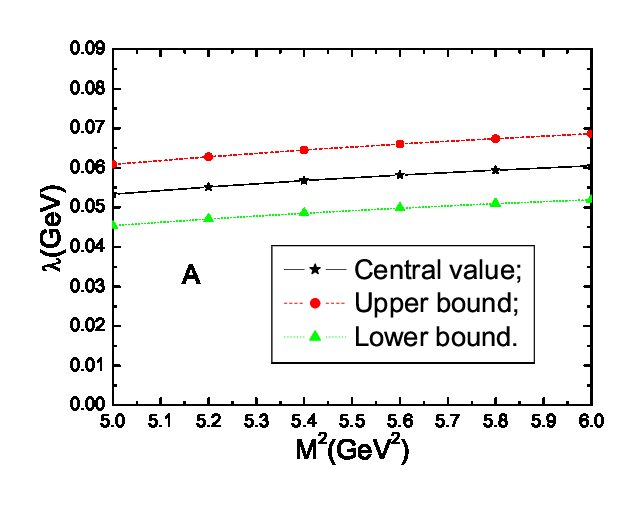 Figure 1
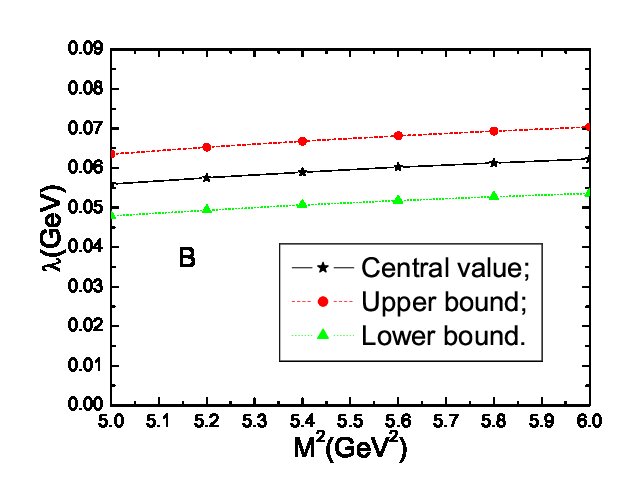 Figure 2
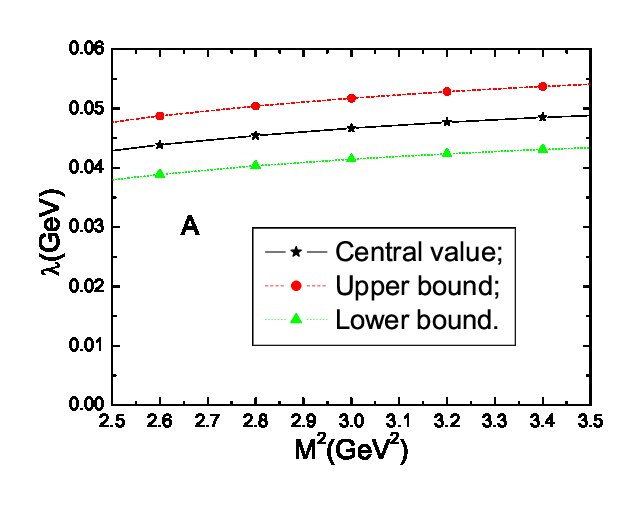 Figure 3
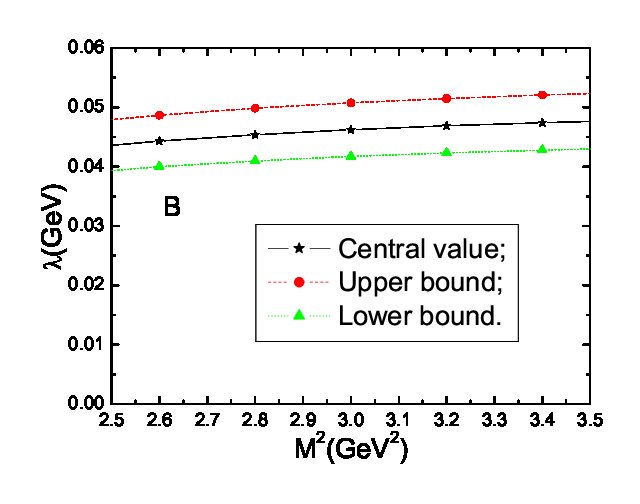 Figure 4
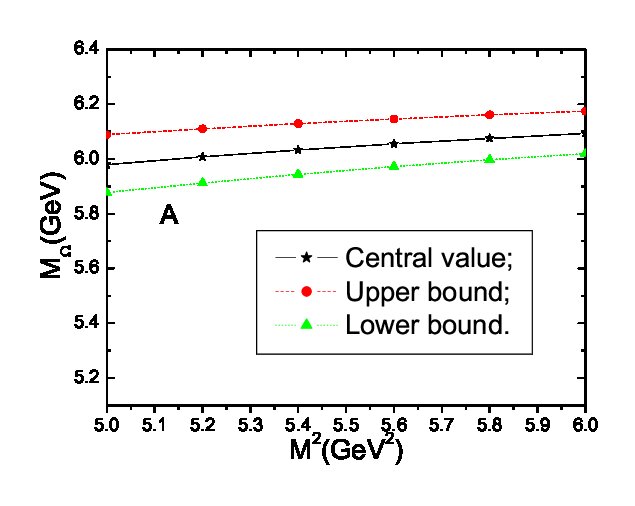 Figure 5
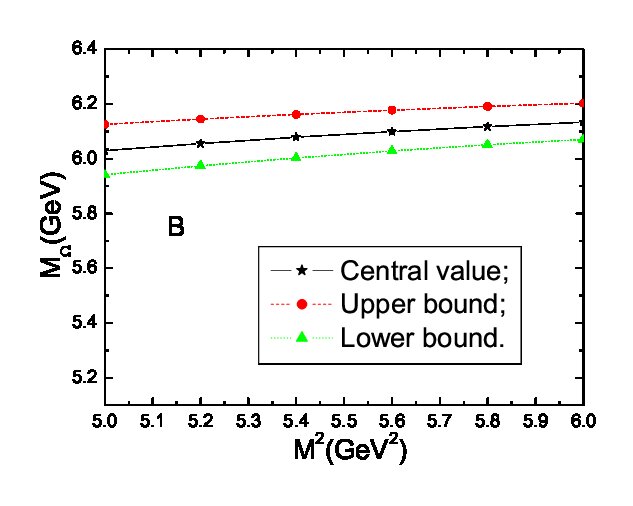 Figure 6
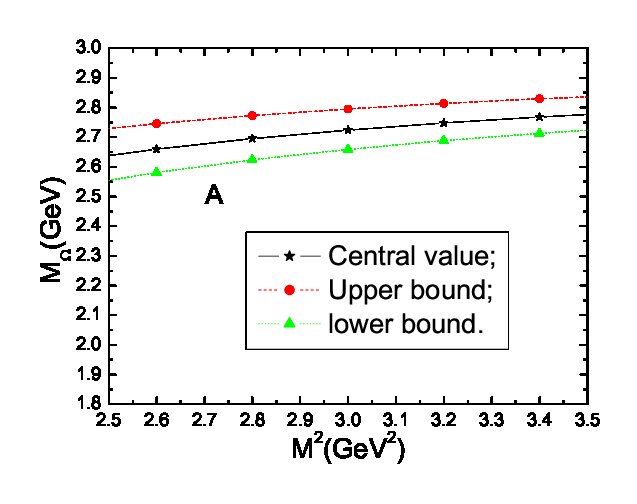 Figure 7
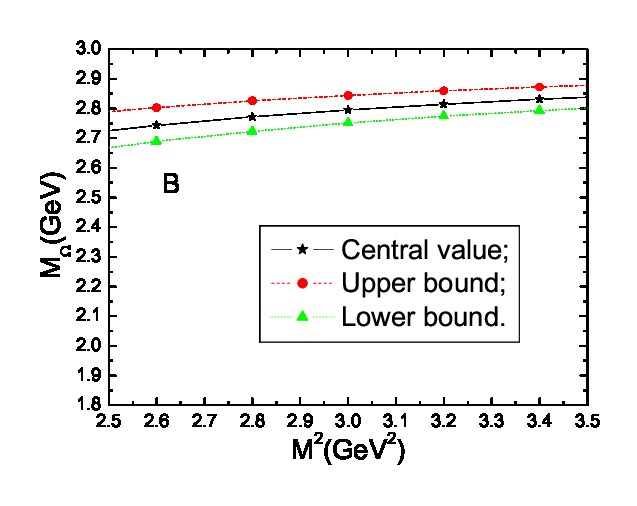 Figure 8
| Eq.(11) | Eq.(12) | |
|---|---|---|
| perturbative term | ||
| Eq.(11) | Eq.(12) | |
|---|---|---|
| perturbative term | ||
Peer Reviews
No public reviews on file for this paper yet. If you reviewed it on a platform where reviews are public (OpenReview, ICLR, NeurIPS, ICML), you can paste yours below so the community can read it here.
Videos
No videos yet. Explain this paper in a talk, walkthrough, or lecture? Add one.
Analysis of and with QCD sum rules
Zhi-Gang Wang 111E-mail,[email protected];[email protected].
Department of Physics, North China Electric Power University, Baoding 071003, P. R. China
Abstract
In this article, we calculate the masses and residues of the heavy baryons and with spin-parity with the QCD sum rules. The numerical values are compatible with experimental data and other theoretical estimations.
PACS number: 14.20.Lq, 14.20.Mr
Key words: , , QCD sum rules
1 Introduction
Several new excited charmed baryon states have been observed by BaBar, Belle and CLEO Collaborations, such as , , , , , , , [1, 2]. The charmed baryons provide a rich source of states, including possible candidates for the orbital excitations. They serve as an excellent ground for testing predictions of the constituent quark models and heavy quark symmetry [3]. The charmed and bottomed baryons, which contain a heavy quark and two light quarks, provides an ideal tool for studying dynamics of the light quarks in the presence of a heavy quark. The , and quarks form an flavor triplet, , two light quarks can form diquarks with a symmetric sextet and an antisymmetric antitriplet. For the -wave baryons, the sextet contains both spin- and spin- states, while the antitriplet contains only spin- states. By now, the antitriplet states (, , and the and sextet states () and () have been established.
The baryon , a candidate for the partner of the strange baryon , was observed by BaBar collaboration in the radiative decay [4]. The baryon was reconstructed in decays to the final states , , and . It lies about above the , and it is the last singly-charmed baryon with zero orbital momentum observed experimentally [5].
In this article, we calculate the mass and residue of the (and as byproduct, the has not been observed experimentally yet) with the QCD sum rules [6, 7]. In the QCD sum rules, operator product expansion is used to expand the time-ordered currents into a series of quark and gluon condensates which parameterize the long distance properties of the QCD vacuum. Based on current-hadron duality, we can obtain copious information about the hadronic parameters at the phenomenological side.
The article is arranged as follows: we derive the QCD sum rules for the masses and residues of the and in section 2; in section 3, numerical results and discussions; section 4 is reserved for conclusion.
2 QCD sum rules for the and
In the following, we write down the two-point correlation functions in the QCD sum rules approach,
[TABLE]
where the upper index represents the and quarks respectively; the and stand for the Rarita-Schwinger spin vector and residue of the baryon , respectively. , and are color indexes, is charge conjunction matrix, and and are Lorentz indexes.
The correlation functions can be decomposed as follows:
[TABLE]
due to Lorentz covariance. The first structure has an odd number of -matrices and conserves chirality, the second structure has an even number of -matrices and violate chirality. In the original QCD sum rules analysis of the nucleon masses and magnetic moments [8], the interval of dimensions (of the condensates) for the odd structure is larger than the interval of dimensions for the even structure, one may expect a better accuracy of results obtained from the sum rules with the odd structure.
In this article, we choose the two tensor structures to study the masses and residues of the heavy baryons and , as the masses of the heavy quarks break the chiral symmetry explicitly.
According to basic assumption of current-hadron duality in the QCD sum rules approach [6], we insert a complete series of intermediate states satisfying unitarity principle with the same quantum numbers as the current operator into the correlation functions in Eq.(1) to obtain the hadronic representation. After isolating the pole terms of the lowest states , we obtain the following result:
[TABLE]
where we have used the relation to sum over the Rarita-Schwinger spin vector,
[TABLE]
In the following, we briefly outline operator product expansion for the correlation functions in perturbative QCD theory. The calculations are performed at large space-like momentum region , which corresponds to small distance required by validity of operator product expansion. We write down the ”full” propagators and of a massive quark in the presence of the vacuum condensates firstly [6]222One can consult the last article of Ref.[6] for technical details in deriving the full propagator.,
[TABLE]
where and , then contract the quark fields in the correlation functions with Wick theorem, and obtain the result:
[TABLE]
Substitute the full , and quark propagators into above correlation functions and complete the integral in coordinate space, then integrate over the variable , we can obtain the correlation functions at the level of quark-gluon degree of freedom:
[TABLE]
where .
We carry out operator product expansion to the vacuum condensates adding up to dimension-6. In calculation, we take assumption of vacuum saturation for high dimension vacuum condensates, they are always factorized to lower condensates with vacuum saturation in the QCD sum rules, factorization works well in large limit. In this article, we take into account the contributions from the quark condensate , mixed condensate , gluon condensate , and neglect the contributions from other high dimension condensates, which are suppressed by large denominators and would not play significant roles.
Once analytical results are obtained, then we can take current-hadron duality below the threshold and perform Borel transformation with respect to the variable , finally we obtain the following sum rules:
[TABLE]
[TABLE]
where and .
Differentiate the above sum rules with respect to the variable , then eliminate the quantity , we obtain two QCD sum rules for the masses :
[TABLE]
and
[TABLE]
3 Numerical results and discussions
The input parameters are taken to be the standard values , , , , , , and [6, 7, 9]. The contribution from the gluon condensate is less than , and the uncertainty is neglected here.
For the octet baryons with , the mass of the proton (the ground state) is , and the mass of the first radial excited state (the Roper resonance) is [10]. For the decuplet baryons with , the mass of the (the ground state) is , and the mass of the first radial excited state is [10]. The separation between the ground states and first radial excited states is about . So in the QCD sum rules for the baryons with the light quarks, the threshold parameters are always chosen to be [8, 11], here stands for the ground states. The threshold parameters for the heavy baryons and can be chosen to be and , respectively. The mass of the bottomed baryon with spin-parity is about , which is predicted by the quark models and lattice QCD [12, 13].
In this article, the threshold parameters and Borel parameters are taken as and for the charmed baryon , and and for the bottomed baryon . The contributions from different terms for the central values of the input parameters are presented in Table.1 and Table.2, respectively. From the two tables, we can expect convergence of the operator product expansion. In the two sum rules in Eqs.(11-12), the contributions from the terms proportional to the quark condensate and mixed condensate are suppressed due to the small mass comparing with the terms proportional to the . Furthermore, from the ’full’ propagator of the quark, we can see that the mixed condensate is companied with additional large denominators, its contribution is even smaller. In the right-hand side of Eqs.(11-12), the terms proportional to the are suppressed by the exponents , which is balanced by the factor in the left-hand side. Although the masses of the quark and baryon are much smaller than the corresponding ones of the quark and baryon, the Borel parameters are different, for the central values of the Borel parameters , . It is not unexpected, the contributions from the are larger in the sum rules for the baryon than the ones for the baryon.
If we approximate the phenomenological spectral density with the perturbative term, the contribution from the pole term is as large as for the charmed baryon and for the bottomed baryon . We can choose smaller Borel parameter or larger threshold parameters to enhance the contributions from the ground states. However, if we take larger threshold parameter , the contribution from the first radial excited state maybe included in; on the other hand, for smaller Borel parameter , the sum rules are not stable enough, the uncertainty with variation of the Borel parameter is large. In the case of the multiquark states, the standard criterion of the lowest pole dominance cannot be satisfied, we have to resort to new criterion to overcome the problem, for detailed discussions about this subject, one can consult Ref.[14].
Taking into account all uncertainties of the input parameters, finally we obtain the values of the masses and residues of the heavy baryons and , which are shown in Figs.1-4 respectively,
[TABLE]
from A from Eq.(11) and Eq.(13), and
[TABLE]
from Eq.(12) and Eq.(14). The average values are about
[TABLE]
The value of the mass is compatible with the experimental data [10], the interpolating current can couple with the charmed baryon and give reasonable mass. The value of the mass for the bottomed baryon with is compatible with other theoretical calculations, , such as the quark models and lattice QCD [12, 13]. Once reasonable values of the residues and are obtained, we can take them as basic input parameters and study the hadronic processes [15], for example, the radiative decay , with the light-cone QCD sum rules or the QCD sum rules in external field.
4 Conclusion
In this article, we calculate the masses and residues of the heavy baryons and with the QCD sum rules. The numerical values are compatible with the experimental data and other theoretical estimations. Once reasonable values of the residues and are obtained, we can take them as basic parameters and study the hadronic processes, for example, the radiative decay , with the light-cone QCD sum rules or the QCD sum rules in external field.
Acknowledgments
This work is supported by National Natural Science Foundation, Grant Number 10405009, 10775051, and Program for New Century Excellent Talents in University, Grant Number NCET-07-0282, and Key Program Foundation of NCEPU.
The reference list from the paper itself. Each links out to its DOI / PubMed record.
- 1[1] B. Aubert, et al, Phys. Rev. Lett. 98 (2007) 012001; R. Mizuk, et al, Phys. Rev. Lett. 98 (2007) 262001; B. Aubert, et al, ar Xiv:hep-ex/0607042; R. Chistov, et al, Phys. Rev. Lett. 97 (2006) 162001; M. Artuso, et al, Phys. Rev. Lett. 86 (2001) 4479.
- 2[2] T. Lesiak, ar Xiv:hep-ex/0612042; J. L. Rosner, ar Xiv:hep-ph/0612332.
- 3[3] J. G. Koerner, D. Pirjol, M. Kraemer, Prog. Part. Nucl. Phys. 33 (1994) 787; F. Hussain, G. Thompson, J. G. Koerner, ar Xiv:hep-ph/9311309.
- 4[4] B. Aubert, et al, Phys. Rev. Lett. 97 (2006) 232001.
- 5[5] J. L. Rosner, Phys. Rev. D 52 (1995) 6461.
- 6[6] M. A. Shifman, A. I. Vainshtein and V. I. Zakharov, Nucl. Phys. B 147 (1979) 385, 448; L. J. Reinders, H. Rubinstein and S. Yazaki, Phys. Rept. 127 (1985) 1.
- 7[7] S. Narison, QCD Spectral Sum Rules, World Scientific Lecture Notes in Physics 26 (1989) 1; P. Colangelo and A. Khodjamirian, hep-ph/0010175.
- 8[8] B. L. Ioffe, Nucl. Phys. B 188 (1981) 317; B. L. Ioffe, A. V. Smilga, Nucl. Phys. B 232 (1984) 109; V. M. Belyaev, B. L. Ioffe, Sov. Phys. JETP 56 (1982) 493; V. M. Belyaev, B. L. Ioffe, Sov. Phys. JETP 57 (1983) 716.