Domain Switching Kinetics in Disordered Ferroelectric Thin Films
J. Y. Jo, H. S. Han, J.-G. Yoon, T. K. Song, S.-H. Kim, and T. W. Noh

TL;DR
This paper studies how ferroelectric domains switch in disordered Pb(Zr,Ti)O$_{3}$ films, revealing that domain switching times follow a Lorentzian distribution influenced by local field variations at defect sites.
Contribution
It introduces a model linking domain switching kinetics to local field variations caused by defects, explaining the distribution of switching times in disordered ferroelectric thin films.
Findings
Switching times follow a Lorentzian distribution.
Local field variations due to defects influence domain pinning.
Domain motion can be modeled as movement through a random medium.
Abstract
We investigated domain kinetics by measuring the polarization switching behaviors of polycrystalline Pb(Zr,Ti)O films, which are widely used in ferroelectric memory devices. Their switching behaviors at various electric fields and temperatures could be explained by assuming the Lorentzian distribution of domain switching times. We viewed the switching process under an electric field as a motion of the ferroelectric domain through a random medium, and we showed that the local field variation due to dipole defects at domain pinning sites could explain the intriguing distribution.
Click any figure to enlarge with its caption.
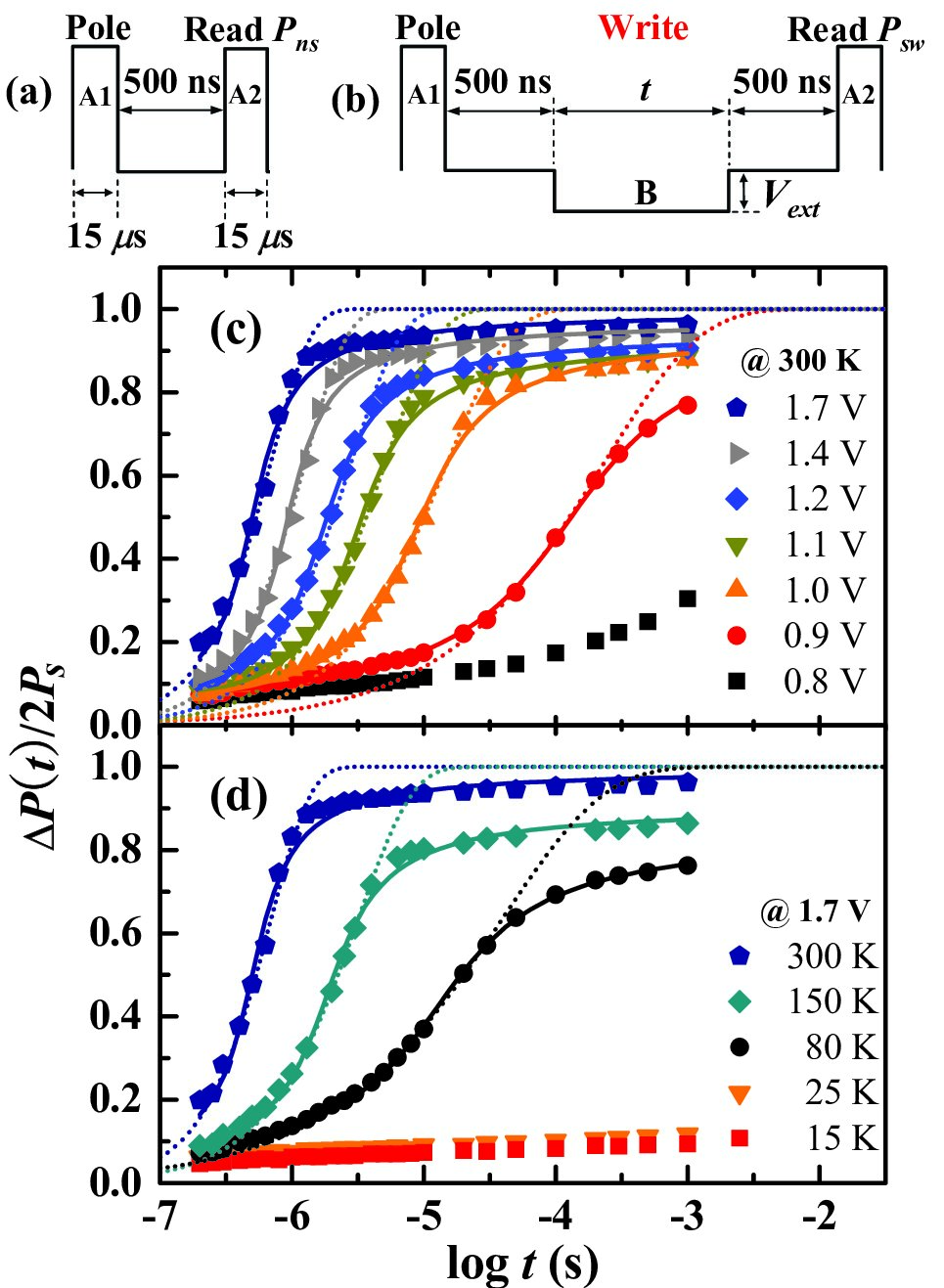 Figure 1
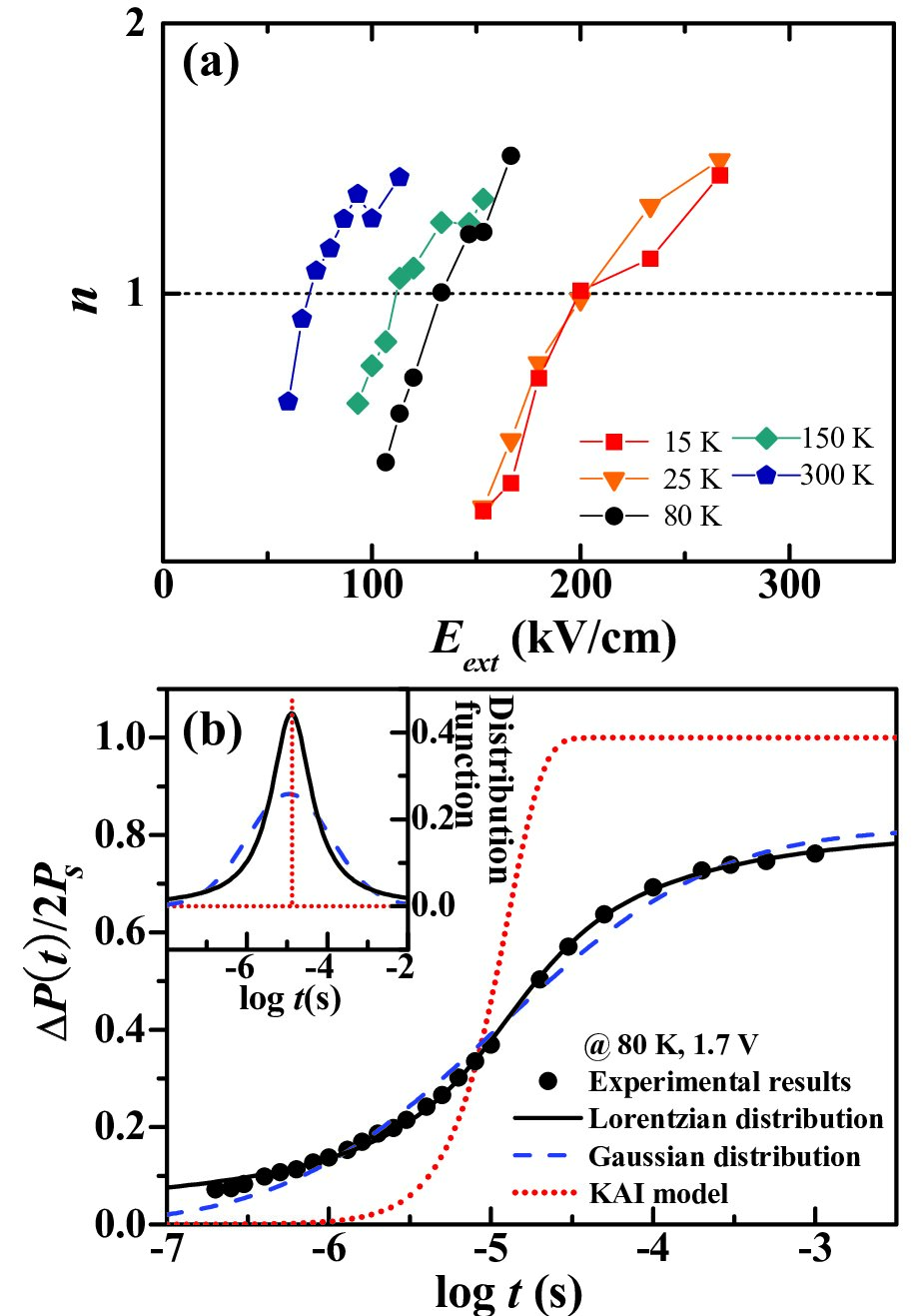 Figure 2
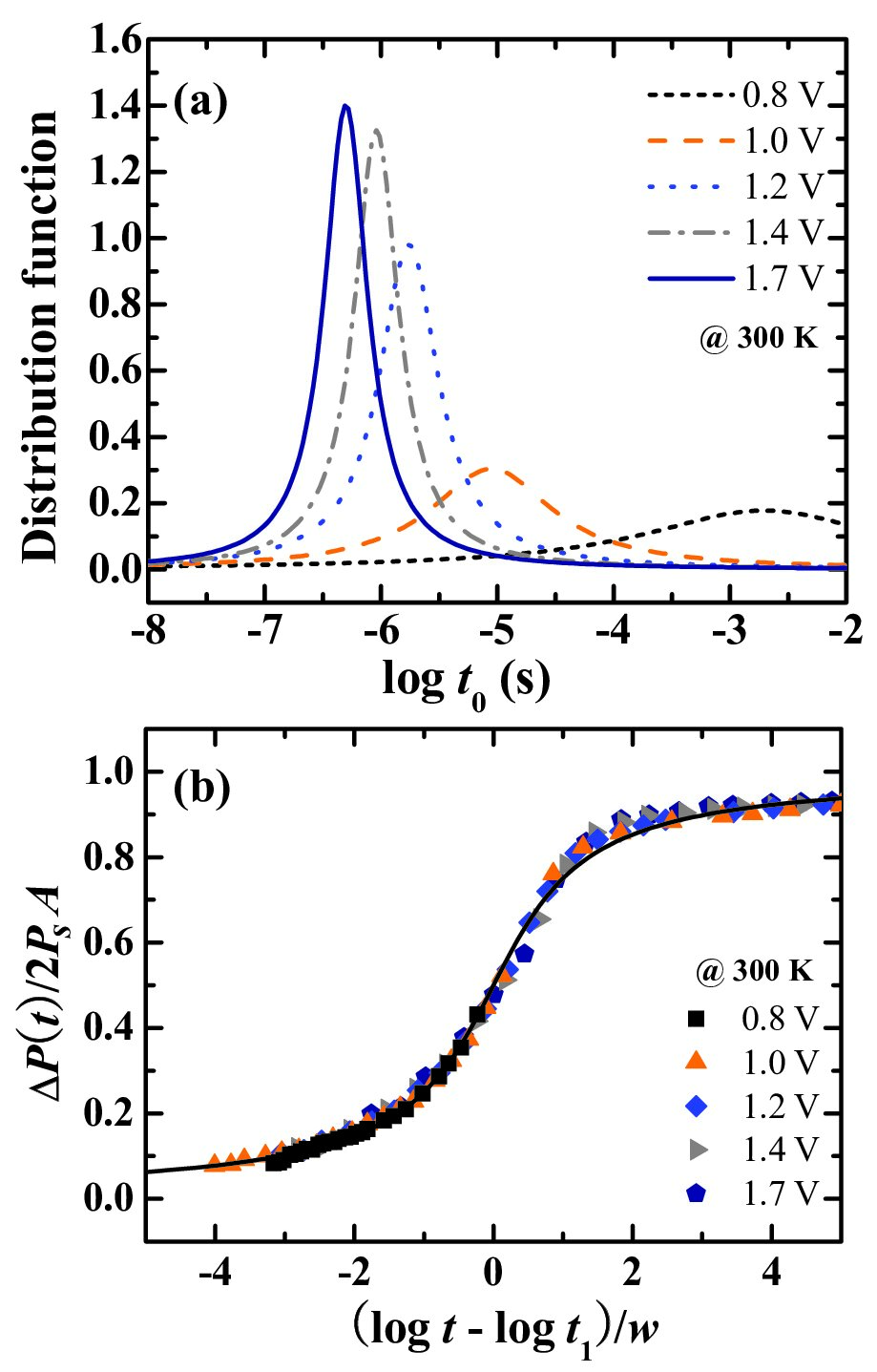 Figure 3
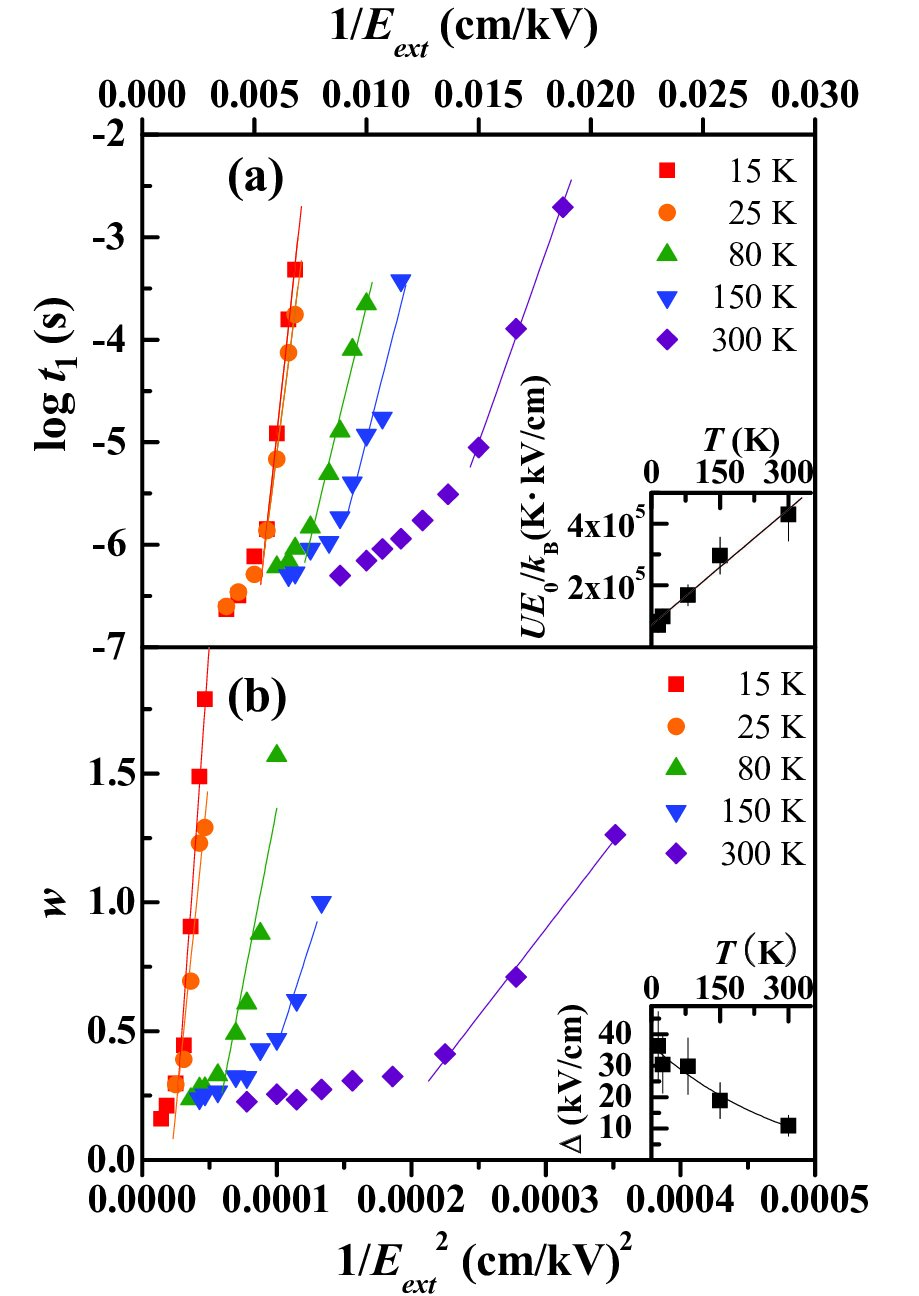 Figure 4
Peer Reviews
No public reviews on file for this paper yet. If you reviewed it on a platform where reviews are public (OpenReview, ICLR, NeurIPS, ICML), you can paste yours below so the community can read it here.
Videos
No videos yet. Explain this paper in a talk, walkthrough, or lecture? Add one.
Domain Switching Kinetics in Disordered Ferroelectric Thin Films
J. Y. Jo,1 H. S. Han,1 J.-G. Yoon,2 T. K. Song,3 S.-H. Kim,4
T. W. Noh1,
1ReCOE FPRD, Department of Physics and Astronomy, Seoul National University, Seoul 151-747, Korea2Department of Physics,University of Suwon, Suwon, Gyeonggi-do 445-743, Korea 3School of Nano Advanced Materials, Changwon National University, Changwon, Gyeongnam 641-773, Korea
4RD center, Inostek Inc., Ansan, Gyeonggi-do 426-901, Korea
Abstract
We investigated domain kinetics by measuring the polarization switching behaviors of polycrystalline Pb(Zr,Ti)O3 films, which are widely used in ferroelectric memory devices. Their switching behaviors at various electric fields and temperatures could be explained by assuming the Lorentzian distribution of domain switching times. We viewed the switching process under an electric field as a motion of the ferroelectric domain through a random medium, and we showed that the local field variation due to dipole defects at domain pinning sites could explain the intriguing distribution.
pacs:
77.80.Fm, 77.80.Dj, 77.84.Dy
††preprint: J. Y. Jo et al.
Domain switching kinetics in ferroelectrics (FEs) under an external electric field have been extensively investigated for several decades Scott1 ; YWSo ; Lohse ; Tagantsev ; Stolichnov ; Gruverman ; Shur ; Stolichnov2 ; BHPark . The traditional approach to explain the FE switching kinetics, often called the Kolmogorov-Avrami-Ishibashi (KAI) model, is based on the classical statistical theory of nucleation and unrestricted domain growth Kolmogorov ; Avrami . For a uniformly polarized FE sample under , the KAI model gives the time ()-dependent change in polarization () as
[TABLE]
where and are the effective dimension and characteristic switching time for the domain growth, respectively, and is spontaneous polarization. When the nuclei are appearing in time with the same probability, = 3 for bulk samples and = 2 for thin films remark1 . In addition, is proportional to the average distance between the nuclei, divided by the domain wall speed. Several studies have used the KAI model successfully to explain the () behaviors of FE single crystals and epitaxial thin films YWSo .
Recently, FE thin films have been intensively investigated for FE random access memory (FeRAM) Scott1 . Most commercial FeRAM use polycrystalline Pb(Zr,Ti)O3 (poly-PZT) films, and their () behaviors determine the reading and writing speeds of the FeRAM. In such non-epitaxial FE films, a domain cannot propagate indefinitely due to pinning caused by numerous defects, so the KAI model cannot be applied. Therefore, it is important both scientifically and technologically to clarify the domain switching kinetics of polycrystalline FE films.
Numerous studies have examined the behaviors of polycrystalline FE films, and the reported results vary markedly Shur ; Lohse ; Tagantsev ; Stolichnov ; Gruverman . Lohse measured the polarization switching currents of poly-PZT films, and showed that () slowed significantly compared to Eq. (1) Lohse . Tagantsev observed similar phenomena for poly-PZT films. To explain these behaviors, they developed the nucleation-limited-switching (NLS) model. They assumed that films consist of several areas that have independent switching kinetics:
[TABLE]
where (log ) is the distribution function for log Tagantsev . They assumed a very broad mesa-like function for (log ), and could explain their () data. The same authors also studied La-doped poly-PZT films and found that at room temperature is limited mainly by nucleation, while at a low temperature (), the switching kinetics are governed by domain wall motion, implying the validity of the KAI model Stolichnov .
In this Letter, we investigate the polarization switching behaviors of poly-PZT films. We can explain the measured () in terms of the Lorentzian distribution function for (log ), irrespective of . We show that such distribution arises from local field variation in a disordered system with dipole-dipole interactions.
Note that (111)-oriented poly-PZT films with a Ti concentration near 0.7 are the most widely used material in FeRAM applications. We prepared our polycrystalline PbZr0.3Ti0.7O3 thin film on Pt/Ti/SiO2/Si substrates using the sol-gel method. The poly-PZT film had a thickness of 150 nm. X-ray diffraction studies showed that it has the (111)-preferred orientation, and scanning electron microscopy studies indicated that our poly-PZT film consists of grains with a size of about 200 nm. We deposited Pt top electrodes using sputtering with a shadow mask. The areas of the top electrodes were about 7.910*-9* m2.
We obtain the () values of our Pt/PZT/Pt capacitors using pulse measurements Tagantsev ; YWSo ; YSKim ; JYJo1 . Figure 1(a) shows the pulse trains used to measure the non-switching polarization change (). Using pulse A1, we poled all the FE domains in one direction. Then, we applied pulse A2 with the same polarity, and measure the current passing a sensing resistor. By integrating the current, we could obtain the values. Figure 1(b) shows the pulse trains used to measure the switching polarization (). Inserting pulse B with the opposite polarity between pulses A1 and A2, we could reverse some portion of the FE domains, so the difference between the values of and represents the polarization change due to domain switching, namely (). We varied from 200 ns to 1 ms, and from 0.8 to 4 V. The value of can be estimated easily by dividing by the film thickness. At of 80300 K, we used pulses A1 and A2 with a height of 4 V, which was larger than the coercive voltage. Below 80 K, the coercive voltage increases, so we increased the pulse height to 6 V remark2 .
Figure 1(c) shows the values of ()/2 at room temperature with numerous values of . Figure 1(d) shows the values of ()/2 at various with = 1.7 V. The dotted lines in both figures are the curves best fitting Eq. (1). The KAI model predictions deviated markedly from the experimental () values in the late switching stage, in agreement with Gruverman . Gruverman . In addition, the best fitting results with the KAI model gave unreasonable values of . As shown in Fig. 2(a), the values of varied markedly with and . In addition, in the low region, we obtained values much smaller than 1, which are not proper as an effective dimension of domain growth. Therefore, Eq. (1) fails to describe the polarization switching behaviors of our PZT films.
To explain the measured (), we tried simple functions for (log ) in Eq. (2). The opposite domain, once nucleated, will propagate inside the film, so we fixed =2. The solid circles in Fig. 2(b) show the experimental t at 80 K with = 1.7 V. For (log ), we tried the delta, Gaussian, and Lorentzian distribution functions, as shown in the inset. The dotted line indicates the fitting results using Eq. (2) with a delta function. Note that this curve corresponds to a fit with the KAI model, and thus the classical theory cannot explain our experimental data. The dashed line shows the Gaussian fitting results. Although this fitting seems reasonable, some discrepancies occur. The solid black shows the fitting results with the Lorentzian distribution:
[TABLE]
where is a normalization constant, and (log ) is the half-width at half-maximum (a central value) remark3 . The Lorentzian fit can account for our observed () behaviors quite well.
We applied the Lorentzian fit to all of the other experimental () data. As shown by the solid lines in Figs. 1(c) and (d), the Lorentzian fit provides excellent explanations. Figure 3(a) presents the Lorentzian distribution functions used for the 300 K data. As increases, log and decrease. We rescaled the experimental ()/2 data using (log - log )/. All the data merge into a single line, an arctangent function remark3 , as shown in Fig. 3(b). Although not indicated in this figure, the experimental data for all other also merged with this line. This scaling behavior suggests that the Lorentzian distribution function for log is intrinsic.
Note that (log ) follows not the Gaussian distribution, but the Lorentzian distribution. For a statistically independent random process, it is a basic statistical rule that the resulting distribution should become Gaussian, regardless of the process details Reif . For example, impurities (or crystal defects) inside a real crystal result in inhomogeneous broadening of the light absorption line, which has a Gaussian line shape.
However, some studies have observed that magnetic resonance line broadening of randomly distributed dipole impurities follows the Lorentzian distribution Vleck . The first rigorous theoretical result for this problem is that of Anderson, who showed that the distribution of any interaction field component in the system of dilute aligned dipoles should be Lorentzian Anderson ; Klauder . Polycrystalline FE films should contain many dipole defects that will act as pinning sites for the domain wall motion. To explain our observed Lorentzian distribution of log , we assume that a local field exists at the FE domain pinning sites and that it has a Lorentzian distribution:
[TABLE]
where is the half-width at half-maximum of the distribution function, related to the concentration of pinning sites.
In the low region, the domain wall motion should be governed by thermal activation process at the pinning sites. Without effects, thermal activation results in a domain wall speed in the form 1/ [-(/)(/)], where is the energy barrier and is the threshold electric field for pinned domains Triscone . Since results in a change in the effective electric field at pinning sites, the associated can be expressed as
[TABLE]
Then, the distribution of results in a distribution in log , using the relation . With
[TABLE]
and
[TABLE]
we can obtain the desired Lorentzian distribution for (log ), i.e., Eq. (3), from Eqs. (4) and (5).
Our experimental values for log and agree with the analytical forms. Figures 4(a) and (b) plot log 1/ and 1/ at various , respectively. Both log and follow the expected -dependence in the low region. Note that Eq. (6) is consistent with Merz’s law Merz , which states that the current coming from FE polarization switching should have a characteristic time of (/), where is the activation field. Using this empirical law, several studies have measured values. For example, So . reported 1700 kV/cm for 100-nm-thick epitaxial PZT films YWSo , and Scott . reported 270 kV/cm for 350-nm-thick poly-PZT films Scott2 . These values are consistent with our room temperature value of /, i.e., 1400 kV/cm.
Our model viewed the FE domain switching kinetics as domain wall motion driven by with a random pinning potential. In the low region, thermal activation at the pinning sites can be important, resulting in the so-called domain wall creep motion. Applying atomic force microscopy, Tybell . Triscone and Paruch . Paruch demonstrated that the domain-switching kinetics in epitaxial PZT films are governed by the domain wall creep motion. Some theoreticians studied the domain wall creep motion of an elastic string in a random potential. They found a linear increase in with an increase in Kolton . The insets in Fig. 4(a) show that the value of / obtained from the linear fits in Fig. 4(a) increase linearly with , consistent with the theoretical prediction for Kolton . The inset in Fig. 4(b) shows obtained from the fits to Fig. 4(b). Similar exponential decay behavior was predicted in a magnetic resonance study of randomly distributed dipoles Klein .
At this point, we wish to compare our model with the NLS model. Although both models use Eq. (2), the origins and forms for (log ) are quite different. In the NLS model, the FE film consists of numerous areas, each with its own and independent . Subsequently, it was suggested that the individually switched regions correspond to single grains or clusters of grains in which the grain boundaries act as frontiers limiting the propagation of the switched region Stolichnov2 . Consequently, the NLS model can be applied for polycrystalline films only, and the form of (log ) should depend on their microstructure. Conversely, in our model, the interaction between dipole defects inside the FE film induces a distribution in the local field, which results in (log ). Therefore, both point defects and the grain boundaries could act as pinning sites. Using the Lorentzian distribution for (log ), our model can be used for both epitaxial and polycrystalline FE films YWSo . Using Eqs. (2) and (3) with small values, we could successfully explain the for FE single crystals or epitaxial thin films YWSo . We also found that our model can explain the data for poly-PZT films with Ti concentrations of 0.48 and 0.65.
Note that our model for thermally activated domain switching kinetics can be viewed as the famous problem that treats the propagation of elastic objects driven by an external force in presence of a pinning potential Triscone ; Paruch ; Kolton . It can be applied to many FE films, since the domain wall motion with a disordered pinning potential should be the dominant mechanism for . Therefore, the studies can be used to investigate numerous intriguing issues concerning nonlinear systems, such as creep motion, avalanche phenomenon, pinning/depinning transition, and so on.
In summary, we investigated the polarization switching behaviors of (111)-oriented poly-PZT films and found that the characteristic switching time obeyed the Lorentzian distribution. We explained this intriguing phenomenon by introducing the local electric field due to the defect dipole.
The authors thank D. Kim for fruitful discussions. This study was financially supported by Creative Research Initiatives (Functionally Integrated Oxide Heterostructure) of MOST/KOSEF.
The reference list from the paper itself. Each links out to its DOI / PubMed record.
- 1(1) Ferroelectric Memories , edited by J. F. Scott (Springer-Verlag, Berlin, 2000).
- 2(2) Y. W. So et al. , Appl. Phys. Lett. 86 , 92905 (2005) and references therein.
- 3(3) O. Lohse et al. , J. Appl. Phys. 89 , 2332 (2001).
- 4(4) A. K. Tagantsev et al. , Phys. Rev. B 66 , 214109 (2002).
- 5(5) I. Stolichnov et al. , Appl. Phys. Lett. 83 , 3362 (2003).
- 6(6) A. Gruverman et al. , Appl. Phys. Lett. 87 , 082902 (2005).
- 7(7) V. Shur et al. , J. Appl. Phys. 84 , 445 (1998).
- 8(8) I. Stolichnov et al. , Appl. Phys. Lett. 86 , 012902 (2005).