Measurement of D0-D0bar mixing in D0->Ks pi+ pi- decays
L.M. Zhang, et al (for the Belle Collaboration)

TL;DR
This paper measures D0-D0bar mixing parameters using a time-dependent Dalitz plot analysis of D0->Ks pi+ pi- decays with a large data sample, exploring CP conservation and violation.
Contribution
It provides the first detailed measurement of D0-D0bar mixing parameters and CP violation effects in this decay mode using a comprehensive Dalitz plot analysis.
Findings
Measured mixing parameters x and y with statistical and systematic uncertainties.
Set limits on CP violation parameters |q/p| and arg(q/p).
Demonstrated the feasibility of time-dependent Dalitz analysis for mixing studies.
Abstract
We report a measurement of D0-D0bar mixing in D0->Ks pi+ pi- decays using a time-dependent Dalitz plot analysis. We first assume CP conservation and subsequently allow for CP violation. The results are based on 540 fb of data accumulated with the Belle detector at the KEKB collider. Assuming negligible CP violation, we measure the mixing parameters and , where the errors are statistical, experimental systematic, and systematic due to the Dalitz decay model, respectively. Allowing for CP violation, we obtain the parameters and .
Click any figure to enlarge with its caption.
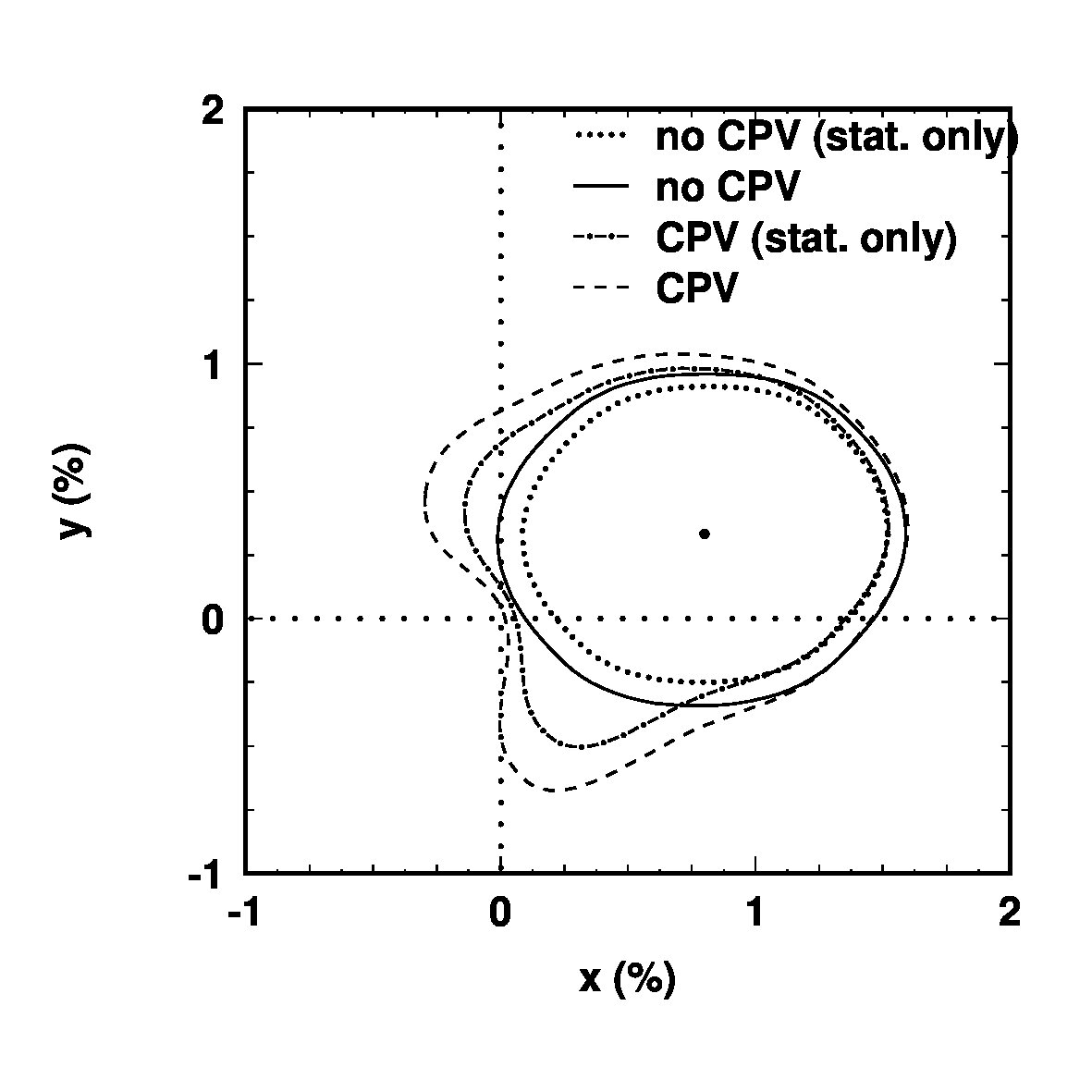 Figure 1
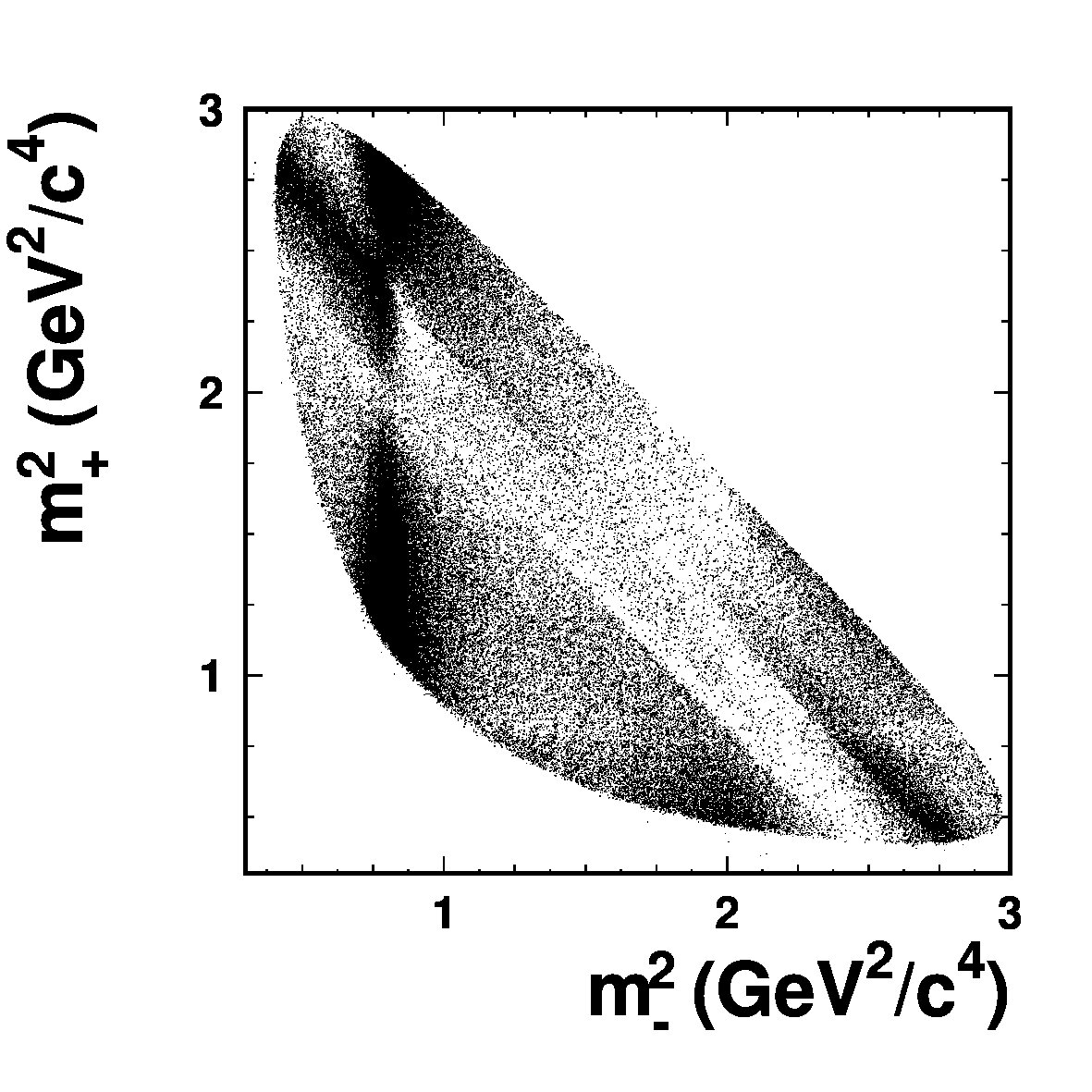 Figure 2
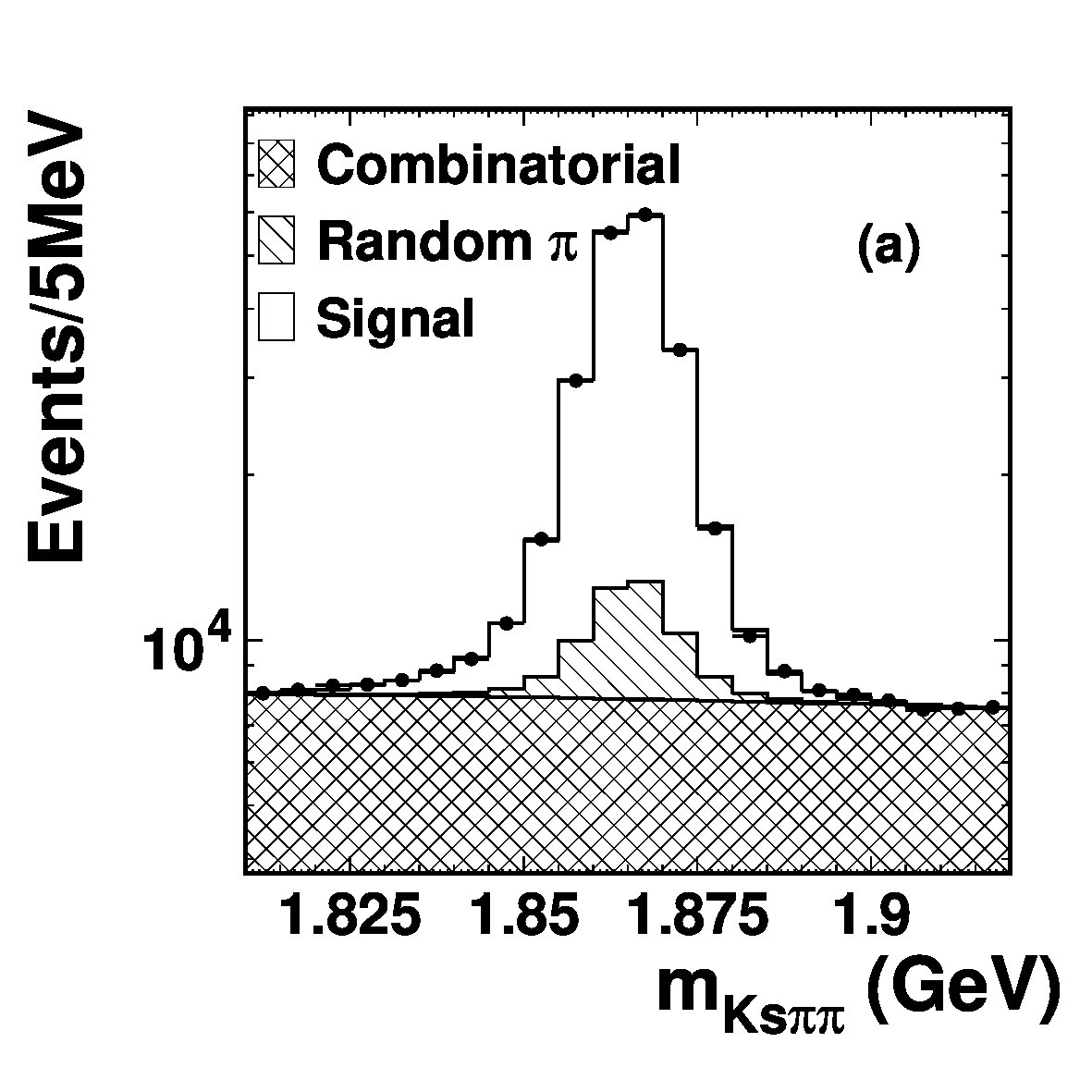 Figure 1
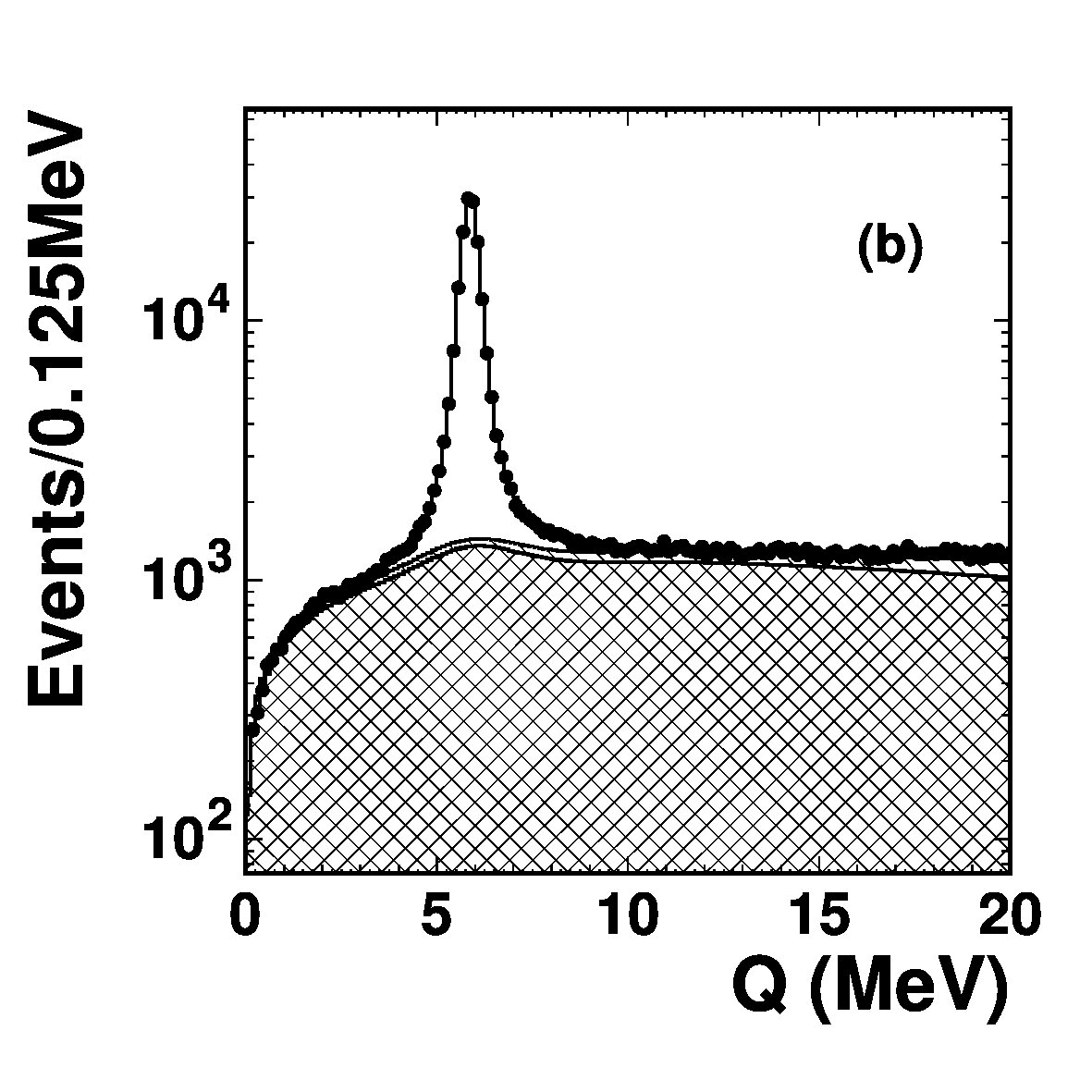 Figure 1
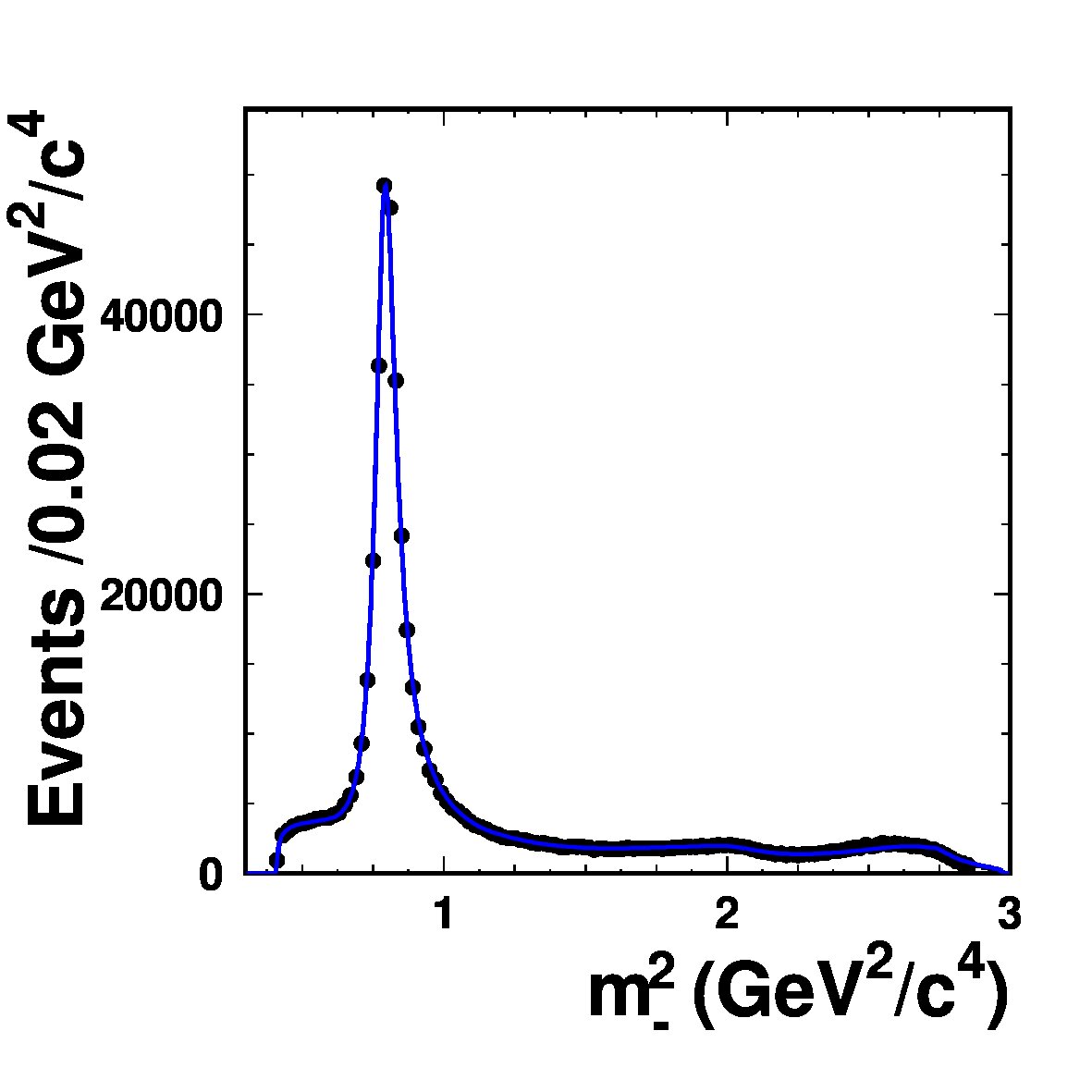 Figure 5
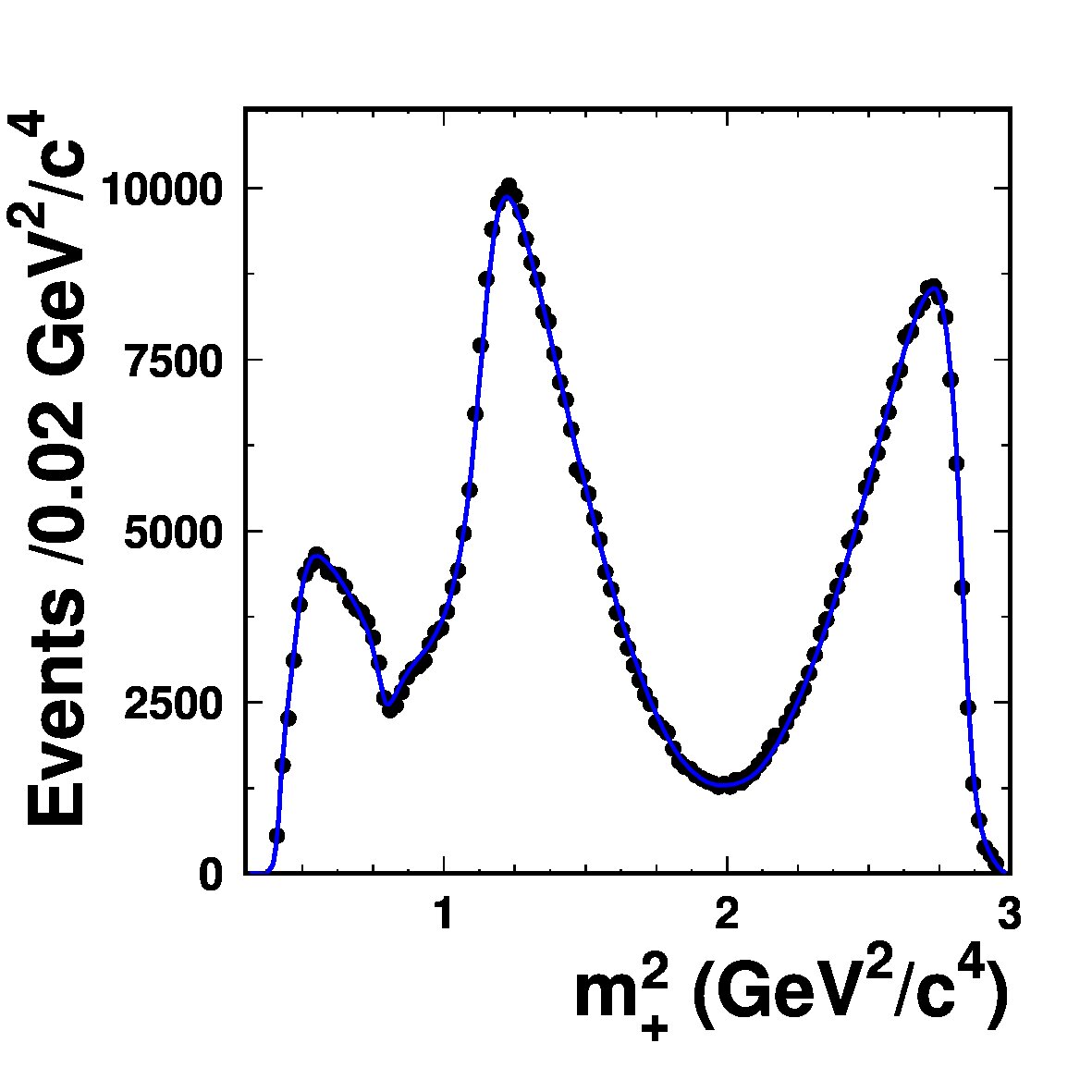 Figure 6
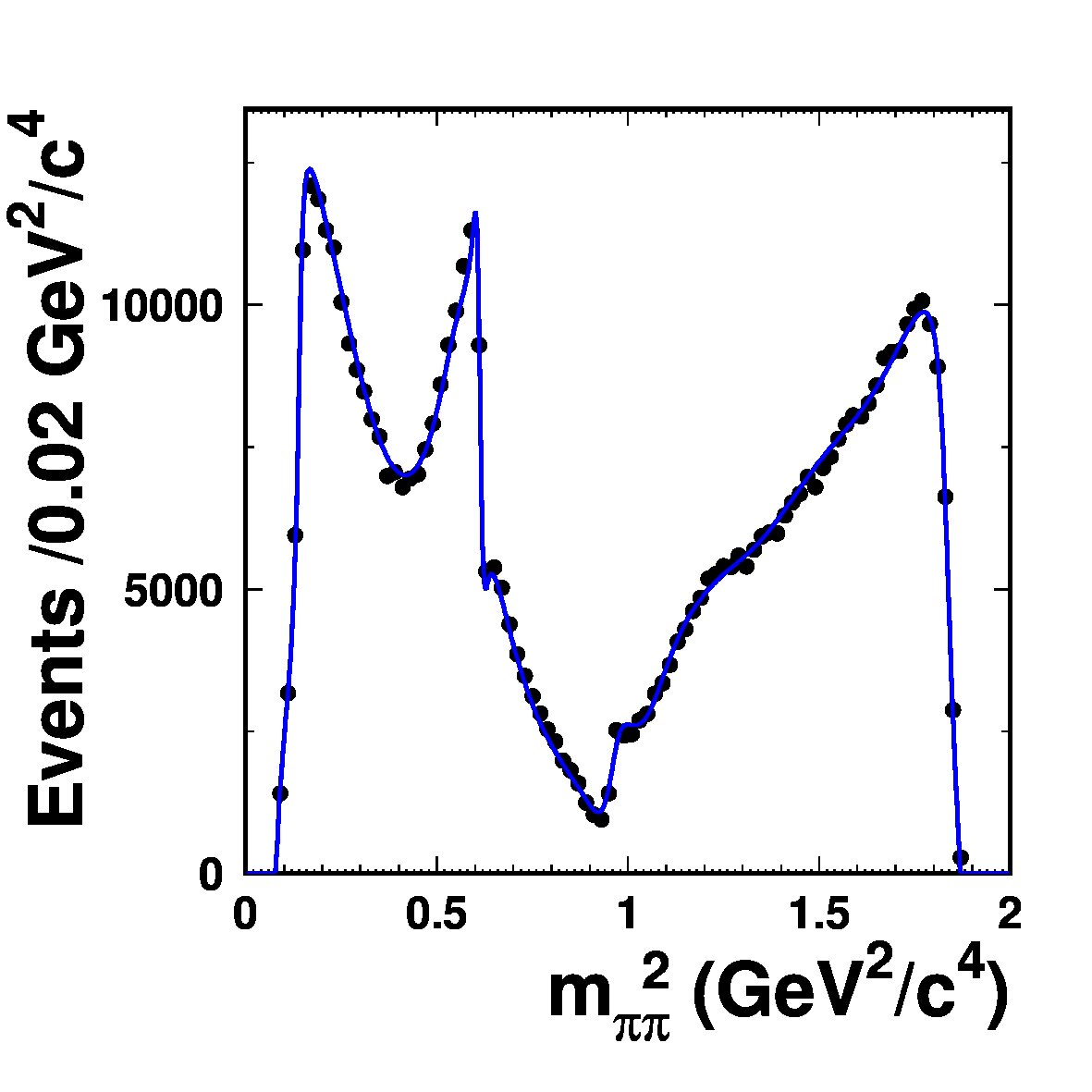 Figure 7
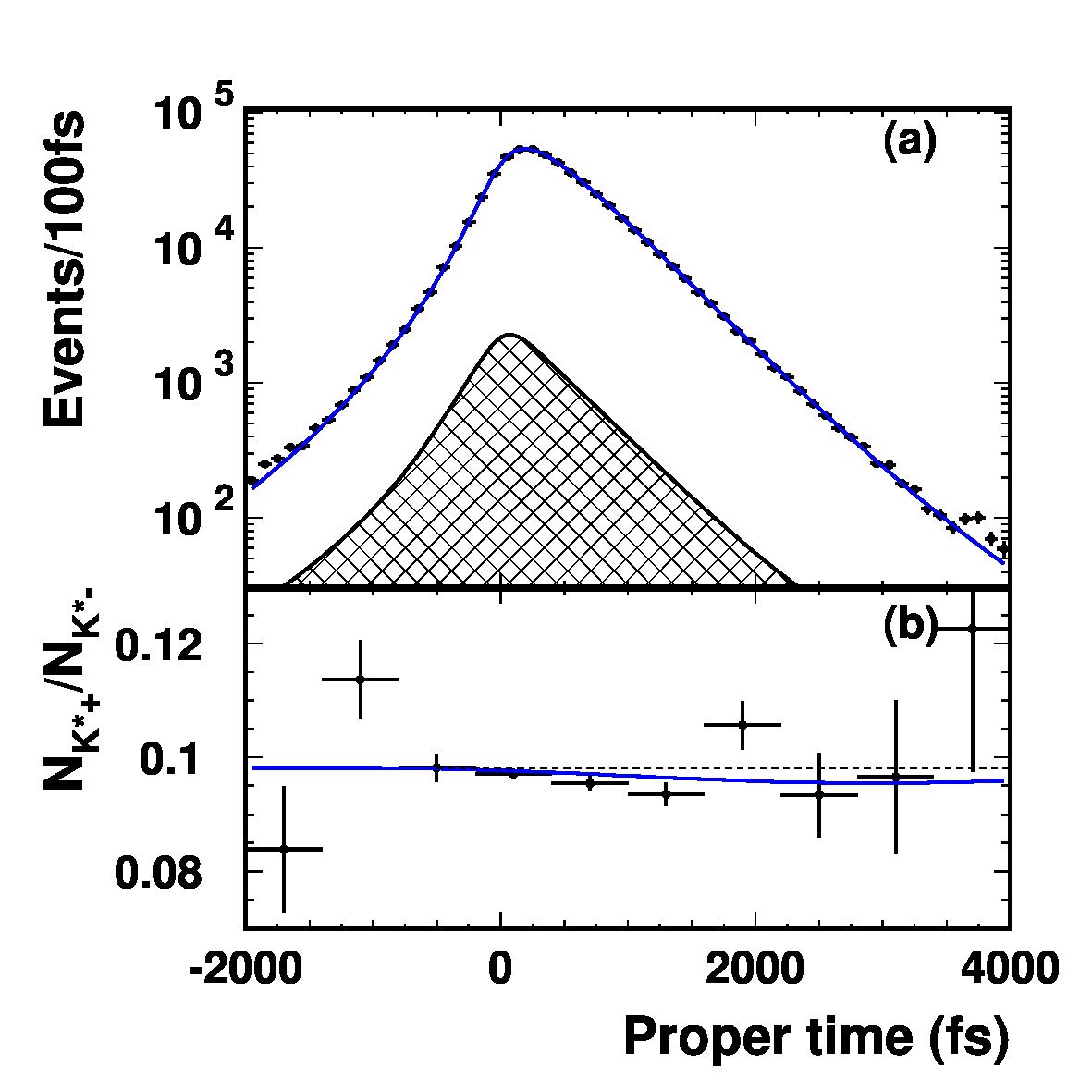 Figure 8
| Fit case | Parameter | Fit result | 95% C.L. interval |
|---|---|---|---|
| No | |||
| 1.6 | |||
| 1.04 | |||
| - | |||
| - |
| Resonance | Amplitude | Phase (∘) | Fit fraction |
| 0.6227 | |||
| 0.0724 | |||
| 0.0133 | |||
| 0.0048 | |||
| 0.0002 | |||
| 0.0054 | |||
| 0.0047 | |||
| 0.0013 | |||
| 0.0013 | |||
| 0.0004 | |||
| 1 (fixed) | 0 (fixed) | 0.2111 | |
| 0.0063 | |||
| 0.0452 | |||
| 0.0162 | |||
| 0.0180 | |||
| 0.0024 | |||
| 0.0914 | |||
| 0.0088 | |||
| NR | 0.0615 |
Peer Reviews
No public reviews on file for this paper yet. If you reviewed it on a platform where reviews are public (OpenReview, ICLR, NeurIPS, ICML), you can paste yours below so the community can read it here.
Videos
No videos yet. Explain this paper in a talk, walkthrough, or lecture? Add one.
The Belle Collaboration
Measurement of - mixing in decays
L. M. Zhang
University of Science and Technology of China, Hefei
Z. P. Zhang
University of Science and Technology of China, Hefei
I. Adachi
High Energy Accelerator Research Organization (KEK), Tsukuba
H. Aihara
Department of Physics, University of Tokyo, Tokyo
V. Aulchenko
Budker Institute of Nuclear Physics, Novosibirsk
T. Aushev
Swiss Federal Institute of Technology of Lausanne, EPFL, Lausanne
Institute for Theoretical and Experimental Physics, Moscow
A. M. Bakich
University of Sydney, Sydney, New South Wales
V. Balagura
Institute for Theoretical and Experimental Physics, Moscow
E. Barberio
University of Melbourne, School of Physics, Victoria 3010
A. Bay
Swiss Federal Institute of Technology of Lausanne, EPFL, Lausanne
K. Belous
Institute of High Energy Physics, Protvino
U. Bitenc
J. Stefan Institute, Ljubljana
A. Bondar
Budker Institute of Nuclear Physics, Novosibirsk
A. Bozek
H. Niewodniczanski Institute of Nuclear Physics, Krakow
M. Bračko
University of Maribor, Maribor
J. Stefan Institute, Ljubljana
J. Brodzicka
High Energy Accelerator Research Organization (KEK), Tsukuba
T. E. Browder
University of Hawaii, Honolulu, Hawaii 96822
P. Chang
Department of Physics, National Taiwan University, Taipei
Y. Chao
Department of Physics, National Taiwan University, Taipei
A. Chen
National Central University, Chung-li
K.-F. Chen
Department of Physics, National Taiwan University, Taipei
W. T. Chen
National Central University, Chung-li
B. G. Cheon
Hanyang University, Seoul
C.-C. Chiang
Department of Physics, National Taiwan University, Taipei
I.-S. Cho
Yonsei University, Seoul
Y. Choi
Sungkyunkwan University, Suwon
Y. K. Choi
Sungkyunkwan University, Suwon
J. Dalseno
University of Melbourne, School of Physics, Victoria 3010
M. Danilov
Institute for Theoretical and Experimental Physics, Moscow
M. Dash
Virginia Polytechnic Institute and State University, Blacksburg, Virginia 24061
A. Drutskoy
University of Cincinnati, Cincinnati, Ohio 45221
S. Eidelman
Budker Institute of Nuclear Physics, Novosibirsk
D. Epifanov
Budker Institute of Nuclear Physics, Novosibirsk
S. Fratina
J. Stefan Institute, Ljubljana
N. Gabyshev
Budker Institute of Nuclear Physics, Novosibirsk
G. Gokhroo
Tata Institute of Fundamental Research, Mumbai
B. Golob
University of Ljubljana, Ljubljana
J. Stefan Institute, Ljubljana
H. Ha
Korea University, Seoul
J. Haba
High Energy Accelerator Research Organization (KEK), Tsukuba
T. Hara
Osaka University, Osaka
N. C. Hastings
Department of Physics, University of Tokyo, Tokyo
K. Hayasaka
Nagoya University, Nagoya
H. Hayashii
Nara Women’s University, Nara
M. Hazumi
High Energy Accelerator Research Organization (KEK), Tsukuba
D. Heffernan
Osaka University, Osaka
T. Hokuue
Nagoya University, Nagoya
Y. Hoshi
Tohoku Gakuin University, Tagajo
W.-S. Hou
Department of Physics, National Taiwan University, Taipei
Y. B. Hsiung
Department of Physics, National Taiwan University, Taipei
H. J. Hyun
Kyungpook National University, Taegu
T. Iijima
Nagoya University, Nagoya
K. Ikado
Nagoya University, Nagoya
K. Inami
Nagoya University, Nagoya
A. Ishikawa
Department of Physics, University of Tokyo, Tokyo
H. Ishino
Tokyo Institute of Technology, Tokyo
R. Itoh
High Energy Accelerator Research Organization (KEK), Tsukuba
M. Iwasaki
Department of Physics, University of Tokyo, Tokyo
Y. Iwasaki
High Energy Accelerator Research Organization (KEK), Tsukuba
N. J. Joshi
Tata Institute of Fundamental Research, Mumbai
D. H. Kah
Kyungpook National University, Taegu
H. Kaji
Nagoya University, Nagoya
S. Kajiwara
Osaka University, Osaka
J. H. Kang
Yonsei University, Seoul
H. Kawai
Chiba University, Chiba
T. Kawasaki
Niigata University, Niigata
H. Kichimi
High Energy Accelerator Research Organization (KEK), Tsukuba
H. J. Kim
Kyungpook National University, Taegu
H. O. Kim
Sungkyunkwan University, Suwon
S. K. Kim
Seoul National University, Seoul
Y. J. Kim
The Graduate University for Advanced Studies, Hayama
K. Kinoshita
University of Cincinnati, Cincinnati, Ohio 45221
S. Korpar
University of Maribor, Maribor
J. Stefan Institute, Ljubljana
P. Križan
University of Ljubljana, Ljubljana
J. Stefan Institute, Ljubljana
P. Krokovny
High Energy Accelerator Research Organization (KEK), Tsukuba
R. Kumar
Panjab University, Chandigarh
C. C. Kuo
National Central University, Chung-li
A. Kuzmin
Budker Institute of Nuclear Physics, Novosibirsk
Y.-J. Kwon
Yonsei University, Seoul
J. S. Lee
Sungkyunkwan University, Suwon
M. J. Lee
Seoul National University, Seoul
S. E. Lee
Seoul National University, Seoul
T. Lesiak
H. Niewodniczanski Institute of Nuclear Physics, Krakow
J. Li
University of Hawaii, Honolulu, Hawaii 96822
A. Limosani
University of Melbourne, School of Physics, Victoria 3010
S.-W. Lin
Department of Physics, National Taiwan University, Taipei
Y. Liu
The Graduate University for Advanced Studies, Hayama
D. Liventsev
Institute for Theoretical and Experimental Physics, Moscow
T. Matsumoto
Tokyo Metropolitan University, Tokyo
A. Matyja
H. Niewodniczanski Institute of Nuclear Physics, Krakow
S. McOnie
University of Sydney, Sydney, New South Wales
T. Medvedeva
Institute for Theoretical and Experimental Physics, Moscow
W. Mitaroff
Institute of High Energy Physics, Vienna
H. Miyake
Osaka University, Osaka
H. Miyata
Niigata University, Niigata
Y. Miyazaki
Nagoya University, Nagoya
R. Mizuk
Institute for Theoretical and Experimental Physics, Moscow
Y. Nagasaka
Hiroshima Institute of Technology, Hiroshima
I. Nakamura
High Energy Accelerator Research Organization (KEK), Tsukuba
E. Nakano
Osaka City University, Osaka
M. Nakao
High Energy Accelerator Research Organization (KEK), Tsukuba
Z. Natkaniec
H. Niewodniczanski Institute of Nuclear Physics, Krakow
S. Nishida
High Energy Accelerator Research Organization (KEK), Tsukuba
O. Nitoh
Tokyo University of Agriculture and Technology, Tokyo
S. Ogawa
Toho University, Funabashi
T. Ohshima
Nagoya University, Nagoya
S. Okuno
Kanagawa University, Yokohama
S. L. Olsen
University of Hawaii, Honolulu, Hawaii 96822
Y. Onuki
RIKEN BNL Research Center, Upton, New York 11973
W. Ostrowicz
H. Niewodniczanski Institute of Nuclear Physics, Krakow
H. Ozaki
High Energy Accelerator Research Organization (KEK), Tsukuba
P. Pakhlov
Institute for Theoretical and Experimental Physics, Moscow
G. Pakhlova
Institute for Theoretical and Experimental Physics, Moscow
C. W. Park
Sungkyunkwan University, Suwon
H. Park
Kyungpook National University, Taegu
L. S. Peak
University of Sydney, Sydney, New South Wales
R. Pestotnik
J. Stefan Institute, Ljubljana
L. E. Piilonen
Virginia Polytechnic Institute and State University, Blacksburg, Virginia 24061
A. Poluektov
Budker Institute of Nuclear Physics, Novosibirsk
H. Sahoo
University of Hawaii, Honolulu, Hawaii 96822
Y. Sakai
High Energy Accelerator Research Organization (KEK), Tsukuba
O. Schneider
Swiss Federal Institute of Technology of Lausanne, EPFL, Lausanne
J. Schümann
High Energy Accelerator Research Organization (KEK), Tsukuba
C. Schwanda
Institute of High Energy Physics, Vienna
A. J. Schwartz
University of Cincinnati, Cincinnati, Ohio 45221
R. Seidl
University of Illinois at Urbana-Champaign, Urbana, Illinois 61801
RIKEN BNL Research Center, Upton, New York 11973
K. Senyo
Nagoya University, Nagoya
M. E. Sevior
University of Melbourne, School of Physics, Victoria 3010
M. Shapkin
Institute of High Energy Physics, Protvino
H. Shibuya
Toho University, Funabashi
S. Shinomiya
Osaka University, Osaka
J.-G. Shiu
Department of Physics, National Taiwan University, Taipei
B. Shwartz
Budker Institute of Nuclear Physics, Novosibirsk
J. B. Singh
Panjab University, Chandigarh
A. Sokolov
Institute of High Energy Physics, Protvino
A. Somov
University of Cincinnati, Cincinnati, Ohio 45221
N. Soni
Panjab University, Chandigarh
S. Stanič
University of Nova Gorica, Nova Gorica
M. Starič
J. Stefan Institute, Ljubljana
H. Stoeck
University of Sydney, Sydney, New South Wales
K. Sumisawa
High Energy Accelerator Research Organization (KEK), Tsukuba
T. Sumiyoshi
Tokyo Metropolitan University, Tokyo
S. Suzuki
Saga University, Saga
O. Tajima
High Energy Accelerator Research Organization (KEK), Tsukuba
F. Takasaki
High Energy Accelerator Research Organization (KEK), Tsukuba
K. Tamai
High Energy Accelerator Research Organization (KEK), Tsukuba
N. Tamura
Niigata University, Niigata
M. Tanaka
High Energy Accelerator Research Organization (KEK), Tsukuba
G. N. Taylor
University of Melbourne, School of Physics, Victoria 3010
Y. Teramoto
Osaka City University, Osaka
X. C. Tian
Peking University, Beijing
I. Tikhomirov
Institute for Theoretical and Experimental Physics, Moscow
T. Tsuboyama
High Energy Accelerator Research Organization (KEK), Tsukuba
S. Uehara
High Energy Accelerator Research Organization (KEK), Tsukuba
K. Ueno
Department of Physics, National Taiwan University, Taipei
T. Uglov
Institute for Theoretical and Experimental Physics, Moscow
Y. Unno
Hanyang University, Seoul
S. Uno
High Energy Accelerator Research Organization (KEK), Tsukuba
P. Urquijo
University of Melbourne, School of Physics, Victoria 3010
Y. Usov
Budker Institute of Nuclear Physics, Novosibirsk
G. Varner
University of Hawaii, Honolulu, Hawaii 96822
K. Vervink
Swiss Federal Institute of Technology of Lausanne, EPFL, Lausanne
S. Villa
Swiss Federal Institute of Technology of Lausanne, EPFL, Lausanne
A. Vinokurova
Budker Institute of Nuclear Physics, Novosibirsk
C. H. Wang
National United University, Miao Li
M.-Z. Wang
Department of Physics, National Taiwan University, Taipei
P. Wang
Institute of High Energy Physics, Chinese Academy of Sciences, Beijing
Y. Watanabe
Kanagawa University, Yokohama
E. Won
Korea University, Seoul
B. D. Yabsley
University of Sydney, Sydney, New South Wales
A. Yamaguchi
Tohoku University, Sendai
Y. Yamashita
Nippon Dental University, Niigata
M. Yamauchi
High Energy Accelerator Research Organization (KEK), Tsukuba
C. Z. Yuan
Institute of High Energy Physics, Chinese Academy of Sciences, Beijing
C. C. Zhang
Institute of High Energy Physics, Chinese Academy of Sciences, Beijing
V. Zhilich
Budker Institute of Nuclear Physics, Novosibirsk
A. Zupanc
J. Stefan Institute, Ljubljana
Abstract
We report a measurement of - mixing in decays using a time-dependent Dalitz plot analysis. We first assume conservation and subsequently allow for violation. The results are based on 540 fb*-1* of data accumulated with the Belle detector at the KEKB collider. Assuming negligible violation, we measure the mixing parameters and , where the errors are statistical, experimental systematic, and systematic due to the Dalitz decay model, respectively. Allowing for violation, we obtain the parameters and .
pacs:
13.25.Ft, 11.30.Er, 12.15.Ff
Mixing in the - system is predicted to be very small in the Standard Model (SM) th1 and, unlike in , , and systems, has eluded experimental observation. Recently, evidence for this phenomenon has been found in y_cp and kpi_BaBar decays. It is important to measure - mixing in other decay modes and to search for -violating () effects in order to determine whether physics contributions outside the SM are present. Here we study the self-conjugate decay .
The time-dependent probability of flavor eigenstates and to mix to each other is governed by the lifetime , and the mixing parameters and . The parameters () are the masses (decay widths) of the mass eigenstates , and . The parameters and are complex coefficients satisfying . Various decay modes have been exploited to measure or constrain and PDG_asner . For decays, the time dependence of the Dalitz plot distribution allows one to measure and directly. This method was developed by CLEO asner using 9.0 fb*-1* of data; here we extend this method to a data sample 60 times larger.
The decay amplitude at time of an initially produced or can be expressed as
[TABLE]
where and are the amplitudes for and decays as functions of the invariant-masses-squared variables . The time dependence is contained in the terms . Upon squaring and , one obtains decay rates containing terms , , and .
We parameterize the Dalitz distribution following Ref. Anton . The overall amplitude as a function of and is expressed as a sum of quasi-two-body amplitudes (subscript ) and a constant non-resonant term (subscript NR):
[TABLE]
The functions are products of Blatt-Weisskopf form factors and relativistic Breit-Wigner functions kopp .
The data were recorded by the Belle detector at the KEKB asymmetric-energy collider kek . The Belle detector belle includes a silicon vertex detector (SVD), a central drift chamber (CDC), an array of aerogel threshold Cherenkov counters (ACC), a barrel-like arrangement of time-of-flight scintillation counters (TOF), and an electromagnetic calorimeter.
We reconstruct candidates via the decay chain , chargeconjugate . Here, denotes a low-momentum pion, the charge of which tags the flavor of the neutral at production. The candidates are reconstructed in the final state; we require that the pion candidates form a common vertex separated from the interaction region and have an invariant mass within MeV/ of . We reconstruct candidates by combining the candidate with two oppositely charged tracks assigned as pions. These tracks are required to have at least two SVD hits in both - and coordinates. A candidate is reconstructed by combining the candidate with a low momentum charged track (the candidate); the resulting momentum in the center-of-mass (CM) frame is required to be larger than 2.5 GeV/ in order to eliminate events and suppress combinatorial background.
The charged pion tracks are refitted to originate from a common vertex, which represents the decay point of the . The vertex is taken to be the intersection of the momentum vector with the interaction region. The proper decay time is calculated from the projection of the vector joining the two vertices () onto the momentum vector: . The uncertainty in () is calculated event-by-event, and we require ps (for selected events, ps).
The signal and background yields are determined from a two-dimensional fit to the variables and . The variable is the kinetic energy released in the decay and equals only 5.9 MeV for decays. We parameterize the signal shape by a triple-Gaussian function for , and the sum of a bifurcated Student distribution and a Gaussian function for . The backgrounds are classified into two types: random background, in which a random is combined with a true decay, and combinatorial background. The shape of the distribution for the random background is fixed to be the same as that used for the signal. Other background distributions are obtained from Monte Carlo (MC) simulation. We perform a two-dimensional fit to the measured - distributions in a wide range and MeV. We define a smaller signal region MeV/ and MeV MeV, corresponding to intervals in these variables. In this region we find signal events and background fractions of 1% and 4% for the random and combinatorial backgrounds, respectively. The and distributions are shown in Fig. 1 along with projections of the fit result.
For the events selected in the signal region we perform an unbinned likelihood fit to the Dalitz plot variables and , and the decay time . For decays, the likelihood function is
[TABLE]
where denotes the signal or background components, and the index runs over candidates. The event weights are functions of and and are obtained from the - fit mentioned above.
The probability density function (PDF) equals convolved with the detector response. Resolution effects in two-particle invariant masses are significant only for . The latter, and variation of the efficiency across the Dalitz plot, are taken into account using the method described in Ref. Anton . The resolution in decay time is accounted for by convolving with a resolution function consisting of a sum of three Gaussians with a common mean and widths (). The scale factors and the common mean are free parameters in the fit.
The random background contains real and decays; in this case the charge of the is uncorrelated with the flavor of the neutral . Thus the PDF is taken to be , convolved with the same resolution function as that used for the signal, where is the wrong-tag fraction. We measure from fitting events in the sideband 3 MeV MeV.
For the combinatorial background, is the product of Dalitz-plot and decay time PDFs. The latter is parameterized as the sum of a delta function and an exponential function convolved with a Gaussian resolution function. The timing and Dalitz PDF parameters are obtained from fitting events in the mass sideband 30 MeV/c^{2}$$<|m_{K_{S}^{0}\pi\pi}-m_{D^{0}}|<55 MeV/.
The likelihood function for decays, , has the same form as , with and (appearing in and ) interchanged. To determine and , we maximize the sum . Table 1 lists the results from two separate fits. In the first fit we assume is conserved, i.e., , , and . We fit all events in the signal region, where the free parameters are , , , the timing resolution parameters of the signal, and the Dalitz plot resonance parameters and . The fit gives fs, which is consistent with the world average PDG . The results for and for the 18 quasi-two-body resonances used (following the same model as in Ref. Anton ) and the NR contribution are listed in Table 2. The Dalitz plot and its projections, along with projections of the fit result, are shown in Fig. 2. We estimate the goodness-of-fit of the Dalitz plot through a two-dimensional test Anton and obtain for degrees of freedom (). We find that the main features of the Dalitz plot are well reproduced, with some significant but numerically small discrepancies at peaks and dips of the distribution in the very high region. The decay-time distribution for all events, and the ratio of decay-time distribution for events in the and regions, are shown in Fig. 3.
For the second fit, we allow for . This introduces the additional free parameters , , and . The fit gives two solutions: if {, , } is a solution, then {, , } is an equally good solution. From the fit to data, we find that the Dalitz plot parameters are consistent for the and samples; hence we observe no evidence for direct . Results for and , parameterizing in mixing and interference between mixed and unmixed amplitudes, respectively, are also found to be consistent with conservation. If we fit the data assuming no direct , the values for and are essentially the same as those for the -conservation case, and the values for the parameters are further constrained: and . A check with independent fits to the and tagged samples gives consistent results for (): () and (), respectively.
We consider systematic uncertainties arising from both experimental sources and from the decay model. We estimate these uncertainties by varying relevant parameters by their errors and interpreting the change in and as the systematic uncertainty due to that source. The main sources of experimental uncertainty are the modeling of the background, the efficiency, and the event selection criteria. We vary the background normalization and timing parameters within their uncertainties, and we also set equal to its expected value of 0.5 or alternatively let it float. To investigate possible correlations between the Dalitz plot distribution and the distribution of combinatorial background, the Dalitz plot distribution is obtained for three bins of decay time; these PDFs are then used according to the reconstructed of individual events. We also try a uniform efficiency function, and we apply a “best-candidate” selection to check the effect of the small fraction of multiple-candidate events. We add all variations in and in quadrature to obtain the overall experimental systematic error.
The systematic error due to our choice of decay model is evaluated as follows. We vary the masses and widths of the intermediate resonances by their known uncertainties PDG , and we also try fits with Blatt-Weisskopf form factors set to unity and with no dependence in the Breit-Wigner widths. We perform a series of fits successively excluding intermediate resonances that give small contributions (), and we also exclude the NR contribution. We account for uncertainty in modeling of the -wave component by using K-matrix formalism kmatrix . We include an uncertainty due to the effect of around 10-20% bias in the amplitudes for the , and intermediate states, which we observe in MC studies. Adding all variations in quadrature gives the final results listed in Table 1.
We obtain a 95% C.L. contour in the plane by finding the locus of points where increases by 5.99 units with respect to the minimum value (i.e., =5.99). All fit variables other than and are allowed to vary to obtain best-fit values at each point on the contour. To include systematic uncertainty, we rescale each point on the contour by a factor , where is a weighted average of the ratios of systematic to statistical errors for and , where the weights depend on the position on the contour. Both the statistical-only and overall contours for both the -allowed and the -conservation case are shown in Fig. 4. We note that for the -allowed case, the reflection of these contours through the origin are also allowed regions. Projecting the overall contour onto the axes gives the 95% C.L. intervals listed in Table 1. After the systematics-rescaling procedure, the no-mixing point (0,0) has a value ; this corresponds to a C.L. of 2.6%. We have confirmed this value by generating and fitting an ensemble of MC fast-simulated experiments.
In summary, we have measured the - mixing parameters and using a Dalitz plot analysis of decays. Assuming negligible violation, we measure and , where the errors are statistical, experimental systematic, and decay-model systematic, respectively. Our results disfavor the no-mixing point with a significance of , while the one dimensional significance for is . We have also searched for ; we see no evidence for this and constrain the parameters and .
Acknowledgements.
We thank the KEKB group for excellent operation of the accelerator, the KEK cryogenics group for efficient solenoid operations, and the KEK computer group and the NII for valuable computing and Super-SINET network support. We acknowledge support from MEXT and JSPS (Japan); ARC and DEST (Australia); NSFC and KIP of CAS (China); DST (India); MOEHRD, KOSEF and KRF (Korea); KBN (Poland); MES and RFAAE (Russia); ARRS (Slovenia); SNSF (Switzerland); NSC and MOE (Taiwan); and DOE (USA).
The reference list from the paper itself. Each links out to its DOI / PubMed record.
- 1(1) A. F. Falk et al. , Phys. Rev. D 65 , 054034 (2002); I. I. Bigi, N. Uraltsev, Nucl. Phys. B 592 , 92 (2001); A. F. Falk et al. , Phys. Rev. D 69 , 114021 (2004); A. A. Petrov, Int. J. Mod. Phys. A 21 , 5686 (2006).
- 2(2) M. Starič et al. (Belle Collaboration), Phys. Rev. Lett. 98 , 211803 (2007).
- 3(3) B. Aubert et al. (Ba Bar Collaboration), Phys. Rev. Lett. 98 , 211802 (2007).
- 4(4) For a review see: D. M. Asner, D 0 superscript 𝐷 0 D^{0} - D ¯ 0 \overline{D}{}^{\,0} Mixing, in Ref. PDG .
- 5(5) D. M. Asner et al. (CLEO Collaboration), Phys. Rev. D 72 , 012001 (2005) and ar Xiv: hep-ex/0503045 v 3.
- 6(6) A. Poluektov et al. (Belle Collaboration), Phys. Rev. D 73 , 112009 (2006).
- 7(7) S. Kopp et al. (CLEO Collaboration), Phys. Rev. D 63 , 092001 (2001).
- 8(8) S. Kurokawa, E. Kikutani et al. , Nucl. Instrum. Methods Phys. Res. Sect. A 499 , 1 (2003), and other papers in this volume.