When the Cramer-Rao Inequality provides no information
Steven J. Miller

TL;DR
This paper explores a specific family of probability densities related to the Pareto distribution where the Cramer-Rao inequality fails to provide any information about parameter estimation.
Contribution
It identifies and analyzes cases where the Cramer-Rao inequality does not offer bounds, highlighting limitations of classical estimation theory.
Findings
Cramer-Rao inequality can be uninformative for certain distributions
The family of densities related to Pareto shows no Fisher information
Implications for statistical inference in these cases
Abstract
We investigate a one-parameter family of probability densities (related to the Pareto distribution, which describes many natural phenomena) where the Cramer-Rao inequality provides no information.
Click any figure to enlarge with its caption.
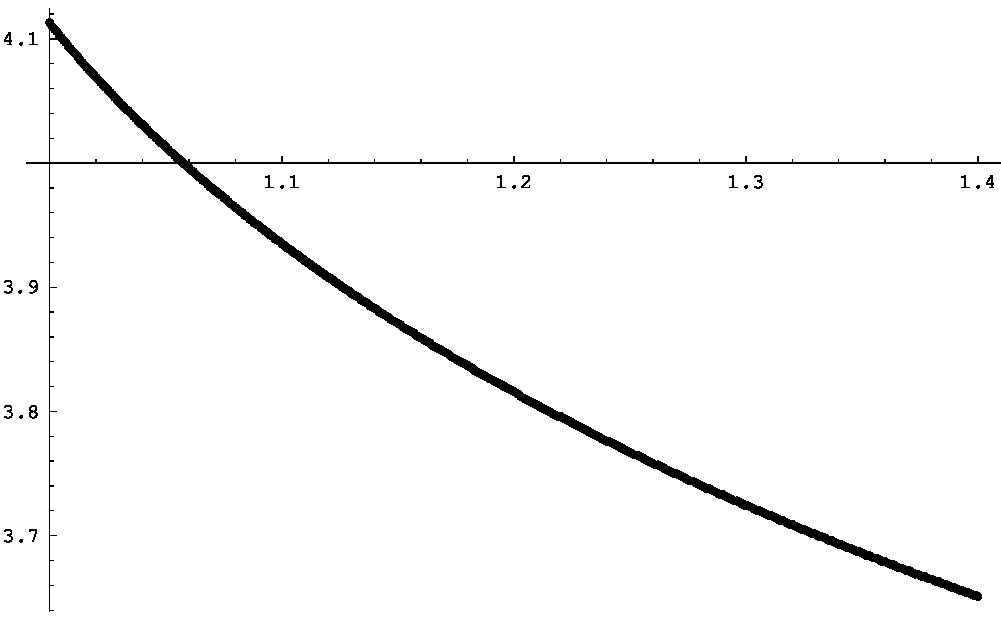 Figure 1
Peer Reviews
No public reviews on file for this paper yet. If you reviewed it on a platform where reviews are public (OpenReview, ICLR, NeurIPS, ICML), you can paste yours below so the community can read it here.
Videos
No videos yet. Explain this paper in a talk, walkthrough, or lecture? Add one.
When the Cramér-Rao Inequality provides no information
Steven J. Miller
Department of Mathematics, Brown University, 151 Thayer Street, Providence, RI 02912
Abstract.
We investigate a one-parameter family of probability densities (related to the Pareto distribution, which describes many natural phenomena) where the Cramér-Rao inequality provides no information.
Key words and phrases:
Cramér-Rao Inequality, Pareto distribution, power law
2000 Mathematics Subject Classification:
62B10 (primary), 62F12, 60E05 (secondary).
The author would like to thank Alan Landman for many enlightening conversations and the referees for helpful comments. The author was partly supported by NSF grant DMS0600848.
1. Cramér-Rao Inequality
One of the most important problems in statistics is estimating a population parameter from a finite sample. As there are often many different estimators, it is desirable to be able to compare them and say in what sense one estimator is better than another. One common approach is to take the unbiased estimator with smaller variance. For example, if are independent random variables uniformly distributed on , and , then and are both unbiased estimators of but the former has smaller variance than the latter and therefore provides a tighter estimate.
Two natural questions are (1) which estimator has the minimum variance, and (2) what bounds are available on the variance of an unbiased estimator? The first question is very hard to solve in general. Progress towards its solution is given by the Cramér-Rao inequality, which provides a lower bound for the variance of an unbiased estimator (and thus if we find an estimator that achieves this, we can conclude that we have a minimum variance unbiased estimator).
Cramér-Rao Inequality: Let be a probability density function with continuous parameter . Let be independent random variables with density , and let be an unbiased estimator of . Assume that satisfies two conditions:
- (1)
we have
[TABLE] 2. (2)
for each , the variance of is finite.
Then
[TABLE]
where denotes the expected value with respect to the probability density function .
For a proof, see for example [CaBe]. The expected value in (1.2) is called the information number or the Fisher information of the sample.
As variances are non-negative, the Cramér-Rao inequality (equation (1.2)) provides no useful bounds on the variance of an unbiased estimator if the information is infinite, as in this case we obtain the trivial bound that the variance is greater than or equal to zero. We find a simple one-parameter family of probability density functions (related to the Pareto distribution) that satisfy the conditions of the Cramér-Rao inequality, but the expectation (i.e., the information) is infinite. Explicitly, our main result is
Theorem: Let
[TABLE]
where is chosen so that is a probability density function. The information is infinite when . Equivalently, the Cramér-Rao inequality yields the trivial (and useless) bound that for any unbiased estimator of when .
In §2 we analyze the density in our theorem in great detail, deriving needed results about and its derivatives as well as discussing how is related to important distributions used to model many natural phenomena. We show the information is infinite when in §3, which proves our theorem. We also discuss there properties of estimators for . While it is not clear whether or not this distribution has an unbiased estimator, there is (at least for close to 1) an asymptotically unbiased estimator rapidly converging to as the sample size tends to infinity. By examining the proof of the Cramér-Rao inequality we see that we may weaken the assumption of an unbiased estimator. While typically there is a cost in such a generalization, as our information is infinite there is no cost in our case. We may therefore conclude that arguments such as those used to prove the Cramér-Rao inequality cannot provide any information for estimators of from this distribution.
2. An Almost Pareto Density
Consider
[TABLE]
where is chosen so that is a probability density function. Thus
[TABLE]
We chose to have in the denominator to ensure that the above integral converges, as does times the integrand; however, the expected value (in the expectation in (1.2)) will not converge.
For example, diverges (its integral looks like ) but converges (its integral looks like ); see pages 62–63 of [Rud] for more on close sequences where one converges but the other does not. This distribution is close to the Pareto distribution (or a power law). Pareto distributions are very useful in describing many natural phenomena; see for example [DM, Ne, NM]. The inclusion of the factor of allows us to have the exponent of in the density function equal and have the density function defined for arbitrarily large ; it is also needed in order to apply the Dominated Convergence Theorem to justify some of the arguments below. If we remove the logarithmic factors then we obtain a probability distribution only if the density vanishes for large . As is a very slowly varying function, our distribution may be of use in modeling data from an unbounded distribution where one wants to allow a power law with exponent , but cannot as the resulting probability integral would diverge. Such a situation occurs frequently in the Benford Law literature; see [Hi, Rai] for more details.
We study the variance bounds for unbiased estimators of , and in particular we show that when then the Cramér-Rao inequality yields a useless bound.
Note that it is not uncommon for the variance of an unbiased estimator to depend on the value of the parameter being estimated. For example, consider again the uniform distribution on . Let denote the sample mean of independent observations, and be the largest observation. The expected value of and are both (implying each is an unbiased estimator for ); however, and both depend on , the parameter being estimated (see, for example, page 324 of [MM] for these calculations).
Lemma 2.1**.**
As a function of , is a strictly increasing function and . It has a one-sided derivative at , and .
Proof.
We have
[TABLE]
When we have
[TABLE]
which is clearly positive and finite. In fact, because the integral is
[TABLE]
though all we need below is that is finite and non-zero, we have chosen to start integrating at to make easy to compute.
It is clear that is strictly increasing with , as the integral in (2.4) is strictly decreasing with increasing (because the integrand is decreasing with increasing ).
We are left with determining the one-sided derivative of at , as the derivative at any other point is handled similarly (but with easier convergence arguments). It is technically easier to study the derivative of , as
[TABLE]
and
[TABLE]
The reason we consider the derivative of is that this avoids having to take the derivative of the reciprocals of integrals. As is finite and non-zero, it is easy to pass to . Thus we have
[TABLE]
We want to interchange the integration with respect to and the limit with respect to above. This interchange is permissible by the Dominated Convergence Theorem (see Appendix A for details of the justification). Note
[TABLE]
one way to see this is to use the limit of a product is the product of the limits, and then use L’Hospital’s rule, writing as . Therefore
[TABLE]
as this is finite and non-zero, this completes the proof and shows . ∎
Remark 2.2**.**
We see now why we chose instead of . If we only had two factors of in the denominator, then the one-sided derivative of at would be infinite.
Remark 2.3**.**
Though the actual value of does not matter, we can compute it quite easily. By (2.10) we have
[TABLE]
Thus by (2.6), and the fact that (Lemma 2.1), we have
[TABLE]
3. Computing the Information
We now compute the expected value, ; showing it is infinite when completes the proof of our main result. Note
[TABLE]
By Lemma 2.1 we know that is finite for each . Thus
[TABLE]
If then the expectation is finite and non-zero. We are left with the interesting case when . As is finite and non-zero, for sufficiently large (say for some , though by Remark 2.3 we see that we may take any ) we have
[TABLE]
As , we have
[TABLE]
Thus the expectation is infinite. Let be any unbiased estimator of . If then the Cramér-Rao inequality gives
[TABLE]
which provides no information as variances are always non-negative. This completes the proof of our theorem.
We now discuss estimators for for our distribution . If are independent random variables with common distribution , then as the sample median converges to the population median (if then the sample median converges to being normally distributed with median and variance ; see for example Theorem 8.17 of [MM]). For close to 1 we see in Figure 1 that the median of is strictly decreasing with increasing ,
which implies that there is an inverse function such that . We obtain an estimator to by applying to the sample median. This estimator is a consistent estimator (as the sample size tends to infinity it will tend to ) and should be asymptotically unbiased.
The proof of the Cramér-Rao inequality starts with
[TABLE]
where is an unbiased estimator of depending only on the sample values . In our case (when each ) we may not have an unbiased estimator. If we denote this expectation by , for our investigations all that we require is that is finite (which is easy to show). Going through the proof of the Cramér-Rao inequality shows that the effect of this is to replace the factor of in (1.2) with ; thus the generalization of the Cramér-Rao inequality for our estimator is
[TABLE]
As our variance is infinite for we see that, no matter what ‘nice’ estimator we use, we will not obtain any useful information from such arguments.
Appendix A Applying the Dominated Convergence
Theorem
We justify applying the Dominated Convergence Theorem in the proof of Lemma 2.1. See, for example, [SS] for the conditions and a proof of the Dominated Convergence Theorem.
Lemma A.1**.**
For each fixed and any , we have
[TABLE]
and is positive and integrable, and dominates each .
Proof.
We first prove (A.1). As and , note . Consider the case of . Since , we have
[TABLE]
We are left with the case of , or . We have
[TABLE]
This, combined with and yields
[TABLE]
It is clear that is positive and integrable, and by L’Hospital’s rule (see (2.9)) we have that
[TABLE]
Thus the Dominated Convergence Theorem implies that
[TABLE]
(the last equality is derived in Remark 2.3). ∎
The reference list from the paper itself. Each links out to its DOI / PubMed record.
- 1[Ca Be] G. Casella and R. Berger, Statistical Inference , 2nd edition, Duxbury Advanced Series, Pacific Grove, CA, 2002.
- 2[DM] D. Devoto and S. Martinez, Truncated Pareto Law and oresize distribution of ground rocks , Mathematical Geology 30 (1998), no. 6, 661–673.
- 3[Hi] T. Hill, A statistical derivation of the significant-digit law , Statistical Science 10 (1996), 354–363.
- 4[MM] I. Miller and M. Miller, John E. Freund’s Mathematical Statistics with Applications , seventh edition, Prentice Hall, 2004.
- 5[Ne] M. E. J. Newman, Power laws, Pareto distributions and Zipf s law , Contemporary Physics 46 (2005), no. 5, 323-351.
- 6[NM] M. Nigrini and S. J. Miller, Benford’s Law applied to hydrology data – results and relevance to other geophysical data , preprint.
- 7[Rai] R. A. Raimi, The first digit problem , Amer. Math. Monthly 83 (1976), no. 7, 521–538.
- 8[Rud] W. Rudin, Principles of Mathematical Analysis , third edition, International Series in Pure and Applied Mathematics, Mc Graw-Hill Inc., New York, 1976 1976 1976 .