Non-extensive thermodynamics of 1D systems with long-range interaction
S. S. Apostolov, Z. A. Mayzelis, O. V. Usatenko, V. A. Yampol'skii

TL;DR
This paper introduces a new framework for non-extensive thermodynamics applied to 1D systems with long-range interactions, using Markov chains to derive asymptotic energy and entropy expressions.
Contribution
It proposes a novel approach linking non-extensive thermodynamics with additive Markov chains, specifically applied to long-range interacting Ising chains.
Findings
Energy and entropy are non-proportional to system size in the weak interaction limit.
Derived asymptotic expressions for thermodynamic quantities.
Established a connection between non-extensive thermodynamics and Markov chain models.
Abstract
A new approach to non-extensive thermodynamical systems with non-additive energy and entropy is proposed. The main idea of the paper is based on the statistical matching of the thermodynamical systems with the additive multi-step Markov chains. This general approach is applied to the Ising spin chain with long-range interaction between its elements. The asymptotical expressions for the energy and entropy of the system are derived for the limiting case of weak interaction. These thermodynamical quantities are found to be non-proportional to the length of the system (number of its particle).
Click any figure to enlarge with its caption.
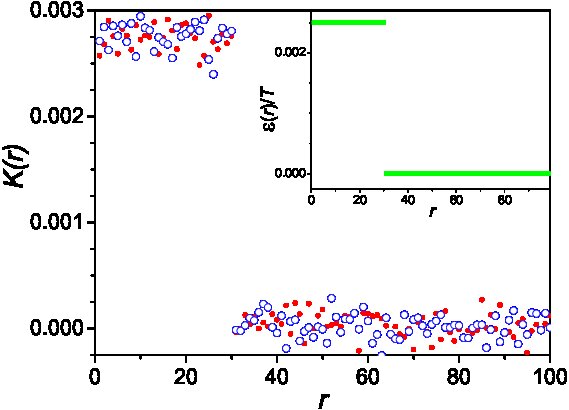 Figure 1
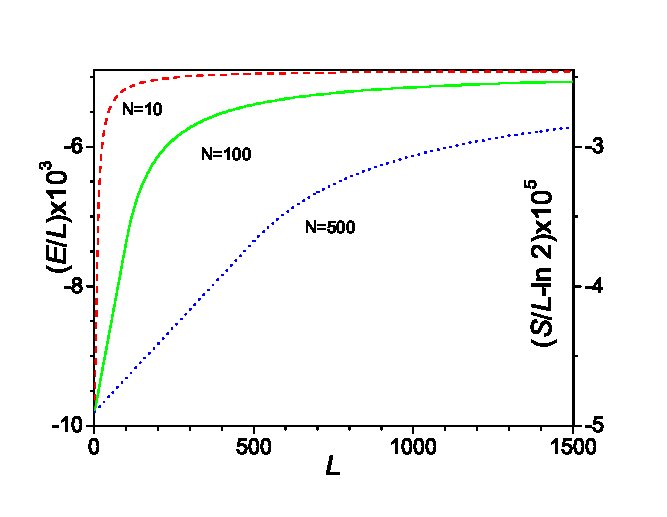 Figure 2
Peer Reviews
No public reviews on file for this paper yet. If you reviewed it on a platform where reviews are public (OpenReview, ICLR, NeurIPS, ICML), you can paste yours below so the community can read it here.
Videos
No videos yet. Explain this paper in a talk, walkthrough, or lecture? Add one.
Taxonomy
TopicsStatistical Mechanics and Entropy · Advanced Thermodynamics and Statistical Mechanics · Theoretical and Computational Physics
Non-extensive thermodynamics of 1D systems with long-range interaction
S. S. Apostolov1,2, Z. A. Mayzelis1,2, O. V. Usatenko1 [email protected], V. A. Yampol’skii1
1 A. Ya. Usikov Institute for Radiophysics and Electronics
Ukrainian Academy of Science, 12 Proskura Street, 61085 Kharkov, Ukraine
2 V. N. Karazin Kharkov National University, 4 Svoboda Sq., 61077 Kharkov, Ukraine
Abstract
A new approach to non-extensive thermodynamical systems with non-additive energy and entropy is proposed. The main idea of the paper is based on the statistical matching of the thermodynamical systems with the additive multi-step Markov chains. This general approach is applied to the Ising spin chain with long-range interaction between its elements. The asymptotical expressions for the energy and entropy of the system are derived for the limiting case of weak interaction. These thermodynamical quantities are found to be non-proportional to the length of the system (number of its particle).
pacs:
05.40.-a, 02.50.Ga, 05.50.+q
One of the basic postulates of the classical statistical physics is an assumption about the particle’s interaction range considered to be small as compared with the system size. If this condition does not hold the internal and free energies, entropy, etc. are no more additive physical quantities. Due to this fact the definitions of the temperature, entropy, etc. are not evident. The distribution function of the non-extensive system is not the Gibbs function, the Boltzman relationship between the entropy and the statistical weight is not any longer valid.
The non-extensive systems are common in physics daux . They are gravitational forces padma , Coulomb forces in globally charged systems nichol , wave-particle interactions, magnets with dipolar interactions barre , etc. Long-range correlated systems are intensively studied not only in physics, but also in the theory of dynamical systems and the theory of probability. The numerous non-Gibbs distributions are found in various sciences, e.g., Zipf distribution in linguistic zipf ; kant , the distribution of nucleotides in DNA sequences and computer codes DNA ; mbgh ; vossDNA , the distributions in financial markets par ; stan ; mant , in sociology, physiology, seismology, and many other sciences sorn ; http .
The important model of the non-extensive systems in physics is the Ising spin chain with elements interacting at great distances isi ; cas . Unfortunately, the generalization of the standard thermodynamic methods for the case of arbitrary number of interacting particles is impossible. There exist solutions for some particular cases of particles interaction only theodor ; isi . The other results obtained for the chains with long-range interaction are either the general theorems about the existence of the phase transitions in the system or the calculations of the critical indexes kad ; halp .
Several algorithms for calculating the thermodynamic quantities of the long-range correlated systems have been proposed. Unfortunately, they are not well grounded and need additional justifications. One of them is the Tsalis thermodynamics (see tsal ; abe ) based on axiomatically introduced entropy: . Here is the statistical weight and is the parameter reflecting the non-extensiveness of the system. However, this expression does not correspond to the entropy of Ising chain with a long but finite range of interaction. Indeed, it does not contain the size of the system and remains non-additive when the length of the system tends to infinity. Meanwhile, the entropy has to be additive if the system is much greater than the characteristic range of interaction. Thus, the problem of finding the thermodynamic quantities for the non-extensive systems is still of great importance.
Recently a new vision on the long-range correlated systems, based on the association of the latter with the Markov chains, has been proposed uya . The binary Markov chains are the sequences of symbols taking on two values, for example, . These sequences are determined by the conditional probability of some symbol to occur after the definite previous symbols and this conditional probability does not depend on the values of symbols at a distance, greater than , . Here are the sets of sequential symbols . The unbiased additive Markov chain is defined by the additive conditional probability function,
[TABLE]
The function is referred to as the memory function muyag . It describes the direct interaction between the elements of the chain contrary to the binary correlation function that also takes into account the indirect interactions. Here means statistical averaging over the chain. As was shown in MUYa05 , the correlation function can be found from the recurrence relation , that establishes the one-to-one correspondence between these two functions. In the limiting case of small , this equation yields .
We consider the chain of classical spins with hamiltonian
[TABLE]
where is the spin variable taking on two values, and , and is the exchange integral of the ferromagnetic coupling. The range of spin interaction may be arbitrary but finite.
We find thermodynamical quantities, specifically, energy and entropy, of such a chain being in thermodynamical equilibrium with a Gibbs thermostat of temperature . The hamiltonian (2) does not include the terms, corresponding to the interaction of the system with the thermostat. Nevertheless, this interaction leads to the relaxation of the temperature in different parts of the chain, and the thermostat fixes its temperature of the whole spin chain. A great many numerical procedures, for example, the Metropolis algorithm, were elaborated for achieving the equilibrium state. The algorithm consists in the sequential trials to change the value of a randomly chosen spin. The probability of spin-flip is determined by the values of spins on both sides of the chain within the interaction range. Thus, the Ising spin chain in the equilibrium state can be characterized by the conditional probability, , of some spin to be equal to under the condition of definite values of all other spins on both sides from . In Ref. equiv , a chain with the two-sided conditional probability function, which is independent of symbols at a distance of more than , was considered. These chains were shown to be equivalent to the -step Markov chain. So, to calculate the statistical properties of the physical object with long-range interaction, it is sufficient to find the corresponding Markov chain.
In this work, we demonstrate that the Ising spin chains with long-range interaction being in the equilibrium state are statistically equivalent to the Markov chains with some conditional probability function. Then, using the known statistical properties of the Markov chains, we calculate the thermodynamical quantities of the corresponding spin chains.
First, we present a method of defining a thermodynamical quantity (e.g., energy, entropy) for a subsystem of arbitrary length (a set of sequential particles) of any non-extensive system. This subsystem, denoted by , interacts with the thermostat and with the rest of the system. The interaction with the latter makes it impossible to use the standard methods of statistical physics. The internal energy of the entire system is not equal to the sum of the internal energies of and the rest of the system.
In order to find the condition of the system equilibrium we divide the ensemble of the system into the subensembles with fixed closest particles from both sides of . We denote these two ”border” subsystems of length by letter . All the other particles, except for and , are denoted by :
[TABLE]
Within every subensemble, the subsystem is fixed and plays the role of a partition wall conducting the energy and keeps its internal energy unchanged. The energy of system equals to the sum of energies of and and their energy of interaction with . Thus, within every subensemble we can use the equilibrium condition between and , analogous to that for extensive thermodynamics:
[TABLE]
where and are the statistical weights of systems, in which the energy of is , those of is , and is fixed. We refer to these statistical weights as the conditional statistical weights.
In a similar way, we introduce any conditional thermodynamical quantity . The real quantity is the conditional one, averaged over the subensembles with different environments :
[TABLE]
Using this way of calculating the thermodynamical quantities, one does not need to find the distribution function of the system . Nevertheless, it is quite appropriate for the non-extensive systems and yields the thermodynamical values that could be measured experimentally. If the system is in the thermal contact with the Gibbs thermostat, within every subensemble with a fixed , the equilibrium condition between thermostat and subsystem yields the temperature of equal to . Thus, the averaged temperature of the subsystem is also .
The conditional entropy can be introduced as the logarithm of the conditional statistical weight: . Equality is fulfilled for the conditional quantities and . Meanwhile, such a relation is not valid for the averaged entropy and energy.
Note that the presented algorithm for calculating the thermodynamical quantities is rather general and can be applied to other quantities, e.g., to the probability for some spin to take on the definite value under the condition of the particular environment.
Now we proceed to the application of this algorithm for the analysis of Ising spin chain with long-range interaction. The theory of Markov chains is built around the expression for the conditional probability function. So, in an effort to find a Markov chain that corresponds to a given Ising system, we have to find its conditional probability function. To this end, we consider one spin as a system and the conditional probability as a quantity in the above-mentioned algorithm. In the extensive thermodynamics, this probability is determined by the Gibbs distribution function. According to our algorithm, one can find that the probability of event under the condition of the fixed spins from is given as
[TABLE]
It should be pointed out that this expression is similar to the Glauber formula glaub written in some other terms. Our result has been that the conditional probability of the occurring is determined by two subsystems of length on both sides of only and does not depend on the remoter spins. As mentioned above, this is a property of the -step Markov sequences.
To arrive at an explicit expressions for the energy and entropy of the subsystem we consider the case of weak interaction, . In this case, Eq. (5) corresponds approximately to the additive Markov chain with the memory function and, thus, its binary correlation function is
[TABLE]
Figure 1 shows that the Ising spin chain being in equilibrium state is statistically equivalent to the Markov chain. The solid circles describe the binary correlation function of the additive Markov chain with the memory function . The open circles correspond to the correlation function of the spin chain being equilibrated by the Metropolis scheme.
It can be shown that the Metropolis scheme also yields the same expression (5) for the conditional probability. Due to this fact one does not need to use the Metropolis algorithm to find an equilibrium state of the spin chain but can generate a Markov chain with a corresponding conditional probability function.
Now we examine binary spin chain determined by the Hamiltonian (2) with and find the non-extensive energy and entropy of subsystem containing particles. Since the explicit expressions for the correlation function were derived for the additive Markov chains with the small memory function only, we suppose the energy of interaction to be small as compared to the temperature, .
The proposed algorithm of finding thermodynamic quantities is considerably simpler while finding the energy of the system of length . The energy is the averaged sum of products of pairs of spin values,
[TABLE]
Formally, this expression depends on the index of the first spin in the system . However, we study the homogeneous systems, so function in Eq. (7) does not contain as an argument. Energy in Eq. (7) can be calculated via the binary correlation function only with the arguments, less than , without finding conditional energies. Using Eq. (6), we arrive at
[TABLE]
with . If the system length is much greater than memory length this expression yields extensive energy. Indeed, in this case subsystems and interact nearly extensively. In the opposite limiting case we get:
[TABLE]
If one regards the whole chain of the length , forming the circle, as the system in the above-mentioned sense, the additive energy is
[TABLE]
This result is very natural because the extensive thermodynamics is valid.
It is seen, that the non-extensive energy is expressed in terms of binary correlation functions only. This is not correct for other thermodynamical quantities, e.g. the entropy of the system . Formally, to find the entropy, we have to calculate all conditional entropies by integration of , and then to average the result over all realizations of the borders. However, at high temperatures, to a first approximation in the small parameter we can change the order of these operations and calculate the averaged entropy by integrating this formula taken with the averaged energy. A constant of integration is such that the chain is completely randomized at , and its entropy is equal to . Thus, we obtain
[TABLE]
Here is determined by one of Eqs. (8)-(10). This expression describes the non-extensive entropy of the system . However, while the energy is non-extensive in the main approximation, the entropy is non-extensive as a first approximation in the parameter . The dependences of the non-extensive energy and entropy on size of the system are given in Fig. 2 for step-wise interaction . The solid line corresponds to additive quantities, it is the asymptotic of these quantities for the large system length.
It should be emphasized, that knowing the energy and entropy we can find some other thermodynamic quantities. For example, at high temperatures the heat capacity can be determined in a similar way as for the entropy calculating. One can use the classical formula with averaged entropy from Eq. (11) and obtain the heat capacity value as . This simple procedure of its finding is valid for the case of high temperatures as the main approximation only. In the general case, is not determined by . This relation holds for the conditional quantities only.
At high temperatures, we calculated the averaged non-additive energy and entropy without using the conditional ones. In the opposite limiting case of low temperatures, the calculation of conditional quantities proves to be necessary.
Thus, we have suggested the algorithm of evaluating thermodynamic characteristics of non-extensive systems. The value of certain thermodynamical quantity can be obtained by averaging the corresponding conditional quantity. This method is applied to the Ising spin chain. The explicit expressions for the non-additive energy and entropy are deduced in the limiting case of high temperatures as compared to the energy of spins interaction. At high temperatures, the equilibrium Ising chain of spin turns out to be equivalent to the additive multi-step Markov chain.
The reference list from the paper itself. Each links out to its DOI / PubMed record.
- 1(1) Dynamics and Thermodynamics of Systems with Long-Range Interactions, T. Dauxois, S. Ruffo, E. Arimondo, and M. Wilkens, Lecture Notes in Physics Vol. 602 (Springer-Verlag, New York, 2002).
- 2(2) T. Padmanabhan, Phys. Rep. 188 , 285 (1990).
- 3(3) D. R. Nicholson, Introduction to Plasma Theory (John Wiley, New York, 1983).
- 4(4) J. Barre, T. Dauxois, G. De Ninno, D. Fanelli, and S. Ruffo, Phys. Rev. E 69 , 045501(R) (2004).
- 5(5) G. K. Zipf, Human Behavior and the Principle of Least Effort (Addison-Wesley, New York, 1949).
- 6(6) I. Kanter and D. A. Kessler, Phys. Rev. Lett. 74 , 4559 (1995); K. E. Kechedzhy, O. V. Usatenko, and V. A. Yampol’skii, Phys. Rev. E. 72 , 046138 (2005).
- 7(7) R. N. Mantegna, S. V. Buldyrev, A. L. Goldberger, S. Havlin, C.-K. Peng, M. Simons, and H. E. Stanley, Phys. Rev. E 52 , 2939 (1995).
- 8(8) R. F. Voss, Phys. Rev. Lett. 68 , 3805 (1992).