
TL;DR
This paper discusses gauge-Higgs unification in warped spacetime, predicting Higgs mass range, coupling deviations, and testable signatures at LHC and ILC, offering a novel approach to electroweak symmetry breaking.
Contribution
It introduces a gauge-Higgs unification model in Randall-Sundrum spacetime with specific predictions for Higgs mass and couplings, providing testable differences from the standard model.
Findings
Higgs mass predicted between 100 GeV and 300 GeV.
Higgs couplings to W and Z are suppressed by cos θ_H.
WWZ gauge couplings remain nearly universal as in the standard model.
Abstract
In the gauge-Higgs unification scenario the 4D Higgs field is identified with the zero mode of the extra-dimensional component of gauge potentials. The mass of the Higgs particle in the unification in the Randall-Sundrum warped spacetime is predicted to be in the range 100 GeV - 300 GeV. The WWZ gauge couplings remains almost universal as in the standard model, but substantial deviation results for the Higgs couplings. The WWH and ZZH couplings are suppressed by a factor \cos \theta_H from the values in the standard model, where \theta_H is the Yang-Mills AB phase along the fifth dimension. These can be tested at LHC and ILC.
Click any figure to enlarge with its caption.
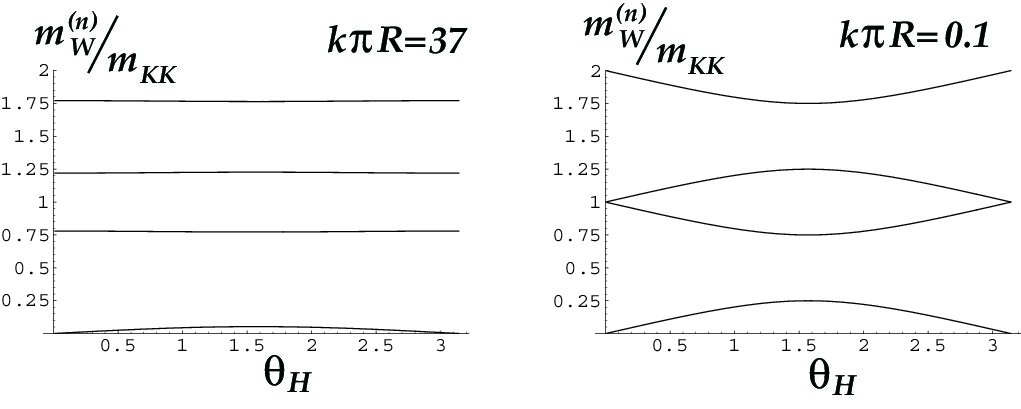 Figure 1
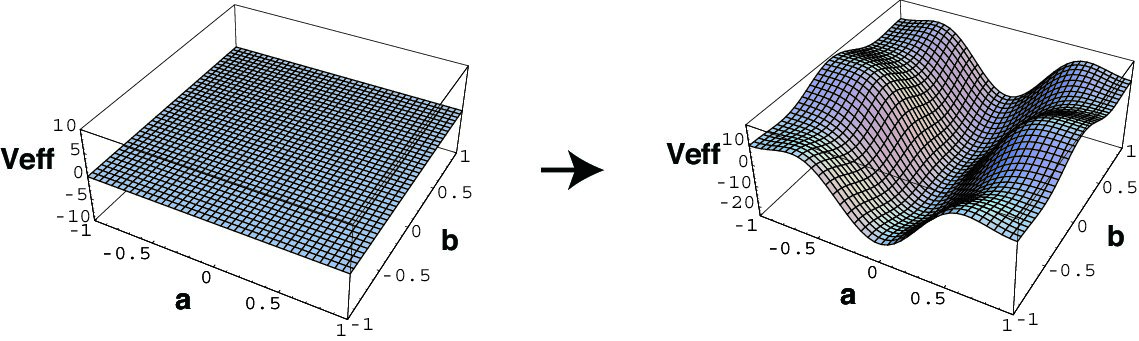 Figure 2
Peer Reviews
No public reviews on file for this paper yet. If you reviewed it on a platform where reviews are public (OpenReview, ICLR, NeurIPS, ICML), you can paste yours below so the community can read it here.
Videos
No videos yet. Explain this paper in a talk, walkthrough, or lecture? Add one.
Gauge-Higgs Unification and LHC/ILC
Yutaka Hosotani∗
Department of Physics, Osaka University,
Toyonaka, Osaka 560-0043, Japan
∗E-mail: [email protected]
Abstract
In the gauge-Higgs unification scenario the 4D Higgs field is identified with the zero mode of the extra-dimensional component of gauge potentials. The mass of the Higgs particle in the unification in the Randall-Sundrum warped spacetime is predicted to be in the range 100 GeV - 300 GeV. The gauge couplings remains almost universal as in the standard model, but substantial deviation results for the Higgs couplings. The and couplings are suppressed by a factor from the values in the standard model, where is the Yang-Mills AB phase along the fifth dimension. These can be tested at LHC and ILC.
keywords:
Gauge-Higgs unification, Hosotani mechanism
April 6, 2007 OU-HET 579/2007
\bodymatter
1 Origin of the Higgs boson
There is one particle missing in the standard model of electroweak interactions. It is the Higgs boson. The Higgs boson must exist, either as an elementary particle or as a composite particle. The electroweak unification is possible, only if there is something which breaks symmetry to symmetry. In the standard model the Higgs boson, whose potential is such that the electroweak symmetry is spontaneously broken, gives masses to and bosons. It also gives quarks and leptons masses through Yukawa couplings.
The standard model seems economical, but it hides dirty secret. Physics ought to be based on simple principles, but there seems no good principle for the Higgs sector. As a result the standard model is afflicted with many arbitrary parameters. There have been many proposals. Technicolor theory views the Higgs boson as a composite state resulting from strong technicolor interactions. Supersymmetry (SUSY) is a leading candidate beyond the standard model which cures the gauge hierarchy problem. However, the situation concerning a large number of arbitrary parameters becomes worse in the minimal supersymmetric standard model. There are other proposals such as the little Higgs theory and the Higgsless theory as well.
In this article I would like to argue that the Higgs field is “clean”. The Higgs field is a part of gauge fields in higher dimensions, the Higgs sector being controlled by the gauge principle. The difference between the Higgs particle and gauge bosons originates from the structure of the extra-dimensional space. The scenario is called the gauge-Higgs unification.
The gauge-Higgs unification scenario can be tested at LHC and ILC.[1][4] It predicts that the mass of the Higgs particle is around 100 GeV - 300 GeV, exactly in the energy region where LHC can explore. Further the couplings of the Higgs particle to the W and Z bosons, and also to quarks and leptons are substantially reduced compared with those in the standard model. Thus the Higgs experiments at LHC may uncover the origin of the Higgs particle, and disclose the existence of extra dimensions.
2 Old gauge-Higgs unification
The idea of the gauge-Higgs unification is very old.[5, 6, 7] In the Kaluza-Klein theory the gravity in five dimensional spacetime of topology unifies the four-dimensional gravity with the electromagnetism. The part of the metric, () , contains the 4D vector potential in the electromagnetism. In the gauge-Higgs unification one considers gauge theory, instead of gravity, in higher dimensional spacetime. Extra-dimensional components, , of gauge potentials transform as 4D scalars under 4D Lorentz transformations. The 4D Higgs field is identified with a low energy mode of . The Higgs field becomes a part of gauge fields.
This scenario was proposed by Fairlie and by Forgacs and Manton in 1979. They tried to achieve unification by restricting configurations of gauge fields in extra dimensions with symmetry ansatz. In ref. 7 Manton considered gauge theory with gauge group defined on . It is assumed that only spherically symmetric configurations are allowed and gauge fields have non-vanishing flux (field strengths) on . Further it is demanded that the gauge group breaks down to by non-vanishing flux. There appears a Higgs doublet as a low energy mode of . Quite amazingly the Higgs doublet turns out to have a negative mass squared so that the symmetry further breaks down to .
There are two parameters; the radius of and the gauge coupling in the six-dimensional spacetime. These two parameters are fixed by the Fermi constant and the four-dimensional gauge coupling . , , and are determined as functions of and . The Weinberg angle is determined by the gauge group only. There are three gauge groups which satisfy the above requirements. The result is summarized in Table 2.
The unification is achieved and the Higgs mass is predicted, though numerical values are not realistic. There are generic problems in this scheme. First, the mass is . In other words, it necessarily predicts a too small Kaluza-Klein scale . Secondly, and more importantly, there is no justification for the ansatz of non-vanishing flux. The restriction to spherically symmetric configurations is not justified either.
3 New gauge-Higgs unification
There is a better way of achieving gauge-Higgs unification. The key is to consider gauge theory in a non-simply connected spacetime. It utilizes the Hosotani mechanism.[8, 9, 10, 11]
3.1 Yang-Mills AB phase
When the space is not simply connected, a configuration of vanishing field strengths does not necessarily mean trivial. The phenomenon is called the Aharonov-Bohm (AB) effect in quantum mechanics. Consider gauge theory on with coordinates , and impose periodic boundary conditions . A configuration constant gives , but gives
[TABLE]
where and (). ’s are Yang-Mills AB phases in the theory, denoted collectively as . They cannot be eliminated by gauge transformations preserving the boundary conditions.
Classical vacua are degenerate. Yang-Mills AB phases label flat directions of the classical potential. The degeneracy is lifted at the quantum level. The mass spectrum of various fields depends on . The effective potential is given at the one loop level by
[TABLE]
The value of is determined by the location of the global minimum of .
3.2 Dynamical gauge symmetry breaking
Once the matter content is specified, the effective potential is determined and so is the value of in the true vacuum. Suppose that all fields are periodic so that the boundary conditions are symmetric. If , the symmetry breaks down to a subgroup of in general. In other words we have dynamical gauge symmetry breaking.
Take as an example. In a pure gauge theory the global minima are located at . The symmetry is unbroken. Add periodic fermions in the fundamental representation. Then the global minimum is given by , the symmetry remaining unbroken. If one has, instead, a periodic fermion in the addjoint representation, then the global minima are found at and its permutations. The symmetry breaks down to . These results are tabulated in Table 3.2. Dynamical gauge symmetry breaking occurs quite naturally. It involves no fine tuning.[12]
Instead of periodic boundary conditions, one might impose more general twisted boundary conditions. For instance, one can impose (). It can be shown that on physics does not depend on the choice of , thanks to dynamics of Yang-Mills AB phases . On orbifolds such as and the Randall-Sundrum warped spacetime there appear a finite number of inequivalent sets of boundary conditions.[9, 13, 14]
3.3 Finiteness of and the Higgs mass
A mode of four-dimensional fluctuations of Yang-Mills AB phase is identified with the 4D Higgs field in an appropriate setup. Hence is directly related to the effective potential for the 4D Higgs field .
One significant feature is that the -dependent part of is finite. The mass squared of the Higgs boson, , is essentially the curvature of at its global minimum, implying the finiteness of .[15]
The finiteness of at the one loop level has been shown explicitly in various models.[8, 9] A general proof goes as follows. [12, 16]
First of all large gauge invariance in theory guarantees that is related to by a large gauge transformation which preserves the boundary conditions. It implies that to all order in perturbation theory. can be expanded in a Fourier series; .
The one loop effective potential is given by (2). In flat space . Here the Kaluza-Klein mass scale and is an integer. is a constant determined by the boundary condition of each field. It follows that becomes finite for sufficiently large almost everywhere in . can develop infrared divergence at a discrete set of values of where vanishes, namely at a set of points of measure zero. Hence () becomes finite, implying the finiteness of at the one loop level. The argument remains valid in the Randall-Sundrum warped spacetime as for .
The finiteness seems to hold beyond one loop. It has been shown that in QED in is finite at the two loop level after renormalization in .[17] There is nonperturbative lattice simulation indicating the finiteness as well.[18]
4 Electroweak interactions
To apply gauge-Higgs unification scenario to electroweak interactions, several features have to be taken into account.[19][29] First, the electroweak symmetry is , which breaks down to . The Higgs field is an doublet. In the gauge-Higgs unification the Higgs field is a part of gauge fields, or must belong to the adjoint representation of the gauge group . This means that must be larger than , as Fairlie, Forgacs, and Manton originally pointed out.[5, 6, 7]
Second, fermion content is chiral. This is highly nontrivial in higher dimensional gauge theory, as a spinor in higher dimensions always contains both right- and left-handed components in four dimensions. The left-right asymmetry in fermion modes at low energies can be induced from nontrivial topology of extra-dimensional space and non-vanishing flux of gauge fields in extra dimensions. There is another, simpler and more powerful, way to have chiral fermions. If the extra-dimensional space is an orbifold, appropriate boundary conditions naturally give rise to chiral fermion content.[19, 20]
Let us illustrate how the orbifold structure fits in the gauge-Higgs unification, by taking gauge theory on . The orbifold is obtained from by identifying and . There appear two fixed points (branes) at and . We define gauge theory on a covering space of , namely for , and impose restrictions such that physics is the same at and . The single-valuedness of physics does not necessarily mean that vector potentials are single-valued. In gauge theory they may be twisted by global gauge transformation. More explicitly
[TABLE]
where and . Here is an element of the gauge group satisfying . When , the gauge symmetry is partially broken by the boundary conditions. The physical symmetry, in general, can be different from the residual symmetry given by . It can be either reduced or enhanced by dynamics of .[10]
To see how an doublet Higgs field emerges, take and . Then, the orbifold boundary condition (3) implies that part of the four-dimensional components are even under parity at , which contains zero modes corresponding to gauge fields in four dimensions. On the other hand the extra-dimensional component has zero modes in the off-diagonal part;
[TABLE]
The zero mode becomes an doublet Higgs field. Take and as another example. In this case the symmetry breaks down to . Zero modes of are
[TABLE]
is an doublet. is related to the Yang-Mills AB phases by (1).
Chiral fermions naturally emerge. Take with in (4). Fermions in the fundamental representation of obey the boundary condition so that
is decomposed as
[TABLE]
, and have zero modes, whereas , and do not. Fermion content at low energies is chiral as desired.
In the gauge-Higgs unification scenario the Higgs boson is massless at the tree level. Its mass is generated by radiative corrections. The mass of the Higgs boson is determined by the curvature of the effective potential at the minimum. In fig. 1 is displayed in the model of ref. 25.
5 Difficulties in flat spacetime
The gauge-Higgs unification scenario in flat spacetime is afflicted with a few intrinsic difficulties. The electroweak symmetry is spontaneously broken by . Non-vanishing gives rise to non-vanishing masses for and bosons. , for instance, is typically given by
[TABLE]
Here is the size of the extra-dimensions. Secondly, the effective potential is generated at the one-loop level, and therefore is where is the coupling. The Higgs mass becomes as well. Evaluation of shows that
[TABLE]
The relations (7) and (8) are generic predictions from the gauge-Higgs unification in flat spacetime. Once the value of is given, and are predicted. The value of is determined from the location of the global minimum of . It depends on the matter content in the theory. Given standard matter content of quarks and leptons with a minimal set of additional matter, the global minimum of is typically located either at or at , as confirmed in various models. In the former case the electroweak symmetry remains unbroken. What we want is the latter. In this case and GeV. One has too low and too small .
There are two ways to circumvent these difficulties. One way is to arrange the matter content such that small is obtained. This is possible as discussed by many authors, but requires either many additional fields in higher dimensional representations in , or fine-tuned cancellations among contributions from various fields.[23, 24, 26] Another way is to consider warped (curved) spacetime in extra-dimensions.[1][4],[30][36] Astonishingly the warped spacetime resolves the above problems quite naturally as discussed below.
6 unification in warped spacetime
An attractive model is obtained by considering gauge theory in the Randall-Sundrum (RS) warped spacetime[37, 38, 39] whose metric is given by
[TABLE]
where and for . The topology of the spacetime is the same as . The spacetime is an orbifold, with fixed points (branes) at and . It has a negative cosmological constant in the bulk five-dimensional spacetime. The RS spacetime is an anti-de Sitter space sandwiched by the Planck brane at and the TeV brane at . At low energies the spacetime resembles four-dimensional Minkowski spacetime.
We consider gauge theory[31] with gauge couplings and defined in the five-dimensional spacetime (9). We suppose that the structure of the spacetime is determined by physics at the Planck scale and therefore . With the warp factor the electroweak scale is naturally generated from the Planck scale.
The orbifold boundary conditions for the and gauge fields, and , are given by and in (3), respectively. With this parity assignment the bulk symmetry breaks down to on the branes. We further break the symmetry on the Planck brane by imposing the Dirichlet condition on , , and which are even under parity. Here () are gauge fields and
[TABLE]
obeys the Neumann condition on both branes. As a result the residual symmetry is . The change of the boundary conditions from Neumann to Dirichlet for , , and is induced by additional dynamics on the Planck brane, and is consistent with the large gauge invariance.[3, 4, 40]
6.1 Mass spectrum
There is one mass scale in the theory, namely , and a few dimensionless parameters , and . The Kaluza-Klein mass scale in the RS spacetime is
[TABLE]
For , and are given by
[TABLE]
In a generic situation one has . It follows from the relation for that the dimensionless parameter for .
Further (11) and (13) imply that
[TABLE]
For moderate values , the Kaluza-Klein scale turns out , which is large enough to be consistent with the current experimental limit. One of the problems in the gauge-Higgs unification scenario in flat spacetime mentioned earlier is solved. In the Randall-Sundrum spacetime there appears an enhancement factor .
The mass scale of low energy modes becomes much smaller than the Kaluza-Klein mass scale in the warped spacetime. This can be most clearly seen by examining the mass spectrum as a function of with various values of . See fig. 2. has weak dependence on for and is much smaller than 1. In the flat spacetime becomes for .
6.2 Higgs mass and self-couplings
The Higgs mass and self-couplings are generated by quantum effects, or by radiative corrections. The 4D Higgs field corresponds to four-dimensional fluctuations of . In the model
[TABLE]
where . Thus, the Higgs mass , for instance, is evaluated from the curvature of at the minimum. Notice that and appear in the effective potential in the combination of
[TABLE]
where the 4D coupling is given by . We observe that gives various quantities in the warped space an enhancement factor compared with those in flat space.
On general ground the effective potential at one loop is estimated as
[TABLE]
where in minimal models. The mass and the quartic coupling (in ) are evaluated as
[TABLE]
where . There is ambiguity in which somewhat depend on detailed content of the model. Inserting typical values and , one finds that GeV and . Although the precise form of depends on details of the model, the feature of the enhancement by the factor in the RS spacetime is general. The problem of too small in flat spacetime has been solved.
6.3 coupling
When , the electroweak symmetry remains unbroken. The gauge coupling in four dimensions is given by . All couplings associated with and are determined by the gauge principle. When , things are not so simple in the gauge-Higgs unification scenario.
With , breaks down to . In the standard model the boson resides in the group. In the gauge-Higgs unification model, mixes various components of , and . It also mixes various Kaluza-Klein excited states. The eigenstate and its wave function are determined by complete diagonalization. This poses an interesting question whether or not the coupling , for instance, remains universal as in the standard model. There is no guarantee for that.
This is an important issue as the LEP2 data on the pair production rate agrees with the coupling in the standard model within an error of a few percents. In Table 6.3 the ratio of in the gauge-Higgs unification to that in the standard model is tabulated for various and . One sees that for the realistic case , deviation from the standard model is tiny for any values of , whereas in the flat spacetime limit () substantial deviation appears for moderate values of .
The coupling remains almost universal in the warped space. The gauge-Higgs unification scenario in the warped space is consistent with the LEP2 data, whereas the scenario in flat space conflicts with the data unless is sufficiently small.
6.4 and couplings
There emerges significant deviation from the standard model in various couplings of the Higgs boson. Unlike 4D gauge bosons the 4D Higgs boson is mostly localized near the TeV brane so that the behavior of wave functions of various fields on the TeV brane becomes relevant for their couplings to the Higgs boson.
Robust prediction is obtained for the and couplings
[TABLE]
The detailed matter content affects the effective potential , but the couplings and are determined independent of such details once is given. One finds that
[TABLE]
where . Compared with the values in the standard model, both couplings are suppressed by a factor . This result can be used to experimentally test the gauge-Higgs unification scenario.
6.5 Yukawa coupling
Couplings of the Higgs boson to quarks and leptons, Yukawa couplings, are also subject to nontrivial -dependent suppression. The Lagrangian for fermions is given by[38, 39]
[TABLE]
is a charge of . The kink mass term naturally arises in the Randall-Sundrum spacetime where a dimensionless parameter for each fermion multiplet plays a crucial role for determining its wave function. There can be “brane interactions” between and additional brane fermion fields defined on one of the branes.
The Higgs coupling to is contained in the gauge interaction involving . Non-vanishing (\raise 0.68889pt\hbox{\langle}\lower 0.68889pt\hbox{}A_{y}\,\raise 0.68889pt\hbox{\rangle}\lower 0.68889pt\hbox{}\not=0) induces a finite fermion mass. Although the gauge interaction is universal, the resulting 4D mass and Yukawa interaction depend on the wave function in the fifth dimension, or on and the brane interactions. This gives flavor-dependent masses and Yukawa couplings. In the absence of brane interactions, c=\pm\hbox{{1\over 2}} gives a fermion a mass of . Light fermions () corresponds to , whereas a heavy fermion () to . The large hierarchy in the fermion mass spectrum is explained by plain distribution in the parameter .
In the minimal standard model the Yukawa coupling is proportional to the mass of a fermion. In the gauge-Higgs unification scenario this relation is modified. In the absence of brane interactions the Yukawa coupling in the gauge-Higgs unification in the RS spacetime is suppressed by a factor or \cos\hbox{{1\over 2}}\theta_{H} compared with the value in the standard model. To realize the observed spectrum of quarks and leptons, however, one needs to include brane interactions, which in turn affects the relationship between the mass and Yukawa coupling. Although the relationship depends on details of the model, it is expected that it deviates from that in the standard model.
6.6 Gauge couplings of fermions
Couplings of quarks and leptons to and also suffer from modification, but the amount of deviation from the standard model turns out tiny. The - universality in weak interactions played an important role in the development of the theory. In the modern language it says that all left-handed leptons and quarks have the same coupling to the boson. It is dictated by the gauge invariance in four dimensions. In the gauge-Higgs unification, however, the universality is not guaranteed at . As explained earlier, non-vanishing mixes various components in the gauge group and various levels in the Kaluza-Klein tower. This mixing for fermions depends on, say, the kink mass parameter , and therefore is not universal.
For wave functions are mostly localized near the Planck brane at so that the 4D gauge coupling to becomes almost universal for any values of . Define where and are the gauge () couplings of and , respectively. One finds typically that for . For , . These numbers are well within the experimental limit, being very hard to test in the near future. For top quarks, the deviation becomes bigger (), but is difficult to measure accurately.
7 Flat v.s. Warped
Why do we need the warped spacetime rather than flat spacetime? The Randall-Sundrum warped spacetime was originally introduced to naturally explain the hierarchy between the Planck scale and weak scale. When applied to the gauge-Higgs unification, there are more benefits.
See Table 8. Both Higgs mass and Kaluza-Klein mass scale turn out too small in flat space for moderate values of . The parameter deviates from 1 even at the tree level and the coupling deviates from the value in the standard model in falt space. All these problems are resolved in the Randall-Sundrum warped space. Besides the observed fermion spectrum can be explained without any fine tuning of the parameters.
All of them indicate that having the Randall-Sundrum warped spacetime as background is not just an accident, but have a deeper reason. In this regard the holographic interpretation of the model in the AdS/CFT correspondence is very suggestive as explored by many authors.
8 Conclusion
The prospect of the gauge-Higgs unification in the warped spacetime is bright. The Higgs field is identified with the Yang-Mills AB phase in the extra dimension. It gives definitive prediction in the Higgs couplings, which can be tested at LHC and ILC. The model has not been completed yet. The most urgent task includes to pin down additional brane interactions for fermions so that the observed quark-lepton mass spectrum and the CKM and MNS mixing matrices are reproduced.
Acknowledgements
This work was supported in part by Scientific Grants from the Ministry of Education and Science, Grant No. 17540257, Grant No. 13135215 and Grant No. 18204024. The author would like to thank the Aspen Center for Physics for its hospitality where a part of this work was performed.
The reference list from the paper itself. Each links out to its DOI / PubMed record.
- 1[1] Y. Hosotani and M. Mabe, Phys. Lett. B 615 (2005) 257.
- 2[2] Y. Hosotani, S. Noda, Y. Sakamura and S. Shimasaki, Phys. Rev. D 73 (2006) 096006.
- 3[3] Y. Sakamura and Y. Hosotani, Phys. Lett. B 645 (2007) 442.
- 4[4] Y. Hosotani and Y. Sakamura, hep-ph/0703212.
- 5[5] D.B. Fairlie, Phys. Lett. B 82 (1979) 97; J. Phys. G 5 (1979) L 55.
- 6[6] P. Forgacs and N. Manton, Comm. Math. Phys. 72 (1980) 15.
- 7[7] N. Manton, Nucl. Phys. B 158 (1979) 141.
- 8[8] Y. Hosotani, Phys. Lett. B 126 (1983) 309.