Density oscillation in highly flattened quantum elliptic rings and tunable strong dipole radiation
Shuping Situ, Yanzhang He, Chengguang Bao

TL;DR
This paper investigates how magnetic fields influence electron behavior in highly flattened elliptic quantum rings, revealing tunable dipole radiation and a novel Aharonov-Bohm oscillation caused by symmetry breaking.
Contribution
It introduces a new type of Aharonov-Bohm oscillation linked to shape-induced symmetry breaking in elliptic quantum rings and explores tunable strong dipole emission.
Findings
Strong dipole photon emission can be achieved and tuned by magnetic field and shape.
Electron density oscillates between patterns with changing magnetic field.
A new symmetry-breaking Aharonov-Bohm oscillation is identified.
Abstract
A narrow elliptic ring containing an electron threaded by a magnetic field B is studied. When the ring is highly flattened, the increase of B would lead to a big energy gap between the ground and excited states, and therefore lead to a strong emission of dipole photons. The photon frequency can be tuned in a wide range by changing B and/or the shape of the ellipse. The particle density is found to oscillate from a pattern of distribution to another pattern back and forth against . This is a new kind of Aharonov-Bohm oscillation originating from symmetry breaking and is different from the usual oscillation of persistent current.
Click any figure to enlarge with its caption.
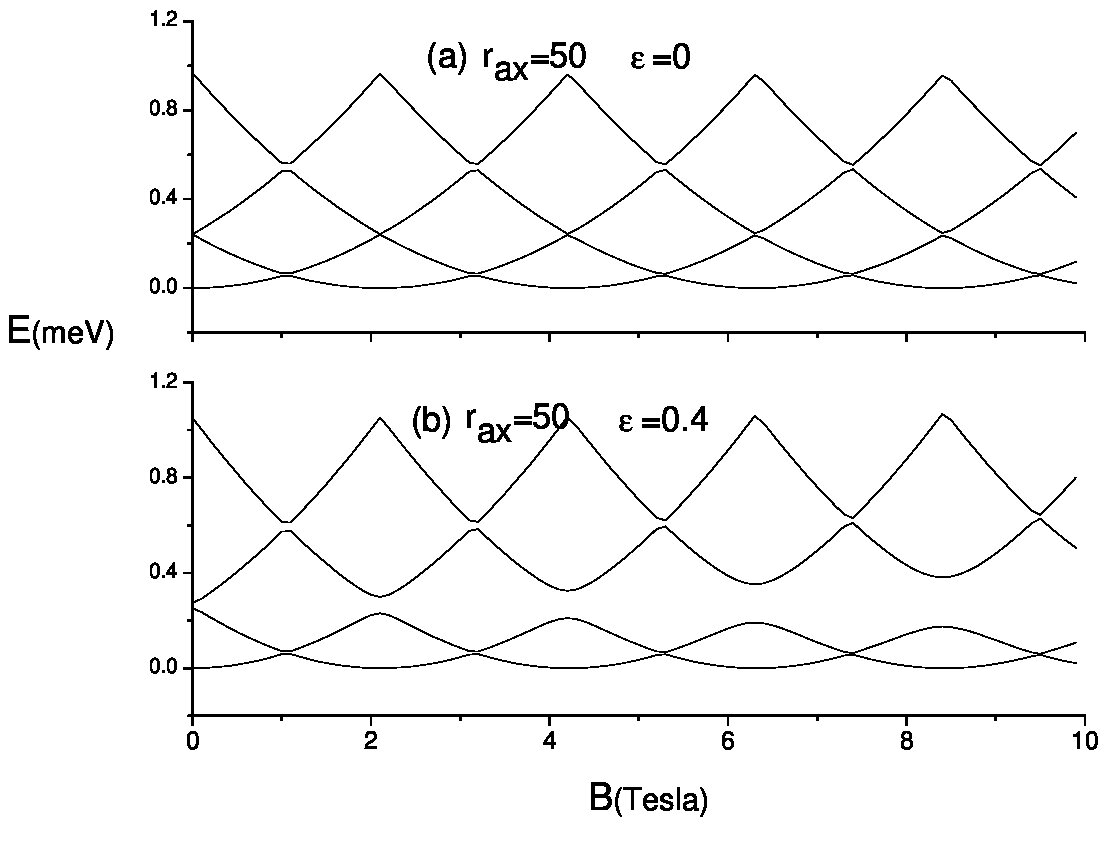 Figure 1
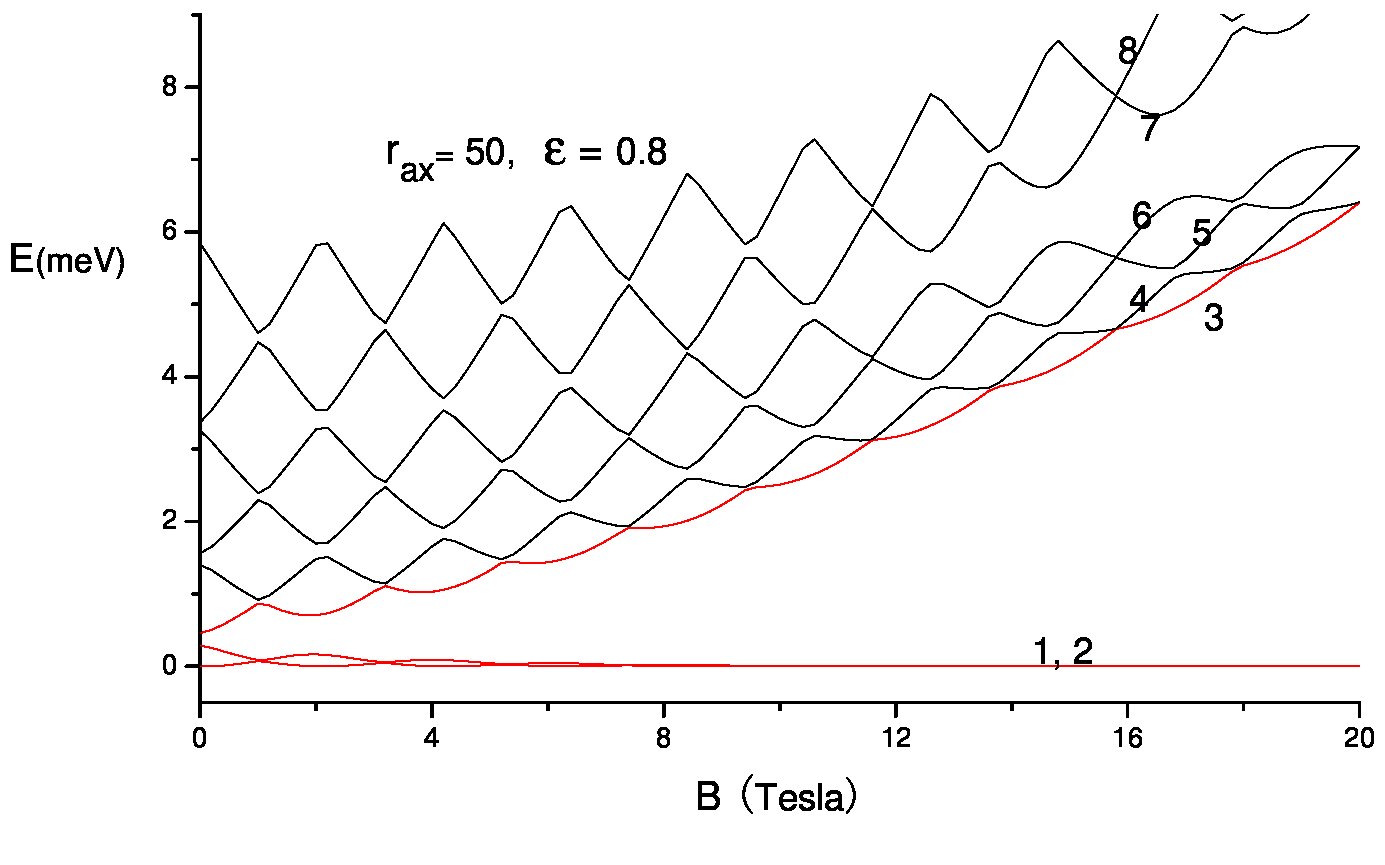 Figure 2
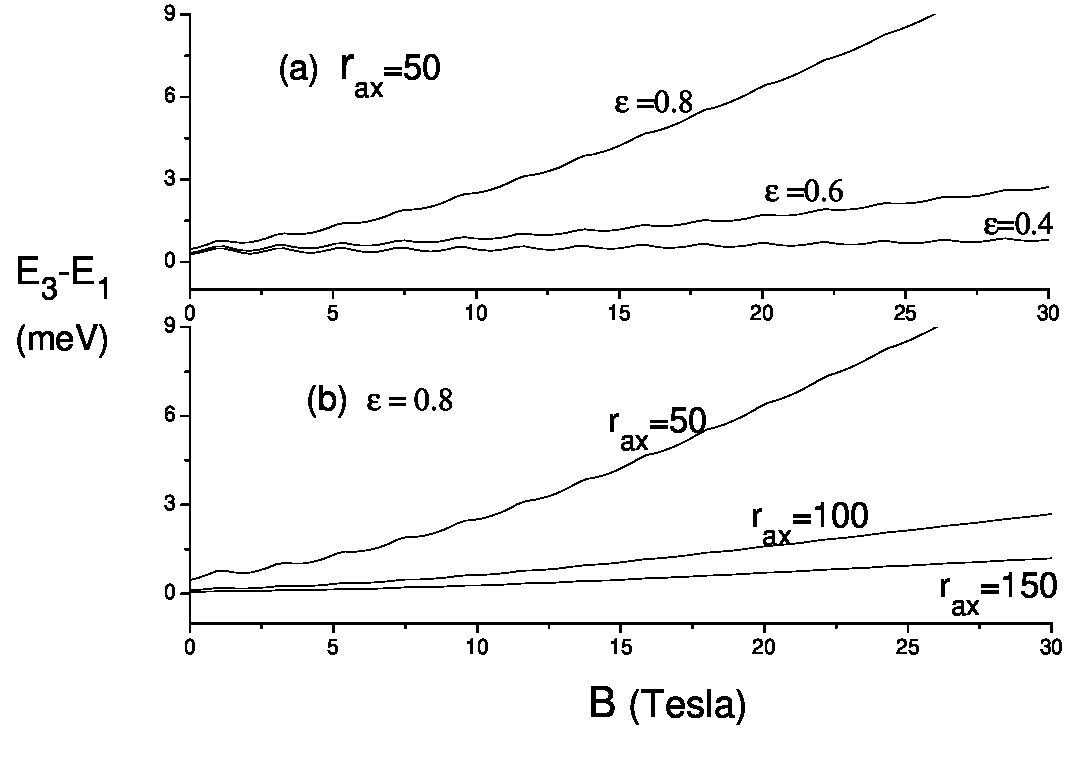 Figure 3
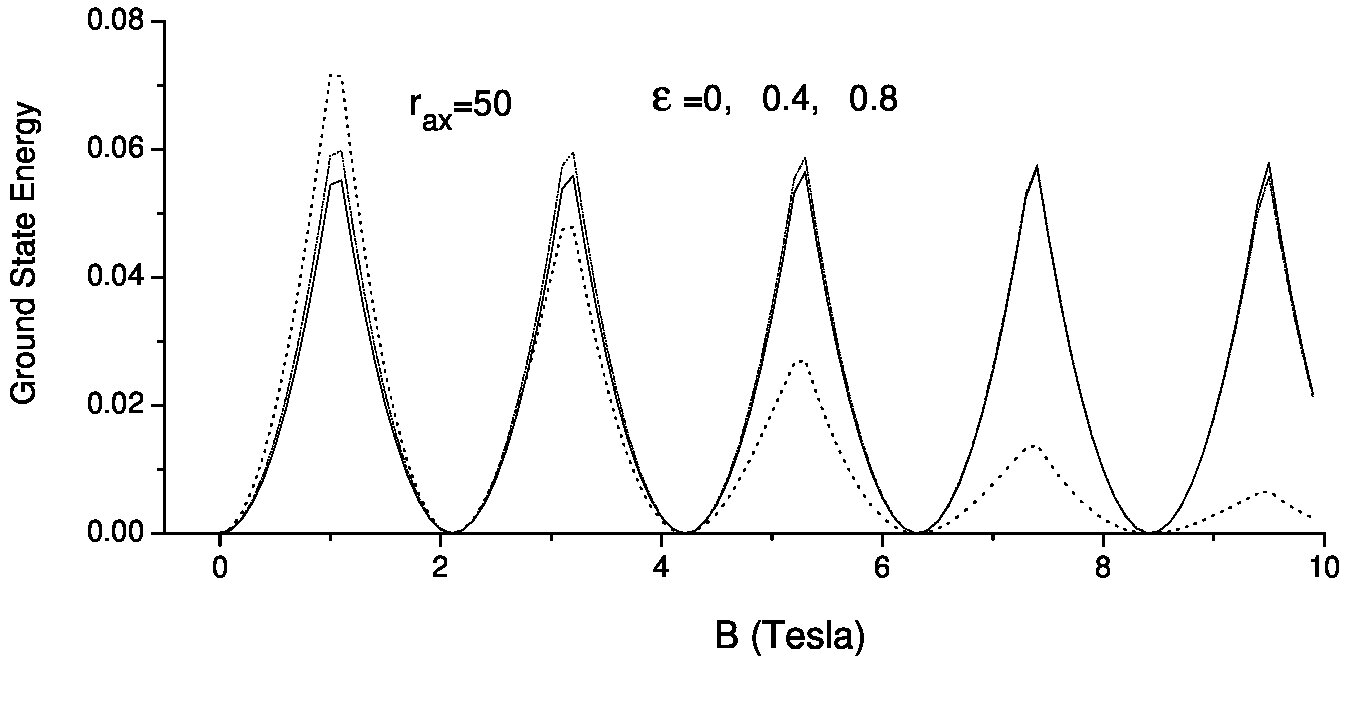 Figure 4
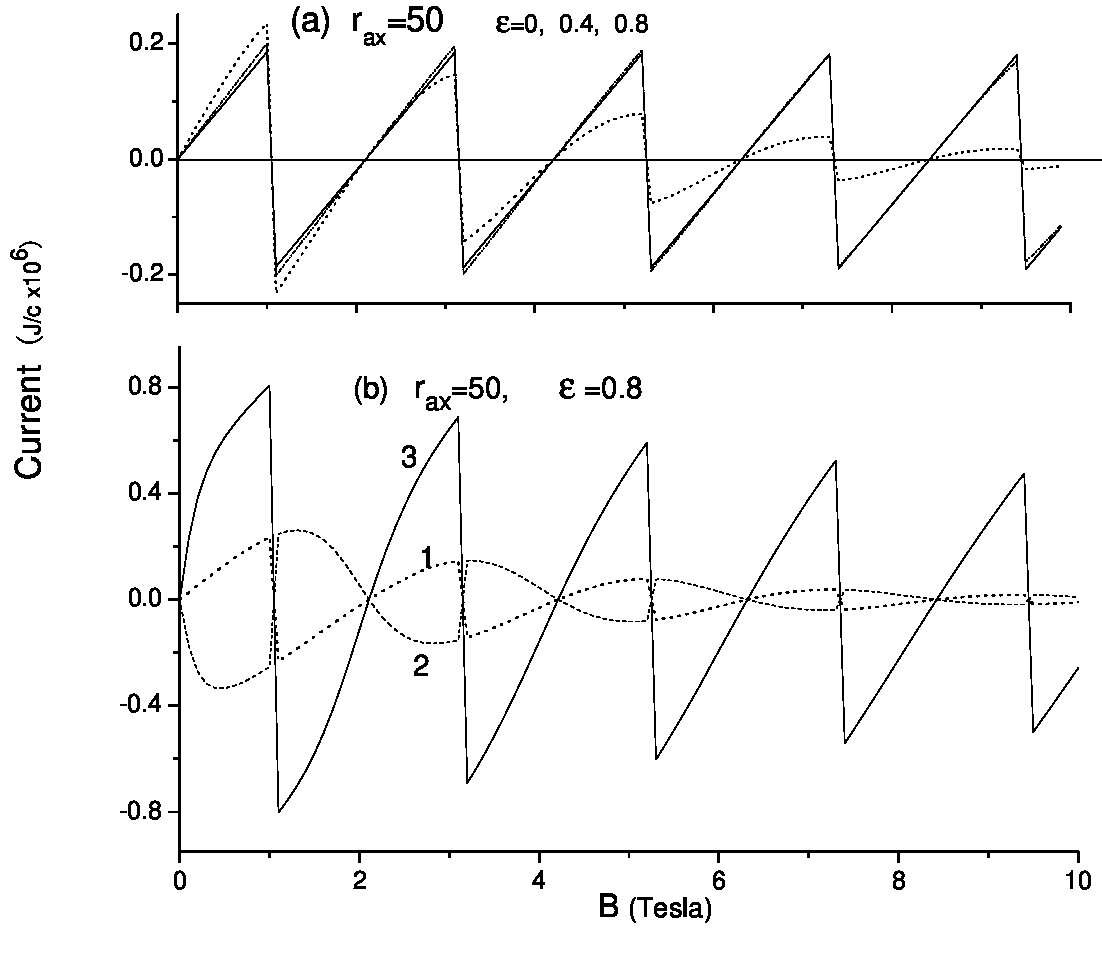 Figure 5
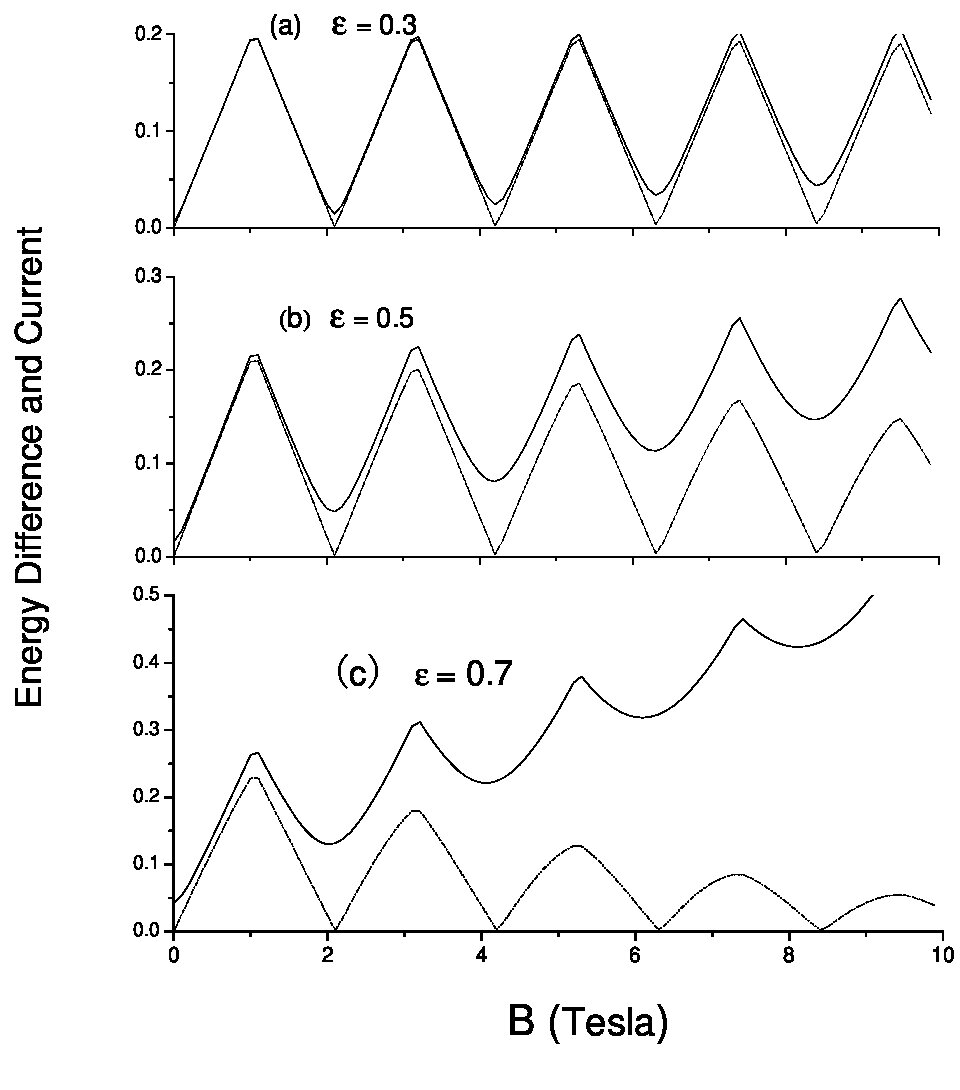 Figure 6
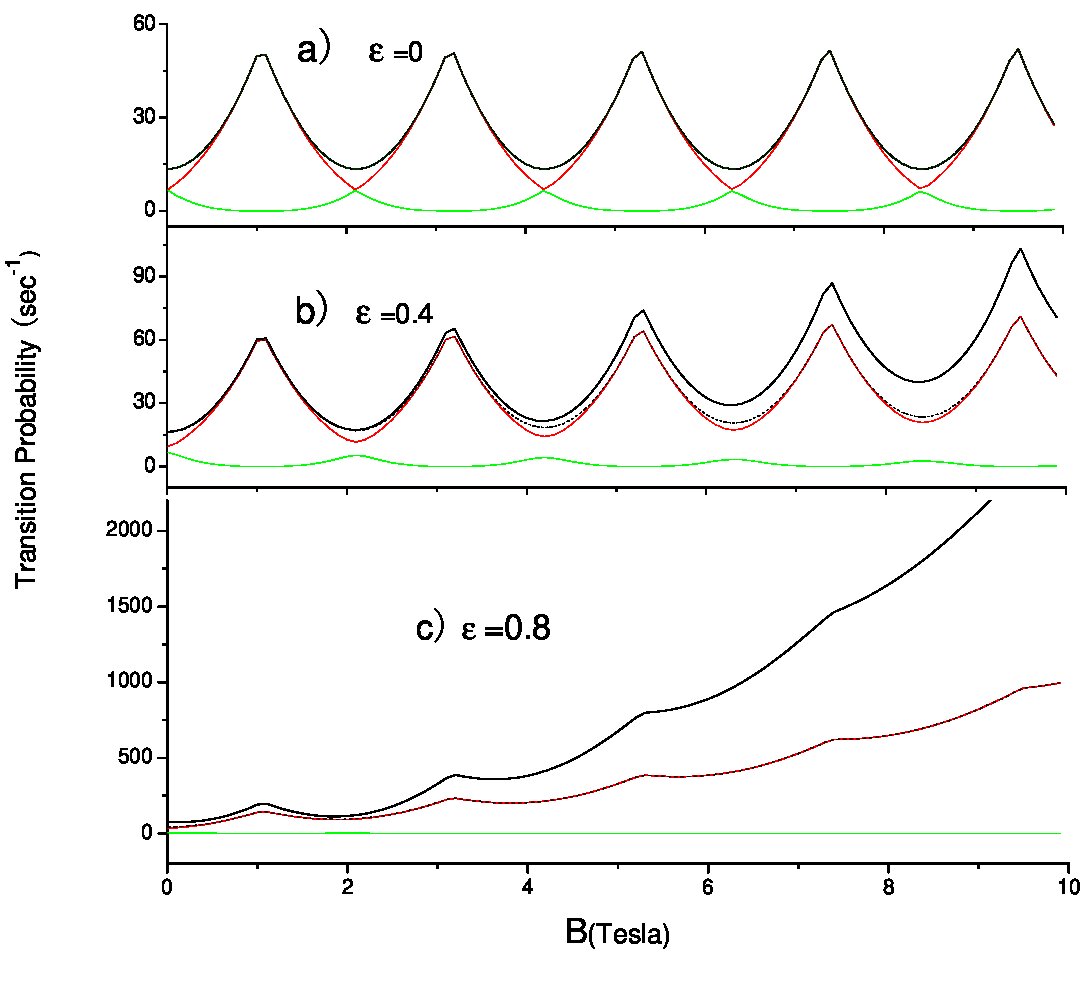 Figure 7
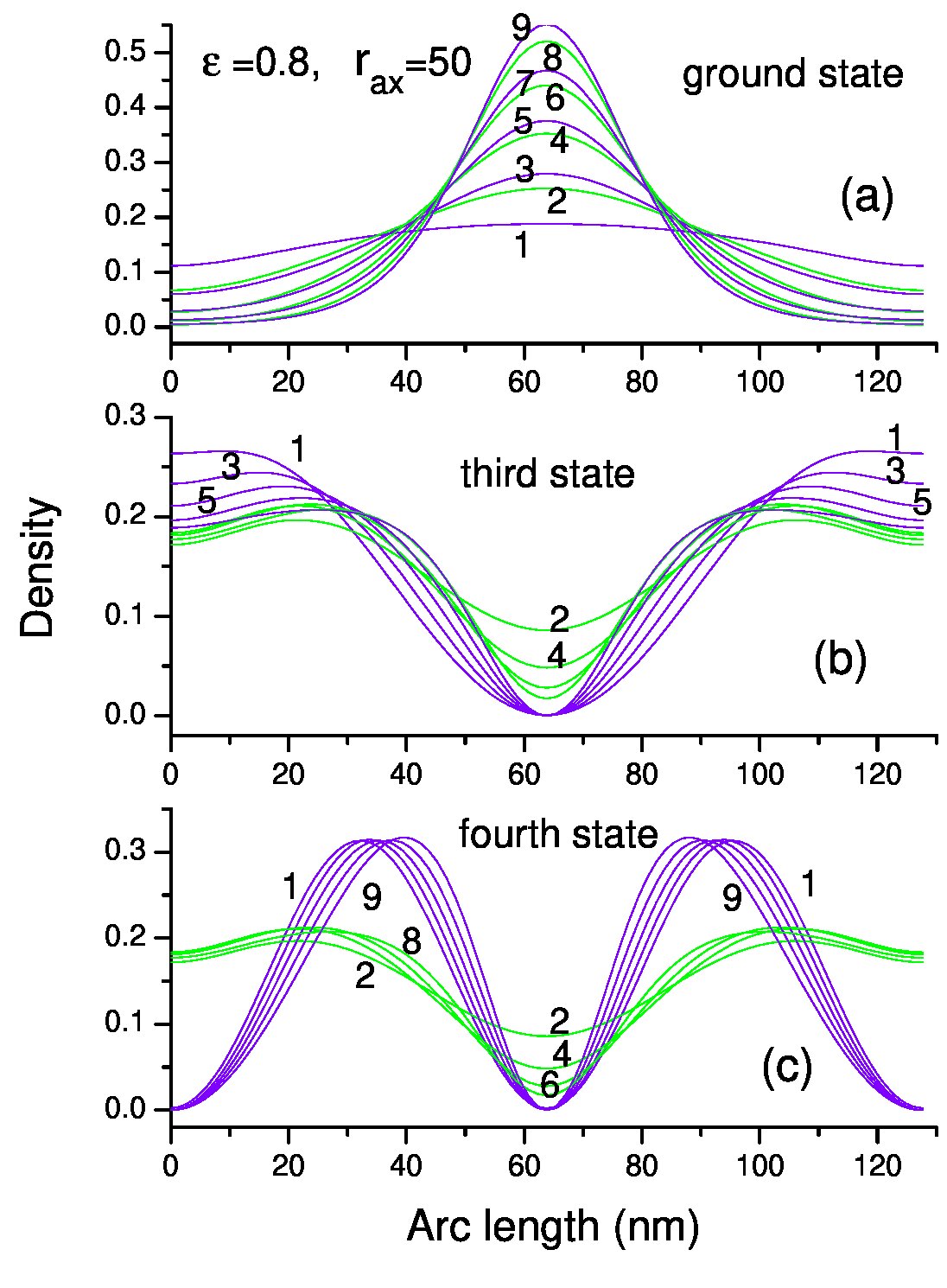 Figure 8
Peer Reviews
No public reviews on file for this paper yet. If you reviewed it on a platform where reviews are public (OpenReview, ICLR, NeurIPS, ICML), you can paste yours below so the community can read it here.
Videos
No videos yet. Explain this paper in a talk, walkthrough, or lecture? Add one.
Taxonomy
TopicsElectromagnetic Simulation and Numerical Methods · Nonlinear Waves and Solitons · Nonlinear Photonic Systems
Density oscillation in highly flattened quantum elliptic rings and
tunable strong dipole radiation
S.P. Situ
Y.Z. He
C.G. Bao*∗*
The State Key Laboratory of Optoelectronic Materials and Technologies, Zhongshan University, Guangzhou, 510275, P.R. China
Abstract
A narrow elliptic ring containing an electron threaded by a magnetic field is studied. When the ring is highly flattened, the increase of would lead to a big energy gap between the ground and excited states, and therefore lead to a strong emission of dipole photons. The photon frequency can be tuned in a wide range by changing and/or the shape of the ellipse. The particle density is found to oscillate from a pattern of distribution to another pattern back and forth against . This is a new kind of Aharonov-Bohm oscillation originating from symmetry breaking and is different from the usual oscillation of persistent current.
pacs:
73.23.Ra, 78.66.-w
Corresponding author
It is recognized that micro-devices are important to micro-techniques. Various kinds of micro-devices, including the quantum rings,1 have been extensively studied theoretically and experimentally in recent years. Quantum rings are different from other devices due to their special geometry. A distinguished phenomenon of the ring is the Aharonov-Bohm (A-B) oscillation of the ground state energy and persistent current It is believed that geometry would affect the properties of small systems. Therefore, in addition to circular rings, elliptic rings or other rings subjected to specific topological transformations deserve to be studied, because new and special properties might be found. There have been a number of literatures devoted to elliptic quantum dots6-9 and rings10-12. It was found that the elliptic rings have two distinguished features. (i) The avoided crossing of the levels and the suppression of the A-B oscillation. (ii) The appearance of localized states which are related to bound states in infinite wires with bends.13 These feature would become more explicit if the eccentricity is larger and the ring is narrower.
On the other hand, as a micro-device, the optical property is obviously essential to its application. It is guessed that very narrow rings with a high eccentricity might have special optical property, this is a point to be clarified. This paper is dedicated to this topic. It turns out that the optical properties of a highly flattened narrow ring is greatly different from a circular ring due to having a tunable energy gap, which would lead to strong dipole transitions with wave length tunable in a very broad range (say, from 0.1 to 0.001cm). Besides, a kind of A-B density-oscillation originating from symmetry breaking was found as reported as follows.
We consider an electron with an effective mass confined on a one-dimensional elliptic ring with a half major axis and an eccentricity . Let us introduce an argument so that a point at the ring is related to as and , where is the half minor axis. A uniform magnetic field confined inside a cylinder with radius vertical to the plane of the ring is applied. The associated vector potential reads , where is a unit** **vector normal to the position vector . Then, the Hamiltonian reads
[TABLE]
where
, is the flux, is the flux quantum.
The eigen-states are expanded as , where is an integer ranging from to , and denotes the ground state, the second state, and so on. The coefficients are obtained via the diagonalization of . In practice, takes positive values, and . This range of assures the numerical results having at least four effective figures. The energy of the state is
[TABLE]
where the eigen-state is normalized as
[TABLE]
In the follows the units meV, nm, and Tesla are used, (for InGaAs rings), and is fixed at 25. When , and 0.4, the evolution of the low-lying spectra with are given in Fig.1. When , the effect of eccentricity is still small, the spectrum is changed only slightly from the case , but the avoided crossing of levels can be seen.10,11 In particular, the A-B oscillation exists and the period of remains to be . However, when becomes large, three remarkable changes emerge as shown in Fig.2. (i) The A-B oscillation of the ground state vanishes gradually. (ii) The energy of the second state becomes closer and closer to the ground state. (iii) There is an energy gap lying between the ground state and the third state, the gap width increases nearly linearly with . The existence of the gap is a remarkable feature which has not yet been found before from the rings with a finite width. This feature is crucial to the optical properties as shown later. Fig.3 demonstrates further how the gap varies with and , where is from 0 to 30 (or from 0 to 14.24). One can see that, when is large and is small, the increase of would lead to a very large gap.
The A-B oscillation of the ground state energy is given in Fig.4. The change of does not affect the period (2.106 Tesla). However, when is large, the amplitude of the oscillation would be rapidly suppressed. Thus, for a highly flattened elliptic ring, the A-B oscillation appears only when is small.
The persistent current of the state reads14
[TABLE]
The A-B oscillation of is plotted in Fig.5. When is small (), just as in Fig.4, the effect of is small as shown in 5a. When is large there are three noticeable points: (i) The oscillation of the ground state current would become weaker and weaker when increases. (ii) The current of the second state has a similar amplitude as the ground state, but in opposite phase. (iii) The third (and higher) state has a much stronger oscillation of current.
For elliptic rings, the angular momentum is not conserved. However, it is useful to define (refer to eq.(2)). This quantity would tend to an integer if . It was found that (i) When is small (), of the ground state decreases step by step with , each step by one, just as the case of circular rings. However, when is large, decreases continuously and nearly linearly. (ii) When is small, is close (not close) to 1 if (otherwise). Since would be changed by under a dipole transition, the ground state would therefore essentially jump to the second and third states. Accordingly, the dipole photon has essentially two energies, namely, and . However, this is not exactly true when is large.
There is a relation between the dipole photon energies and the persistent current.15 For , the ground state with would have the current , while the ground state energy . Accordingly the second and third states would have , therefore we have
[TABLE]
This relation implies that the current can be accurately measured simply by measuring the energy difference of the photons emitted in dipole transitions. For elliptic rings, this relation holds approximately when is small (), as shown in Fig.6a. However, the deviation is quite large when is large as shown in 6c.
The probability of dipole transition from to reads
[TABLE]
where is the photon energy,
[TABLE]
The probability of the transition of the ground state to the state is shown in Fig.7. When is small () and is not very large (), the allowed final states essentially and , and the oscillation of the probability is similar to the case of circular rings with the same period as shown in 7a and 7b. In particular, is considerably larger than due to having a larger photon energy, thus the third state is particularly important to the optical properties. When is large (Fig.7c), the oscillation disappears gradually with while the probability increases very rapidly due to the factor . Since is nearly proportional to as shown in Fig.3, the probability is nearly proportional to . This leads to a very strong emission (absorption). Furthermore, in Fig.7c the black solid curve is much higher than the dash-dot-dot curve, it implies that the final states can be higher than , this leads to an even larger probability.
For circular rings, the particle densities of all the eigen-states are uniform under arbitrary . However, for elliptic rings, is no more uniform as shown in Fig.8. For the ground state (8a), when =0, the non-uniformity is slight and is a little smaller at the two ends of the major axis (). When increases, the density at the two ends of the minor axis () increases as well. When the non-uniformity is very strong as shown by the curve 9, where when or . The second state has a parity opposite to the ground state, but their densities are similar. For the third state (8b), is peaked not at the ends of the major and minor axes but in between. In particular, when increases, oscillates from one pattern (say, in violet line) to another pattern (in green line), and repeatedly. The density oscillation would become stronger in higher states (8c). The period of oscillation remains to be , thus it is a new type of A-B oscillation without analogue in circular rings (where remains uniform). Incidentally, the density oscillation does not need to be driven by a strong field, instead, a small change of from 0 to is sufficient.
Let us evaluate roughly by using to replace the operator in eq.(2) Then,
[TABLE]
There are two terms at the right each is a square of a pair of brackets (for circular rings the second term does not exist). It is reminded that, while is given positive, is negative. Thus there is a cancellation inside the first term. Therefore, when and are large, the second term would be more important. It is recalled that both and are mainly distributed around and (refer to Fig.8a), where the second term is zero due to the factor . Accordingly the energies of and are lower. On the contrary, both and are distributed close to the peaks of the second term (refer to Fig.8b and 8c), this leads to a higher energy. This effect would be greatly amplified by , this leads to the large energy gap shown in Fig.3.
In summary, the optical property of highly flattened elliptic narrow rings was found to be greatly different from circular rings. For the latter, both the energy of the dipole photon and the probability of transition are low, and they are oscillating in small domains. On the contrary, for the former, both the energy and the probability are not limited, the energy (probability) is nearly proportional to , they are tunable by changing and/or . It implies that a strong source of light with frequency adjustable in a wide domain can be designed by using highly flattened, narrow, and small rings. Furthermore, a new type of A-B oscillation, namely, the density oscillation, originating from symmetry breaking, was found. This is a noticeable point because the density oscillation might be popular for the systems with broken symmetry (e.g., with C3 symmetry).
Acknowledgment: The support under the grants 10574163 and 90306016 by NSFC is appreciated.
References
1, S.Viefers, P. Koskinen, P. Singha Deo, M. Manninen, Physica E ** 21 **, 1 (2004)
2, U.F. Keyser, C. Fühner, S. Borck, R.J. Haug, M. Bichler, G. Abstreiter, and W. Wegscheider, Phys. Rev. Lett. 90, 196601 (2003)
3, D. Mailly, C. Chapelier, and A. Benoit, Phys. Rev. Lett.** 70**, 2020 (1993)
4, A. Fuhrer, S. Lüscher, T. Ihn, T. Heinzel, K. Ensslin, W. Wegscheider, and M. Bichler, Nature (London) 413, 822 (2001)
5, A.E. Hansen, A. Kristensen, S. Pedersen, C.B. Sorensen, and P.E. Lindelof, Physica E (Amsterdam) 12, 770 (2002)
6, M. van den Broek, F.M. Peeters, Physica E,11, 345 (2001)
7, E. Lipparini, L. Serra, A. Puente, European Phys. J. B 27, 409 (2002)
8, J. Even, S. Loualiche, P. Miska, J. of Phys.: Cond. Matt., 15, 8737 (2003)
9, C. Yannouleas, U. Landman, Physica Status Solidi A 203, 1160 (2006)
10, D. Berman, O Entin-Wohlman, and M. Ya. Azbel, Phys. Rev. B 42, 9299 (1990)
11, D. Gridin, A.T.I. Adamou, and R.V. Craster, Phys. Rev. B 69, 155317 (2004)
12, A. Bruno-Alfonso, and A. Latgé, Phys. Rev. B 71, 125312 (2005)
13, J. Goldstone and R.L. Jaffe, Phys. Rev. B 45, 14100 (1992)
14, Eq.(4) originates from a 2-dimensional system via the following steps. (i) the components of the current along X- and Y-axis are firstly obtained from the conservation of mass as well known. (ii) Then, the component along the tangent of ellipse can be obtained. (iii) is integrated along the normal of the ellipse under the assumption that the wave function is restricted in a very narrow region along the normal, then it leads to eq.(4).
15, Y.Z. He, C.G. Bao (submitted to PRB)