The Low CO Content of the Extremely Metal Poor Galaxy I Zw 18
Adam Leroy, John Cannon, Fabian Walter, Alberto Bolatto, Axel Weiss

TL;DR
This study provides sensitive measurements showing that the extremely metal-poor galaxy I Zw 18 has an exceptionally low CO luminosity, indicating a very low molecular gas content relative to its star formation activity.
Contribution
First sensitive CO observations of I Zw 18 reveal its CO luminosity is much lower than expected, suggesting a very low CO-to-H2 ratio in this metal-poor galaxy.
Findings
CO luminosity is an order of magnitude lower than previous limits.
I Zw 18's CO content is comparable to or less than that of nearby low-mass irregulars.
The galaxy likely has a CO-to-H2 ratio about 100 times lower than the Milky Way.
Abstract
We present sensitive molecular line observations of the metal-poor blue compact dwarf I Zw 18 obtained with the IRAM Plateau de Bure interferometer. These data constrain the CO J=1-0 luminosity within our 300 pc (FWHM) beam to be L_CO < 1 \times 10^5 K km s^-1 pc^2 (I_CO < 1 K km s^-1), an order of magnitude lower than previous limits. Although I Zw 18 is starbursting, it has a CO luminosity similar to or less than nearby low-mass irregulars (e.g. NGC 1569, the SMC, and NGC 6822). There is less CO in I Zw 18 relative to its B-band luminosity, HI mass, or star formation rate than in spiral or dwarf starburst galaxies (including the nearby dwarf starburst IC 10). Comparing the star formation rate to our CO upper limit reveals that unless molecular gas forms stars much more efficiently in I Zw 18 than in our own galaxy, it must have a very low CO-to-H_2 ratio, \sim 10^-2 times the Galactic…
Click any figure to enlarge with its caption.
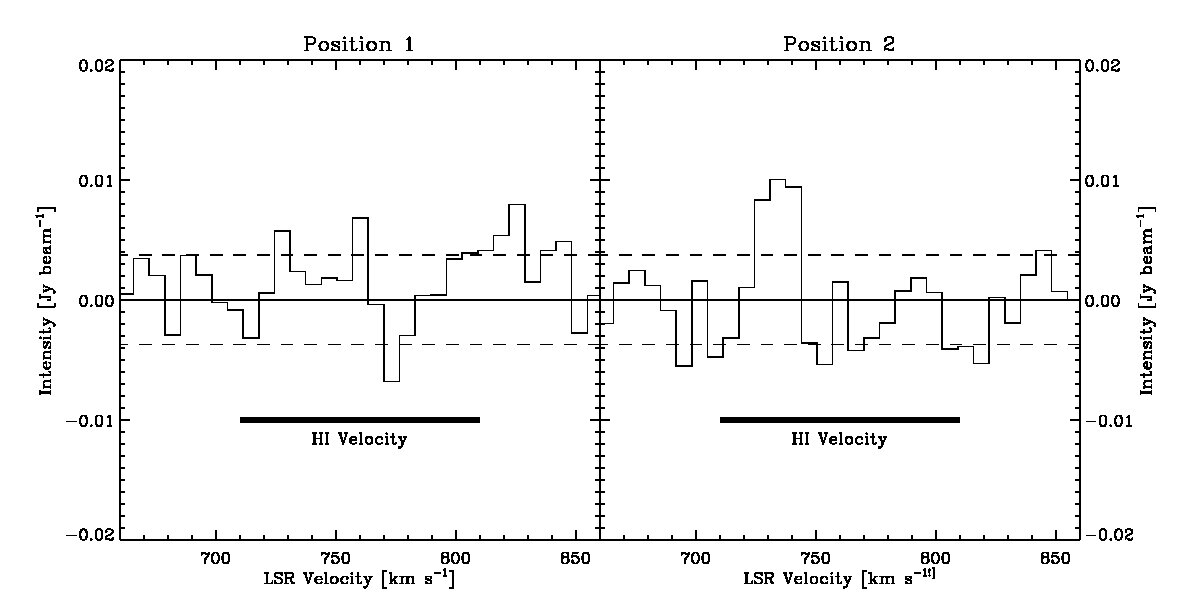 Figure 1
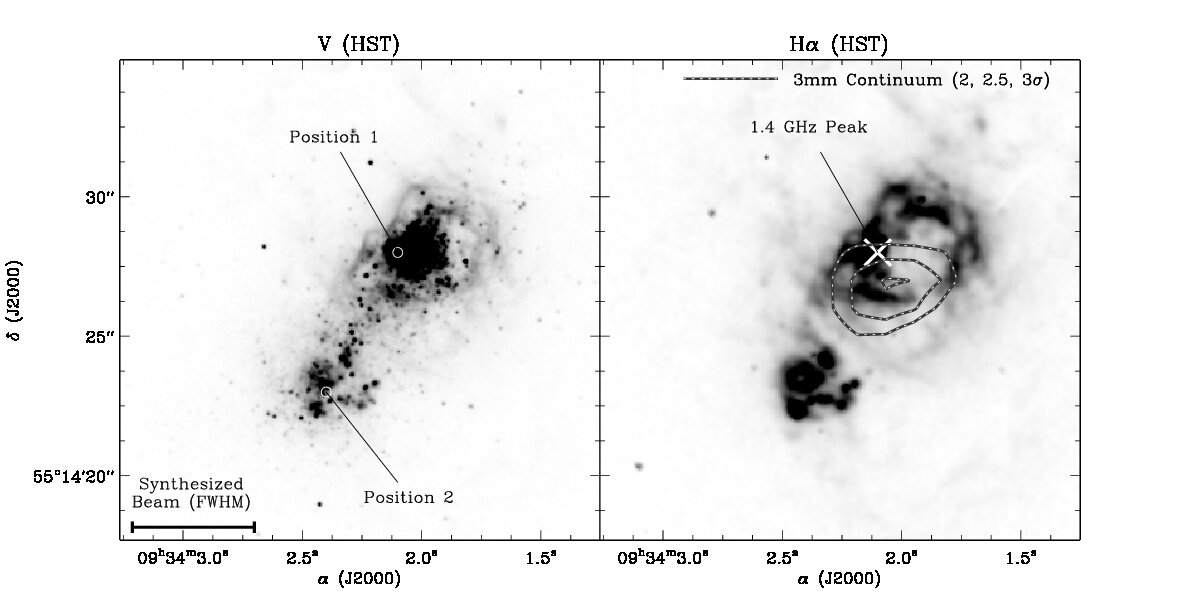 Figure 2
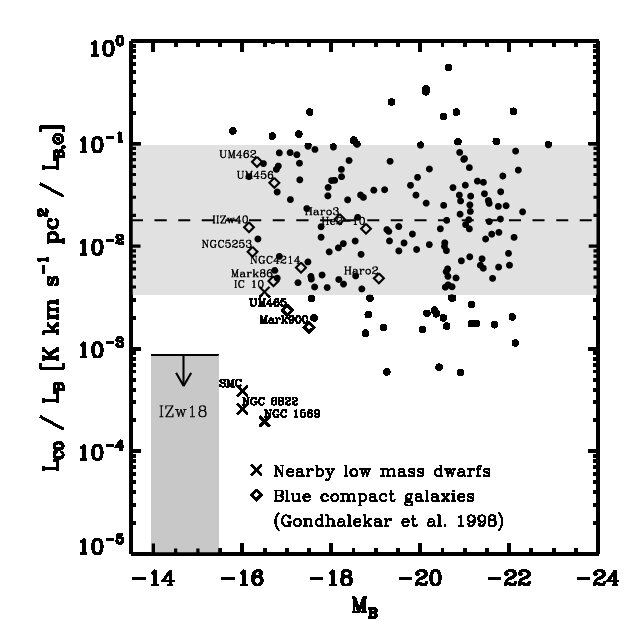 Figure 3
| Galaxy | aaPeak integrated intensity at 210 and 300 pc, corresponding to our beam size at 10 and 14 Mpc, respectively. | aaPeak integrated intensity at 210 and 300 pc, corresponding to our beam size at 10 and 14 Mpc, respectively. | Reference | ||
|---|---|---|---|---|---|
| (mag) | (K km s-1 pc2) | (K km s-1) | (K km s-1) | ||
| NGC 1569 | Greve et al. (1996) | ||||
| Taylor et al. (1999) | |||||
| SMC | Mizuno et al. (2001, 2006) | ||||
| NGC 6822 | Israel (1997b) | ||||
| IC 10 | Leroy et al. (2006) | ||||
| I Zw 18 | Arnault et al. (1988); Gondhalekar et al. (1998) | ||||
| I Zw 18 | this paper |
Peer Reviews
No public reviews on file for this paper yet. If you reviewed it on a platform where reviews are public (OpenReview, ICLR, NeurIPS, ICML), you can paste yours below so the community can read it here.
Videos
No videos yet. Explain this paper in a talk, walkthrough, or lecture? Add one.
Taxonomy
TopicsStellar, planetary, and galactic studies · Astrophysics and Star Formation Studies · Astronomy and Astrophysical Research
The Low CO Content of the Extremely Metal Poor Galaxy I Zw 18
Adam Leroy11affiliation: Max-Planck-Institut für Astronomie, Königstuhl 17, D-69117, Heidelberg, Germany; email: [email protected] , John Cannon11affiliation: Max-Planck-Institut für Astronomie, Königstuhl 17, D-69117, Heidelberg, Germany; email: [email protected] 22affiliation: Astronomy Department, Wesleyan University, Middletown, CT 06459, [email protected] , Fabian Walter11affiliation: Max-Planck-Institut für Astronomie, Königstuhl 17, D-69117, Heidelberg, Germany; email: [email protected] , Alberto Bolatto33affiliation: Radio Astronomy Lab, UC Berkeley, 601 Campbell Hall, Berkeley, CA, 94720 , Axel Weiss44affiliation: MPIfR, Auf dem Hügel 69, 53121, Bonn, Germany
Abstract
We present sensitive molecular line observations of the metal-poor blue compact dwarf I Zw 18 obtained with the IRAM Plateau de Bure interferometer. These data constrain the CO luminosity within our 300 pc (FWHM) beam to be K km s*-1* pc2 ( K km s*-1*), an order of magnitude lower than previous limits. Although I Zw 18 is starbursting, it has a CO luminosity similar to or less than nearby low-mass irregulars (e.g. NGC 1569, the SMC, and NGC 6822). There is less CO in I Zw 18 relative to its -band luminosity, H I mass, or star formation rate than in spiral or dwarf starburst galaxies (including the nearby dwarf starburst IC 10). Comparing the star formation rate to our CO upper limit reveals that unless molecular gas forms stars much more efficiently in I Zw 18 than in our own galaxy, it must have a very low CO-to-H2 ratio, times the Galactic value. We detect 3mm continuum emission, presumably due to thermal dust and free-free emission, towards the radio peak.
Subject headings:
galaxies: individual (I Zw 18); galaxies: ISM; galaxies: dwarf, radio lines: ISM
1. Introduction
With the lowest nebular metallicity in the nearby universe (, Skillman & Kennicutt, 1993), the blue compact dwarf I Zw 18 plays an important role in our understanding of galaxy evolution. Vigorous ongoing star formation implies the presence of molecular gas, but direct evidence has been elusive. Vidal-Madjar et al. (2000) showed that there is not significant diffuse H2, but Cannon et al. (2002) found M*⊙* of dust organized in clumps with sizes 50 – 100 pc. Vidal-Madjar et al. (2000) did not rule out compact, dense molecular clouds, and Cannon et al. (2002) argued that this dust may indicate the presence of molecular gas.
Observations by Arnault et al. (1988) and Gondhalekar et al. (1998) failed to detect CO emission, the most commonly used tracer of H2. This is not surprising. The low dust abundance and intense radiation fields found in I Zw 18 may have a dramatic impact on the formation of H2 and structure of molecular clouds. A large fraction of the H2 may exist in extended envelopes surrounding relatively compact cold cores. In these envelopes, H2 self-shields while CO is dissociated (Maloney & Black, 1988). The result may be that in such galaxies [CII] or FIR emission trace H2 better than CO (Madden et al., 1997; Israel, 1997a; Pak et al., 1998). Further, H2 may simply be underabundant, as there is a lack of grains on which to form while photodissociation is enhanced by an intense UV field. Indeed, Bell et al. (2006) found that at , a molecular cloud may take as long as a Gyr to reach chemical equilibrium.
A low CO content in I Zw 18 is then expected, and a stringent upper limit would lend observational support to predictions for molecular cloud structure at low metallicity. However, while the existing upper limits are sensitive in an absolute sense, they do not even show I Zw 18 to have a lower normalized CO content than a spiral galaxy (e.g. less CO per -band luminosity). The low luminosity (, Gil de Paz et al., 2003) and large distance (d=14 Mpc, Izotov & Thuan, 2004) of this system require very sensitive observations to set a meaningful upper limit.
In this letter we present observations, obtained with the IRAM Plateau de Bure Interferometer (PdBI)111Based on observations carried out with the IRAM Plateau de Bure Interferometer. IRAM is supported by INSU/CNRS (France), MPG (Germany) and IGN (Spain).”, that constrain the CO luminosity, , to be equal to or less than that of nearby CO-poor (non-starbursting) dwarf irregulars.
2. Observations
I Zw 18 was observed with the IRAM Plateau de Bure Interferometer on 17, 21, and 27 April and 13 May 2004 for a total of 11 hours. The phase calibrators were 0836+710 ( Jy), and 0954+556 ( Jy). One or more calibrators with known fluxes were also observed during each track. The data were reduced at the IRAM facility in Grenoble using the GILDAS software package; maps were prepared using AIPS. The final CO data cube has beam size , and a velocity (frequency) resolution of km s*-1* ( MHz). The velocity coverage stretches from to km s*-1*. The data have an RMS noise of mJy beam*-1* ( mK; Jy beam*-1* = K). The (FWHM) primary beam completely covers the galaxy. Based on variation of the relative fluxes of the calibrators, we estimate the gain uncertainty to be .
3. Results
3.1. Upper Limit on CO Emission
To search for significant CO emission, we smooth the cube to 20 km s*-1* velocity resolution, a typical line width for CO at our spatial resolution (e.g., Helfer et al., 2003). The noise per channel map in this smoothed cube is K km s*-1*. Over the H I velocity range (710 – 810 km s*-1*, van Zee et al., 1998), there are no regions with K km s*-1* (4) within the primary beam. We pick a slightly conservative upper limit for two reasons. First, if there were CO emission with this intensity we would be certain of detecting it. Second, the noise in the cube is slightly non-Gaussian, so that the false positive rate for K km s*-1* — estimated from the negatives and the channel maps outside the H I velocity range — is %, very close to that of a deviate.
For Mpc, the synthesized beam has a FWHM of 300 pc and an area of pc2. Our intensity limit, K km s*-1*, therefore translates to a CO luminosity limit of K km s*-1* pc2.
There is a marginal signal toward the southern knot of H emission (, ). This emission has the largest found over the H I velocity range, corresponding to K km s*-1* pc2, just below our limit. This same line of sight also shows over three consecutive channels, a feature seen along only one other line of sight (in negative) over the H I velocity range. The marginal signal is suggestively located in the southeast of I Zw 18, where Cannon et al. (2002) identified several potential sites of molecular gas from regions of relatively high extinction. While tantalizing, the signal is not strong enough to be categorized as a detection. Figure 3.1 shows CO spectra towards the H/radio continuum peak (Cannon et al., 2002, 2005; Hunt et al., 2005a, see Figure 3.2) and this marginal signal.
3.2. Continuum Emission
We average the data over all channels and produce a continuum map with noise mJy beam*-1*. The highest value in the map is mJy beam*-1* at , . This is within a fraction of a beam of the 1.4 GHz peak identified by Cannon et al. (2005, , ) and Hunt et al. (2005a, , ). Figure 3.2 shows the radio continuum peak and 115 GHz continuum contours plotted over H emission from I Zw 18 (Cannon et al., 2002). There is only one other region with within the primary beam and the star-forming extent of I Zw 18 occupies of the primary beam. Therefore, we estimate the chance of a false positive coincident with the galaxy to be only .
4. Discussion
Here we discuss the implications of our CO upper limit and continuum detection. We adopt the following properties for I Zw 18, all scaled to Mpc: (Gil de Paz et al., 2003), M*⊙* (van Zee et al., 1998), H luminosity erg s*-1* (Cannon et al., 2002; Gil de Paz et al., 2003), 1.4 GHz flux mJy (Cannon et al., 2005).
4.1. Point Source Luminosity
Our upper limit along each line of sight, K km s*-1* pc2, matches the luminosity of a fairly massive Galactic giant molecular cloud (Blitz, 1993). For a Galactic CO-to-H2 conversion factor, cm*-2* (K km s*-1*)-1, the corresponding molecular gas mass is M*⊙*, similar to the mass of the Orion-Monoceros complex (e.g. Wilson et al., 2005).
4.2. Comparison With More Luminous Galaxies
In galaxies detected by CO surveys, the CO content per unit -band luminosity is fairly constant. Figure 4.5 shows the CO luminosity normalized by -band luminosity, , as a function of absolute -band magnitude ( is extinction corrected). is nearly constant over two orders of magnitude in , though with substantial scatter (much of it due to the extrapolation from a single pointing to ).
Based on these data and assuming that is not a function of the metallicity of the galaxy, we may extrapolate to an expected CO luminosity for I Zw 18. For the CO luminosity corresponding to the median value of (dashed line) in Figure 4.5 is K km s*-1* pc2. The H, 1.4 GHz, and H I luminosities lead to similar predictions. Young et al. (1996) found for Sd–Irr galaxies, which implies K km s*-1* pc2. Murgia et al. (2005) measured Jy km s*-1* (mJy)-1 for spirals, that would imply L K km s*-1*. For Sd/Sm galaxies, (Young & Scoville, 1991), leading to K km s*-1* pc2. Both and tend to be even higher in earlier-type spirals.
Therefore, surveys would predict K km s*-1* pc2, very close to the previously established upper limits of K km s*-1pc2 (Arnault et al., 1988; Gondhalekar et al., 1998). With the present observations, we constrain K km s-1pc2 and thus clearly rule out K km s-1* pc2. This may be seen in Figure 4.5; even if I Zw 18 has the highest possible CO content, it will still have a lower than of the survey galaxies.
4.3. Comparison With Nearby Metal-Poor Dwarfs
The subset of irregular galaxies detected by CO surveys tend to be CO-rich and actively star-forming, resembling scaled-down versions of spiral galaxies (Young et al., 1995, 1996; Leroy et al., 2005). Such galaxies may not be representative of all dwarfs. Because they are nearby, several of the closest dwarf irregulars have been detected despite very small . With their low masses and metallicities, they may represent good points of comparison for I Zw 18. Table 1 and Figure 4.5 show CO luminosities and for four nearby dwarfs: NGC 1569, the Small Magellanic Cloud (SMC), NGC 6822, and IC 10. The SMC, NGC 1569, and NGC 6822 have K km s*-1* pc2, close to our upper limit, and occupy a region of - parameter space similar to I Zw 18. All four of these galaxies have active star formation but very low CO content relative to their other properties.
We test whether our observations would have detected CO in NGC 1569, the SMC, and IC 10 at the plausible lower limit of 10 Mpc (from km s*-1*) or our adopted distance of 14 Mpc. We convolve the integrated intensity maps to resolutions of 210 and 300 pc and measure the peak integrated intensity. The results appear in columns 4 and 5 of Table 1. The PdBI observations of NGC 1569 resolve out most of the flux, so we also apply this test to a distribution with the size and luminosity derived by Greve et al. (1996) from single dish observations. Our observations would detect an analog to IC 10 but not the SMC, with NGC 1569 an intermediate case. With a factor of better sensitivity (requiring times more observing time) we would expect to detect all three nearby galaxies. However, achieving such sensitivity with present instrumentation will be quite challenging. ALMA will likely be necessary to place stronger constraints on CO in galaxies like I Zw 18.
IC 10 may be the nearest blue compact dwarf (Richer et al., 2001), so it may be telling that we would detect it at the distance of I Zw 18. The blue compact galaxies that have been detected in CO have LCO/LB similar to IC 10 (Gondhalekar et al., 1998, the diamonds in Figure 4.5). Most searches for CO towards BCDs have yielded nondetections, so those detected may not be representative, but I Zw 18 is clearly not among the “CO-rich” portion of the BCD population.
4.4. Interpretation of the Continuum
We measure continuum intensity of mJy towards the radio continuum peak. The continuum is detected along only one line of sight, so we refer to it here as a point source and compare it to integrated values for I Zw 18. is expected to be the product of mainly two types of emission: thermal free-free emission and thermal dust emission. At long wavelengths, the integrated thermal free-free emission is – mJy (Cannon et al., 2005; Hunt et al., 2005a), implying – mJy at GHz (). The H flux predicts a similar value, mJy (Cannon et al., 2005, Equation 1). Hunt et al. (2005b) placed an upper limit of mJy on dust continuum emission at 850m; this is consistent with the M*⊙* estimated by Cannon et al. (2002) given almost any reasonable dust properties. Extrapolating this to mm assuming a pure blackbody spectrum, the shallowest plausible SED, constrains thermal emission from dust to be mJy at GHz. Based on these data, we would predict mJy. Thus our measured is consistent with, but somewhat higher than, the thermal free-free plus dust emission expected based on optical, centimeter, and submillimeter data.
4.5. Relation to Star Formation
I Zw 18 has a star formation rate – M*⊙* yr*-1*, based on H and cm radio continuum measurements (Cannon et al., 2002; Kennicutt, 1998a; Hunt et al., 2005a). Our continuum flux suggests a slightly higher value – M*⊙* yr*-1* (following Hunt et al., 2005a; Condon, 1992), with the exact value depending on the contribution from thermal dust emission. For any value in this range, the star formation rate per CO luminosity, is much higher in I Zw 18 than in spirals. For comparison, our upper limit and the molecular “Schmidt Law” derived by Murgia et al. (2002) predicts a star formation rate M*⊙* yr*-1*. Fits by Young et al. (1996) and Kennicutt (1998b, applied to just the molecular limit) yield similar values. Again, I Zw 18 is similar to the SMC and NGC 6822, which have star formation rates of M*⊙* yr*-1* and M*⊙* yr*-1* (Wilke et al., 2004; Israel, 1997b) and K km s*-1* pc2.
4.6. Variations in
Several calibrations of the CO-to-H2 conversion factor, as a function of metallicity exist in the literature. The topic has been controversial and these calibrations range from little or no dependence (e.g. Walter, 2003; Rosolowsky et al., 2003) to very steep dependence (e.g., \mbox{X_{\rm CO}}\ \propto Z^{-2.7} Israel, 1997a). Comparing the star formation rate to our CO upper limit, we may rule out that I Zw 18 has a Galactic unless molecular gas in I Zw 18 forms stars much more efficiently than in the Galaxy. Either the ratio of CO-to-H2 is low in I Zw 18 or molecular gas in this galaxy forms stars with an efficiency two orders of magnitude higher than that in spiral galaxies.
5. Conclusions
We present new, sensitive observations of the metal-poor dwarf galaxy I Zw 18 at 3 mm using the Plateau de Bure Interferometer. These data constrain the integrated CO intensity to be K km s*-1* over our pc (FWHM) beam and the luminosity to be K km s*-1* pc2.
I Zw 18 has less CO relative to its -band luminosity, H I mass, or SFR than spiral galaxies or dwarf starbursts, including more metal-rich blue compact galaxies such as IC 10 (, Lee et al., 2003). Because of its small size and large distance, these are the first observations to impose this constraint.
We show that I Zw 18 should be grouped with several local analogs — NGC 1569, the SMC, NGC 6822 — as a galaxy with active star formation but a very low CO content relative to its other properties. In these galaxies, observations suggest that the environment affects the molecular gas and these data suggest that the same is true in I Zw 18. A simple comparison of star formation rate to CO content shows that this must be true at a basic level: either the ratio of CO to H2 is dramatically low in I Zw 18 or molecular gas in this galaxy forms stars with an efficiency two orders of magnitude higher than that in spiral galaxies.
We detect 3mm continuum with mJy coincident with the radio peak identified by Cannon et al. (2005) and Hunt et al. (2005a). This flux is consistent with but somewhat higher than the thermal free-free plus dust emission one would predict based on centimeter, submillimeter, and optical measurements.
Finally, we note that improving on this limit with current instrumentation will be quite challenging. The order of magnitude increase in sensitivity from ALMA will be needed to place stronger constraints on CO in galaxies like I Zw 18.
We thank Roberto Neri for his help reducing the data. We acknowledge the usage of the HyperLeda database (http://leda.univ-lyon1.fr).
The reference list from the paper itself. Each links out to its DOI / PubMed record.
- 1Arnault et al. (1988) Arnault, P., Kunth, D., Casoli, F., & Combes, F. 1988, A&A, 205, 41
- 2Bell et al. (2006) Bell, T. A., Roueff, E., Viti, S., & Williams, D. A. 2006, MNRAS, 371, 1865
- 3Blitz (1993) Blitz, L. 1993, Protostars and Planets III, 125
- 4Böker et al. (2003) Böker, T., Lisenfeld, U., & Schinnerer, E. 2003, A&A, 406, 87
- 5Cannon et al. (2002) Cannon, J. M., Skillman, E. D., Garnett, D. R., & Dufour, R. J. 2002, Ap J, 565, 931
- 6Cannon et al. (2005) Cannon, J. M., Walter, F., Skillman, E. D., & van Zee, L. 2005, Ap J, 621, L 21
- 7Condon (1992) Condon, J. J. 1992, ARA&A, 30, 575
- 8Gil de Paz et al. (2003) Gil de Paz, A., Madore, B. F., & Pevunova, O. 2003, Ap JS, 147, 29