Semi-spheroidal Quantum Harmonic Oscillator
D. N. Poenaru, R. A. Gherghescu, A. V. Solov'yov, W. Greiner

TL;DR
This paper introduces a new shell model based on a semi-spheroidal potential well, revealing unique magic numbers for oblate and prolate shapes, aligning with known superdeformed and spherical harmonic oscillator results.
Contribution
It derives a semi-spheroidal quantum harmonic oscillator model, identifying new magic numbers for oblate and prolate shapes, extending shell model understanding.
Findings
Identifies new magic numbers for oblate semi-spheroids: 2, 6, 14, 26, 44, 68, 100, 140.
Finds superdeformed prolate magic numbers match spherical harmonic oscillator: 2, 8, 20, 40, 70, 112, 168.
Shows only negative parity states are allowed for the Z(z) wave function component.
Abstract
A new single-particle shell model is derived by solving the Schr\"odinger equation for a semi-spheroidal potential well. Only the negative parity states of the component of the wave function are allowed, so that new magic numbers are obtained for oblate semi-spheroids, semi-sphere and prolate semi-spheroids. The semi-spherical magic numbers are identical with those obtained at the oblate spheroidal superdeformed shape: 2, 6, 14, 26, 44, 68, 100, 140, ... The superdeformed prolate magic numbers of the semi-spheroidal shape are identical with those obtained at the spherical shape of the spheroidal harmonic oscillator: 2, 8, 20, 40, 70, 112, 168 ...
Click any figure to enlarge with its caption.
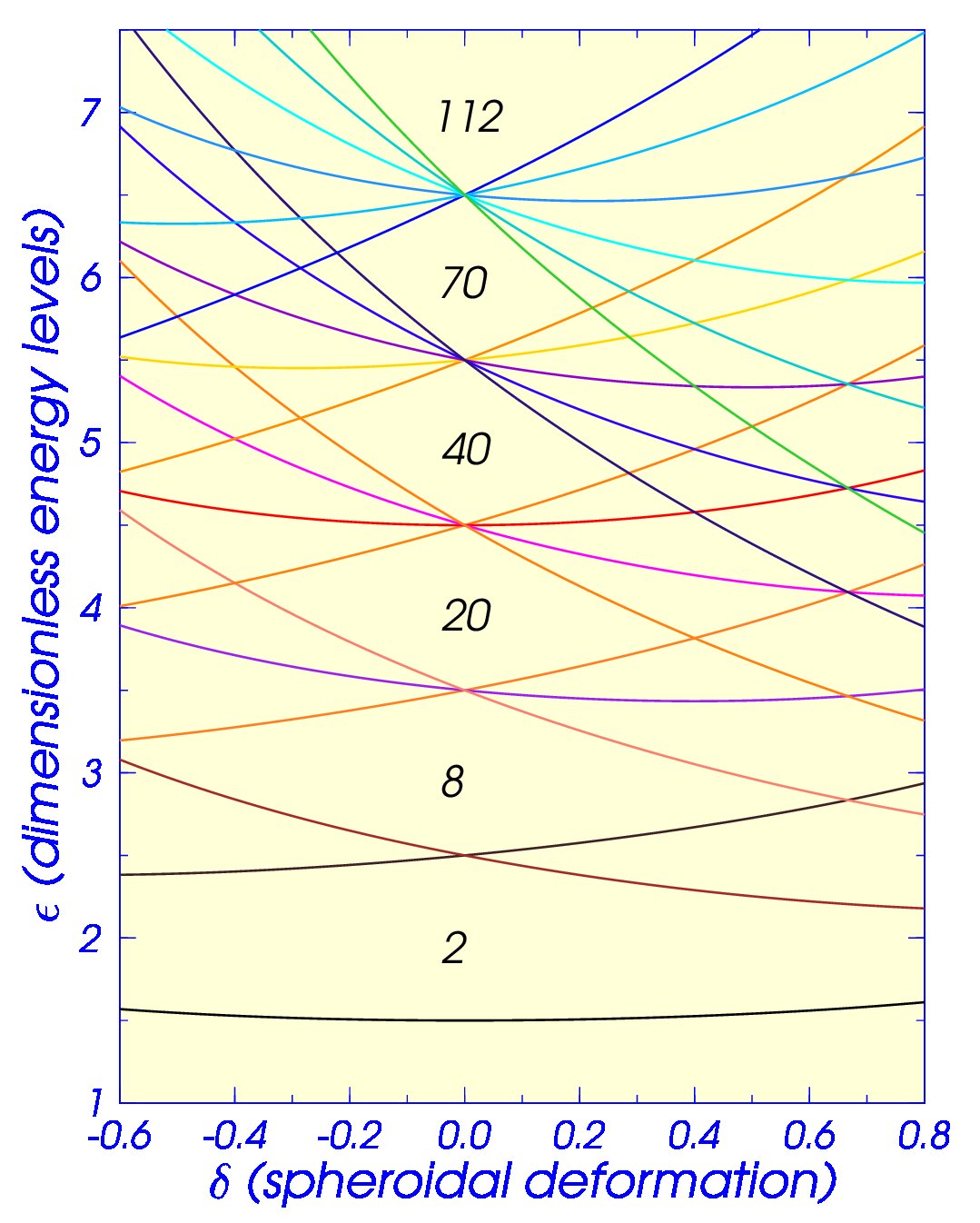 Figure 1
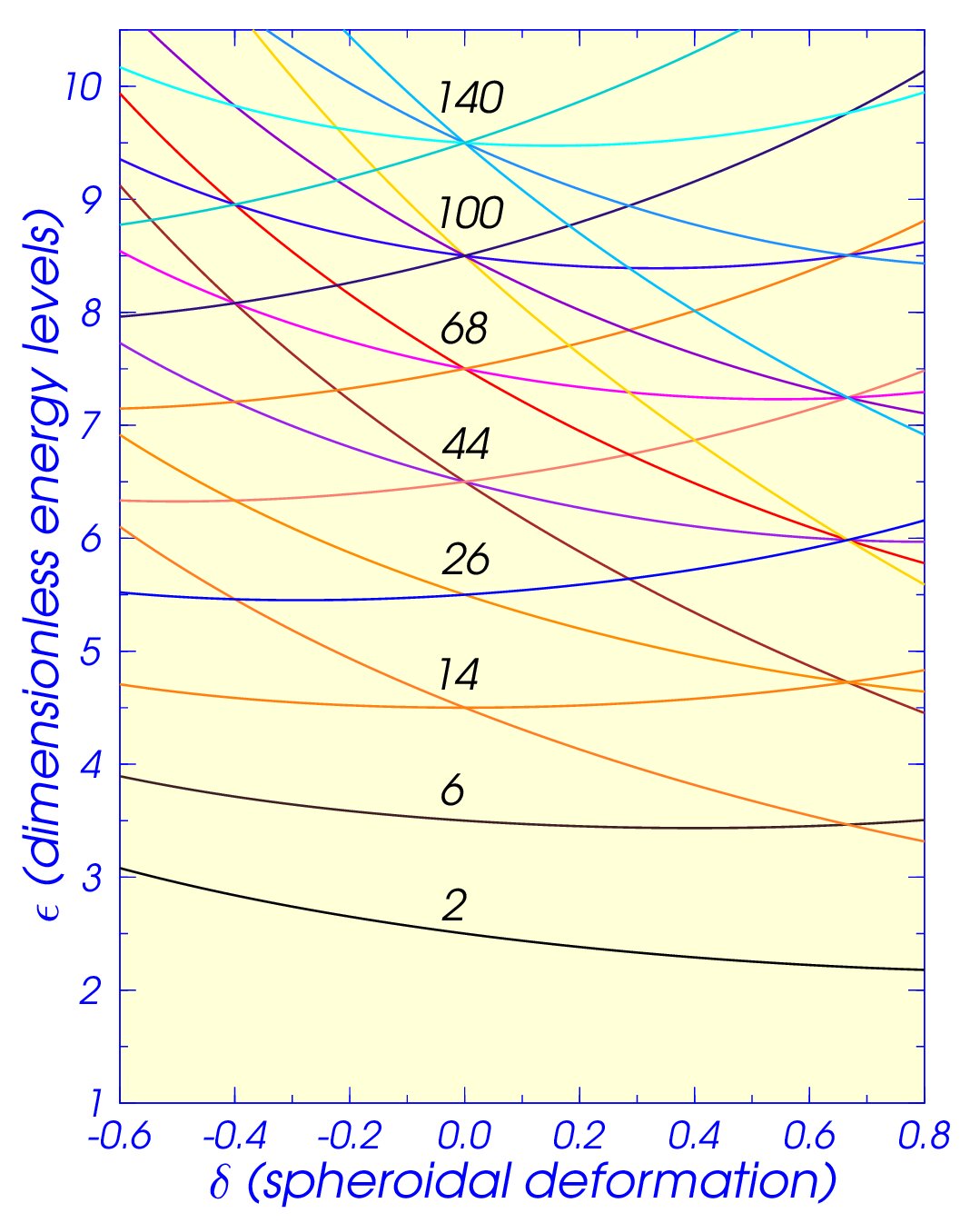 Figure 1
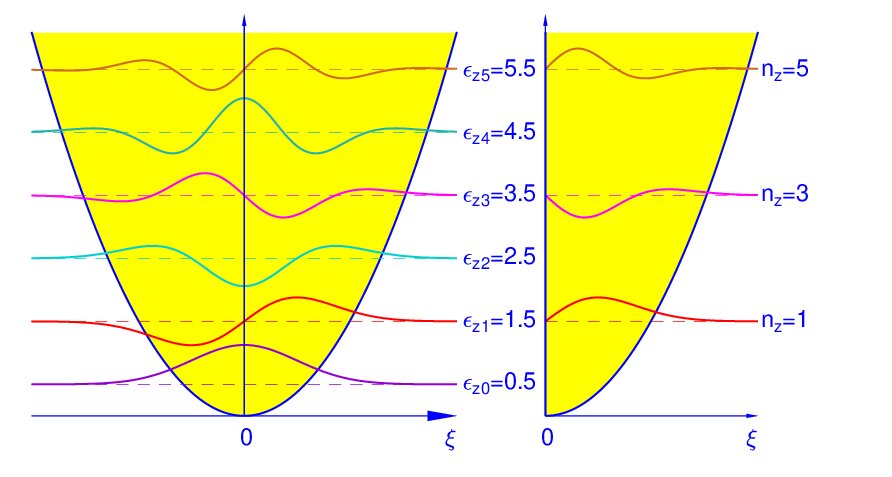 Figure 2
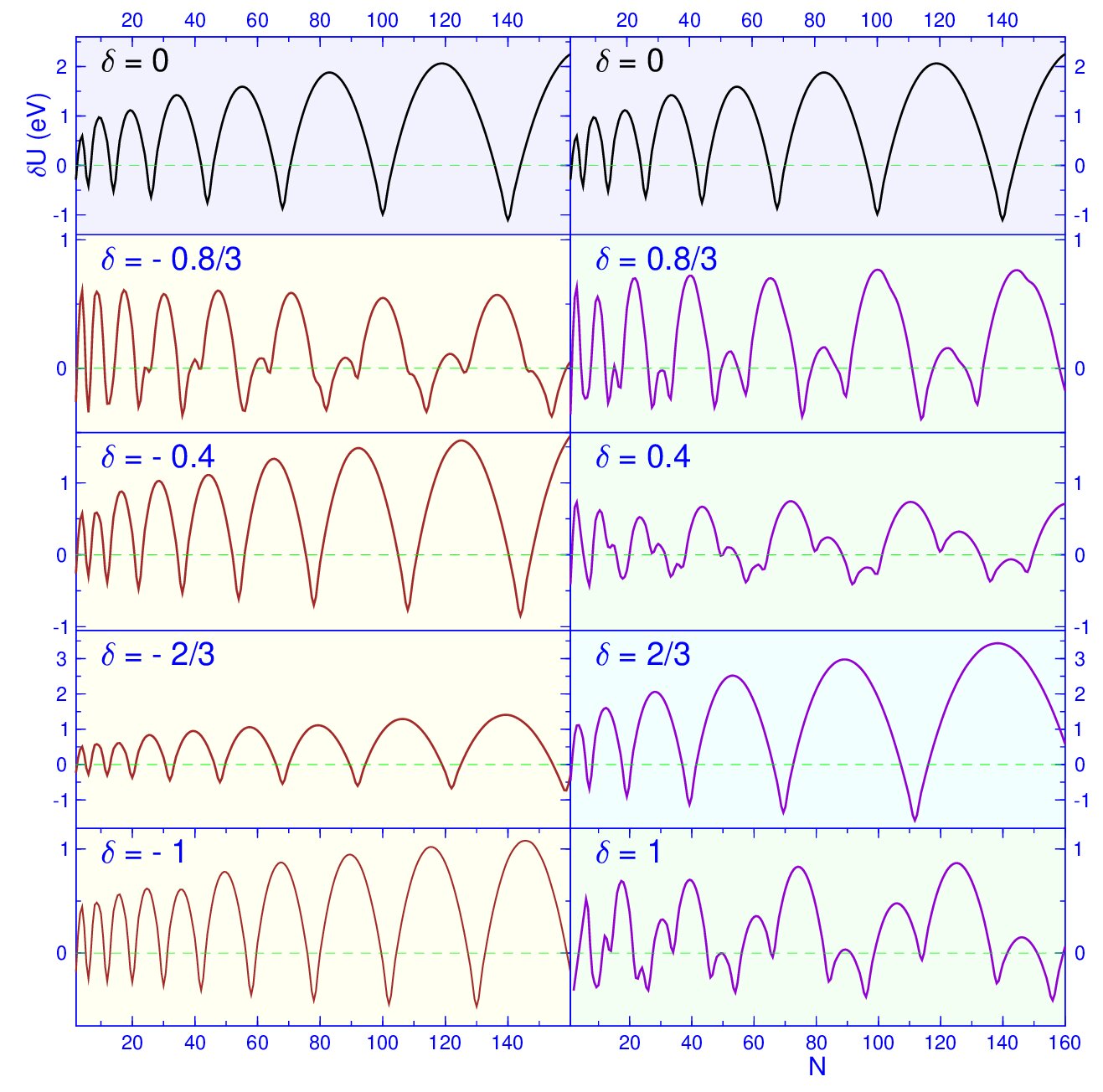 Figure 3
| OBLATE | PROLATE | ||||
|---|---|---|---|---|---|
| Magic numbers | Magic numbers | ||||
| 17/13 | 2, 8, 18, 20, 34, 38, 58, 64, 92, 100, 136, 148, … | 0.8/3 | 13/17 | 2, 8, 20, 22, 42, 46, 76, 82, 124, 134 … | |
| 1.5 | 2, 6, 8, 14, 18, 28, 34, 48, 58, 76, 90, 114, 132, … | 0.4 | 2/3 | 2, 8, 10, 22, 26, 46, 54, 66, 84, 96, 114, 138, 156, … | |
| 2 | 2, 6, 14, 26, 44, 68, 100, 140, … | 2/3 | 0.5 | 2, 4, 10, 16, 28, 40, 60, 80, 110, 140, … | |
| 3 | 2, 6, 12, 22, 36, 54, 78, 108, 144, … | 1 | 1/3 | 4, 12, 18, 24, 36, 48, 60, 80, 100, 120, 150, … | |
Peer Reviews
No public reviews on file for this paper yet. If you reviewed it on a platform where reviews are public (OpenReview, ICLR, NeurIPS, ICML), you can paste yours below so the community can read it here.
Videos
No videos yet. Explain this paper in a talk, walkthrough, or lecture? Add one.
Semi-spheroidal Quantum Harmonic Oscillator
D. N. Poenaru
Frankfurt Institute for Advanced Studies, J. W. Goethe Universität, Max-von-Laue-Str. 1, D-60438 Frankfurt am Main, Germany
Horia Hulubei National Institute of Physics and Nuclear Engineering (IFIN-HH),
P.O. Box MG-6, RO-077125 Bucharest-Magurele, Romania
R. A. Gherghescu
Frankfurt Institute for Advanced Studies, J. W. Goethe Universität, Max-von-Laue-Str. 1, D-60438 Frankfurt am Main, Germany
Horia Hulubei National Institute of Physics and Nuclear Engineering (IFIN-HH),
P.O. Box MG-6, RO-077125 Bucharest-Magurele, Romania
A. V. Solov’yov
Frankfurt Institute for Advanced Studies, J. W. Goethe Universität, Max-von-Laue-Str. 1, D-60438 Frankfurt am Main, Germany
W. Greiner
Frankfurt Institute for Advanced Studies, J. W. Goethe Universität, Max-von-Laue-Str. 1, D-60438 Frankfurt am Main, Germany
Abstract
A new single-particle shell model is derived by solving the Schrödinger equation for a semi-spheroidal potential well. Only the negative parity states of the component of the wave function are allowed, so that new magic numbers are obtained for oblate semi-spheroids, semi-sphere and prolate semi-spheroids. The semi-spherical magic numbers are identical with those obtained at the oblate spheroidal superdeformed shape: 2, 6, 14, 26, 44, 68, 100, 140, … The superdeformed prolate magic numbers of the semi-spheroidal shape are identical with those obtained at the spherical shape of the spheroidal harmonic oscillator: 2, 8, 20, 40, 70, 112, 168 …
pacs:
03.65.Ge, 21.10.Pc, 31.10.+z,
The spheroidal harmonic oscillator have been used in various branches of Physics. Of particular interest was the famous single-particle Nilsson model Nilsson (1955) very successful in Nuclear Physics and its variants Knight et al. (1984); Clemenger (1985a); Reimann et al. (1993) for atomic clusters. Major spherical-shells have been found Knight et al. (1984) in the mass spectra of sodium clusters of atoms per cluster, and the Clemenger’s shell model Clemenger (1985a) was able to explain this sequence of spherical magic numbers.
In the present paper we would like to write explicitly the analytical relationships for the energy levels of the spheroidal harmonic oscillator and to derive the corresponding solutions for a semi-spheroidal harmonic oscillator which may be useful to study atomic cluster deposited on planar surfaces.
For spheroidal equipotential surfaces, generated by a potential with cylindrical symmetry the states of the valence electrons were found Clemenger (1985a) by using an effective single-particle Hamiltonian with a potential
[TABLE]
In order to get analytical solutions we shall neglect an additional term proportional to . We plan to include in the future such a term which needs a numerical solution. K. L. Clemenger introduced the deformation by expressing the dimensionless two semiaxes (in units of the radius of a sphere with the same volume, , where is the Wigner-Seitz radius, 2.117 Å for Na Brack (1989); Yannouleas and Landman (1995)) as
[TABLE]
The spheroid surface equation in dimensionless cylindrical coordinates and is given by
[TABLE]
where is the minor (major) semiaxis for prolate (oblate) spheroid and is the major (minor) semiaxis for prolate (oblate) spheroid. Volume conservation leads to .
One can separate the variables in the Schrödinger equation, , written in cylindrical coordinates. As a result the wave function Rassey (1958); Vautherin (1973) may be written as
[TABLE]
where each component of the wave function is ortonormalized leading to
[TABLE]
[TABLE]
in which and the quantum numbers with up to for an odd or to for an even . is the associated Laguerre polynomial and the constant has the dimension of a length.
[TABLE]
where , , and the main quantum number .
The eigenvalues are
[TABLE]
The parity of the Hermite polynomials is given by meaning that the even order Hermite polynomials are even functions and the odd order Hermite polynomials are odd functions . There is a recurrence relationship . One has , , , , , , etc.
In units of the eigenvalues, , are given by
[TABLE]
For a prolate spheroid, , at the energy level decreases with deformation except for , but when it increases.
For a given prolate deformation and a maximum energy , there are closed shells and other levels for
high-order shells up to :
[TABLE]
[TABLE]
and similar formulae for oblate deformations, . The low lying energy levels for the six shells (main quantum number ) can be seen in figure 1. Each level, labelled by , may accomodate particles. One has nucleons in a completely filled shell charcterized by , and the total number of states of the low-lying shells is leading to the magic numbers for a spherical shape. Besides the important degeneracy at a spherical shape (), one also have degeneracies at some superdeformed shapes, e.g. for prolate shapes at the ratio i.e. . More details may be found in the Table 1. The first five shells can reproduce the experimental magic numbers mentioned above; in order to describe the other shells Clemenger introduced the term proportional to .
Let us consider a particular shape (half of an oblate or prolate spheroid) of a semi-spheroidal cluster deposited on a surface with the axis perpendicular on the surface and the axis in the surface plane. Then the semi-spheroidal surface equation is given by
[TABLE]
The radius of the semi-sphere obtained for the deformation is , given by the volume conservation, , leading to . We shall give in units of instead of . According to the volume conservation, so that . Other kind of shapes obtained from a spheroid by removing less or more than its half (as in the liquid drop calculations Semenikhina et al. (2007)) will be considered in the future; in this case it is not possible to obtain analytical solutions.
The new potential well we have to consider in order to solve the quantum mechanical problem is shown in the right-hand side of the figure 2. The potential along the symmetry axis, , has a wall of an infinitely large height at , and concerns only positive values of
[TABLE]
In this case the wave functions should vanish in the origin, where the potential wall is infinitely high, so that only negative parity Hermite polynomials ( odd) should be taken into consideration.
From the energy levels given in figure 1 we have to select only those corresponding to this condition. In this way the former lowest level with should be excluded. From the two leveles with we can retain the level with i.e. . This will be the lowest level for the semi-spherical harmonic oscillator and will accomodate atoms. From the three levels with only the one with
with degeneracy is retained so that the first two magic numbers at spherical shape () are now 2 followed by 6, etc. Some deformed magic numbers may be found in the Table 1 and as position of minima in Fig. 3.
Each level, labelled by , may accomodate particles. When is an odd number, one should only have even in order to select the odd . The contribution of the shells with odd to the semi-spherical magic numbers will be
[TABLE]
leading to the sequence 2, 8, 18 for . The contribution of the shells with even to the semi-spherical magic numbers will be
[TABLE]
which gives the sequence 4, 12, 24 for . This should be interlaced with the preceding one so that the magic numbers will be 2, , , , , , as shown at the right-hand side of the Fig. 1.
The equation (9) from the harmonic oscillator, in units of is still valid, but one should only allow the values of and for which are odd numbers.
The ortonormalization condition of the component of the wave function became
[TABLE]
with for odd and for even . Consequently the normalization factor is times the preceding one
[TABLE]
For a nucleus with mass number the shell gap is given by MeV. For an atomic cluster Clemenger (1985b) the single-particle shell gap is given by
[TABLE]
which is eV in case of Na clusters. Since we consider solely monovalent elements, in this eq. is the number of atoms and denotes the electronic spillout for the neutral cluster according to Clemenger (1985b).
The shell correction energy, Strutinsky (1967), in figure 3 shows minima at the oblate and prolate magic numbers given in the lower part of the table 1. The striking result is that the superdeformed prolate magic numbers of the semi-spheroidal shape are identical with those obtained at the spherical shape of the spheroidal harmonic oscillator. We expect that this kind of symmetry will not be present anylonger for the Hamiltonian including the term proportional to and/or the more complex equipotential surface we shall study in the future.
The reference list from the paper itself. Each links out to its DOI / PubMed record.
- 1Nilsson (1955) S. G. Nilsson, Det Kongelige Danske Videnskabernes Selskab (Dan. Mat. Fys. Medd.) 29 (1955).
- 2Knight et al. (1984) W. D. Knight, K. Clemenger, W. A. de Heer, W. A. Saunders, M. Y. Chou, and M. L. Cohen, Phys. Rev. Lett. 52 , 2141 (1984).
- 3Clemenger (1985 a) K. L. Clemenger, Phys. Rev. B 32 , 1359 (1985 a).
- 4Reimann et al. (1993) S. M. Reimann, M. Brack, and K. Hansen, Z. Phys. D 28 , 235 (1993).
- 5Brack (1989) M. Brack, Phys. Rev. B 39 , 3533 (1989).
- 6Yannouleas and Landman (1995) C. Yannouleas and U. Landman, Phys. Rev. B 51 , 1902 (1995).
- 7Rassey (1958) A. J. Rassey, Phys. Rev. 109 , 949 (1958).
- 8Vautherin (1973) D. Vautherin, Phys. Rev. C 7 , 296 (1973).