Structure of Strange Dwarfs with Color Superconducting Core
Masayuki Matsuzaki, Etsuchika Kobayashi (Fukuoka Univ. of Educ.)

TL;DR
This paper investigates how two-flavor color superconductivity influences the structure of strange dwarfs, stellar objects with quark matter cores, finding that unpaired quark matter approximates their core composition well.
Contribution
It provides new insights into the core composition of strange dwarfs, showing unpaired quark matter as a good approximation in their structure.
Findings
Unpaired quark matter effectively models the core of strange dwarfs.
Color superconductivity has notable effects on the stellar structure.
Strange dwarfs share similar mass-radius characteristics with white dwarfs.
Abstract
We study effects of two-flavor color superconductivity on the structure of strange dwarfs, which are stellar objects with similar masses and radii with ordinary white dwarfs but stabilized by the strange quark matter core. We find that unpaired quark matter is a good approximation to the core of strange dwarfs.
Click any figure to enlarge with its caption.
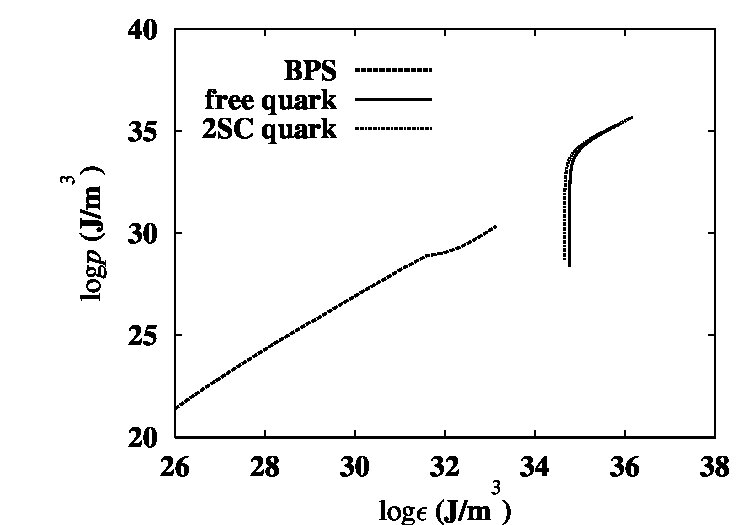 Figure 1
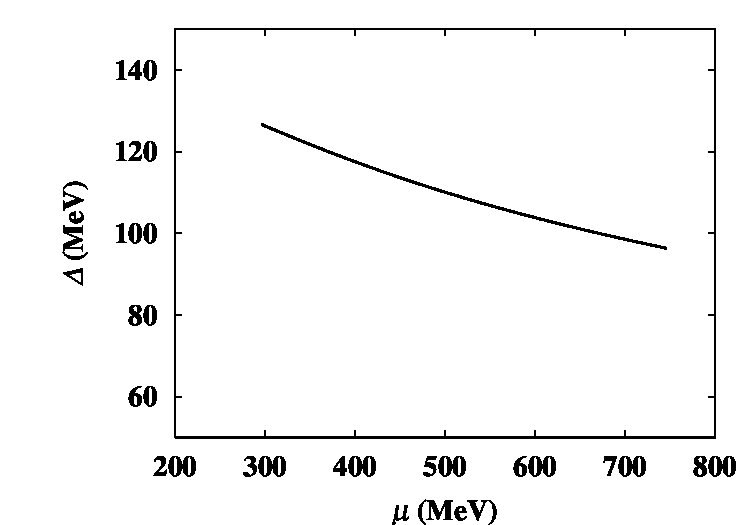 Figure 2
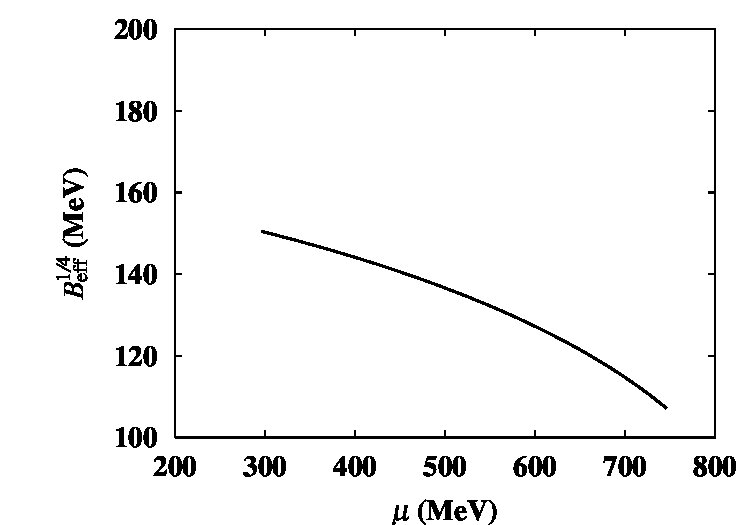 Figure 3
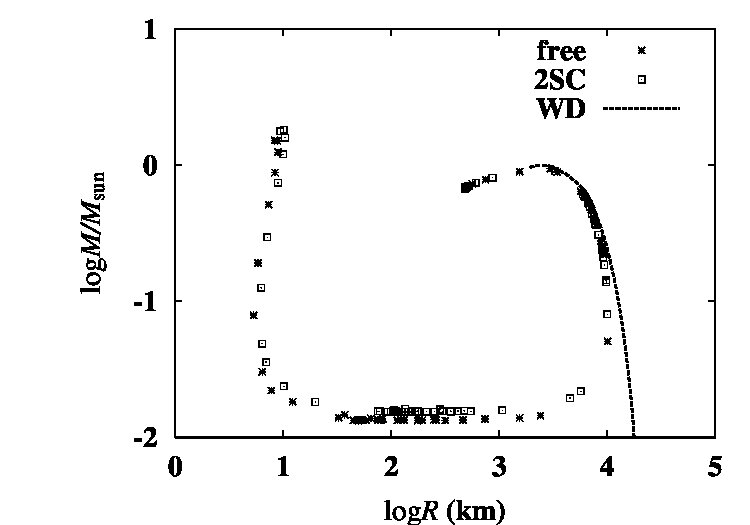 Figure 4
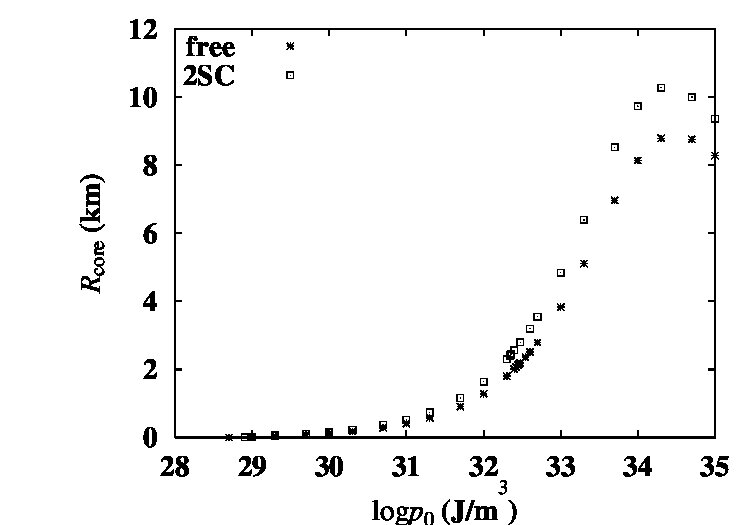 Figure 5
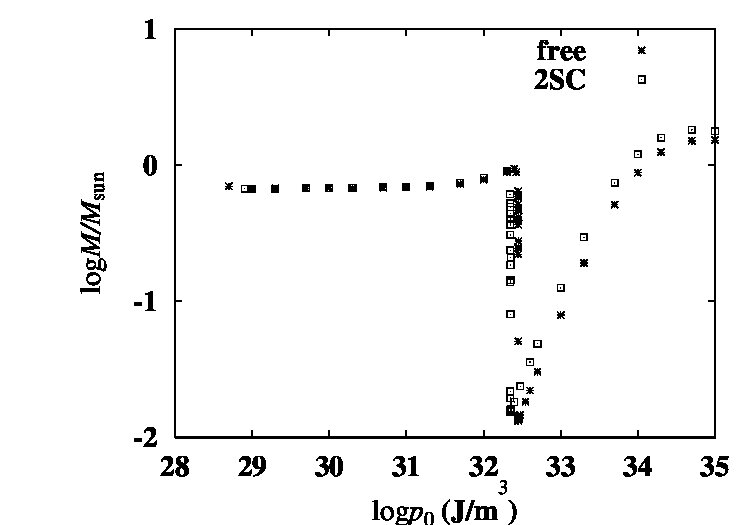 Figure 6
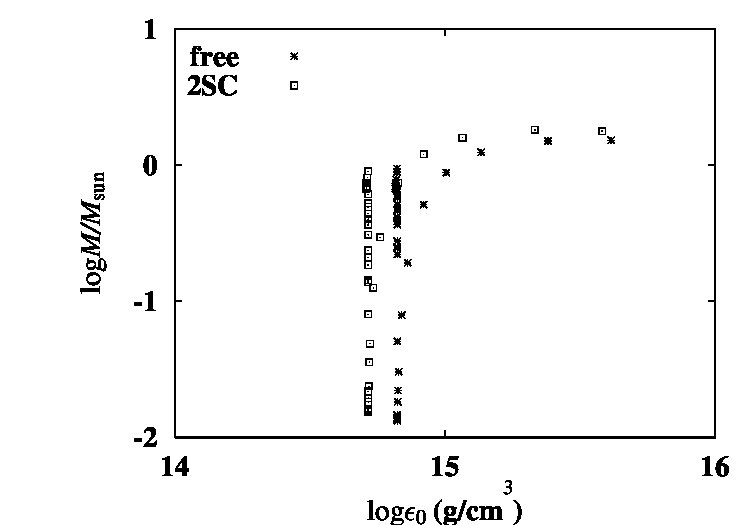 Figure 7
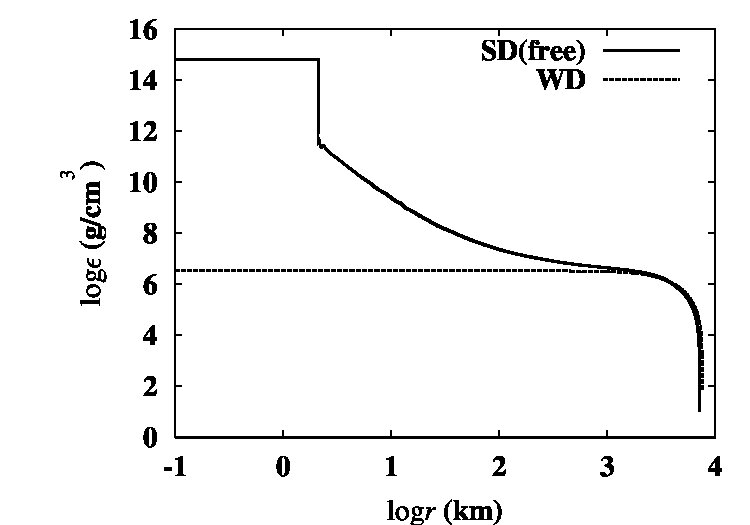 Figure 8
Peer Reviews
No public reviews on file for this paper yet. If you reviewed it on a platform where reviews are public (OpenReview, ICLR, NeurIPS, ICML), you can paste yours below so the community can read it here.
Videos
No videos yet. Explain this paper in a talk, walkthrough, or lecture? Add one.
Structure of Strange Dwarfs with Color Superconducting Core
Masayuki Matsuzaki
Department of Physics, Fukuoka University of Education, Munakata, Fukuoka 811-4192, Japan
Etsuchika Kobayashi
Department of Physics, Fukuoka University of Education, Munakata, Fukuoka 811-4192, Japan
Abstract
We study effects of two-flavor color superconductivity on the structure of strange dwarfs, which are stellar objects with similar masses and radii with ordinary white dwarfs but stabilized by the strange quark matter core. We find that unpaired quark matter is a good approximation to the core of strange dwarfs.
pacs:
95.30.-k
Witten made a conjecture that the absolute ground state of quantum chromodynamics (QCD) is not 56Fe but strange quark matter, which is a plasma composed of almost equal number of deconfined u, d, and s quarks Wit . Although this conjecture has been neither confirmed nor rejected, if this is true, since deconfinement is expected in high density cores of compact stars, there could exist stars that contain strange quark matter converted from two-flavor quark matter via weak interaction. Strange quark stars whose radii are about 10 km, with or without thin nuclear crust, have long been investigated.
Glendenning et al. proposed a new class of compact stars containing strange quark matter and thick nuclear crust ranging from a few hundred to ten thousand km Gle1 ; Gle2 ; Gle3 . They named them the strange dwarfs because their radii correspond to those of white dwarfs. Alcock et al. discussed the mechanism that the strange quark core supports the cruct Alc . Since the mass of s quark is larger than those of u and d, strange quark matter is positively charged. In order to electrically neutralize the core, electrons are bound to the surface of the core. They estimated that the thickness of this electric dipole layer is a few hundred fm. Then this layer can support a nuclear crust. Although Alcock et al. considered only thin crusts, Glendenning et al. considered thick crusts up to about ten thousand km. Very recently, Mathews et al. identified eight candidates of strange dwarfs from observed data Mat .
A theoretical facet whose importance in nuclear physics was recognized later is color superconductivity in quark matter. At asymptotically high density, the color-flavor locking (CFL) is believed to be the ground state Raj . At realistic densities, however, the two-flavor color superconductivity (2SC) is thought to be realized even when electric neutrality is imposed if the coupling constant is strong Abu . Thus, in the present paper, we discuss effects of the 2SC phase in the strange quark matter core on the structure of strange dwarfs.
In order to determine the structure of compact stars, we solve the general relativistic Tolman-Oppenheimer-Volkoff (TOV) equation,
[TABLE]
for the pressure , the energy density , and the mass enclosed within the radius , . Here is the gravitational constant and is the speed of light. The equation is closed when an equation of state (EOS), a relation between and , is specified. In the present case, strange dwarfs are composed of the strange quark matter core and the nuclear crust. Accordingly two parameters, the pressure at the center and at the core-crust boundary, must be specified to integrate the TOV equation. The latter must be equal or less than that corresponds to the nucleon drip density . Otherwise neutrons drip and gravitate to the core. In the present calculation we take a calculated from .
We assume zero temperature throughout this paper. As for the EOS of the quark core, we adopt the MIT bag model without any QCD corrections (see Ref. Gle3 , for example). For unpaired free quark matter,
[TABLE]
where , , and are the mass, the Fermi momentum, and the chemical potential of quarks of each flavor, respectively, and runs , , and . Hereafter we put . The quantity is the bag constant. The effect of color superconductivity is incorporated as a chemical potential dependent effective bag constant. In the 2SC case Alf ,
[TABLE]
where is the quark pairing gap as a function of a chemical potential , whose relation to is specified later.
The pairing gap is obtained as a function of the Fermi momentum by solving the gap equation MM
[TABLE]
with , , and . The one gluon exchange pairing interaction is given by
[TABLE]
where and are the magnitudes of 3-momenta. The running coupling constant is given by Hig
[TABLE]
As for the EOS of the crust, we adopt the tabulated one for -equilibrium nuclear matter of Baym, Pethick, and Sutherland Bay (BPS) conforming to Refs. Gle1 ; Gle2 ; Gle3 .
The positively charged strange quark matter in the core is simply approximated by . Quark masses are given by 10 MeV, 150 MeV. The bag constant is chosen to be 160 MeV. Parameters entering into the pairing interaction are and 400 MeV. The nucleon drip density is 4.31011 g/cm3.
The adopted EOS is displayed in Fig. 1. The logarithm is to base 10 throughout this paper. The quark matter EOS describes the core and the BPS EOS describes the crust. At the boundary, the pressure is common whereas the energy density jumps discontinuously. In order to obtain the EOS for 2SC matter, the pairing gap must be calculated at each beforehand. This is shown in Fig. 2 left. The effective bag constant determined by the pairing gap is shown in Fig. 2 right. The resulting 2SC EOS is included in Fig. 1.
Figure 3 presents the mass-radius relation obtained by integrating the TOV equation with a fixed , determined from , and various central pressures. This result can be classified into three regions. The first region (larger central pressures), almost vertical curve at around 10 km, describes strange stars with thin crusts. In this region, color superconductivity makes the maximum mass and radius larger because the pairing gap reduces the bag constant and consequently the energy density decreases and the pressure increases. This is consistent with another calculation with the CFL phase Lug . The second region, horizontal at around 10*-2*, and the third region, vertical at around 104 km up to the maximum mass, correspond to strange dwarfs. In the second region, color superconducting quark cores support slightly larger masses than unpaired free quark cores. In the third region, effect of color superconductivity is negligible. In Fig. 3, The mass-radius relation of ordinary white dwarfs without quark matter cores calculated by adopting the BPS EOS is also shown although it is known that the BPS EOS is not very suitable for white dwarfs. As the central pressure decreases, the quark matter core shrinks (Fig. 4 left) and eventually strange dwarfs reduce to ordinary white dwarfs. When their masses are the same, the former is more compact than the latter (see also Fig. 5 right) because of the gravity of the core. Mathews et al. paid attention to this difference in the mass-radius relation and classified the observed data of dwarfs Mat . According to their work, eight of them are classified into strange dwarfs.
Figure 4 right indicates that strange dwarfs, in particular those of 103 km 104 km, are realized in a very narrow range of the central pressure. This is reflected in the density of calculated points. During this rapid structure change from the second to the third region, the core radius almost does not change, see Fig. 4 left. Figure 5 left also graphs as Fig. 4 right but as a function of the central energy density. The difference between these two figures at the low pressure/energy density side can be understood from the quark matter EOS in Fig. 1 such that the pressure decreases steeply at the lowest energy density. Figure 5 left indicates that strange dwarfs have central energy densities just below the lowest stable compact strange stars and several orders of magnitude larger than those of ordinary white dwarfs. This is clearly demonstrated in Fig. 5 right.
To summarize, we have solved the Tolman-Oppenheimer-Volkoff equation for strange dwarfs with and a wide range of the central pressure. We have examined effects of the two-flavor color superconductivity in the strange quark matter core in a simplified manner. The obtained results indicate that, aside from a slight increase of the minimum mass, effect of color superconductivity is negligible in the mass-radius relation. This is consistent with the conjecture given in Ref. Mat . As a function of the central energy density, however, strange dwarfs are realized at slightly lower energy densities than the unpaired free quark case reflecting the effect on the equation of state. Recently Usov discussed that electric fields are also generated on the surface of the color-flavor locked matter Uso . This suggests that strange dwarfs with color-flavor locked cores might also be possible although this is expected only at relatively high densities. Since the pairing gap enters into the calculation only through the effective bag constant, aside from a possible slight change in chemical potentials, it can surely be expected that the effect of color-flavor locking does not differ much from that of the two-flavor color superconductivity. In conclusion, unpaired quark matter is a good approximation to the core of strange dwarfs. Another aspect that might be affected by color superconductivity is the cooling Ben . This is beyond the scope of the present study.
The reference list from the paper itself. Each links out to its DOI / PubMed record.
- 1(1) E. Witten, Phys. Rev. D 30 (1984), 272.
- 2(2) N. K. Glendenning, Ch. Ketter and F. Weber, Phys. Rev. Lett. 74 (1995), 3519.
- 3(3) N. K. Glendenning, Ch. Ketter and F. Weber, Astrophys. J. 450 (1995), 253.
- 4(4) N. K. Glendenning, Compact Stars (Springer, New York, 1996).
- 5(5) C. Alcock, E. Farhi and A. Olinto, Astrophys. J. 310 (1986), 261.
- 6(6) G. J. Mathews, I. -S. Suh, B. O’Gorman, N. Q. Lan, W. Zech, K. Otsuki and F. Weber, J. Phys. G 32 (2006), 747.
- 7(7) K. Rajagopal and F. Wilczek, Phys. Rev. Lett. 86 (2001), 3492.
- 8(8) H. Abuki and T. Kunihiro, Nucl. Phys. A 768 (2006), 118.