Compton X-ray and Gamma-ray Emission from Extended Radio Galaxies
C.C. Cheung

TL;DR
This paper predicts that extended radio galaxy lobes emit X-ray and gamma-ray radiation via inverse Compton scattering, and such emissions could be detectable and imageable with the GLAST LAT instrument, providing new insights into these structures.
Contribution
It introduces a model estimating gamma-ray emission from radio galaxy lobes based on radio measurements, highlighting potential detectability with GLAST LAT.
Findings
Lobe spectra extend into soft gamma-rays for magnetic fields >~0.3-1 micro-G
Predicted gamma-ray emissions are detectable with GLAST LAT
Large angular extents allow imaging of radio lobes in gamma-rays
Abstract
The extended lobes of radio galaxies are examined as sources of X-ray and gamma-ray emission via inverse Compton scattering of 3K background photons. The Compton spectra of two exemplary examples, Fornax A and Centaurus A, are estimated using available radio measurements in the ~10's MHz - 10's GHz range. For average lobe magnetic fields of >~0.3-1 micro-G, the lobe spectra are predicted to extend into the soft gamma-rays making them likely detectable with the GLAST LAT. If detected, their large angular extents (~1 deg and 8 deg) will make it possible to ``image'' the radio lobes in gamma-rays. Similarly, this process operates in more distant radio galaxies and the possibility that such systems will be detected as unresolved gamma-ray sources with GLAST is briefly considered.
Click any figure to enlarge with its caption.
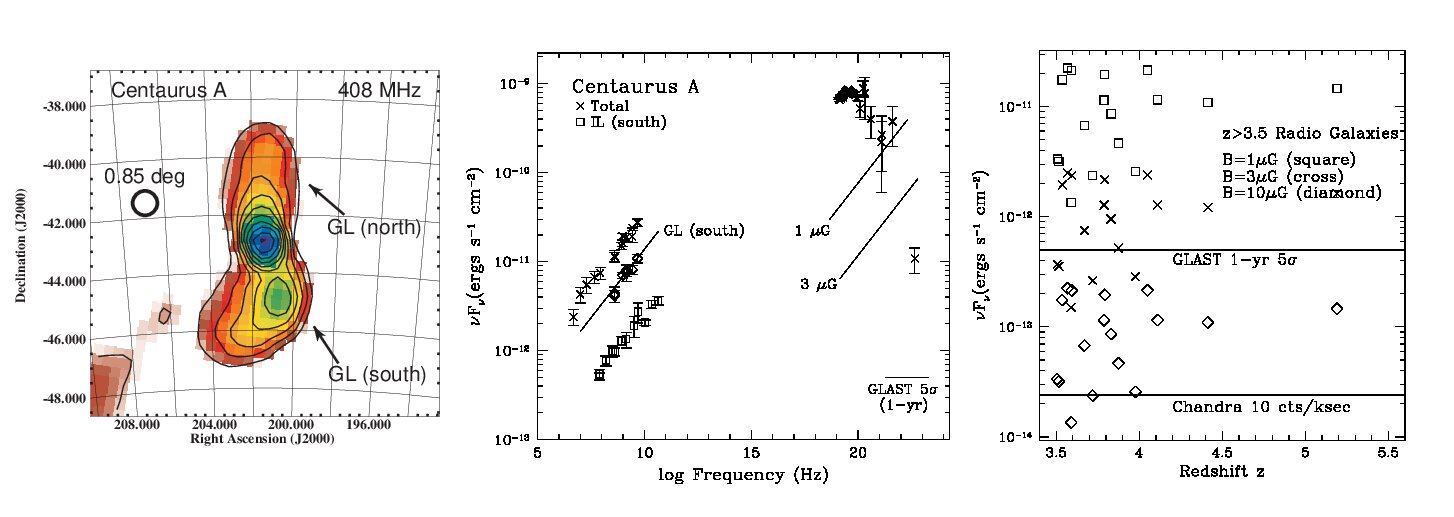 Figure 1
Peer Reviews
No public reviews on file for this paper yet. If you reviewed it on a platform where reviews are public (OpenReview, ICLR, NeurIPS, ICML), you can paste yours below so the community can read it here.
Videos
No videos yet. Explain this paper in a talk, walkthrough, or lecture? Add one.
Compton X-ray and -ray Emission from Extended Radio Galaxies
C. C. Cheung111Jansky Postdoctoral Fellow. The National Radio Astronomy Observatory is operated by Associated Universities, Inc. under a cooperative agreement with the U.S. National Science Foundation.
Abstract
The extended lobes of radio galaxies are examined as sources of X-ray and -ray emission via inverse Compton scattering of 3K background photons. The Compton spectra of two exemplary examples, Fornax A and Centaurus A, are estimated using available radio measurements in the 10’s MHz – 10’s GHz range. For average lobe magnetic fields of 0.3–1 G, the lobe spectra are predicted to extend into the soft -rays making them likely detectable with the GLAST LAT. If detected, their large angular extents (1∘ and 8∘) will make it possible to “image” the radio lobes in -rays. Similarly, this process operates in more distant radio galaxies and the possibility that such systems will be detected as unresolved -ray sources with GLAST is briefly considered.
Keywords:
gamma-ray sources (astronomical); radiofrequency spectra; imaging; radiogalaxies
:
98.54.Gr,98.58.Fd
1 Inverse Compton ”Images” of Large Radio Galaxies
Inverse Compton (IC) scattering of the CMB is a mandatory process in synchrotron emitting sources. This emission becomes most prominent in regions of weaker -field like the extended lobes of radio galaxies. Many such IC/CMB lobe X-ray sources are now known (e.g., Croston et al. 2005; Kataoka & Stawarz 2005) and we explore the possibility of the IC spectra extending into the -ray band. This is independent of possible -ray emission from the unresolved nuclei of radio galaxies, i.e., from the misaligned blazar (Sreekumar et al. 1999; Bai & Lee 2001; Foshini et al. 2005).
The case of the nearby (D=18.6 Mpc) double-lobed radio galaxy, Fornax A was discussed in Cheung (2007). Radio flux density measurements down to 30 MHz (Isobe et al. 2006) were used to estimate the IC/CMB spectra of the lobes. Normalizing the IC spectra to the X-ray detections of the lobes (which indicate B$$\sim1.5G on average; Feigelson et al. 1995, Isobe et al. 2006), the presence of high frequency radio emission observed in the 10–90 GHz range with WMAP (with ) imply a detectable soft -ray signal. As this emission is not expected to be time variable, the LAT can simply integrate on this position during its normal scanning mode to test this prediction.
Here, we similarly consider the case of Centaurus A which is only 3.5 Mpc away. It is long known to have structure extended over 8∘ in declination (Cooper et al. 1965, and references therein). We use the extensive compilation by Alvarez et al. (2000) of the various components of the radio source; Figure 1 shows a low resolution 408 MHz image from Haslam et al. (1982). The outer (degree-scale) giant lobes (GLs) visible in Figure 1 account for 2/3 of the total 408 MHz emission at 1000 Jy each; the arcmin-scale inner lobes (ILs) are only 3–4 times fainter than each GL. The northern GL was searched for such IC emission with ASCA data but the extended X-rays could not be uniquely attributed to such a process (Isobe et al. 2001).
Repeating the analysis as for Fornax A, it appears that the extended components of Cen A will also emit -rays at a level detectable by GLAST. The various data from 10 MHz to 43 GHz are consistent with a single spectral index =0.7. Since the luminosities of both the ILs and GLs are similar (within 20), only the SEDs of the southern ones are plotted in Figure 1. Utilizing these radio measurements, the expected IC/CMB spectra for example -field strengths are drawn. The integrated Compton Gamma-Ray Observatory (CGRO) COMPTEL detections of Cen A (Steinle et al. 1998) at 1021 Hz already limit B\lower 2.15277pt\hbox{;\buildrel>\over{\sim};}1\muG for both the northern and southern GLs (since they have similar radio spectra); a similar extrapolation for the ILs give B\lower 2.15277pt\hbox{;\buildrel>\over{\sim};}0.3\muG.
Thermal emission will be a complicating factor at energies below 10 keV, so hard X-ray and soft -ray measurements are better suited for detecting the suspected IC/CMB emission. Additionally, since Fornax A and Cen A are quite extended in the sky (1∘ and 8∘), if they are detected with GLAST, the contributions from the two lobes will be separable with the LAT making IC/CMB -ray “images” of these radio galaxies possible. These -ray images will appear most similar to radio maps at frequencies, \nu\lower 2.15277pt\hbox{;\buildrel>\over{\sim};}10 GHz; such radio maps of Cen A’s extended components have already been obtained by WMAP (Page et al. 2007, Fig. 2 therein) and are available for this comparison.
2 The Highest-Redshift Radio Galaxies
Using the above examples as a guide, we can gauge the feasibility of detecting even more distant radio galaxies at the higher-energies. Utilizing the recent large compilation of bright z$$>2.5 radio sources by Carson et al. (2007), we consider the highest-redshift () radio galaxies for illustration. The observed monochromatic Compton (X-ray, -ray) to synchrotron (radio) flux ratio for IC/CMB emission has a strong redshift dependence: for =1, it is simply (f_{\nu}\equiv\nu$$F_{\nu}, and is the Doppler factor which is set to 1). We use the NVSS (Condon et al. 1998) 1.4 GHz fluxes for . Most of the considered sources (13/17) are detected at 74 MHz in the VLSS database (Cohen et al. 2005) giving , so the approximate relation is applicable.
As in the nearby sources, these distant radio galaxies are expected to be IC/CMB X-ray sources unless 10G (Fig. 1). Chandra observations should easily detect this emission to constrain the lobe -fields, and thus the lobe energetics. In one of the highest-redshift () radio galaxies observed so far with Chandra (Scharf et al. 2003), it was necessary to remove the contribution from a bright nucleus (spatially) and extended IC emission from other sources of seed photons (by spectral fitting). Such X-ray observations can guide our determination of the expected level of (soft) -ray emission from the IC/CMB process; at the moment, the estimates (Fig. 1) are rather crude.
The reference list from the paper itself. Each links out to its DOI / PubMed record.
- 1Alvarez et al. (2000) H. Alvarez, J. Aparici, J. May, & P. Reich, Astron. Astrophys. 355 , pp. 863–872 (2000).
- 2Bai & Lee (2001) J. M. Bai & M. G. Lee, Astrophys. Journal Lett. 549 , pp. L 173–L 177 (2001).
- 3Carson et al. (2007) J. E. Carson, T. M. Arias, & C. C. Cheung, in preparation (2007).
- 4Cheung (2006) C. C. Cheung, in The Central Engine of Active Galactic Nuclei , edited by L. C. Ho & J.-M. Wang, ASP Conf. Series, in press, ar Xiv:astro-ph/0612372 (2007).
- 5Cohen et al. (2005) A. S. Cohen, et al., in From Clark Lake to the Long Wavelength Array: Bill Erickson’s Radio Science , edited by N. Kassim et al., ASP Conf. Series 345, 299–303 (2005).
- 6Cooper et al. (1965) B. F. C. Cooper, R. M. Price, & D. J. Cole, Australian Journal of Physics 18 , pp. 589–625 (1965).
- 7Condon et al. (1998) J. J. Condon, W. D. Cotton, E. W. Greisen, Q. F. Yin, R. A. Perley, G. B. Taylor, & J. J. Broderick, Astron. Journal 115 , pp. 1693–1716 (1998).
- 8Croston et al. (2005) J. H. Croston, et al., Astrophys. Journal 626 , pp. 733–747 (2005).