Tri-layer superlattices: A route to magnetoelectric multiferroics?
Alison J. Hatt, Nicola A. Spaldin

TL;DR
This study computationally investigates tri-layer superlattices as a potential pathway to create magnetoelectric multiferroics, highlighting the limited polarization contribution from tri-layering but emphasizing strain-induced polarization enhancement.
Contribution
It demonstrates that strain and negative pressure can induce large, switchable polarizations in superlattices without active ferroelectric ions, offering a new approach to multiferroic design.
Findings
Tri-layering contributes minimally to polarization.
Epitaxial strain and negative pressure induce large switchable polarization.
Magnetism can coexist with strain-induced polarization in these structures.
Abstract
We explore computationally the formation of tri-layer superlattices as an alternative approach for combining ferroelectricity with magnetism to form magnetoelectric multiferroics. We find that the contribution to the superlattice polarization from tri-layering is small compared to typical polarizations in conventionalferroelectrics, and the switchable ferroelectric component is negligible. In contrast, we show that epitaxial strain and ``negative pressure'' can yield large, switchable polarizations that are compatible with the coexistence of magnetism, even in materials with no active ferroelectric ions.
Click any figure to enlarge with its caption.
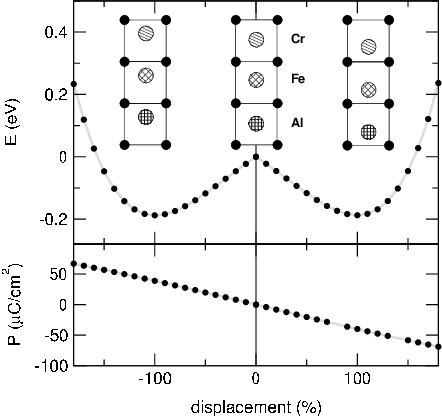 Figure 1
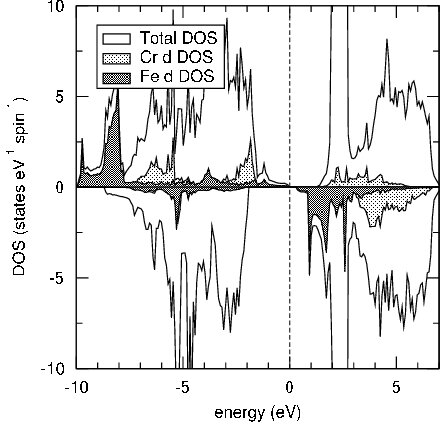 Figure 2
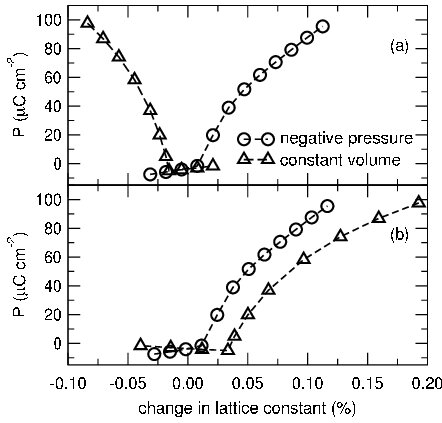 Figure 3
Peer Reviews
No public reviews on file for this paper yet. If you reviewed it on a platform where reviews are public (OpenReview, ICLR, NeurIPS, ICML), you can paste yours below so the community can read it here.
Videos
No videos yet. Explain this paper in a talk, walkthrough, or lecture? Add one.
Tri-layer superlattices: A route to magnetoelectric multiferroics?
Alison J. Hatt
Nicola A. Spaldin
Materials Department, University of California
Abstract
We explore computationally the formation of tri-layer superlattices as an alternative approach for combining ferroelectricity with magnetism to form magnetoelectric multiferroics. We find that the contribution to the superlattice polarization from tri-layering is small compared to typical polarizations in conventional ferroelectrics, and the switchable ferroelectric component is negligible. In contrast, we show that epitaxial strain and “negative pressure” can yield large, switchable polarizations that are compatible with the coexistence of magnetism, even in materials with no active ferroelectric ions.
The simultaneous presence of ferromagnetism and ferroelectricity in magnetoelectric multiferroics suggests tremendous potential for innovative device applications and exploration of the fundamental physics of coupled phenomena. However, the two properties are chemically contra-indicated, since the transition metal electrons which are favorable for ferromagnetism disfavor the off-centering of cations required for ferroelectricity Hill (2000). Continued progress in this burgeoning field rests on the identification of alternative mechanisms for ferroelectricity which are compatible with the existence of magnetism Ederer and Spaldin (2005); Fiebig (2005). Mechanisms discovered to date include the incorporation of stereochemically active lone pair cations, for example in BiMnO3 Seshadri and Hill (2001); dos Santos et al. (2002) and BiFeO3 Wang et al. (2003); Neaton et al. (2005), geometric ferroelectricity in YMnO3 van Aken et al. (2004), BaNiF4 Fox and Scott (1977); Ederer and Spaldin (2006) and related compounds, charge ordering as in LuFe2O4 Ikeda et al. (2005); Subramanian et al. (2006), and polar magnetic spin-spiral states, of which TbMnO3 is the prototype Kimura et al. (2003). However, there are currently no single phase multiferroics with large and robust magnetization and polarization at or near room temperature Ramesh and Spaldin (2007).
The study of ferroelectrics has been invigorated over the last few years by tremendous improvements in the ability to grow high quality ferroelectric thin films with precisely controlled composition, atomic arrangements and interfaces. In particular, the use of compositional ordering that breaks inversion symmetry, such as the layer-by-layer growth of three materials in an A-B-C-A-B-C… arrangement, has produced systems with enhanced polarizations and large non-linear optical responses Sai et al. (2000); Lee et al. (2005); Warusawithana et al. (2003); Ogawa et al. (2003). Here we explore computationally this tri-layering approach as an alternative route to magnetoelectric multiferroics. Our hypothesis is that the magnetic ions in such a tri-layer superlattice will be constrained in a polar, ferroelectric state by the symmetry of the system, in spite of their natural tendency to remain centrosymmetric. We note, however, that in previous tri-layering studies, at least one of the constituents has been a strong ferroelectric in its own right, and the other constituents have often contained so-called second-order Jahn-Teller ions such as Ti4+, which have a tendency to off-center. Therefore factors such as electrostatic effects from internal electric fields originating in the strong ferroelectric layers Neaton and Rabe (2003), or epitaxial strain, which is well established to enhance or even induce ferroelectric properties in thin films with second-order Jahn-Teller ions Choi et al. (2004); Wang et al. (2003); Haeni et al. (2004), could have been responsible for the enhanced polarization in those studies.
We choose a [001] tri-layer superlattice of perovskite-structure LaAlO3, LaFeO3 and LaCrO3 as our model system (see Fig. 1, inset.) Our choice is motivated by three factors. First, all of the ions are filled shell or filled sub-shell, and therefore insulating behavior, a prerequisite for ferroelectricity, is likely. Second, the Fe3+ and Cr3+ will introduce magnetism. And third, none of the parent compounds are ferroelectric or even contain ions that have a tendency towards ferroelectric distortions, allowing us to test the influence of trilayering alone as the driving force for ferroelectricity. For all calculations we use the LDA+ method Anisimov et al. (1997) of density functional theory as implemented in the Vienna Ab-initio Simulation Package (VASP) Kresse and Furthmüller (1996). We use the projector augmented wave (PAW) method Blöchl (1994); Kresse and Joubert (1999) with the default VASP potentials (La, Al, Fe_pv, Cr_pv, O), a 6x6x2 Monkhorst-Pack mesh and a plane-wave energy cutoff of 450 eV. Polarizations are obtained using the standard Berry phase technique King-Smith and Vanderbilt (1993); Vanderbilt and King-Smith (1993) as implemented in VASP. We find that values of 6/0.6 eV and 5/0.5 eV on the Fe and Cr ions respectively, are required to obtain insulating band structures; smaller values of lead to metallic ground states. These values have been shown to give reasonable agreement with experimental band gaps and magnetic moments in related systems Yang et al. (1999) but are somewhat lower than values obtained for trivalent Fe and Cr using a constrained LDA approach Solovyev et al. (1996). We therefore regard them as a likely lower limit of physically meaningful values. (Correspondingly, since increasing often decreases the covalency of a system, our calculated polarizations likely provide upper bounds to the experimentally attainable polarizations).
We begin by constraining the in-plane lattice constant to the LDA lattice constant of cubic SrTiO3 (3.85 Å) to simulate growth on a substrate, and adjust the out-of-plane lattice constant until the stress is minimized, with the ions constrained in each layer to the ideal, high-symmetry perovskite positions. We refer to this as our reference structure. (The LDA (LDA+U) lattice constants for cubic LaAlO3 (LaFeO3, LaCrO3) are 3.75, 3.85 and 3.84 Å, respectively. Thus, LaAlO3 is under tensile strain and LaFeO3/LaCrO3 are unstrained.) The calculated total density of states, and the local densities of states on the magnetic ions, are shown in Figure 2; a band gap of 0.32 eV is clearly visible. The polarization of this reference structure differs from that of the corresponding non-polar single-component material (for example pure LaAlO3) at the same lattice parameters by 0.21 C/cm2 . Note, however, that this polarization is not switchable by an electric field since it is a consequence of the tri-layered arrangement of the B-site cations. Next, we remove the constraint on the high symmetry ionic positions, and relax the ions to their lowest energy positions along the axis by minimizing the Hellmann-Feynman forces, while retaining tetragonal symmetry. We obtain a ground state that is significantly (0.14 eV) lower in energy than the reference structure, but which has a similar value of polarization. Two stable ground states with different and opposite polarizations from the reference structure, the signature of a ferroelectric, are not obtained. Thus it appears that tri-layering alone does not lead to a significant switchable polarization in the absence of some additional driving force for ferroelectricity. In all cases, the magnetic ions are high spin with negligible energy differences between ferro- and ferri-magnetic orderings of the Fe and Cr ions; both arrangements lead to substantial magnetizations of 440 and 110 emu/cm3 respectively. Such magnetic tri-layer systems could prove useful in non-linear-optical applications, where a breaking of the inversion center is required, but a switchable polarization is not.
Since epitaxial strain has been shown to have a strong influence on the polarization of some ferroelectrics (such as increasing the remanent polarization and Curie temperature of BaTiO3 Choi et al. (2004) and inducing room temperature ferroelectricity in otherwise paraelectric SrTiO3 Haeni et al. (2004)) we next explore the effect of epitaxial strain on the polarization of La(Al,Fe,Cr)O3. To simulate the effects of epitaxial strain we constrain the value of the in-plane lattice parameter, adjust the out of plane parameter so as to maintain a constant cell volume, and relax the atomic positions. The volume maintained is that of the calculated fully optimized structure, 167 Å3, which has an in-plane lattice constant of 3.82 Å. As shown in Figure 3, we find that La(Al,Fe,Cr)O3 undergoes a phase transition to a polar state at an in-plane lattice constant of 3.76 Å, which corresponds to a (compressive) strain of -0.016 (calculated from where a*∥* is the in-plane lattice constant and a0 is the calculated equilibrium lattice constant). A compressive strain of -0.016 is within the range attainable by growing a thin film on a substrate with a suitably reduced lattice constant.
We find that significant ferroelectric polarizations can be induced in La(Al,Fe,Cr)O3 at even smaller strain values by using negative pressure conditions. We simulate negative pressure by increasing all three lattice constants and imposing the constraint a=b=c/3; such a growth condition might be realized experimentally by growing the film in small cavities on the surface of a large-lattice-constant substrate, such that epitaxy occurs both horizontally and vertically. As in the planar epitaxial strain state, the system becomes strongly polar; this time the phase transition to the polar state occurs at a lattice constant of 3.85 Å, at which the strain is a negligible 0.001 relative to the lattice constant of the fully optimized system.
In Fig. 1 we show the calculated energy versus distortion profile and polarization for negative pressure La(Al,Fe,Cr)O3 with in-plane lattice constant = 3.95 Å, well within the ferroelectric region of the phase diagram shown in Fig. 3. The system has a characteristic ferroelectric double well potential which is almost symmetric in spite of the tri-layering; the two ground states have polarizations of 38.9 and -39.9 C cm*-2* respectively, relative to the reference structure at the same lattice constant. Since the energies of the two minima are almost identical, the effective electric field Eeff=E/P, introduced in Ref Sai et al. (2000), is close to zero and there is no tendency to self pole. The origin of the symmetry is seen in the calculated Born effective charges (3.6, 3.5 and 3.3 for Al, Fe and Cr respectively) which show that the system is largely ionic, with the ions showing very similar trivalent cationic behavior. A similar profile is observed under planar epitaxial strain, although the planar strained system is around 0.15 eV lower in energy than the negative pressure system for the same in-plane lattice constant.
To decouple the effects of interfacial strain and tri-layering we calculate the polarization as a function of strain and negative pressure for the individual components, LaAlO3, LaFeO3 and LaCrO3. We find that all three single-phase materials become polar at planar epitaxial strains of -0.03 (LaAlO3), -0.02 (LaFeO3), and -0.01 (LaCrO3). Likewise, all three components become polar at negative pressure, under strains of +0.03 (LaAlO3), +0.001 (LaFeO3), and +0.001 (LaCrO3). (The higher strains required in LaAlO3 reflect its smaller equilibrium lattice constant.)
These results confirm our earlier conclusion that the large polarizations obtained in strained and negative pressure La(Al,Fe,Cr)O3 are not a result of the tri-layering. We therefore suggest that many perovskite oxides should be expected to show ferroelectricity provided that two conditions imposed in our calculations are met: First, the ionic radii of the cation sites in the high symmetry structure are larger than the ideal radii, so that structural distortions are desirable in order to achieve an optimal bonding configuration. This can be achieved by straining the system epitaxially or in a “negative pressure” configuration. And second, non-polar structural distortions, such as Glazer tiltings Glazer (1972), are de-activated relative to polar, off-centering distortions. These have been prohibited in our calculations by the imposition of tetragonal symmetry; we propose that the symmetry constraints provided experimentally by hetero-epitaxy in two or three dimensions should also disfavor non-polar tilting and rotational distortions. A recent intriguing theoretical prediction that disorder can be used to disfavor cooperative tilting modes is awaiting experimental verification Bilc and Singh (2006).
Finally, we compare the tri-layered La(Al,Fe,Cr)O3 with the polarization of its individual components. Calculated separately, the remnant polarizations of LaAlO3, LaFeO3 and LaCrO3, all at negative pressure with a=c=3.95 Å, average to 40.4 C cm*-2*. This is only slightly larger than the calculated polarizations of the heterostructure, 38.9 and 39.9 C cm*-2*, indicating that tri-laying has a negligible effect on the polarity. This surprizing result warrants further investigation into how the layering geometry modifies the overall polarization.
In conclusion, we have shown that asymmetric layering alone is not sufficient to produce a significant switchable polarization in a La(Al,Fe,Cr)O3 superlattice, and we suggest that earlier reports of large polarizations in other tri-layer structures may have resulted from the intrinsic polarization of one of the components combined with epitaxial strain. We find instead that La(Al,Fe,Cr)O3 and its parent compounds can become strongly polar under reasonable values of epitaxial strain and symmetry constraints, and that tri-layering serves to modify the resulting polarization. Finally, we suggest “negative pressure” as an alternative route to ferroelectricity and hope that our prediction motivates experimental exploration of such growth techniques.
This work was funded by the NSF IGERT program, grant number DGE-9987618, and the NSF Division of Materials Research, grant number DMR-0605852. The authors thank Massimiliano Stengel and Claude Ederer for helpful discussions.
The reference list from the paper itself. Each links out to its DOI / PubMed record.
- 1Hill (2000) N. A. Hill, J. Phys. Chem. B 104 , 6694 (2000).
- 2Ederer and Spaldin (2005) C. Ederer and N. A. Spaldin, Curr. Opin. Solid State Mater. Sci. 9 , 128 (2005).
- 3Fiebig (2005) M. Fiebig, J. Phys. D: Appl. Phys. 38 , R 1 (2005).
- 4Seshadri and Hill (2001) R. Seshadri and N. A. Hill, Chem. Mater. 13 , 2892 (2001).
- 5dos Santos et al. (2002) A. M. dos Santos, S. Parashar, A. R. Raju, Y. S. Zhao, A. K. Cheetham, and C. N. R. Rao, Solid State Commun. 122 , 49 (2002).
- 6Wang et al. (2003) J. Wang, J. B. Neaton, H. Zheng, V. Nagarajan, S. B. Ogale, B. Liu, D. Viehland, V. Vaithyanathan, D. G. Schlom, U. V. Waghmare, et al., Science 299 , 1719 (2003).
- 7Neaton et al. (2005) J. B. Neaton, C. Ederer, U. V. Waghmare, N. A. Spaldin, and K. M. Rabe, Phys. Rev. B 71 , 014113 (2005).
- 8van Aken et al. (2004) B. B. van Aken, T. T. M. Palstra, A. Filippetti, and N. A. Spaldin, Nat. Mater. 3 , 164 (2004).