GRO J1655-40: from ASCA and XMM-Newton Observations
Xiao-Ling Zhang, Shuang Nan Zhang, Gloria Sala, Jochen Greiner, Yuxin, Feng, Yangsen Yao

TL;DR
This paper analyzes multiple X-ray observations of GRO J1655-40 in high/soft state, modeling the spectra to estimate black hole spin, spectral hardening factor, and distance, revealing variability across observations.
Contribution
It applies relativistic disk modeling to multiple datasets to estimate black hole parameters and explores the variability of spectral hardening factor and distance constraints.
Findings
Black hole spin estimated from spectral modeling.
Spectral hardening factor varies between observations.
Distance constraints depend on the spectral hardening factor.
Abstract
We have analysed four ASCA observations (1994--1995, 1996--1997) and three XMM-Newton observations (2005) of this source, in all of which the source is in high/soft state. We modeled the continuum spectra with relativistic disk model kerrbb, estimated the spin of the central black hole, and constrained the spectral hardening factor f_col and the distance. If kerrbb model applies, for normally used value of f_col, the distance cannot be very small, and f_col changes with observations.
Click any figure to enlarge with its caption.
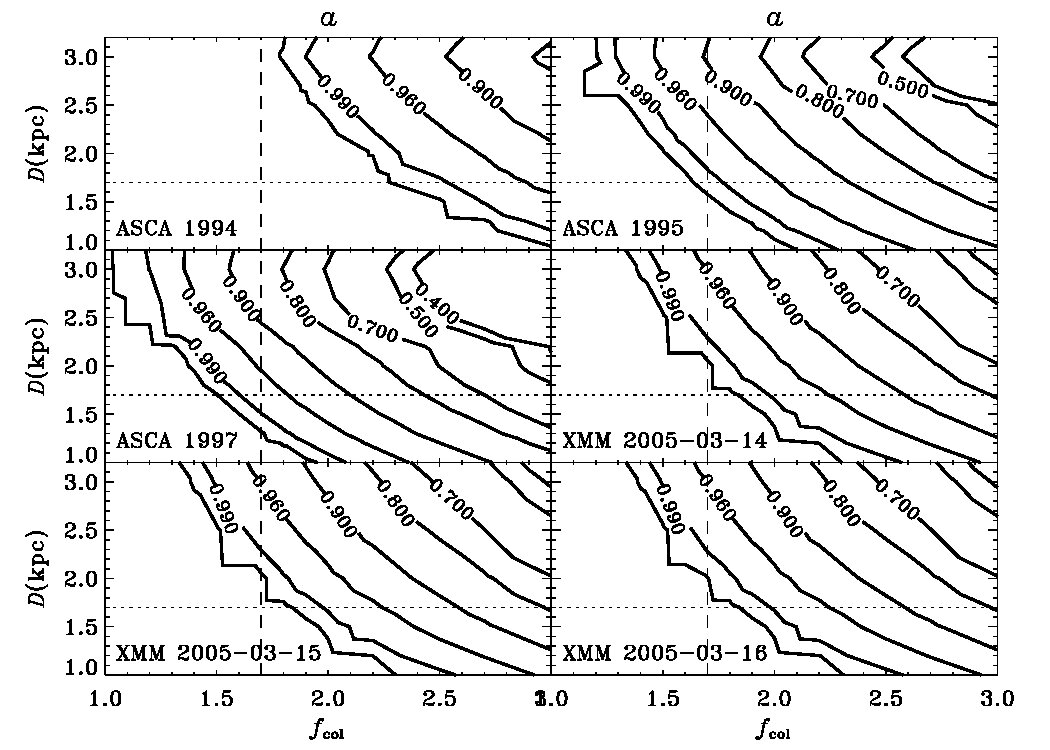 Figure 1
Peer Reviews
No public reviews on file for this paper yet. If you reviewed it on a platform where reviews are public (OpenReview, ICLR, NeurIPS, ICML), you can paste yours below so the community can read it here.
Videos
No videos yet. Explain this paper in a talk, walkthrough, or lecture? Add one.
Taxonomy
TopicsAstrophysical Phenomena and Observations · Gamma-ray bursts and supernovae · Astronomical Observations and Instrumentation
GRO J1655-40: from ASCA and XMM-Newton Observations
Xiao-Ling Zhang1, Shuang Nan Zhang2,3,4, Gloria Sala1, Jochen Greiner1, Yuxin Feng3,4, Yangsen Yao5
Abstract
We have analysed four ASCA observations (1994–1995, 1996–1997) and three XMM-Newton observations (2005) of this source, in all of which the source is in high/soft state. We modeled the continuum spectra with relativistic disk model kerrbb, estimated the spin of the central black hole, and constrained the spectral hardening factor and the distance. If kerrbb model applies, for normally used value of (1.7), the distance cannot be very small, and changes with observations.
11footnotetext: MPE, Postfach 1312, 85741 Garching, Germany, [email protected]: Tsinghua Univ, 100084, Beijing, China33footnotetext: U. of Alabama, Huntsville, AL 35899, USA44footnotetext: NSSTC, Sparkman Dr. 320, Huntsville AL 35805, USA55footnotetext: MIT Kavli Inst. for Astro. and Space Research, 70 Vassar Street, Cambridge, MA 02139
1. Background
GRO J1655-40, the second microquasar (after GRS 1915-105), had X-ray outbursts in 1994-1995, 1996-1997, 2005. Its geometric parameters are considered best determined: mass , inclination angle \theta=69.50\hbox{{}^{\circ}}\pm 0.08 (Orosz & Bailyn 1997), distance kpc (Hjellming & Rupen 1995), which makes it a very good laboratory of studying black holes and environments.
The spin of the central black hole has been estimated by various authors with various methods (see, e.g., Zhang et al. 1997; Abramowicz & Kluźniak 2001; Aschenbach 2004; Shafee et al. 2006), and the reported value range from 0.2 (Abramowicz & Kluźniak 2001) to 0.996 (Aschenbach 2004).
In estimating black hole spin from continuum spectral modeling, the color correction factor , is one of the key factors. The normally used value of is 1.7, following Shimura & Takahara (1995), while many authors believe it should not be constant (see, e.g., Merloni et al. 2000). The distance is also very important. The widely accepted value kpc was challenged by Foellmi et al. (2006), who gave an upper limit of 1.7 kpc.
2. Observations, data reduction and model fitting
We analysed three ASCA observations during the 1994–1995 and the 1996–1997 outbursts, and three XMM-Newton observations during the 2005 outburst, in all of which the source was in high/soft state. For ASCA, only GIS2 data were used, after gain correction and deadtime correction. For XMM-Newton, only Epic-pn data were used, after correction for rate-dependent Charge-Transfer-Efficiency (Sala et al. 2006).
The classical way of estimating black hole spin from the continuum spectral fitting is to fit the spectra with disk models, and obtain the spin directly or indirectly. All models take the source distance as parameter, and most models treat the disk as multi-temperature black-body rings and the derived spin value depends on the apparent/effective temperature ratio.
The relativistic disk model kerrbb in XSPEC was used in the fitting. We let vary from 1.0 to 3.0, and vary from 1.0 kpc and 3.2 kpc. For each combination of and D, we fitted the data sets and obtained a spin value, if the fit was acceptable (). The contour of the derived spin over and are shown in the Fig. 1.
3. Conclusion
From Fig. 1 we can see,
- for the normally used value 1.7, kerrbb model does not favor small distance;
- because the black hole spin and the source distance should be constant, changes dramatically between these observations.
The reference list from the paper itself. Each links out to its DOI / PubMed record.
- 1Abramowicz & Kluźniak (2001) Abramowicz, M. A., & Kluźniak, W. 2001, A&A, 374, L 19
- 2Aschenbach (2004) Aschenbach, B. 2004, A&A, 425, 1075
- 3Foellmi et al. (2006) Foellmi, C., Depagne, E., Dall, T. H., & Mirabel, I. F. 2006, A&A, 457, 249
- 4Hjellming & Rupen (1995) Hjellming, R.M. & Rupen, M.P. 1995, Nat, 375, 464
- 5Merloni et al. (2000) Merloni, A., Fabian, A.C., Ross, R.R. 2000, MNRAS, 313, 193
- 6Orosz & Bailyn (1997) Orosz, J. A., & Bailyn, C. D. 1997, Ap J, 477, 876
- 7Sala et al. (2006) Sala, G., et al 2006, A&A, accepted (astro-ph/0606272 )
- 8Shafee et al. (2006) Shafee, R., et al. 2006, Ap J, 636, L 113