Complete Set of Polarization Transfer Observables for the $^{12}{\rm C}(p,n)$ Reaction at 296 MeV and 0$^{\circ}$
M. Dozono, T. Wakasa, E. Ihara, S. Asaji, K. Fujita, K. Hatanaka, T., Ishida, T. Kaneda, H. Matsubara, Y. Nagasue, T. Noro, Y. Sakemi, Y. Shimizu,, H. Takeda, Y. Tameshige, A. Tamii, Y. Yamada

TL;DR
This study measures a complete set of polarization transfer observables for the $^{12}{ m C}(p,n)$ reaction at 296 MeV and 0 degrees, revealing insights into spin-dipole resonance and transition strengths.
Contribution
It provides the first comprehensive polarization transfer data for this reaction at these energies and angles, enhancing understanding of spin-isospin excitations.
Findings
Spin-dipole resonance at 7 MeV has more $2^-$ strength than $1^-$.
Predominance of spin-flip and unnatural-parity transitions in the continuum.
Exchange tensor interaction effects at high momentum transfer are discussed.
Abstract
A complete set of polarization transfer observables has been measured for the reaction at and . The total spin transfer and the observable deduced from the measured polarization transfer observables indicate that the spin--dipole resonance at has greater strength than strength, which is consistent with recent experimental and theoretical studies. The results also indicate a predominance of the spin-flip and unnatural-parity transition strength in the continuum. The exchange tensor interaction at a large momentum transfer of is discussed.
Click any figure to enlarge with its caption.
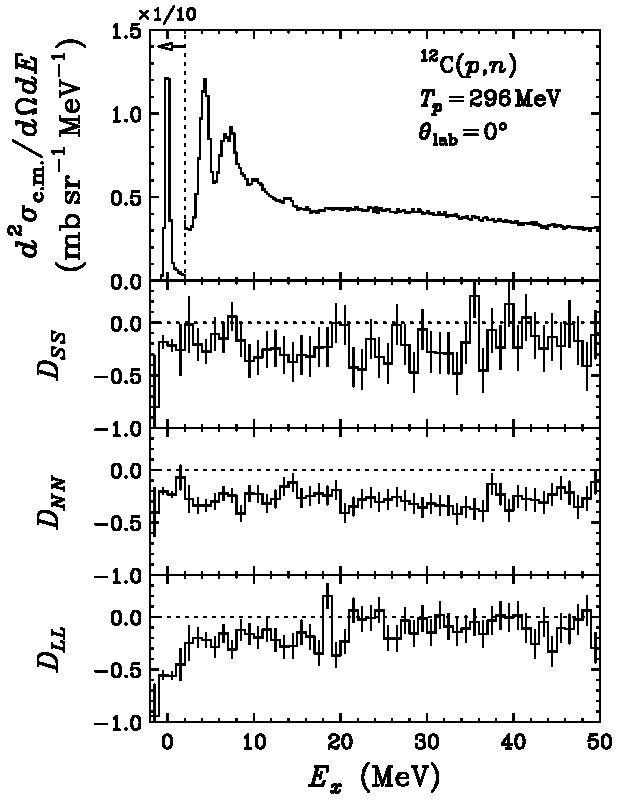 Figure 1
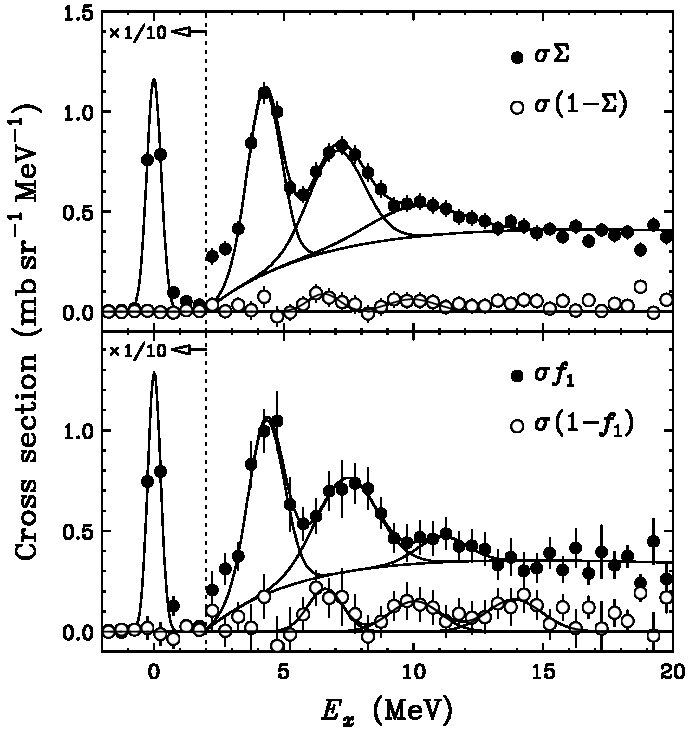 Figure 2
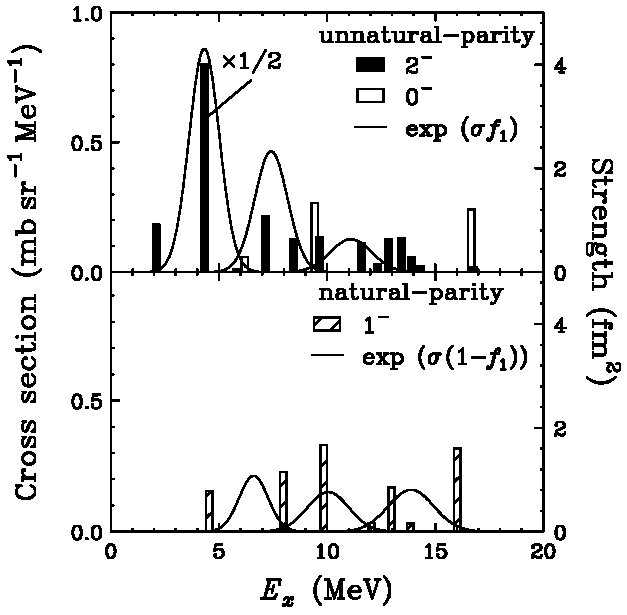 Figure 3
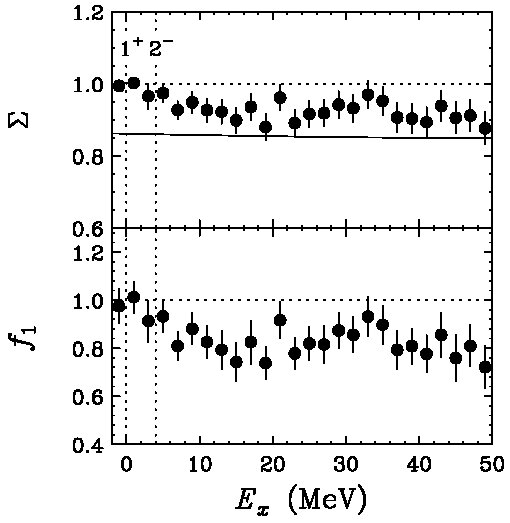 Figure 4
| Exp. | This work | |||
|---|---|---|---|---|
| ref. \citenphys.rev.C51_R2871 | – | – | ||
| DWIA | FL 270 MeV | |||
| FL 325 MeV |
Peer Reviews
No public reviews on file for this paper yet. If you reviewed it on a platform where reviews are public (OpenReview, ICLR, NeurIPS, ICML), you can paste yours below so the community can read it here.
Videos
No videos yet. Explain this paper in a talk, walkthrough, or lecture? Add one.
Complete Set of Polarization Transfer Observables
for the Reaction at 296 MeV and
Masanori Dozono E-mail address: [email protected]
Tomotsugu Wakasa
Ema Ihara
Shun Asaji
Kunihiro Fujita1
Kichiji Hatanaka1
Takashi Ishida2
Takaaki Kaneda1
Hiroaki Matsubara1
Yuji Nagasue
Tetsuo Noro
Yasuhiro Sakemi3
Yohei Shimizu1
Hidemitsu Takeda
Yuji Tameshige1
Atsushi Tamii1 and Yukiko Yamada Department of PhysicsDepartment of Physics Kyushu University Kyushu University Fukuoka 812-8581
1Research Center for Nuclear Physics Fukuoka 812-8581
1Research Center for Nuclear Physics Osaka University Osaka University Osaka 567-0047
2Laboratory of Nuclear Science Osaka 567-0047
2Laboratory of Nuclear Science Tohoku University Tohoku University Sendai 982-0826
3Cyclotron and Radioisotope Center Sendai 982-0826
3Cyclotron and Radioisotope Center Tohoku University Tohoku University Sendai 980-8578 Sendai 980-8578
Abstract
A complete set of polarization transfer observables has been measured for the reaction at and . The total spin transfer and the observable deduced from the measured polarization transfer observables indicate that the spin–dipole resonance at has greater strength than strength, which is consistent with recent experimental and theoretical studies. The results also indicate a predominance of the spin-flip and unnatural-parity transition strength in the continuum. The exchange tensor interaction at a large momentum transfer of is discussed.
complete set of polarization transfer observables, spin–dipole resonance, exchange tensor interaction
The charge exchange reaction at intermediate energies () is one of the best probes to study spin–isospin excitations in nuclei, such as spin–dipole (SD) excitations characterized by . In previous and experiments on , [1, 2] spin–dipole resonances (SDRs) were found at and 7 MeV. Analysis of the angular distributions of the SDRs at indicate that they consist of mainly and components, respectively. However, a recent experiment [3] suggested that the SDR at in has more components than components. This suggestion is supported by a experiment [4] and by theoretical calculations including tensor correlations. [5] Thus the spin-parity assignment of the SDR at for the system is still controversial.
A complete set of polarization transfer (PT) observables at is a powerful tool for investigating the spin-parity of an excited state. The total spin transfer deduced from such a set gives information on the transferred spin , which is independent of theoretical models. [6] Furthermore, information can be obtained on the parity from the observable . [7] On the other hand, each PT observable is sensitive to the effective nucleon–nucleon () interaction. The PT observables for transitions have been used to study the exchange tensor interaction at large momentum transfers. [8, 9]
In this Letter, we present measurements of a complete set of PT observables for the reaction at and . We have deduced the total spin transfer and the observable using the measured PT observables in order to investigate the spin-parity structure in both the SDR and continuum regions. We also compare the PT observables for the reaction with distorted-wave impulse approximation (DWIA) calculations employing the effective interaction in order to assess the effective tensor interaction at a large exchange momentum transfer of .
Measurements were carried out at the neutron time-of-flight facility [10] at the Research Center for Nuclear Physics (RCNP), Osaka University. The proton beam energy was 296 MeV and the typical current and polarization were 500 nA and 0.70, respectively. The neutron energy and polarization were measured by the neutron detector/polarimeter NPOL3. [11] We used a natural carbon target with a thickness of 89 mg/cm2. The measured cross sections were normalized to the reaction, which has a center of mass (c.m.) cross section of at this incident energy. [12] The systematic uncertainties of the data were estimated to be 4–6%.
Asymmetries of the and reactions in NPOL3 were used to deduce the neutron polarization. The effective analyzing power of NPOL3 was calibrated by using polarized neutrons from the reaction at 296 MeV and . A detailed description of the calibration can be found in Ref. \citennimA547_569. The resulting was , where the first and second uncertainties are statistical and systematic, respectively.
Figure 1 shows the double differential cross section and a complete set of PT observables at as a function of excitation energy . The laboratory coordinates at are defined so that the normal (\hat{\mbox{\boldmathN}}) direction is the same as \hat{\mbox{\boldmathN}} at finite angles (normal to the reaction plane), the longitudinal (\hat{\mbox{\boldmathL}}) direction is along the momentum transfer, and the sideways (\hat{\mbox{\boldmathS}}) direction is given by \hat{\mbox{\boldmathS}}=\hat{\mbox{\boldmathN}}\times\hat{\mbox{\boldmathL}}. The data of the cross section in Fig. 1 have been sorted into 0.25-MeV bins, while the data of have been sorted into 1-MeV bins to reduce statistical fluctuations. A high energy resolution of 500 keV full width at half maximum (FWHM) was realized by NPOL3, which enabled us to observe clearly two SDR peaks at . It should be noted that the value should be equal to the corresponding value because the \hat{\mbox{\boldmathN}} direction is identical to the \hat{\mbox{\boldmathS}} direction at . The experimental and values are consistent with each other within statistical uncertainties over the entire range of , demonstrating the reliability of our measurements.
Figure 2 shows the total spin transfer and the observable defined as [6, 7]
[TABLE]
as a function of excitation energy . The value is either 0 or 1 depending on whether or , which is independent of theoretical models. [6] The value is either 0 or 1 depending on the natural-parity or unnatural-parity transition if a single transition is dominant. [7] The and values of the spin-flip unnatural-parity and states at and 4 MeV, respectively, are almost unity, which is consistent with theoretical predictions. The continuum values are almost independent of and take values larger than up to , indicating the predominance of the spin-flip strength. The solid line in the top panel of Fig. 2 represents the free values of for the corresponding kinematical condition. [13] Enhancement of relative to the free values means enhancement of the response relative to the response in nuclei at small momentum transfers, which is consistent with previous studies of scattering. [14, 15] The large values of up to indicate a predominance of the unnatural-parity transition strength in the continuum, consistent with the result at 295 MeV. [7]
The top panel of Fig. 3 shows the spin-flip () and non-spin-flip () cross sections as filled and open circles, respectively, as functions of . The bottom panel shows the unnatural-parity dominant () and natural-parity dominant () components of the cross section as filled and open circles, respectively. The solid lines are the results of peak fitting of the spectra with Gaussian peaks and a continuum. The continuum was assumed to be the quasi-free scattering contribution, and its shape was given by the formula given in Ref. \citenphys.rev.C34_1822. It should be noted that the spin-flip unnatural-parity and states at and 4 MeV, respectively, form peaks only in the and spectra. It is found that the prominent peak at is the spin-flip unnatural-parity component with a value estimated to be because the values are consistent with the theoretical prediction for . [17] In the spectrum, possible evidence for SD peaks is seen at . The top and bottom panels of Fig. 4 show theoretical calculations for the unnatural-parity and natural-parity SD strengths, respectively. [5] Experimentally extracted peaks in the and spectra are also shown. Concentration of the SD strength at three peaks at has been predicted. Our data agree with this prediction qualitatively, but give slightly different excitation energies of . On the other hand, the SD strength has been predicted to be quenched and fragmented due to tensor correlations. [5] The experimental results are spread over a wide region of – and exhibit similar cross sections, which supports fragmentation of the SD strength.
Effective tensor interactions at –3 have mainly been studied using high spin stretched states. [18, 19] The present data can give information on the exchange tensor interaction at an extremely large exchange momentum transfer of . In the Kerman–McNanus–Thaler (KMT) representation [20], the scattering amplitude is represented as
[TABLE]
where is the tensor operator, and are direct and exchange momentum transfers, respectively, and \mbox{\boldmath\hat{n}}=\mbox{\boldmath\hat{Q}}\times\mbox{\boldmath\hat{q}}. In a plane-wave impulse approximation (PWIA), the PT observables for the Gamow–Teller (GT) transition at are simply expressed using parameters – as [17]
[TABLE]
If there is no exchange tensor S_{12}(\mbox{\boldmath\hat{Q}}) interaction (i.e., ), then .
The measured PT observables for the GT transition are listed in Table 1, where the listed uncertainties are statistical only. The present and values are consistent with each other, as expected, and the present value agrees with the previously measured value at the same energy. [9] The experimental values deviated from , which indicates that there are contributions from both the exchange tensor interaction at and nuclear distortion effects.
In order to assess these effects quantitatively, we performed microscopic DWIA calculations using the computer code dw81 [21]. The transition amplitudes were calculated from the Cohen–Kurath wave functions [22] assuming Woods–Saxon radial dependence. [23] Distorted waves were generated using the optical model potential (OMP) for proton elastic scattering data on at 318 MeV. [24] We used the effective interaction parameterized by Franey and Love (FL) at 270 or 325 MeV. [25]
First, we examined the sensitivity of the DWIA results to the OMPs by using two different parameters. [24, 26] The OMP dependence of was found to be less than 0.01. This insensitivity allows us to use as a probe to study the effective interaction. Table 1 shows the DWIA results for with the interaction at 270 and 325 MeV. It is found that the values, and in particular, are sensitive to the choice of the interaction. These differences are mainly due to the exchange tensor interaction at . The real part of for the FL 325 MeV interaction is about twice as large as that for the FL 270 MeV interaction at (see Fig. 3 of Ref. \citenphys.rev.C51_R2871). The experimental values support the DWIA results with the FL 270 MeV interaction, which indicates that the exchange tensor part of the FL 270 MeV interaction has an appropriate strength at . This conclusion has already been reported for data, [9] however, the present data make the conclusion more rigorous because of the high sensitivity of to the exchange tensor interaction.
In summary, a complete set of PT observables for the reaction at and has been measured. The total spin transfer and the observable are deduced in order to study the spin-parity structure in both the SDR and continuum regions. The and values show that the SDR at has greater strength than strength, which agrees with the recent theoretical prediction. In the continuum up to , a predominance of the spin-flip and unnatural-parity transition strength is also found. We have compared the PT observables of the reaction with DWIA calculations employing the FL interaction. The exchange tensor interaction of the FL 270 MeV interaction is found to be more appropriate at than that of the FL 325 MeV interaction. Thus a complete set of PT observables provides rigorous information not only on the spin-parity structure in nuclei but also on the effective interaction.
Acknowledgment
We are grateful to the RCNP cyclotron crew for providing a good quality beam for our experiments. We also thank H. Tanabe for his help during the experiments. This work was supported in part by the Grants-in-Aid for Scientific Research Nos. 14702005 and 16654064 of the Ministry of Education, Culture, Sports, Science, and Technology of Japan.
The reference list from the paper itself. Each links out to its DOI / PubMed record.
- 1[1] X. Yang, L. Wang, J. Rapaport, C. D. Goodman, C. Foster, Y. Wang, W. Unkelbach, E. Sugarbaker, D. Marchlenski, S. de Lucia, B. Luther, J. L. Ullmann, A. G. Ling, B. K. Park, D. S. Sorenson, L. Rybarcyk, T. N. Taddeucci, C. R. Howell and W. Tornow: Phy. Rev. C 48 (1993) 1158.
- 2[2] B. D. Anderson, L. A. C. Garcia, D. J. Millener, D. M. Manley, A. R. Baldwin, A. Fazely, R. Madey, N. Tamimi, J. W. Watson and C. C. Foster: Phys. Rev. C 54 (1996) 237.
- 3[3] H. Okamura, T. Uesaka, K. Suda, H. Kumasaka, R. Suzuki, A. Tamii, N. Sakamoto and H. Sakai: Phys. Rev. C 66 (2002) 054602.
- 4[4] T. Ichihara, M. Ishihara, H. Ohnuma, T. Niizeki, T. Yamamoto, K. Katoh, T. Yamashita, Y. Fuchi, S. Kubono, M. H. Tanaka, H. Okamura, S. Ishida and T. Uesaka: Nucl. Phys. A 577 (1994) 93c.
- 5[5] T. Suzuki and H. Sagawa: Nucl. Phys. A 637 (1998) 547.
- 6[6] T. Suzuki: Prog. Theor. Phys. 103 (2000) 859.
- 7[7] T. Wakasa, H. Sakai, H. Okamura, H. Otsu, T. Nonaka, T. Ohnishi, K. Yako, K. Sekiguchi, S. Fujita, T. Uesaka, Y. Satou, S. Ishida, N. Sakamoto, M. B. Greenfield and K. Hatanaka: J. Phys. Soc. Jpn. 73 (2004) 1611.
- 8[8] D. J. Mercer, T. N. Taddeucci, L. J. Rybarcyk, X. Y. Chen, D. L. Prout, R. C. Byrd, J. B. Mc Clelland, W. C. Sailor, S. De Lucia, B. Luther, D. G. Marchlenski, E. Sugarbaker, E. G u ¨ ¨ u \ddot{\rm u} lmez, C. A. Whitten, Jr., C. D. Goodman and J. Rapaport: Phys. Rev. Lett. 71 (1993) 684.