Reply to 'Comment on 'Heavy element production in inhomogeneous big bang nucleosynthesis''
Shunji Matsuura, Shin-ichirou Fujimoto, Masa-aki Hashimoto, Katsuhiko, Sato

TL;DR
This paper defends the possibility of heavy element production in high baryon density regions of the early universe, demonstrating it can occur without conflicting with light element and CMB observations.
Contribution
It provides a detailed analysis showing that under certain conditions, heavy element synthesis in high baryon density regions is compatible with observational constraints.
Findings
Heavy elements can be produced in high baryon density regions without contradicting observations.
Certain parameter spaces allow for significant heavy element synthesis.
The model aligns with light element and CMB data.
Abstract
This is a reply report to astro-ph/0604264. We studied heavy element production in high baryon density region in early universe astro-ph/0507439. However it is claimed in astro-ph/0604264 that small scale but high baryon density region contradicts observations for the light element abundance or in order not to contradict to observations high density region must be so small that it cannot affect the present heavy element abundance. In this paper we study big bang nucleosynthesis in high baryon density region and show that in certain parameter spaces it is possible to produce enough amount of heavy element without contradiction to CMB and light element observations.
Click any figure to enlarge with its caption.
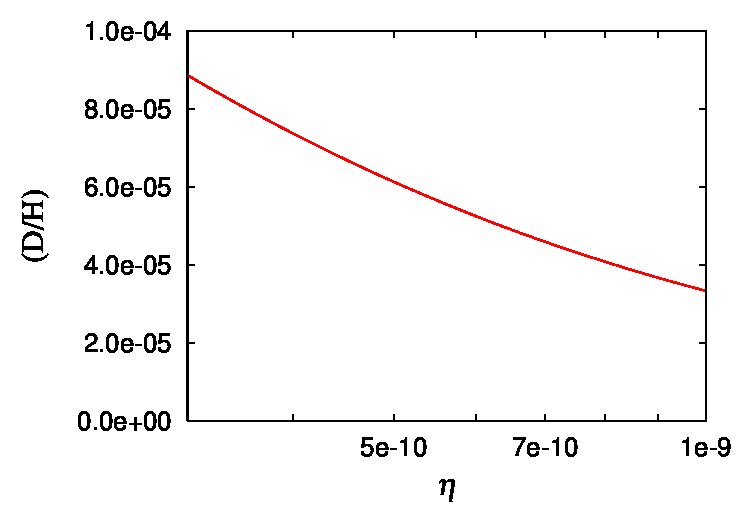 Figure 1
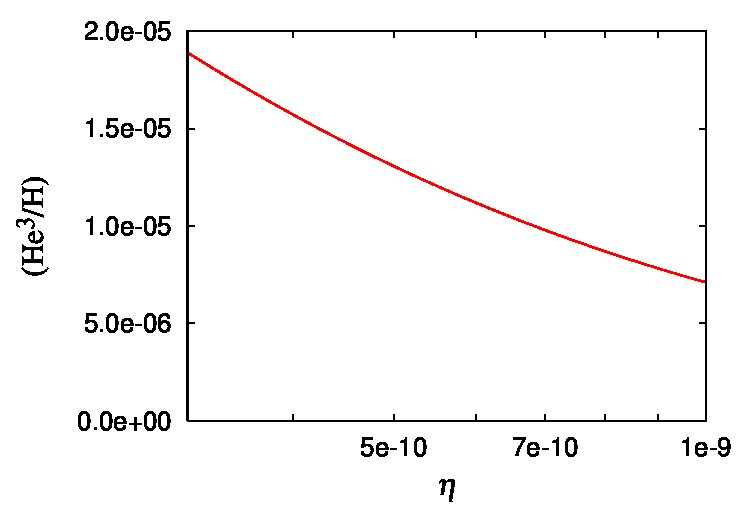 Figure 2
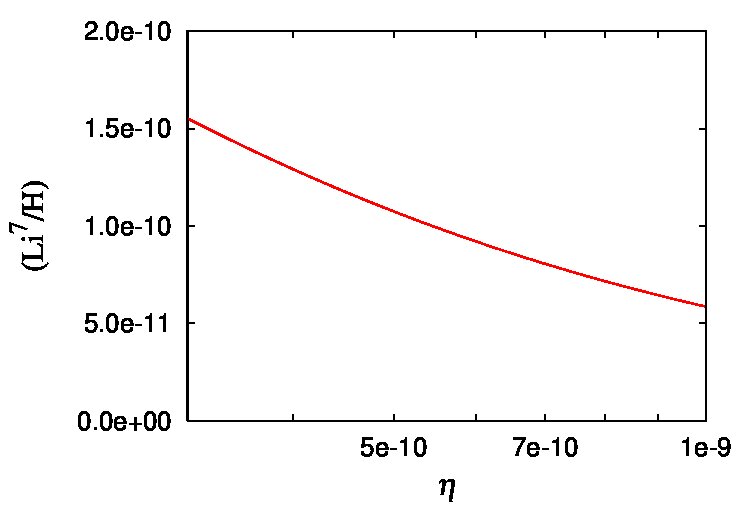 Figure 3
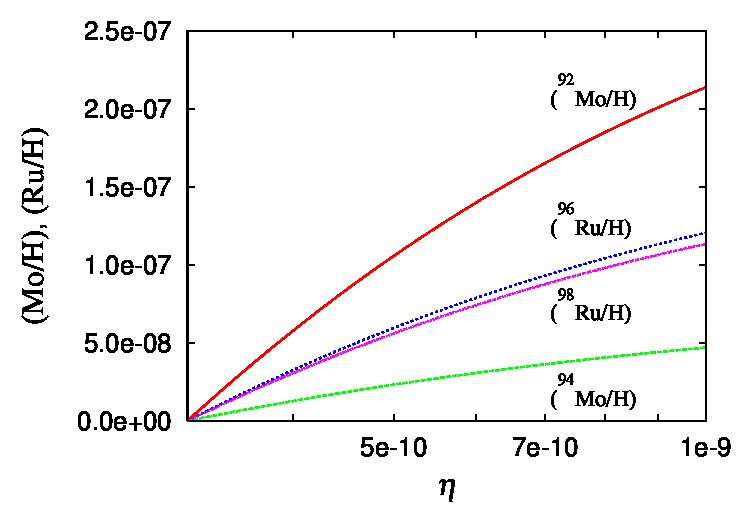 Figure 4
| name | mass fraction | number fraction |
|---|---|---|
| H | ||
| 4He | ||
| 3He | ||
| 7Li+7Be | ||
| D | ||
| name | mass fraction | number fraction |
|---|---|---|
| H | ||
| 4He | ||
| 3He | ||
| 7Li + 7Be | ||
| D | ||
| name | mass fraction |
|---|---|
| H | |
| 4He | |
| 92Mo | |
| 94Mo | |
| 96Ru | |
| 98Ru | |
| name | number fraction | ratio to H |
|---|---|---|
| H | 1 | |
| 92Mo | ||
| 94Mo | ||
| 96Ru | ||
| 98Ru |
| temperature and scale | |
|---|---|
| temperature | scale |
| K (BBN) | d |
| 3000K (decouple) | |
| 2.725K (now) | |
Peer Reviews
No public reviews on file for this paper yet. If you reviewed it on a platform where reviews are public (OpenReview, ICLR, NeurIPS, ICML), you can paste yours below so the community can read it here.
Videos
No videos yet. Explain this paper in a talk, walkthrough, or lecture? Add one.
Reply to ’Comment on ’Heavy element production in inhomogeneous big bang nucleosynthesis”
Shunji Matsuura
Department of Physics, School of Science, University of Tokyo, 7-3-1 Hongo, Bunkyo, Tokyo 113-0033, Japan
Shin-ichirou Fujimoto
Department of Electronic Control, Kumamoto National College of Technology, Kumamoto 861-1102, Japan
Masa-aki Hashimoto
Department of Physics, School of Sciences, Kyushu University, Fukuoka 810-8560, Japan
Katsuhiko Sato
Department of Physics, School of Science, University of Tokyo, 7-3-1 Hongo, Bunkyo, Tokyo 113-0033, Japan
Research Center for the Early Universe, University of Tokyo, 7-3-1 Hongo, Bunkyo, Tokyo 113-0033, Japan
Abstract
This is a reply report to Rauscher:2006mv . We studied heavy element production in the high baryon density region in the early universeMatsuura:2005rb . However it is claimed by Rauscher:2006mv that a small scale but high baryon density region contradicts observations for the light element abundance or, in order not to contradict to the observations the high density region must be so small that it cannot affect the present heavy element abundance.
In this paper we study big bang nucleosynthesis in the high baryon density region and show that in certain parameter spaces it is possible to produce enough amount of the heavy element without contradiction to cosmic microwave background and light element observations.
pacs:
26.35.+c, 98.80.Ft, 13.60.Rj
I Introduction
In a standard scenario, big bang nucleosynthesis (BBN) can produce only light elements, up to 7Li, and all heavy elements have been synthesized in stars. However, many phase transitions in the early universe could have printed their trace in a non-standard way. For example, some baryogenesis modelsDolgov:1992pu predict very high baryon density islands in ordinary low density backgrounds.
In the previous paperMatsuura:2005rb , we studied heavy element production in inhomogeneous BBN from this point of view. 111For previous works on the inhomogeneous big bang nucleosynthesis, see IBBN1 ; IBBN2 . Heavy elements production is also mentioned in jedam . However we limited ourselves to the heavy element abundance and did not discuss about the light element abundance and consistency with observations. This is because we assumed that high baryon density region is very local and do not affect the global light element abundance. In Rauscher:2006mv , Rauscher pointed out that in order not to contradict to observations, the high baryon density region must be very small and cannot affect the present heavy element abundance. In this paper, we show that there is a parameter region in which the heavy element can be produced enough to affect observation while keeping the light element abundance consistent with observations. We consider that the disagreement between Rauscher’s opinion and our opinion comes from two points. One is that we are looking at some parameter regions in which neutrons in high baryon density do not diffuse so much as to cause disaster in standard BBN. We would like to emphasize this point. The other is that the relevant quantity is not the spatial size of the high baryon density region but the amount of baryon in high density regions.
We will discuss the following issues: In section II, we discuss the light element abundance in the homogeneous high baryon density region and after mixing the high and the low baryon density region. In section III, we study the heavy element(Ru,Mo) abundance in high and averaged baryon density and show that heavy elements can be produced enough without contradicting the light element observation. In section IV, we briefly comment on the diffusion scale of the high baryon density region.
II Light element abundance
II.1 Homogeneous BBN
We calculate homogeneous BBN with various values of (baryon photon ratio). In Table.1 and 2, we show the numerical result of the mass fraction and the number fraction of each light element for and .
As baryon density becomes higher, more protons and neutrons are bounded to form 4He. At , most of the final product of comes from which decays to after BBN. Details on light element production for various can also be found in Wagoner:1966pv . In this paper we almost concentrate on a case in which the high baryon density region has . We expect that compared to , the profile of the abundance for is more different from standard BBN because most of the light element abundances change monotonically with respect to and if this case does not contradict to observations, other cases would also be consistent. Briefly, the amount of decreases and increases monotonically as become larger. The number fraction of is less than for greater than . For , the number fraction drastically decreases around down to , and for , the number fraction increases until and drastically decreases for a larger value of . In the following sections, we will see that this non-standard setup does not strongly contradict to the observations. For simplicity we ignore the diffusion effect before and during BBN, and after BBN both high and low baryon density regions are completely mixed. Detailed analysis such as the case in which the high baryon density region doesn’t completely mixed, or taking into account diffusion effects are left for future work.
II.2 Parameters and Basic equations
In this section, we summarize the relations among parameters.
Notations : , , are averaged, high, and low baryon number density. , are the volume fractions of the high and the low baryon density region. , , are the mass fractions of each element (i) in averaged-, high- and low-density regions. The basic relations are
[TABLE]
Under the assumption that the temperature of the universe is homogeneous, the above equation can be written as
[TABLE]
where , Conventional parameters for inhomogeneous BBN are , and density ratio . Here we use a different combination of parameters. Relevant values for the abundance analysis are products and . determines the amount of baryon from high- and low- density regions. determines the mass fraction of each species of nuclei. For convenience, we write the ratio of baryon number contribution from high density region as , i.e., . There are 5 parameters( and ) and 2 constraints (Eq.(1) and Eq.(2)). We calculate the light element abundance for various values of . can also take any value, but in order not to contradict observational constraints, we choose from to . is determined by Eq(4). The aim of the analysis in this section is not to find parameter regions which precisely agree with the observational light element abundance and from CMB. Our model is too simple to determine the constraints to parameters. For example, we completely ignore the diffusion effect before and during BBN. Instead we see that at least our analysis in previous paper is physically reasonable.
II.3 Theoretical predictions and observations of light elements
We consider the cases of and . The mass fractions of and and in the high density region are and , respectively, while those in the low density region are and . From Eq.(5), we have
[TABLE]
[TABLE]
We can calculate an averaged value of the abundance ratio of 3He to H as
[TABLE]
where is related to as
[TABLE]
Here varies from 0 to 0.9 for reasonable values of , or . Similarly, for the number fractions are
[TABLE]
[TABLE]
Fig.1,2 and 3 represent the averaged abundance ratio, (D/H), (3He/H) and (7Li/H) respectively.
We can see that the light element abundance is the same order around as observations Fields:2004cb ; Kirkman:2003uv ; O'Meara:2000dh ; Kirkman:1999zu ; Linsky:2003ia ; Ryan:1999jq ; Bonifacio:2002yx ; Pinsonneault:2001ub .
[TABLE]
We do not discuss detail about diffusion here. But at least above result suggest that our analysis is not beside the point.
III Theoretical predictions and observations of heavy elements (92,94Mo, 96,98Ru)
The same analysis can be applied for heavy elements such as , , and . We are interested in these elements because in many models of supernovae nucleosynthesis, these p-nuclei are less produced. We will see that some amount of these heavy elements can be synthesized in BBN.
From Table.LABEL:heavy, we can derive the expected value of these elements.
[TABLE]
[TABLE]
[TABLE]
[TABLE]
We plot expected value of these quantities in Fig.4.
These values should be compared with the solar abundance(Table.4)Anders:1989zg .
Compared those observational values with Fig.4, it is clear that the heavy element produced in BBN can affect the solar abundance heavy element. Some of them are produced too much. But this is not a problem of the previous work Matsuura:2005rb , because we assumed that high density regions are very small and do not disturb standard BBN. The analysis here suggest that even if we assume the density fluctuations are completely mixed, heavy element can have enough affect to the solar abundance.
IV Diffusion during BBN
In the previous analysis, we assumed that the diffusion effect can be ignored during BBN and both high density regions and low density regions are completely mixed after BBN. In this section, we determine the scale of high baryon density island in which the diffusion effect during BBN is very small enough and our assumption is valid. We do not discuss the diffusion after BBN here.
A detail analysis of the comoving diffusion distance of the baryon, the neutron and the proton is in Applegate:1987hm . From Fig.1 in Applegate:1987hm , in order to safely ignore the diffusion effect, it is necessary for the high baryon density island to be much larger than cm at T=0.1MeV(K). Notice that , where A is a scale factor. For scale d now corresponds to at BBN epoch. Present galaxy scale is cm, which corresponds to cm cm at BBN epoch.
The maximum angular resolution of CMB is 2000. The size of universe is Mpc. In order not to contradict to CMB observation, the fluctuation of baryon density must be less than Mpc now. This corresponds to cm at BBN.
Since the density fluctuation size in Dolgov and Silk’s modelDolgov:1992pu is a free parameter, the above brief estimation suggests that we can take the island size large enough to ignore the diffusion effect without contradicting to observations, i.e., the reasonable size of cm -$$10^{17}cm at the BBN epoch. We can choose distances between high density islands so that we obtain a suitable value of .
V Summary
In this paper, we studied the relation between the heavy element production in high baryon density regions during BBN and the light element observation. By averaging the light element abundances in the high and the low density regions we showed that it is possible to produce a relevant amount of heavy element without contradicting to observations. However we should stress that in this paper we restricted ourselves to some parameter regions where neutrons in high baryon density regions do not destroy the standard BBN. So our setup is different from the conventional inhomogeneous BBN studies. We also studied the size of the density fluctuation to show that there is a parameter region in which the neutron diffusion is negligible and which is much smaller than CMB observation scale. It is worthwhile to investigate further how the produced heavy elements can be related to the detailed observations.
VI Acknowledgements
We thank R.H. Cyburt, R. Allahverdi and R. Nakamura for useful discussions. This research was supported in part by Grants-in-Aid for Scientific Research provided by the Ministry of Education, Science and Culture of Japan through Research Grant No.S 14102004, No.14079202. S.M.’s work was supported in part by JSPS(Japan Society for the Promotion of Science).
The reference list from the paper itself. Each links out to its DOI / PubMed record.
- 1(1) T. Rauscher, “Comment on Heavy element production in inhomogeneous big bang ar Xiv:astro-ph/0604264.
- 2(2) A. Dolgov and J. Silk, “Baryon isocurvature fluctuations at small scales and baryonic dark Phys. Rev. D 47 , 4244 (1993).
- 3(3) S. Matsuura, S. I. Fujimoto, S. Nishimura, M. A. Hashimoto and K. Sato, Phys. Rev. D 72 , 123505 (2005) [ar Xiv:astro-ph/0507439].
- 4(4) JD Barrow and J Morgan, Mon.Not.Roy. astr. Soc. 203 , 203 (1983); J.H. Applegate, C.J. Hogan, and R.J. Scherrer, Phys. Rev. D 35 , 1151 (1987); C. Alcock, G.M. Fuller, and G.J. Mathews, Astrophys. J. 320 , 439 (1987); R.M. Malaney and W.A. Fowler, Astrophys. J 333 , 14 (1988); H. Kurki-Suonio, R. A. Matzner, J. M. Centrella, T. Rothman, and J. R. Wilson, Phys. Rev. D 38 , 1091 (1988); N. Terasawa and K. Sato, Phys. Rev. D 39 , 2893 (1989); N. Terasawa and K. Sato, Prog. Theor. Phys. 81
- 5(5) T. Rauscher, H. Applegate, J. Cowan, F. Thielmann, and M. Wiescher, Astrophys. J. 429 , 499 (1994); S. Matsuura, A. D. Dolgov, S. Nagataki and K. Sato, Prog. Theor. Phys. 112 , 971 (2004) [ar Xiv:astro-ph/0405459].
- 6(6) K. Jedamzik [astro-ph/9911242].
- 7(7) R. V. Wagoner, W. A. Fowler and F. Hoyle, Astrophys. J. 148 , 3 (1967).
- 8(8) B. Fields and S. Sarkar, ar Xiv:astro-ph/0406663.