Electromagnetic structure and weak decay of meson K in a light-front QCD-inspired
Fabiano P. Pereira (Instituto de Fisica, Universidade Federal, Fluminense, Niteroi, RJ, Brazil), J. P. B. C. de Melo (Universidade Cruzeiro, do Sul, CETEC, Sao Paulo, SP, Brazil), T. Frederico (Instituto Tecnologico de, Aeronautica, Sao Jose dos Campos, SP, Brazil)

TL;DR
This paper reviews the electromagnetic form factor and weak decay of the kaon using a light-front QCD-inspired model, emphasizing the importance of quark-antiquark pair contributions for covariance and matching experimental data.
Contribution
It introduces a light-front constituent quark model that incorporates quark-antiquark pair terms to improve covariance and accurately describe kaon properties.
Findings
Good agreement with experimental data for kaon weak decay constant.
Quark-antiquark pair terms are crucial for full covariance of the electromagnetic current.
Valence component probability of about 80% is consistent with observations.
Abstract
The kaon electromagnetic (e.m.) form factor is reviewed considering a light-front constituent quark model. In this approach, it is discussed the relevance of the quark-antiquark pair terms for the full covariance of the e.m. current. It is also verified, by considering a QCD dynamical model, that a good agreement with experimental data can be obtained for the kaon weak decay constant once a probability of about 80% of the valence component is taken into account.
Click any figure to enlarge with its caption.
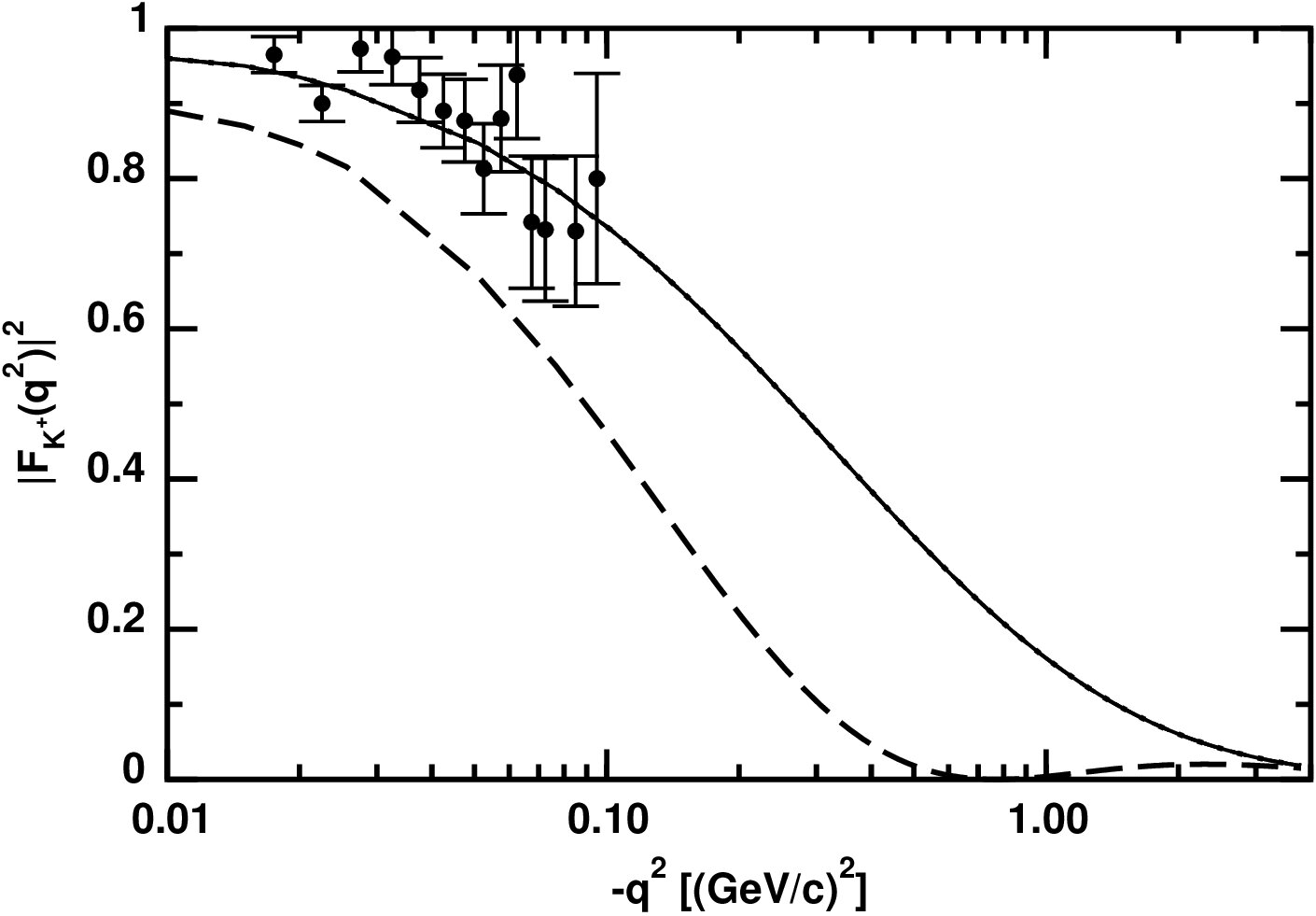 Figure 1
Peer Reviews
No public reviews on file for this paper yet. If you reviewed it on a platform where reviews are public (OpenReview, ICLR, NeurIPS, ICML), you can paste yours below so the community can read it here.
Videos
No videos yet. Explain this paper in a talk, walkthrough, or lecture? Add one.
Electromagnetic structure and weak decay of meson K in a light-front
QCD-inspired model††thanks: Work partially supported by the Brazilian funding agencies FAPESP and CNPq
Fabiano P. Pereira , J. P. B. C. de Melo
, T. Frederico , and Lauro Tomio JPBC de Melo thanks Instituto de Física Teórica, UNESP, for supporting facilities Instituto de Física, Universidade Federal Fluminense, 24210-900, Niterói, RJ, Brazil
Universidade Cruzeiro do Sul, CETEC, 08060-070, São Paulo, SP, Brazil
Instituto Tecnológico de Aeronáutica, 12228-900, São José dos Campos, SP, Brazil
Instituto de Física Teórica, UNESP, 01405-900, São Paulo, SP, Brazil
Abstract
The kaon electromagnetic (e.m.) form factor is reviewed considering a light-front constituent quark model. In this approach, it is discussed the relevance of the quark-antiquark pair terms for the full covariance of the e.m. current. It is also verified, by considering a QCD dynamical model, that a good agreement with experimental data can be obtained for the kaon weak decay constant once a probability of about 80% of the valence component is taken into account.
1 INTRODUCTION
The kaon, as quark-antiquark bound states, is one appropriate system to study aspects of QCD at low and intermediate energy regions. By using quantum field theory at the light-front the subnuclear structure can be more easily studied [1, 2, 3]. Within the light-front framework and an appropriate choice of the frame, it is possible to obtain the pion electromagnetic form factor at both space- and time-like regimes[4]. Using the light-cone components and of the kaon electromagnetic current, one can obtain the corresponding form factors in the light-front formalism, with a pseudoscalar coupling for the quarks and considering the Breit frame (, ) [5]. In the case of there is no pair term contribution in the Breit frame. However, for the component of the electromagnetic current, the pair term contribution is different from zero and necessary to preserve the rotational symmetry of the current.
In the next section, we outline the main equations of the model for the kaon electromagnetic current, detailed in [5], with the corresponding results obtained for the kaon elastic form factor. In section 3, we briefly review a QCD inspired model, presenting results for the weak decay pseudoscalar constants compared to data. In section 4 we present our conclusions.
2 ELECTROMAGNETIC FORM FACTOR
The initial light-front wave function considered in the present model is given by:
[TABLE]
where is a normalization constant, is the quark or antiquark index with is the corresponding quark mass, is the kaon mass, is the momentum fraction, and
[TABLE]
with the free quark-mass operator given by . is a mass constant chosen to regularize the triangle diagram. For the corresponding final wave-functions, and , we just need to exchange in (1) and (2). The relation between the electromagnetic current and the space-like kaon electromagnetic form factor is given by In terms of the initial and final light-front wave functions, we have
[TABLE]
where is the color number, is the coupling constant, is the charge of quark , and In the light-front approach, beside the valence contribution, we have also the non-valence contributions to the currents. In the case of the component, the non-valence component does not contribute to the corresponding matrix elements [5]. The kaon electromagnetic form factor obtained with is the sum of two contributions from quark and antiquark currents:
[TABLE]
In the case that we consider the component, to obtain the kaon electromagnetic form factor, after considering the contribution from the interval (interval I), we need to add a second contribution, which is originated from the pair terms, and non-zero in the interval (interval II). The contribution is obtained after a Cauchy integral in is performed in the limit [5]. So, instead of (5), we will have:
[TABLE]
normalized by the charge conservation to
The parameters of the model are the constituent quark masses, 220 MeV, 419 MeV and the regulator mass 946 MeV, adjusted to fit the electromagnetic radius of the kaon. The electromagnetic radius is related to the corresponding form factor, with the mean-square-radius given by
[TABLE]
With the parameters adjusted as given above, we have 0.354 fm2, which is very close to the experimental value 0.340 fm2 [6].
Our results for the kaon electromagnetic form factor are presented in Fig. 1, in comparison with available experimental data [6]. We observe that the full kaon electromagnetic form factor is covariant only after the inclusion of the pair terms or non-valence contribution to the component of the electromagnetic current.
3 WEAK DECAY CONSTANTS IN A QCD INSPIRED MODEL
Next, we briefly review the calculation of the pseudoscalar constants, in a light-front QCD-inspired dynamical model. In this case, the constituent quark masses need to be readjusted in view of the fact that, differently from the approach outlined in section 2, the wave-function is obtained from an eigenvalue equation, as follows.
The valence wave function is obtained by solving an eigenvalue equation for the effective square mass operator [7]:
[TABLE]
where is the free square mass operator in the meson rest frame, are the constituent quark masses, gives the strength of the Coulomb-like interaction. is the model form factor, with the strength of the separable interaction. We consider two expressions for the form factors:
[TABLE]
where the parameters and are adjusted to reproduce the experimental values of the pion electromagnetic radius and mass, . For , we have and . . In Table 1, we have the results compared with experimental data [8].
4 CONCLUSIONS
Considering a light-front model wave-function we have observed a good agreement of the results for the kaon electromagnetic form factor with experimental data. The electromagnetic form factor was obtained using the plus and minus components of the electromagnetic current. The inclusion of the non-valence component of the current was shown to be essential in this approach to obtain covariant results for the calculated matrix elements. We also show that a good agreement with experimental data is obtained for the kaon weak decay constants once a probability of the valence component of about 80% is taken into account.
The reference list from the paper itself. Each links out to its DOI / PubMed record.
- 1[1] F. Cardarelli, I. L. Grach, I. M. Narodetsky, E. Pace, G. Salme, S. Simula, Phys. Rev. D 53 (1996) 6682.
- 2[2] J. P. B. C. de Melo, H. W. Naus and T. Frederico, Phy. Rev. C 59 (1999) 2278.
- 3[3] B. L. G. Bakker, H.-M. Choi and C.-R. Ji, Phys. Rev. D 63 (2001) 074014.
- 4[4] J. P. B. C. de Melo, T. Frederico, E. Pace and G. Salmè, Phy. Rev. D 73 (2006) 074013; J. P. B. C. de Melo, T. Frederico, E. Pace and G. Salmè, Phy. Lett. B 581 (2004) 75.
- 5[5] F.P. Pereira, J.P.B.C. de Melo, T. Frederico and L. Tomio, Phys. of Part. and Nucl. 36 (2005) 5217; F.P. Pereira, Fatores de Forma Eletromagnéticos do Píon e do Kaon na Frente de Luz , Msc Dissertation, IFT, São Paulo, 2005.
- 6[6] S. R. Amendolia et al., Phys. Lett. B 178 (1986) 435.
- 7[7] T. Frederico and H.-C. Pauli, Phy. Rev. D 64 (2001) 054004; L. A. M. Salcedo, J. P. B. C. de Melo, D. Hadjmichef and T. Frederico, Eur. Phys. J. A 27 (2006) 213.
- 8[8] W.-M. Yao et al., Journal of Physics G 33 (2006) 1.