Anomalous c-axis transport in layered metals
D. B. Gutman, D. L. Maslov

TL;DR
This paper investigates the anisotropic transport properties of layered metals, demonstrating the robustness of coherent band transport and proposing a phonon-assisted tunneling model to explain non-monotonic c-axis resistivity behavior.
Contribution
It introduces a model of phonon-assisted tunneling to explain anomalous c-axis transport in layered metals with anisotropic spectra.
Findings
Coherent band transport persists with high $E_F\tau$
Phonon-assisted tunneling explains non-monotonic resistivity
Standard Boltzmann equation applies to all directions
Abstract
Transport in metals with strongly anisotropic single-particle spectrum is studied. Coherent band transport in all directions, described by the standard Boltzmann equation, is shown to withstand both elastic and inelastic scattering as long as . A model of phonon-assisted tunneling via resonant states located in between the layers is suggested to explain a non-monotonic temperature dependence of the c-axis resistivity observed in experiments.
Click any figure to enlarge with its caption.
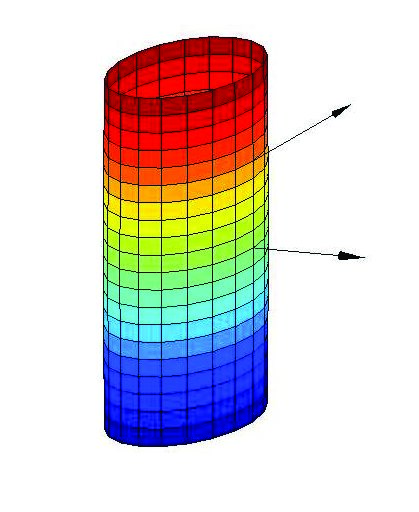 Figure 1
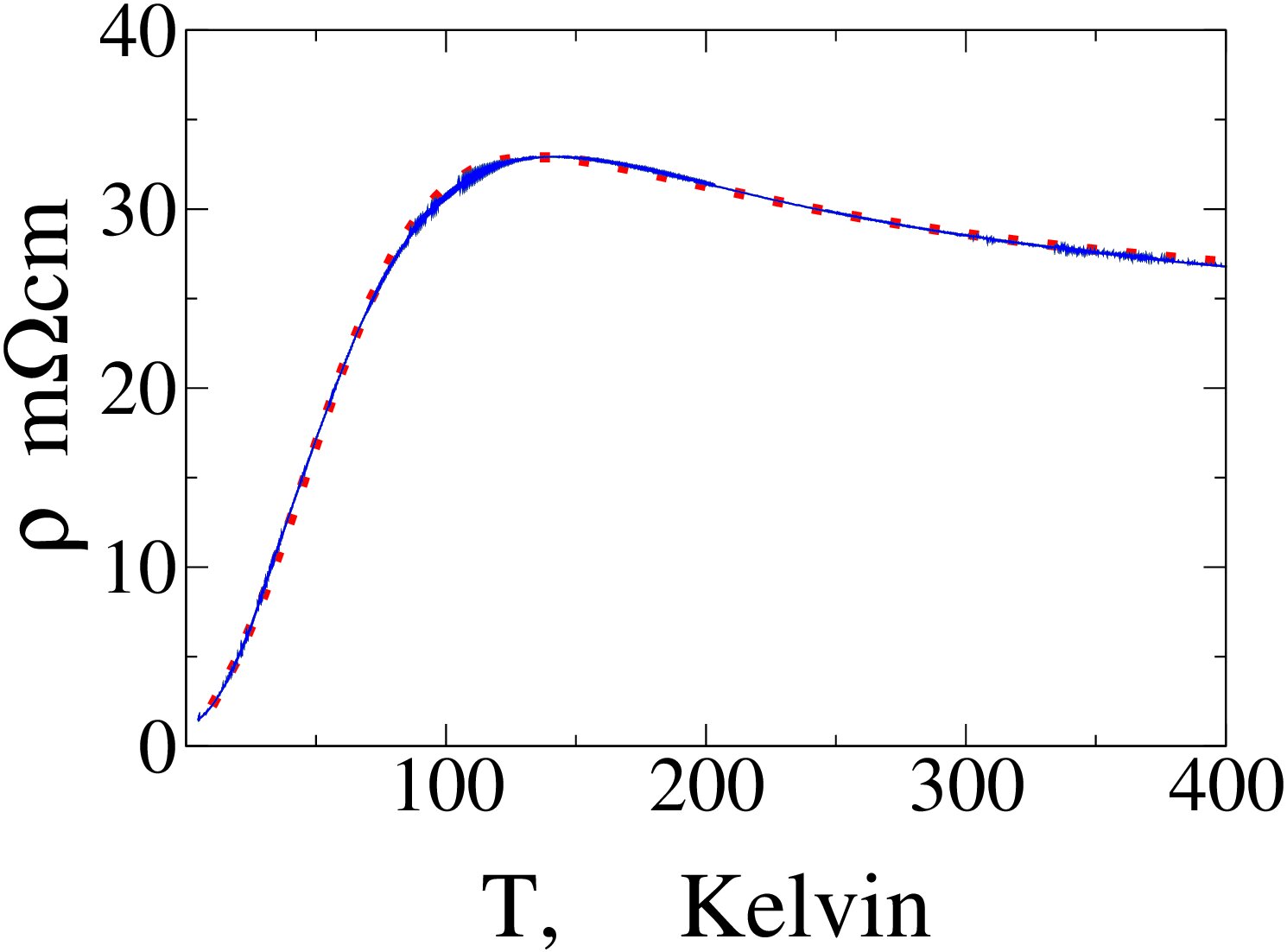 Figure 2
Peer Reviews
No public reviews on file for this paper yet. If you reviewed it on a platform where reviews are public (OpenReview, ICLR, NeurIPS, ICML), you can paste yours below so the community can read it here.
Videos
No videos yet. Explain this paper in a talk, walkthrough, or lecture? Add one.
Anomalous -axis transport in layered metals
D. B. Gutman and D. L. Maslov
Department of Physics, University of Florida, Gainesville, FL 32611, USA
Abstract
Transport in metals with strongly anisotropic single-particle spectrum is studied. Coherent band transport in all directions, described by the standard Boltzmann equation, is shown to withstand both elastic and inelastic scattering as long as . A model of phonon-assisted tunneling via resonant states located in between the layers is suggested to explain a non-monotonic temperature dependence of the -axis resistivity observed in experiments.
pacs:
72.10.-d,72.10.Di
Electron transport in layered materials exhibits a number of unusual properties. The most striking example is a qualitatively different behavior of the in-plane and out-of-plane ( resistivities: whereas the temperature dependence of is metallic-like, that of is either insulating-like or even non-monotonic. At the level of non-interacting electrons, layered systems are metals with strongly anisotropic Fermi surfaces. A commonly used model is free motion along the planes and nearest-neighbor hopping between the planes:
[TABLE]
where and are in the in-plane and -axis components of momentum, respectively, is the in-plane mass, and is lattice constant in the -axis direction. For the strongly anisotropic case ( the equipotential surfaces are “corrugated cylinders” (see Fig.1).
If the Hamiltonian consists of the band motion with spectrum (1) and the interaction of electrons with potential disorder as well as with inelastic degrees of freedom, e.g., phonons, the Boltzmann equation predicts that the conductivities are given by
[TABLE]
where denotes averaging over the Fermi surface and over the thermal (Fermi) distribution, is the density of states, and is the transport time, resulting from all scattering processes (we set . If decreases with the temperature, *both * and are expected to decrease with as well. This is not what the experiment shows.
The -axis puzzle received a lot of attention in connection to the HTC materials ginsberg , and a non-Fermi-liquid nature of these materials was suggested to be responsible for the anomalous -axis transport anderson . However, other materials, such as graphite graphite , TaS2 frindt , Sr2RuO4 srruo , organic metals organics , etc., behave as canonical Fermi liquids in all aspects but the -axis transport. This suggests that the origin of the effect is not related to the specific properties of HTC compounds but common for all layered materials. A large number of models were proposed to explain the -axis puzzle. Despite this variety, most authors seem to agree on that the coherent band transport in the -axis direction is destroyed. Although there is no agreement as to what replaces the band transport in the ”incoherent” regime, the most frequently discussed mechanisms include incoherent tunneling between the layers, assisted by either out-of-plane impurities sauls ; levin ; peter ; abrikosov_res or by coupling to dissipative environment leggett , and polarons polaron_schofield ; polaron_mckenzie .
The message of this Letter is two-fold. First, we observe that neither elastic or inelastic (electron-phonon) scattering can destroy band transport even in a strongly anisotropic metal as long as the familiar parameter is large. Nothing happens to the Boltzmann conductivities in Eq.(2) except for becoming very small at high temperatures so that other mechanisms, not included in Eq.(2), dominate transport. This observation is in agreement with recent experiment singleton where a coherent feature (angle-dependent magnetoresistance) was observed in a supposedly incoherent regime. Second, we propose phonon-assisted tunneling through resonant impurities as the mechanism competing with the band transport. As such tunneling provides an additional channel for transport, the total conductivity is levin
[TABLE]
where is the resonant-impurity contribution. Because increases with the temperature, the band channel is short-circuited by the resonant one at high enough temperaturesPalevskii . Accordingly, goes through a minimum at a certain temperature (and goes through a maximum). We consider phonon-assisted tunneling through a wide band of resonant levels distributed uniformly in space. We show that the non-perturbative (in the electron-phonon coupling) version of this theory is in a quantitative agreement with the experiment on Sr2RuO4 srruo . Due to a similarity between phonon-assisted tunneling and other problems, in which interaction leads to the formation of a cloud surrounding the electron (such as polaronic effect and zero bias anomaly), many ideas put forward earlier sauls ; levin ; peter ; abrikosov_res ; leggett ; polaron_schofield ; polaron_mckenzie agree with our picture. Nevertheless, we believe that only a combination of resonant impurities and electron-phonon interaction solves the puzzle of -axis resistivity and provides a microscopic theory for some of the mechanisms considered in prior work. We begin with the discussion of the breakdown (or lack of it thereof) of the Boltzmann equation.
One may wonder whether the band transport along the -axis breaks down because the Anderson localization transition occurs in the -direction whereas the in-plane transport remains metallic. This does not happen, however, because an electron, encountering an obstacle for motion along the -axis, moves quickly to another point in the plane, where such an obstacle is absent. More formally, it has been shown the Anderson transition occurs only simultaneously in all directions woelfle_loc ; lee ; dupuis and only if is exponentially smaller than . Therefore, localization cannot explain the observed behavior.
Refs.kumar ; mckenzie suggested an idea of the “coherent-incoherent crossover”. It implies that the coherent band motion breaks down if electrons are scattered faster than they tunnel between adjacent layers, i.e., if Consequently, the current in the -direction is carried via incoherent hops between conducting layers. It was noted by a number of authors that the assumption about incoherent nature of the transport does not, by itself, explain the difference in temperature dependences of and mckenzie ; ioffe : due to conservation of the in-plane momentum, is proportional to both in the coherent and incoherent regimes. Nevertheless, an issue of the “coherent-incoherent crossover” poses a fundamentally important question: can scattering destroy band transport only in some directions, if the spectrum is anisotropic enough chaikin ? We argue here that this is not the case.
Since we have already ruled out elastic scattering, this leaves inelastic one as a potential culprit. We focus on the case of the electron-phonon interaction as a source of inelastic scattering. For an isotropic metal, the quantum kinetic equation is derived from the Keldysh equations of motion for the Green’s function via the Prange-Kadanoff procedure rammer for any strength of the electron-phonon interaction. In this Letter, we apply the Prange-Kadanoff theory to metals with strongly anisotropic Fermi surfaces, such as the one in Fig. 1. We show that, exactly as in the isotropic case, the Boltzmann equation holds its standard form as long as . Since this form does not change between coherent () and incoherent () regimes, it means that the coherent-incoherent crossover is, in fact, absent.
We adopt the standard Frölich Hamiltonian for the deformation-potential interaction with longitudinal acoustic phonons (
[TABLE]
Since tunneling matrix elements are much more sensitive to the increase in the inter-plane distance than the elastic moduli, the anisotropy of phonon spectra in layered materials, albeit significant, is still weaker than the anisotropy of electron spectra (see, e.g., Ref. elastic ). Therefore, we treat phonons in the isotropic approximation, and assume that the magnitude of the Fermi velocity is larger than the speed of sound
For a static and uniform electric field, the Keldysh component of the electron’s Green function satisfies the Dyson equation
[TABLE]
Here is the Liouville operator, is the spectral function, , and denotes the convolution in space and time. Thanks to the Migdal theorem, the self-energy does not depend on electron’s dispersion and Eq.(5) can be integrated over This results in an equation
[TABLE]
for the “distribution function”
[TABLE]
where is a local normal to the Fermi surface.
We consider a linear *dc * response, when the self-energy is needed only at equilibrium. Within the Migdal theory, the Matsubara self-energy is given by a single diagram
[TABLE]
where the dressed phonon propagator
[TABLE]
is expressed through bare one
[TABLE]
and polarization operator which, for is given by its 2D form
[TABLE]
We assume that the electron-phonon vertex decays on some scale shorter than Fermi momentum (). This assumption allows one to linearize the dispersion and simplifies the analysis without changing the results qualitatively. As long as we have where is the radius of the cylinder in Fig. 1 for . Despite the fact that the electron velocity does have a small component along the -axis, its in-plane component is large (cf. Fig. 1). Since it is the magnitude of that controls the Migdal’s approximation, the problem reduces to the interaction of *fast *2D electrons with *slow *3D phonons. With these simplifications, we find
[TABLE]
where is a dimensionless coupling constant and We see that, despite the strong anisotropy, the self-energy remains local, i.e., independent of .
Vertex renormalization leads to two types of corrections to the self-energy: those that are proportional to the Migdal’s parameter () and those that are proportional to . The second type of corrections invalidates the Migdal’s theory for temperatures below , which is about 1 K in a typical metal. For metals with anisotropic spectrum the existence of such a scale is potentially dangerous, since it is not obvious which of the masses (light or heavy) defines this scale. We find that the in-plane mass () controls the vertex renormalization for the nearly cylindrical Fermi surface. This shows that the Migdal theory for layered metals has the same range of applicability as for isotropic metals divergence .
The rest of the derivation proceeds in the same way as for the isotropic case rammer , and the resulting Boltzmann equation assumes its standard form. Since no assumption about the relation between and the dwell time () has been made, the conductivities obtained from the Boltzmann equation have the same form regardless of whether is large or small. In other words, there is no coherent-incoherent crossover due to inelastic scattering in an anisotropic metal polarons .
The situation changes qualitatively if resonant impurities are present in between the layers. Electrons that tunnel through such impurities are moving with the speed controlled by the broadening of a resonant level, i.e., much slower than speed of sound. For that reason they can not be treated within the formalism outlined above and require a separate study.
To evaluate the resonant-impurity contribution to the conductivity, we assume that the impurities are randomly distributed in space with density whereas their energy levels uniformly distributed over an interval . The tunneling conductance of a bilayer junction is
[TABLE]
where is a transition probability per unit time and is the Fermi function. To calculate we use the results of Ref.Glazman_1988 ; wingreen for the probability of phonon-assisted tunneling through a single impurity
[TABLE]
where , is the deformation-potential constant, and are tunneling widths of the resonant level, and is the energy of a resonant level renormalized by the electron-phonon interaction. In the limit of no electron-phonon interaction, Eq.(10) reproduces the well-known Breit-Wigner formula. From now on, we consider a wide band of resonant levels: . Averaging Eq.(10) over spatial and energy positions of resonant levels, one obtains
[TABLE]
Here is the conductivity due to elastic resonant tunneling and is the dimensionless coupling constant for localized electrons. In the absence of electron-phonon interaction, is temperature independent and given by Larkin_Matveev , where is the localization radius of a resonant state and is its typical width. We note that the electron-phonon interaction is much stronger for localized electrons than for band ones: Since typically one needs to consider a non-perturbative regime of phonon-assisted tunneling. In that case, resonant tunneling is exponentially suppressed at : . At finite , we find
[TABLE]
As increases, growth, resembling the zero-bias anomaly in disordered metals and Mössbauer effect. At high temperatures () approaches the non-interacting value (). The asymptotic regimes in the interval can also be studied but we will not pause for this here. Notice that, in contrast to the phenomenological model of Ref.levin , there is no simple relation between the -dependences of and .
To compare our model with the experiment, we extract from the low-temperature (between 10 and 50 K) -axis resistivity of Sr2RuO4 and extrapolate it to higher temperatures srruo . The resonant part of the conductivity is calculated numerically using Eq.(11). The fit to the data for cm*-1*, K and is shown in Fig. 2. The agreement between the theory and experiment is quite good and the values of the fitting parameters are reasonable. An immediate consequence of our model is the sample-to-sample variation of the -axis conductivity. Among the layered materials, the largest amount of data is collected for graphite graphite . Even within the group of samples with comparable in-plane mobilities, the temperature of the maximum in varies from 40K to 300 K graphite ; hebard_unpub .
To conclude, we have shown that the Boltzmann equation and its consequences are no less robust for anisotropic metals than they are for isotropic ones. The only condition controlling the validity of the Boltzmann equation is the large value of regardless of whether comes from elastic or inelastic scattering. Out-of-plane localized states change the -axis transport radically while playing only minor role for the in-plane one. While remains metallic, an interplay between phonon-assisted tunneling and conventional momentum relaxation causes insulating or non-monotonic dependence of on temperature. This model is in a good agreement with the experimental data on Sr2RuO4.
This research was supported by NSF-DMR-0308377. We acknowledge stimulating discussions with B. Altshuler, A. Chubukov, A. Hebard, S. Hill, P. Hirschfeld, P. Littlewood, D. Khmelnistkii, N. Kumar, Yu. Makhlin, A. Mirlin, M. Reizer, A. Schofield, S. Tongay, A.A. Varlamov, and P. Wölfle. We are indebted to A. Hebard, A. Mackenzie, and S. Tongay for making their data available to us.
The reference list from the paper itself. Each links out to its DOI / PubMed record.
- 1(1) S. L. Cooper and K. E. Gray, in Physical Properties of High Temperature Superconductors, edited by D. M. Ginsberg, (World Scientific, Singapore, 1994), p. 61.
- 2(2) P. W. Anderson, Science 256 , 1526 (1990); P. W. Anderson and Z. Zou, Phys. Rev. Lett. 42 , 2642 (1992); D. G. Clarke, S. P. Strong, and P. W. Anderson, Phys. Rev. Lett. 72 , 3218-3221 (1994).
- 3(3) see N. B. Brandt, S. M. Chudinov, and Ya. G. Ponomarev, Semimetals: I. Graphite and its compounds, (North-Holland, Amsterdam, 1988) and references therein.
- 4(4) W. J. Wattamaniuk, J. P. Tidman, and R. F. Frindt, Phys. Rev. Lett. 35 62 (1975).
- 5(5) A. W. Tyler, A. P. Mackenzie, S. Nishi Zaki, and Y. Maeno, Phys. Rev. B 58 , 10107 (R) (1998).
- 6(6) J. Singleton and C. Mielke, Contemp. Phys. 43 , 63 (2002).
- 7(7) J. Singleton et al. cond-mat/0610318.
- 8(8) A. Rojo and K. Levin, Phys. Rev. B 48 , 16861 (1993).