Measurement of Decay Amplitudes of B -->(c cbar) Kstar with an Angular Analysis, for (c cbar)=J/psi, psi(2S) and chi_c1
The BABAR Collaboration, B. Aubert, et al

TL;DR
This study measures decay amplitudes of B mesons into charmonium states and K* mesons using angular analysis, revealing polarization differences and no CP violation in the processes.
Contribution
First three-dimensional measurement of B decays to (2S) K* and 1 K* states, updating previous results for J/ K* with a large data sample.
Findings
Longitudinal polarization is larger for 1 than for J/ or (2S).
No evidence of direct CP violation observed.
Measurements improve understanding of decay dynamics.
Abstract
We perform the first three-dimensional measurement of the amplitudes of and decays and update our previous measurement for . We use a data sample collected with the BaBar detector at the PEP2 storage ring, corresponding to 232 million pairs. The longitudinal polarization of decays involving a meson is found to be larger than that with a or meson. No direct {\it CP}-violating charge asymmetry is observed.
Click any figure to enlarge with its caption.
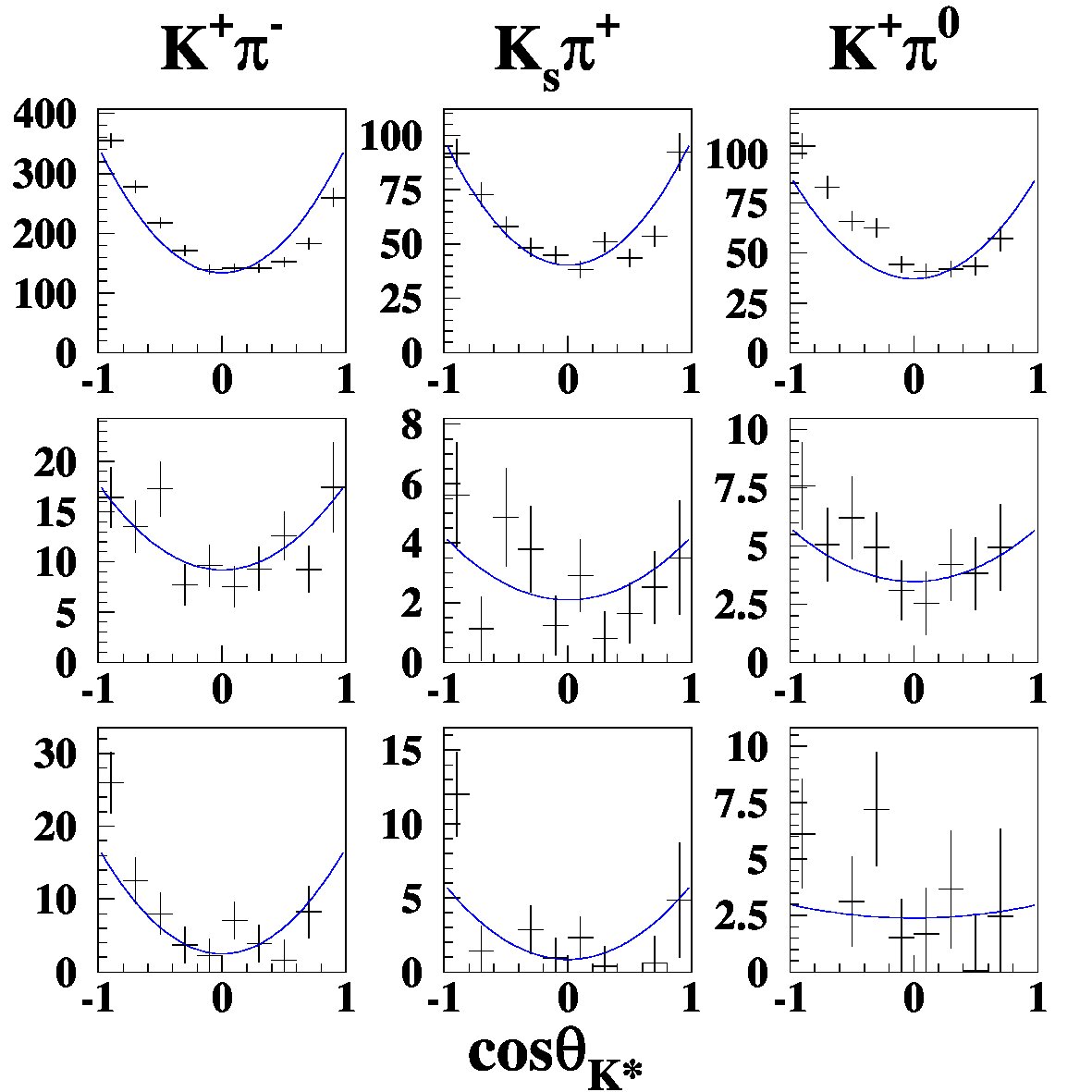 Figure 1
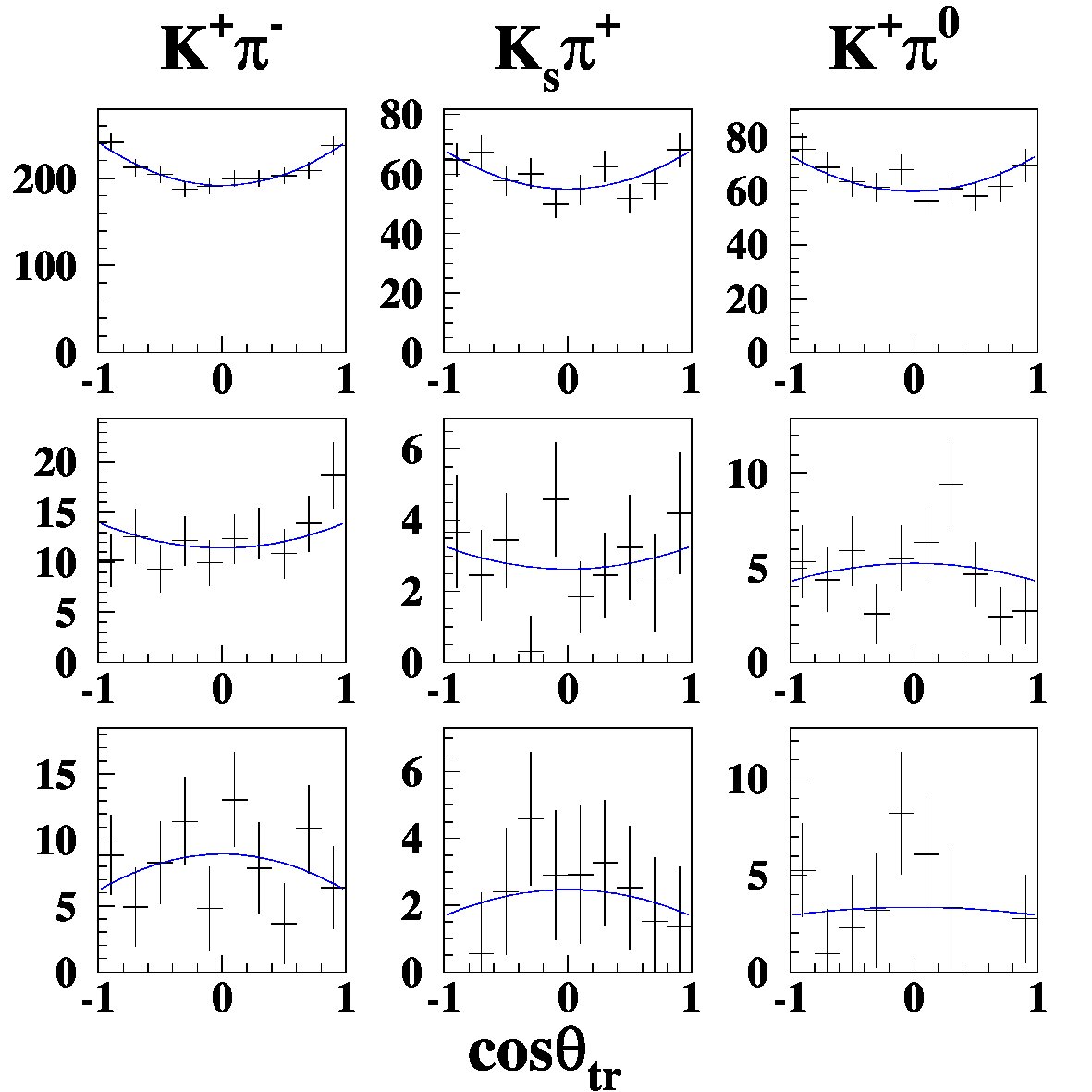 Figure 2
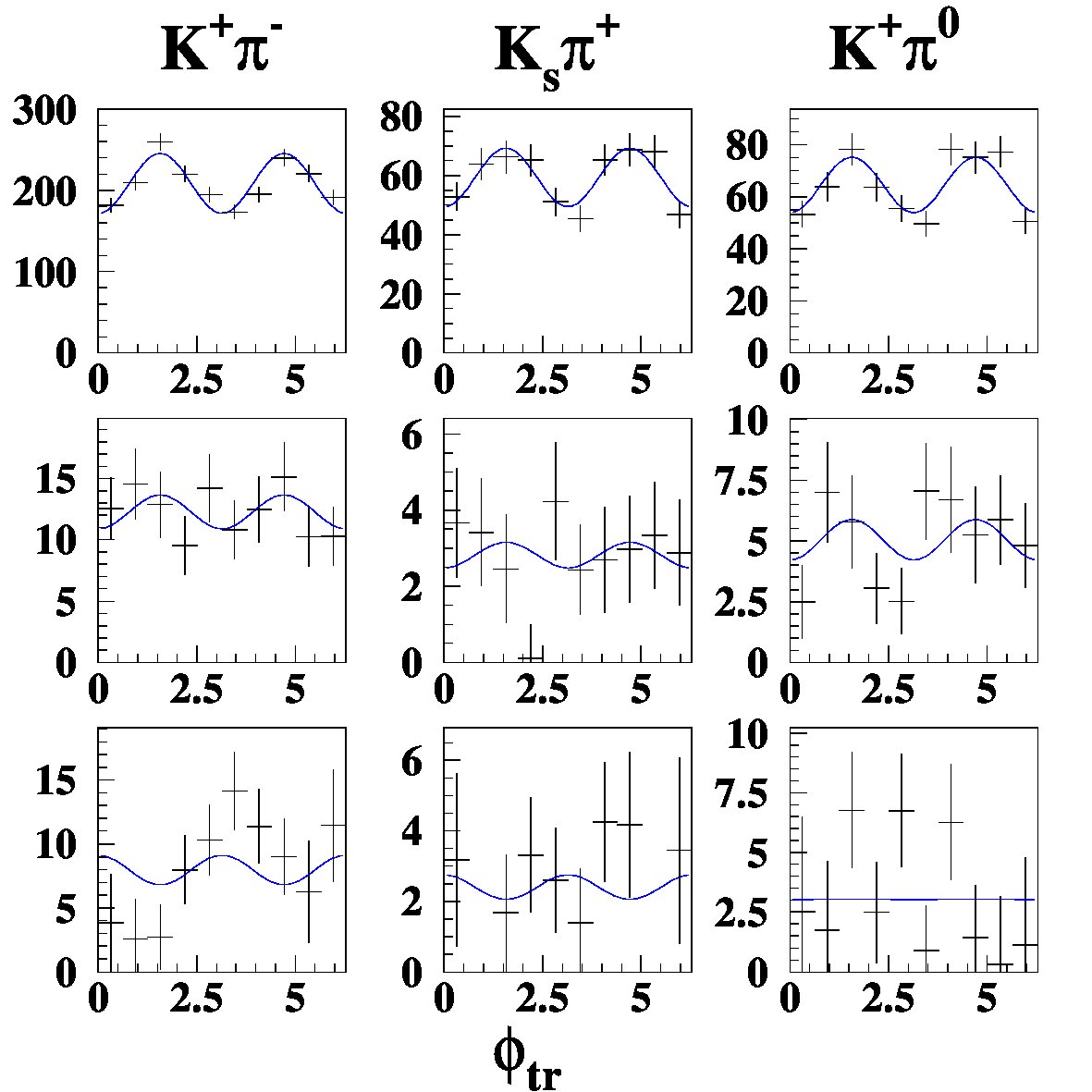 Figure 3
 Figure 4
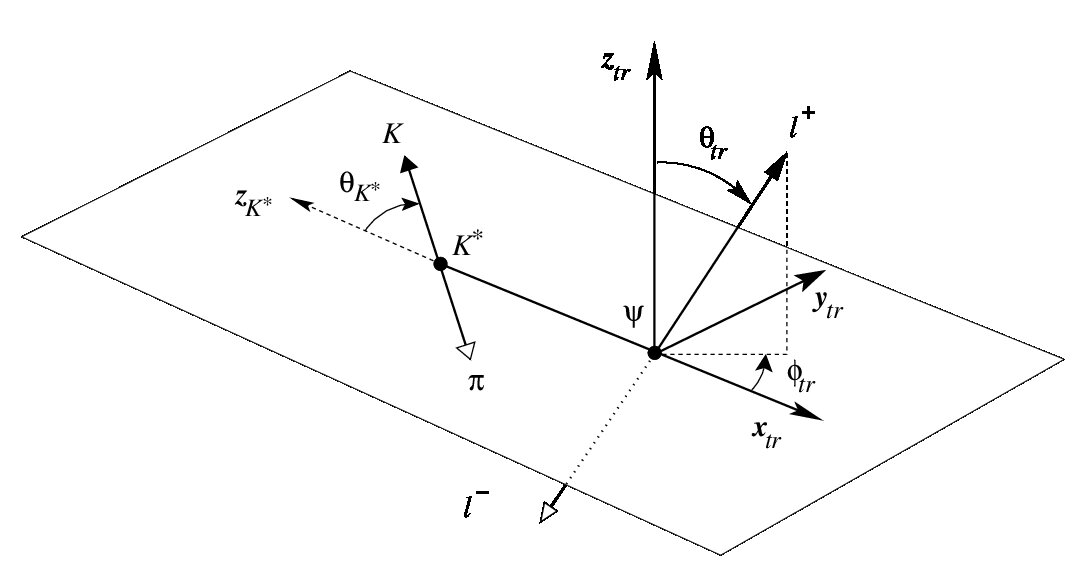 Figure 5
| for Aubert:2004cp ; Aubert:2001pe | for Stephane | ||
|---|---|---|---|
| 1 | |||
| 2 | |||
| 3 | |||
| 4 | |||
| 5 | |||
| 6 |
| Channel | |||||
|---|---|---|---|---|---|
| – |
Peer Reviews
No public reviews on file for this paper yet. If you reviewed it on a platform where reviews are public (OpenReview, ICLR, NeurIPS, ICML), you can paste yours below so the community can read it here.
Videos
No videos yet. Explain this paper in a talk, walkthrough, or lecture? Add one.
BABAR-PUB-07/009
SLAC-PUB-12430
hep-ex/0704.0522
††thanks: Deceased
The BABAR Collaboration
Measurement of Decay Amplitudes of with an Angular Analysis, for , and
B. Aubert
M. Bona
D. Boutigny
Y. Karyotakis
J. P. Lees
V. Poireau
X. Prudent
V. Tisserand
A. Zghiche
Laboratoire de Physique des Particules, IN2P3/CNRS et Université de Savoie, F-74941 Annecy-Le-Vieux, France
J. Garra Tico
E. Grauges
Universitat de Barcelona, Facultat de Fisica, Departament ECM, E-08028 Barcelona, Spain
L. Lopez
A. Palano
Università di Bari, Dipartimento di Fisica and INFN, I-70126 Bari, Italy
G. Eigen
I. Ofte
B. Stugu
L. Sun
University of Bergen, Institute of Physics, N-5007 Bergen, Norway
G. S. Abrams
M. Battaglia
D. N. Brown
J. Button-Shafer
R. N. Cahn
Y. Groysman
R. G. Jacobsen
J. A. Kadyk
L. T. Kerth
Yu. G. Kolomensky
G. Kukartsev
D. Lopes Pegna
G. Lynch
L. M. Mir
T. J. Orimoto
M. Pripstein
N. A. Roe
M. T. Ronan
K. Tackmann
W. A. Wenzel
Lawrence Berkeley National Laboratory and University of California, Berkeley, California 94720, USA
P. del Amo Sanchez
C. M. Hawkes
A. T. Watson
University of Birmingham, Birmingham, B15 2TT, United Kingdom
T. Held
H. Koch
B. Lewandowski
M. Pelizaeus
T. Schroeder
M. Steinke
Ruhr Universität Bochum, Institut für Experimentalphysik 1, D-44780 Bochum, Germany
W. N. Cottingham
D. Walker
University of Bristol, Bristol BS8 1TL, United Kingdom
D. J. Asgeirsson
T. Cuhadar-Donszelmann
B. G. Fulsom
C. Hearty
N. S. Knecht
T. S. Mattison
J. A. McKenna
University of British Columbia, Vancouver, British Columbia, Canada V6T 1Z1
A. Khan
M. Saleem
L. Teodorescu
Brunel University, Uxbridge, Middlesex UB8 3PH, United Kingdom
V. E. Blinov
A. D. Bukin
V. P. Druzhinin
V. B. Golubev
A. P. Onuchin
S. I. Serednyakov
Yu. I. Skovpen
E. P. Solodov
K. Yu Todyshev
Budker Institute of Nuclear Physics, Novosibirsk 630090, Russia
M. Bondioli
S. Curry
I. Eschrich
D. Kirkby
A. J. Lankford
P. Lund
M. Mandelkern
E. C. Martin
D. P. Stoker
University of California at Irvine, Irvine, California 92697, USA
S. Abachi
C. Buchanan
University of California at Los Angeles, Los Angeles, California 90024, USA
S. D. Foulkes
J. W. Gary
F. Liu
O. Long
B. C. Shen
L. Zhang
University of California at Riverside, Riverside, California 92521, USA
H. P. Paar
S. Rahatlou
V. Sharma
University of California at San Diego, La Jolla, California 92093, USA
J. W. Berryhill
C. Campagnari
A. Cunha
B. Dahmes
T. M. Hong
D. Kovalskyi
J. D. Richman
University of California at Santa Barbara, Santa Barbara, California 93106, USA
T. W. Beck
A. M. Eisner
C. J. Flacco
C. A. Heusch
J. Kroseberg
W. S. Lockman
T. Schalk
B. A. Schumm
A. Seiden
D. C. Williams
M. G. Wilson
L. O. Winstrom
University of California at Santa Cruz, Institute for Particle Physics, Santa Cruz, California 95064, USA
E. Chen
C. H. Cheng
A. Dvoretskii
F. Fang
D. G. Hitlin
I. Narsky
T. Piatenko
F. C. Porter
California Institute of Technology, Pasadena, California 91125, USA
G. Mancinelli
B. T. Meadows
K. Mishra
M. D. Sokoloff
University of Cincinnati, Cincinnati, Ohio 45221, USA
F. Blanc
P. C. Bloom
S. Chen
W. T. Ford
J. F. Hirschauer
A. Kreisel
M. Nagel
U. Nauenberg
A. Olivas
J. G. Smith
K. A. Ulmer
S. R. Wagner
J. Zhang
University of Colorado, Boulder, Colorado 80309, USA
A. M. Gabareen
A. Soffer
W. H. Toki
R. J. Wilson
F. Winklmeier
Q. Zeng
Colorado State University, Fort Collins, Colorado 80523, USA
D. D. Altenburg
E. Feltresi
A. Hauke
H. Jasper
J. Merkel
A. Petzold
B. Spaan
K. Wacker
Universität Dortmund, Institut für Physik, D-44221 Dortmund, Germany
T. Brandt
V. Klose
H. M. Lacker
W. F. Mader
R. Nogowski
J. Schubert
K. R. Schubert
R. Schwierz
J. E. Sundermann
A. Volk
Technische Universität Dresden, Institut für Kern- und Teilchenphysik, D-01062 Dresden, Germany
D. Bernard
G. R. Bonneaud
E. Latour
V. Lombardo
Ch. Thiebaux
M. Verderi
Laboratoire Leprince-Ringuet, CNRS/IN2P3, Ecole Polytechnique, F-91128 Palaiseau, France
P. J. Clark
W. Gradl
F. Muheim
S. Playfer
A. I. Robertson
Y. Xie
University of Edinburgh, Edinburgh EH9 3JZ, United Kingdom
M. Andreotti
D. Bettoni
C. Bozzi
R. Calabrese
A. Cecchi
G. Cibinetto
P. Franchini
E. Luppi
M. Negrini
A. Petrella
L. Piemontese
E. Prencipe
V. Santoro
Università di Ferrara, Dipartimento di Fisica and INFN, I-44100 Ferrara, Italy
F. Anulli
R. Baldini-Ferroli
A. Calcaterra
R. de Sangro
G. Finocchiaro
S. Pacetti
P. Patteri
I. M. Peruzzi
Also with Università di Perugia, Dipartimento di Fisica, Perugia, Italy
M. Piccolo
M. Rama
A. Zallo
Laboratori Nazionali di Frascati dell’INFN, I-00044 Frascati, Italy
A. Buzzo
R. Contri
M. Lo Vetere
M. M. Macri
M. R. Monge
S. Passaggio
C. Patrignani
E. Robutti
A. Santroni
S. Tosi
Università di Genova, Dipartimento di Fisica and INFN, I-16146 Genova, Italy
K. S. Chaisanguanthum
M. Morii
J. Wu
Harvard University, Cambridge, Massachusetts 02138, USA
R. S. Dubitzky
J. Marks
S. Schenk
U. Uwer
Universität Heidelberg, Physikalisches Institut, Philosophenweg 12, D-69120 Heidelberg, Germany
D. J. Bard
P. D. Dauncey
R. L. Flack
J. A. Nash
M. B. Nikolich
W. Panduro Vazquez
Imperial College London, London, SW7 2AZ, United Kingdom
P. K. Behera
X. Chai
M. J. Charles
U. Mallik
N. T. Meyer
V. Ziegler
University of Iowa, Iowa City, Iowa 52242, USA
J. Cochran
H. B. Crawley
L. Dong
V. Eyges
W. T. Meyer
S. Prell
E. I. Rosenberg
A. E. Rubin
Iowa State University, Ames, Iowa 50011-3160, USA
A. V. Gritsan
Z. J. Guo
C. K. Lae
Johns Hopkins University, Baltimore, Maryland 21218, USA
A. G. Denig
M. Fritsch
G. Schott
Universität Karlsruhe, Institut für Experimentelle Kernphysik, D-76021 Karlsruhe, Germany
N. Arnaud
J. Béquilleux
M. Davier
G. Grosdidier
A. Höcker
V. Lepeltier
F. Le Diberder
A. M. Lutz
S. Pruvot
S. Rodier
P. Roudeau
M. H. Schune
J. Serrano
V. Sordini
A. Stocchi
W. F. Wang
G. Wormser
Laboratoire de l’Accélérateur Linéaire, IN2P3/CNRS et Université Paris-Sud 11, Centre Scientifique d’Orsay, B. P. 34, F-91898 ORSAY Cedex, France
D. J. Lange
D. M. Wright
Lawrence Livermore National Laboratory, Livermore, California 94550, USA
C. A. Chavez
I. J. Forster
J. R. Fry
E. Gabathuler
R. Gamet
D. E. Hutchcroft
D. J. Payne
K. C. Schofield
C. Touramanis
University of Liverpool, Liverpool L69 7ZE, United Kingdom
A. J. Bevan
K. A. George
F. Di Lodovico
W. Menges
R. Sacco
Queen Mary, University of London, E1 4NS, United Kingdom
G. Cowan
H. U. Flaecher
D. A. Hopkins
P. S. Jackson
T. R. McMahon
F. Salvatore
A. C. Wren
University of London, Royal Holloway and Bedford New College, Egham, Surrey TW20 0EX, United Kingdom
D. N. Brown
C. L. Davis
University of Louisville, Louisville, Kentucky 40292, USA
J. Allison
N. R. Barlow
R. J. Barlow
Y. M. Chia
C. L. Edgar
G. D. Lafferty
T. J. West
J. I. Yi
University of Manchester, Manchester M13 9PL, United Kingdom
J. Anderson
C. Chen
A. Jawahery
D. A. Roberts
G. Simi
J. M. Tuggle
University of Maryland, College Park, Maryland 20742, USA
G. Blaylock
C. Dallapiccola
S. S. Hertzbach
X. Li
T. B. Moore
E. Salvati
S. Saremi
University of Massachusetts, Amherst, Massachusetts 01003, USA
R. Cowan
P. H. Fisher
G. Sciolla
S. J. Sekula
M. Spitznagel
F. Taylor
R. K. Yamamoto
Massachusetts Institute of Technology, Laboratory for Nuclear Science, Cambridge, Massachusetts 02139, USA
S. E. Mclachlin
P. M. Patel
S. H. Robertson
McGill University, Montréal, Québec, Canada H3A 2T8
A. Lazzaro
F. Palombo
Università di Milano, Dipartimento di Fisica and INFN, I-20133 Milano, Italy
J. M. Bauer
L. Cremaldi
V. Eschenburg
R. Godang
R. Kroeger
D. A. Sanders
D. J. Summers
H. W. Zhao
University of Mississippi, University, Mississippi 38677, USA
S. Brunet
D. Côté
M. Simard
P. Taras
F. B. Viaud
Université de Montréal, Physique des Particules, Montréal, Québec, Canada H3C 3J7
H. Nicholson
Mount Holyoke College, South Hadley, Massachusetts 01075, USA
G. De Nardo
F. Fabozzi
Also with Università della Basilicata, Potenza, Italy
L. Lista
D. Monorchio
C. Sciacca
Università di Napoli Federico II, Dipartimento di Scienze Fisiche and INFN, I-80126, Napoli, Italy
M. A. Baak
G. Raven
H. L. Snoek
NIKHEF, National Institute for Nuclear Physics and High Energy Physics, NL-1009 DB Amsterdam, The Netherlands
C. P. Jessop
J. M. LoSecco
University of Notre Dame, Notre Dame, Indiana 46556, USA
G. Benelli
L. A. Corwin
K. K. Gan
K. Honscheid
D. Hufnagel
H. Kagan
R. Kass
J. P. Morris
A. M. Rahimi
J. J. Regensburger
R. Ter-Antonyan
Q. K. Wong
Ohio State University, Columbus, Ohio 43210, USA
N. L. Blount
J. Brau
R. Frey
O. Igonkina
J. A. Kolb
M. Lu
R. Rahmat
N. B. Sinev
D. Strom
J. Strube
E. Torrence
University of Oregon, Eugene, Oregon 97403, USA
N. Gagliardi
A. Gaz
M. Margoni
M. Morandin
A. Pompili
M. Posocco
M. Rotondo
F. Simonetto
R. Stroili
C. Voci
Università di Padova, Dipartimento di Fisica and INFN, I-35131 Padova, Italy
E. Ben-Haim
H. Briand
J. Chauveau
P. David
L. Del Buono
Ch. de la Vaissière
O. Hamon
B. L. Hartfiel
Ph. Leruste
J. Malclès
J. Ocariz
A. Perez
Laboratoire de Physique Nucléaire et de Hautes Energies, IN2P3/CNRS, Université Pierre et Marie Curie-Paris6, Université Denis Diderot-Paris7, F-75252 Paris, France
L. Gladney
University of Pennsylvania, Philadelphia, Pennsylvania 19104, USA
M. Biasini
R. Covarelli
E. Manoni
Università di Perugia, Dipartimento di Fisica and INFN, I-06100 Perugia, Italy
C. Angelini
G. Batignani
S. Bettarini
G. Calderini
M. Carpinelli
R. Cenci
A. Cervelli
F. Forti
M. A. Giorgi
A. Lusiani
G. Marchiori
M. A. Mazur
M. Morganti
N. Neri
E. Paoloni
G. Rizzo
J. J. Walsh
Università di Pisa, Dipartimento di Fisica, Scuola Normale Superiore and INFN, I-56127 Pisa, Italy
M. Haire
Prairie View A&M University, Prairie View, Texas 77446, USA
J. Biesiada
P. Elmer
Y. P. Lau
C. Lu
J. Olsen
A. J. S. Smith
A. V. Telnov
Princeton University, Princeton, New Jersey 08544, USA
E. Baracchini
F. Bellini
G. Cavoto
A. D’Orazio
D. del Re
E. Di Marco
R. Faccini
F. Ferrarotto
F. Ferroni
M. Gaspero
P. D. Jackson
L. Li Gioi
M. A. Mazzoni
S. Morganti
G. Piredda
F. Polci
F. Renga
C. Voena
Università di Roma La Sapienza, Dipartimento di Fisica and INFN, I-00185 Roma, Italy
M. Ebert
H. Schröder
R. Waldi
Universität Rostock, D-18051 Rostock, Germany
T. Adye
G. Castelli
B. Franek
E. O. Olaiya
S. Ricciardi
W. Roethel
F. F. Wilson
Rutherford Appleton Laboratory, Chilton, Didcot, Oxon, OX11 0QX, United Kingdom
R. Aleksan
S. Emery
M. Escalier
A. Gaidot
S. F. Ganzhur
G. Hamel de Monchenault
W. Kozanecki
M. Legendre
G. Vasseur
Ch. Yèche
M. Zito
DSM/Dapnia, CEA/Saclay, F-91191 Gif-sur-Yvette, France
X. R. Chen
H. Liu
W. Park
M. V. Purohit
J. R. Wilson
University of South Carolina, Columbia, South Carolina 29208, USA
M. T. Allen
D. Aston
R. Bartoldus
P. Bechtle
N. Berger
R. Claus
J. P. Coleman
M. R. Convery
J. C. Dingfelder
J. Dorfan
G. P. Dubois-Felsmann
D. Dujmic
W. Dunwoodie
R. C. Field
T. Glanzman
S. J. Gowdy
M. T. Graham
P. Grenier
C. Hast
T. Hryn’ova
W. R. Innes
M. H. Kelsey
H. Kim
P. Kim
D. W. G. S. Leith
S. Li
S. Luitz
V. Luth
H. L. Lynch
D. B. MacFarlane
H. Marsiske
R. Messner
D. R. Muller
C. P. O’Grady
A. Perazzo
M. Perl
T. Pulliam
B. N. Ratcliff
A. Roodman
A. A. Salnikov
R. H. Schindler
J. Schwiening
A. Snyder
J. Stelzer
D. Su
M. K. Sullivan
K. Suzuki
S. K. Swain
J. M. Thompson
J. Va’vra
N. van Bakel
A. P. Wagner
M. Weaver
W. J. Wisniewski
M. Wittgen
D. H. Wright
A. K. Yarritu
K. Yi
C. C. Young
Stanford Linear Accelerator Center, Stanford, California 94309, USA
P. R. Burchat
A. J. Edwards
S. A. Majewski
B. A. Petersen
L. Wilden
Stanford University, Stanford, California 94305-4060, USA
S. Ahmed
M. S. Alam
R. Bula
J. A. Ernst
V. Jain
B. Pan
M. A. Saeed
F. R. Wappler
S. B. Zain
State University of New York, Albany, New York 12222, USA
W. Bugg
M. Krishnamurthy
S. M. Spanier
University of Tennessee, Knoxville, Tennessee 37996, USA
R. Eckmann
J. L. Ritchie
A. M. Ruland
C. J. Schilling
R. F. Schwitters
University of Texas at Austin, Austin, Texas 78712, USA
J. M. Izen
X. C. Lou
S. Ye
University of Texas at Dallas, Richardson, Texas 75083, USA
F. Bianchi
F. Gallo
D. Gamba
M. Pelliccioni
Università di Torino, Dipartimento di Fisica Sperimentale and INFN, I-10125 Torino, Italy
M. Bomben
L. Bosisio
C. Cartaro
F. Cossutti
G. Della Ricca
L. Lanceri
L. Vitale
Università di Trieste, Dipartimento di Fisica and INFN, I-34127 Trieste, Italy
V. Azzolini
N. Lopez-March
F. Martinez-Vidal
D. A. Milanes
A. Oyanguren
IFIC, Universitat de Valencia-CSIC, E-46071 Valencia, Spain
J. Albert
Sw. Banerjee
B. Bhuyan
K. Hamano
R. Kowalewski
I. M. Nugent
J. M. Roney
R. J. Sobie
University of Victoria, Victoria, British Columbia, Canada V8W 3P6
J. J. Back
P. F. Harrison
T. E. Latham
G. B. Mohanty
M. Pappagallo
Also with IPPP, Physics Department, Durham University, Durham DH1 3LE, United Kingdom
Department of Physics, University of Warwick, Coventry CV4 7AL, United Kingdom
H. R. Band
X. Chen
S. Dasu
K. T. Flood
J. J. Hollar
P. E. Kutter
Y. Pan
M. Pierini
R. Prepost
S. L. Wu
Z. Yu
University of Wisconsin, Madison, Wisconsin 53706, USA
H. Neal
Yale University, New Haven, Connecticut 06511, USA
Abstract
We perform the first three-dimensional measurement of the amplitudes of and decays and update our previous measurement for . We use a data sample collected with the BABAR detector at the PEP-II storage ring, corresponding to 232 million pairs. The longitudinal polarization of decays involving a meson is found to be larger than that with a or meson. No direct -violating charge asymmetry is observed.
pacs:
13.25.Hw, 12.15.Hh, 11.30.Er
††preprint: BABAR-PUB-07/009††preprint: SLAC-PUB-12430
In the context of measuring the parameters of the Unitarity Triangle of the CKM matrix, decays to charmonium-containing final states (, , ), defined collectively here as , are of interest for the precise measurement of , where , in a similar way as for . Furthermore, the channel allows the measurement of Aubert:2004cp .
For the modes considered in this paper, the final state consists of two spin-1 mesons, leading to three possible values of the total angular momentum with different eigenvalues ( is odd, while are even). The different contributions must be taken into account in the measurement of . The amplitude for longitudinal polarization of the two spin-1 mesons is . There are two amplitudes for polarizations of the mesons transverse to the decay axis, here expressed in the transversity basis Dunietz:1990cj : for parallel polarization and for their perpendicular polarization. Only the relative amplitudes are measured, so that . Previous measurements by the CLEO Jessop:1997jk , CDF Affolder:2000ec , BABAR Aubert:2004cp and Belle Itoh:2005ks collaborations for the channels are all compatible with each other, and with a -odd intensity fraction close to 0.2.
Factorization predicts that the phases of the transversity decay amplitudes are the same. BABAR has observed Aubert:2004cp ; Aubert:2001pe a significant departure from this prediction.
Precise measurements of the branching fractions of decays are now available Aubert:2004rz to test the theoretical description of the non-factorizable contributions Chen:2005ht , but polarization measurements are also needed. In particular, measurements for and , compared to that of , would discriminate the mass dependence from the quantum number dependence. CLEO has measured the longitudinal polarization of decays to be Richichi:2000ca . Belle has studied decays and obtained Soni:2005fw .
decays provide a clean environment for the measurement of the CKM angle because one tree amplitude dominates the decay. Very small direct -violating charge asymmetries are expected in these decays, and no such signal has been found Aubert:2004rz . While more than one amplitude with different strong and weak phases are needed to create a charge asymmetry in a simple branching fraction measurement, London et al. have suggested London:2000zi that an angular analysis of vector-vector decays can detect charge asymmetries even in the case of vanishing strong phase difference. Belle has looked for, and not found, such a signal Itoh:2005ks .
In this paper we present the amplitude measurement of charged and neutral using a selection similar to that of Ref. Aubert:2004rz , and a fitting method similar to that of Ref. Aubert:2004cp . We use the notation for the states and . () candidates are reconstructed in their decays to (), where represents an electron or a muon. Decays to the flavor eigenstates , and are used. The relative strong phases are known to have a two-fold ambiguity when measured in an angular analysis alone. In contrast to earlier publications Jessop:1997jk ; Affolder:2000ec ; Aubert:2001pe we use here the set of phases predicted in Ref. Suzuki:2001za , with arguments based on the conservation of the -quark helicity in the decay of the quark. We have confirmed experimentally this prediction through the study of the variation with invariant mass of the phase difference between the amplitude and a non-resonant -wave amplitude Aubert:2004cp .
The data were collected with the BABAR detector at the PEP-II asymmetric storage ring, and correspond to an integrated luminosity of about 209 at the center-of-mass energy near the mass. The BABAR detector is described in detail elsewhere detector . Charged-particle tracking is provided by a five-layer silicon vertex tracker (SVT) and a 40-layer drift chamber (DCH). For charged-particle identification (PID), ionization energy loss in the DCH and SVT, and Cherenkov radiation detected in a ring-imaging device (DIRC) are used. Photons are identified by the electromagnetic calorimeter (EMC), which comprises 6580 thallium-doped CsI crystals. These systems are mounted inside a 1.5-T solenoidal superconducting magnet. Muons are identified in the instrumented flux return (IFR), composed of resistive plate chambers and layers of iron that return the magnetic flux of the solenoid. We use the GEANT4 geant software to simulate interactions of particles traversing the detector, taking into account the varying accelerator and detector conditions.
() candidates must have a mass between () . candidates are required to have invariant masses or . Electron candidates are combined with photon candidates in order to recover some of the energy lost through Bremsstrahlung. candidates and candidates with an energy larger than , are combined to form candidates, which must satisfy . candidates must satisfy . The energy of each photon has to be greater than . candidates are required to satisfy . In addition, the flight distance from the vertex must be larger than three times its uncertainty. and candidates are required to satisfy and , respectively. In addition, due to the presence of a large background of low-energy non-genuine ’s, the cosine of the angle between the momentum and the momentum in the rest frame has to be less than 0.8 for . In events where two ’s reconstruct to modes with the same and candidate, one with a and the other with a , the candidate with a is discarded due to the high background induced by fake ’s.
candidates, reconstructed by combining and candidates, are characterized by two kinematic variables: the difference between the reconstructed energy of the candidate and the beam energy in the center-of-mass frame \mbox{\Delta E}=E_{B}^{*}-\sqrt{s}/2, and the beam-energy substituted mass \mbox{m_{\rm ES}}\equiv\sqrt{(s/2+{\bf p}_{0}\cdot{\bf p}_{B})^{2}/E_{0}^{2}-{\bf p}_{B}^{2}}, where subscript [math] and correspond to and the candidate in the laboratory frame. For a correctly reconstructed meson, is expected to peak near zero and near the -meson mass . The analysis is performed in a region of the vs plane defined by 5.2<\mbox{m_{\rm ES}}<5.3 and -120<\mbox{\Delta E}<120 . The signal region is defined as \mbox{m_{\rm ES}}>5.27 and |\mbox{\Delta E}| smaller than 40 (30) for channels with (without) a . For events that have multiple candidates, the candidate having the smallest |\mbox{\Delta E}| is chosen. distributions are available in Ref. Aubert:2006mg .
The decay amplitudes are measured from the differential decay distribution, expressed in the transversity basis Aubert:2004cp ; Aubert:2001pe , Fig. 1, with conventions detailed in Ref. Stephane .
is the helicity angle of the decay. It is defined in the rest frame of the meson, and is the angle between the kaon and the opposite direction of the meson in this frame. and are defined in the () rest frame and are the polar and azimutal angle of the positive lepton ( daughter of ) , with respect the axis defined by:
- •
: opposite direction of the meson;
- •
: perpendicular to , in the plane, with a direction such that ;
- •
: to complete the frame, ie: .
In terms of the transversity angular variables , the time-integrated differential decay rate for the decay of the meson is
[TABLE]
where the amplitude coefficients and the angular functions , are listed in Table 1. The decays to two spin-1/2 particles, while the decays to two vector particles. The angular dependencies are therefore different Stephane .
The symbol denotes the transversity amplitudes for the decay of the meson, and for the meson decay. In the absence of direct violation, we can choose a phase convention in which these amplitudes are related by , , , so that is -odd and and are -even. The phases of the amplitudes, where , are defined by . Phases are defined relative to .
We perform an unbinned likelihood fit of the three-dimensional angle probability density function (PDF). The acceptance of the detector and the efficiency of the event reconstruction may vary as a function of the transversity angles, in particular as the angle is strongly correlated with the momentum of the final kaon and pion. We use the acceptance correction method developped in Ref. Aubert:2004cp . The PDF of the observed events, , is :
[TABLE]
where
is the angle-dependent acceptance and
[TABLE]
is the average acceptance. We take into account the presence of cross-feed from channels with the same candidate and a different candidate that has (due to isospin symmetry) the same dependence as the signal. The observed PDF for channel is then
[TABLE]
where is the efficiency, defined as the ratio between the reconstructed and generated yield for the process (, ), and we do not distinguish between correctly reconstructed signal and cross-feed in the numerator
[TABLE]
is the probability for an event generated in channel and with angle to be detected as an event in channel . denotes the fraction of each channel in the total branching fraction , . The are the moments of the total efficiency , including cross-feed :
[TABLE]
Under the approximations of neglecting the angular resolution for signal and cross-feed events, and the possible mis-measurement of the flavor such as in events where both daughters in are mis-identified (- swap), the PDF can be expressed as in Eq. (2), and only the coefficients are needed. The biases induced by these approximations have been estimated with Monte Carlo (MC) based studies and found to be negligible.
The coefficients are computed with exclusive signal MC samples obtained using a full simulation of the experiment geant ; Evtgen . PID efficiencies measured with data control samples are used to adjust the MC simulation to the observed performance of the detector. Separate coefficients are used for different charges of the final state mesons, in particular to take into account the charge dependence of the interaction of charged kaons with matter, and a possible charge asymmetry of the detector. Writing the expression for the log-likelihood for the PDF for a pure signal sample of events, the relevant contribution is
[TABLE]
since the remaining term does not depend on the amplitudes.
We use a background correction method Aubert:2004cp in which background events from a pure background sample of events are added with a negative weight to the log-likelihood that is maximized
[TABLE]
where . The fit is performed within the signal region. Background events used here for subtraction are from generic (, ) MC samples. is an estimate of the unknown number of background events that are present in the signal region in the data sample.
As is not a log-likelihood, the uncertainties yielded by the minimization program Minuit minuit are biased estimates of the actual uncertainties. An unbiased estimation of the uncertainties is described and validated in Appendix A of Ref. Aubert:2004cp . With this pseudo-log-likelihood technique, we avoid parametrizing the acceptance as well as the background angular distributions.
The measurement is affected by several systematic uncertainties. The branching fractions used in the cross-feed part of the acceptance cross section are varied by , and the largest variation is retained. The uncertainty induced by the finite size of the MC sample used to compute the coefficients is estimated by the statistical uncertainty of the angular fit on that MC sample Aubert:2001pe . The uncertainty due to our limited understanding of the PID efficiency is estimated by using two different methods to correct for the MC-vs-data differences. The background uncertainty is obtained by comparing MC and data shapes of the distributions for the combinatorial component and by using the corresponding branching errors for the peaking component. The uncertainty due to the presence of a wave under the peak is estimated by a fit including it. The differential decay rate is described by Eqs. (-) of Ref. Aubert:2004cp .
The results are summarized in Table 2.
The values of , , are negatively correlated due to the constraint . In particular, , which would be the least precisely measured parameter in separate one-dimensional fits, is strongly anti-correlated with , which would be the best measured. The one-dimensional (1D) distributions, acceptance-corrected with an 1D Ansatz and background-subtracted, are overlaid with the fit results and shown on Figure 2. In contrast with the dedicated method used in the fit, for the plots, we simply computed the 1D efficiency maps from the distributions of the accepted events divided by the 1D PDF. As in lower statistics studies, the forward backward asymmetry due to the interference with the S wave is clearly visible.
Our measurement of the amplitudes of decays to are compatible with, and of better precision than, previous measurements. A comparison of neutral and charged decays (not shown) yields results consistent with isospin symmetry. The strong phase difference is obtained from a fit in which the phase origin is . We confirm our previous observation that the strong phase differences are significantly different from zero, in contrast with what is predicted by factorization. For , it amounts to . The presence of direct -violating triple-products in the amplitude would produce a to difference in the interference terms and : and . Our results (see Table 3), with improved precision relative to Ref. belletp , are consistent with no violation.
In summary, we have performed the first three-dimensional analysis of the decays to and . The longitudinal polarization of the decay to is lower than that to , while the -odd intensity fraction is higher (by 1.4 and 1.0 standard deviations, respectively). This is compatible with the prediction of models of meson decays in the framework of factorization. The longitudinal polarization of the decay to is found to be larger than that to , in contrast with the predictions of Ref. Chen:2005ht , which include non-factorizable contributions. The -odd intensity fraction of this decay is compatible with zero. The parallel and longitudinal amplitudes for seem to be aligned () while for they are anti-aligned ().
We are grateful for the extraordinary contributions of our PEP-II colleagues in achieving the excellent luminosity and machine conditions that have made this work possible. The success of this project also relies critically on the expertise and dedication of the computing organizations that support BABAR. The collaborating institutions wish to thank SLAC for its support and the kind hospitality extended to them. This work is supported by the US Department of Energy and National Science Foundation, the Natural Sciences and Engineering Research Council (Canada), the Commissariat à l’Energie Atomique and Institut National de Physique Nucléaire et de Physique des Particules (France), the Bundesministerium für Bildung und Forschung and Deutsche Forschungsgemeinschaft (Germany), the Istituto Nazionale di Fisica Nucleare (Italy), the Foundation for Fundamental Research on Matter (The Netherlands), the Research Council of Norway, the Ministry of Science and Technology of the Russian Federation, Ministerio de Educación y Ciencia (Spain), and the Science and Technology Facilities Council (United Kingdom). Individuals have received support from the Marie-Curie IEF program (European Union) and the A. P. Sloan Foundation.
The reference list from the paper itself. Each links out to its DOI / PubMed record.
- 1(1) B. Aubert et al. [BABAR Collaboration], Phys. Rev. D 71 , 032005 (2005).
- 2(2) I. Dunietz, H. R. Quinn, A. Snyder, W. Toki and H. J. Lipkin, Phys. Rev. D 43 , 2193 (1991).
- 3(3) C. P. Jessop et al. [CLEO Collaboration], Phys. Rev. Lett. 79 , 4533 (1997).
- 4(4) T. Affolder et al. [CDF Collaboration], Phys. Rev. Lett. 85 , 4668 (2000).
- 5(5) R. Itoh et al. [Belle Collaboration], Phys. Rev. Lett. 95 , 091601 (2005).
- 6(6) B. Aubert et al. [BABAR Collaboration], Phys. Rev. Lett. 87 , 241801 (2001).
- 7(7) B. Aubert et al. [BABAR Collaboration], Phys. Rev. Lett. 94 , 141801 (2005).
- 8(8) C. H. Chen and H. N. Li, Phys. Rev. D 71 , 114008 (2005).