Fragmentation of general relativistic quasi-toroidal polytropes
Burkhard Zink, Nikolaos Stergioulas, Ian Hawke, Christian D. Ott, Erik, Schnetter, Ewald Mueller

TL;DR
This paper explores how rotational instabilities in relativistic stars can cause fragmentation and off-center black hole formation, offering an alternative pathway for supermassive black hole creation.
Contribution
It demonstrates that low-$T/|W|$ instabilities can lead to fragmentation and off-center horizon formation in differentially rotating relativistic stars.
Findings
Low-$T/|W|$ instabilities cause fragmentation.
Off-center horizon formation observed.
Potential pathway for SMBH formation from supermassive stars.
Abstract
We investigate the role of rotational instabilities in the context of black hole formation in relativistic stars. In addition to the standard scenario - an axially symmetric dynamical instability forming a horizon at the star's center - the recently found low- instabilities are shown to lead to fragmentation and off-center horizon formation in differentially rotating stars. This process might be an alternative pathway to produce SMBHs from supermassive stars with inefficient angular momentum transport.
Click any figure to enlarge with its caption.
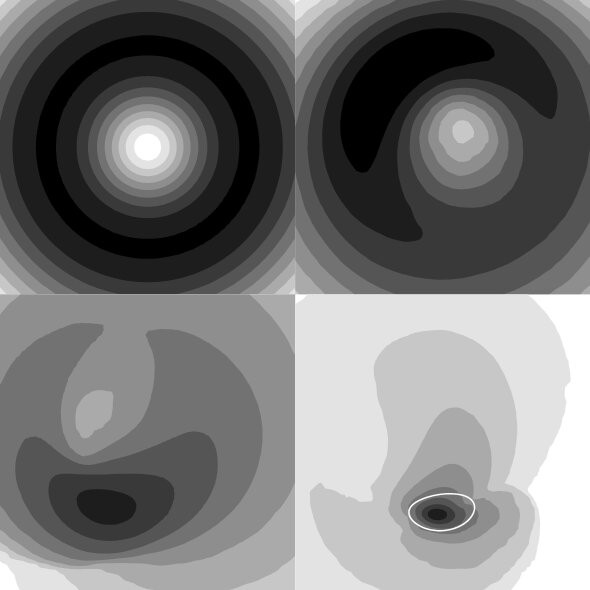 Figure 1
Peer Reviews
No public reviews on file for this paper yet. If you reviewed it on a platform where reviews are public (OpenReview, ICLR, NeurIPS, ICML), you can paste yours below so the community can read it here.
Videos
No videos yet. Explain this paper in a talk, walkthrough, or lecture? Add one.
FRAGMENTATION OF GENERAL RELATIVISTIC QUASI-TOROIDAL POLYTROPES
Burkhard Zink
Center for Computation and Technology, Louisiana State University, Baton Rouge, LA 70803, USA
Horace Hearne Jr. Institute for Theoretical Physics, Louisiana State University, Baton Rouge, LA 70803, USA
Nikolaos Stergioulas
Department of Physics, Aristotle University of Thessaloniki, Thessaloniki 54124, Greece
Ian Hawke
School of Mathematics, University of Southampton, Southampton SO17 1BJ, UK
Christian D. Ott
Department of Astronomy and Steward Observatory, The University of Arizona, Tucson, AZ, USA
Erik Schnetter
Center for Computation and Technology, Louisiana State University, Baton Rouge, LA 70803, USA
Max-Planck-Institut für Gravitationsphysik, Albert-Einstein-Institut, 14476 Golm, Germany
Ewald Müller
Max-Planck-Institut für Astrophysik, Karl-Schwarzschild-Str. 1, 85741 Garching bei München, Germany
How do black holes form from relativistic stars? This question is of great fundamental and practical importance in gravitational physics and general relativistic astrophysics. On the fundamental level, black holes are genuinely relativistic objects, and thus the study of their production involves questions about horizon dynamics, global structure of spacetimes, and the nature of the singularities predicted as a consequence of the occurrence of trapped surfaces. On the level of astrophysical applications, systems involving black holes are possible engines for highly energetic phenomena like AGNs or gamma-ray bursts, and also likely a comparatively strong source of gravitational radiation.
The most simple model of black hole formation from, say, cold neutron stars, is a fluid in spherically symmetric polytropic equilibrium moving on a sequence of increasing mass due to accretion Shapiro83 . This assumes that (i) the stellar structure and dynamics are represented reasonably by the ideal fluid equation of state and the polytropic stratification, (ii) accretion processes are slow compared to the dynamical timescales of the star, and (iii) rotation is negligible. Our focus has been to study the effects of relaxing the third assumption.
In spherical symmetry, the sequence of equilibrium polytropes has a maximum in the mass function , where denotes the central rest-mass density of the polytrope. This maximum is connected to a change in the stability of the fundamental mode of oscillation Shapiro83 , and thus collapse sets in via a dynamical instability to radial deformations. During the subsequent evolution, a trapped tube forms at the center which traverses the stellar material entirely Shapiro80 .
How much of this behaviour is preserved when rotation is taken into account? Rotation is known to change the equilibrium structure of the star, and, in consequence, its modes of oscillation and set of unstable perturbations. The collapse might also lead to the formation of a massive disk around the new-born black hole, and finally only systems without spherical symmetry can be a source of gravitational radiation.
Numerical simulations have been used to study the collapse and black hole formation of general relativistic rotating polytropic stars Baiotti04 . For the uniformly and moderately differentially rotating models investigated in those studies, the dynamical process is described by the instability of a quasi-radial mode and subsequent collapse of the star up to the formation of an accreting Kerr black hole at the star’s center.
Will strong differential rotation modify this picture? Even before our study, there was evidence that this should be the case. (i) Strong differential rotation can deform the high-density regions of a star into a toroidal shape, thus changing the equilibrium structure considerably. (ii) It admits stars of high normalized rotational energy Shapiro83 which are stable to axisymmetric perturbations. (iii) It admits non-axisymmetric instabilities, for example by the occurrence of corotation pointsWatts:2003nn , at low values of Centrella:2001xp . (iv) A bar-mode instability of the type found in Maclaurin spheroidsChandrasekhar69c would likely express itself by the formation of two orbiting fragments if the initial high-density region has toroidal shape.
This last property has motivated us to ask this question: Can a bar deformation transform a strongly differentially rotating star into a binary black hole merger with a massive accretion disk? If so, this process might occur in supermassive stars if the timescales associated with angular momentum transport are too large to enforce uniform rotation.
We have investigated black hole formation in strongly differentially rotating, quasi-toroidal models of supermassive stars Zink2005a ; Zink2006a , and found that a non-axisymmetric instability can lead to the off-center formation of a trapped surface (see figure). An extensive parameter space study of this fragmentation instability Zink2006a reveals that many quasi-toroidal stars of this kind are dynamically unstable in this manner, even for low values of , and we have found evidence that the corotation mechanism observed by Watts et al. Watts:2003nn might be active in these models. Since, on a sequence of increasing , one of the low order modes becomes dynamically unstable before and higher order modes, one would not expect a binary black hole system to form in many situations (although this may depend on the rotation law and details of the pre-collapse evolution as well). Rather, the off-center production of a single black hole with a massive accretion disk appears more likely.
Since the normalized angular momentum of the initial model is greater than unity, there is another interesting consequence of this formation process: the resulting black hole, unless it is ejected from its shell, may very well be rapidly rotating, spun up by accretion of the material remaining outside the initial location of the trapped surface. Investigating the late time behaviour of this accretion process, estimating possible kick velocities of the resulting black hole, and finding the mass of the final accretion disk is, however, beyond our present-day capabilities and subject of future study.
The reference list from the paper itself. Each links out to its DOI / PubMed record.
- 1(1) S. Shapiro and S. Teukolsky, Black Holes, White Dwarfs and Neutron Stars (Wiley 1983).
- 2(2) S. Shapiro and S. Teukolsky, Astrophys. J. 235 , 199 (1980).
- 3(3) M. Shibata, T. Baumgarte and S. Shapiro, Phys. Rev. D 61 , 044012 (2000). L. Baiotti, I. Hawke, P. Montero, F. Löffler, L. Rezzolla, N. Stergioulas, J. A. Font and E. Seidel, Phys. Rev. D 71 , 024035 (2005), and references therein.
- 4(4) A. Watts, N. Andersson and D. Jones, Astrophys. J. L 37 (2005).
- 5(5) J. Centrella, K. New, L. Lowe and J. Brown, Astrophys. J. 550 (2001).
- 6(6) S. Chandrasekhar, Ellipsoidal Figures of Equilibrium (Yale UP 1969).
- 7(7) B. Zink, N. Stergioulas, I. Hawke, C. D. Ott, E. Schnetter and E. Müller, Phys. Rev. Letters 96 , 161101 (2006).
- 8(8) B. Zink, N. Stergioulas, I. Hawke, C. D. Ott, E. Schnetter and E. Müller, astro-ph/0611601 (2006).