Exotic Hadron in Pole-dominated QCD Sum Rules
Toru Kojo, Daisuke Jido, Arata Hayashigaki

TL;DR
This paper investigates the pentaquark $ heta^+$ using QCD sum rules, emphasizing the importance of the Borel window and operator product expansion to reliably determine its properties, including mass and positive parity.
Contribution
It introduces a method to accurately extract pentaquark properties by optimizing the Borel window and expanding the operator product to dimension 15 within factorization.
Findings
Pentaquark $ heta^+$ mass estimated at 1.68±0.22 GeV.
Parity of $ heta^+$ determined to be positive.
Method reduces high energy contamination in sum rule analysis.
Abstract
We study pentaquark in the QCD sum rules emphasizing that we can not extract any properties of the pentaquark outside of the Borel window. To find the appropriate Borel window, we prepare a favorable set up of the correlators and carry out the operator product expansion up to dimension 15 within factorization hypothesis. Our procedures reduce the unwanted high energy contaminations and enhance the low energy correlation. In the Borel window, independent analyses for the chiral-even and odd sum rules give the consistent values of the mass, GeV, and the residue. The parity is found to be {\it positive}.
Click any figure to enlarge with its caption.
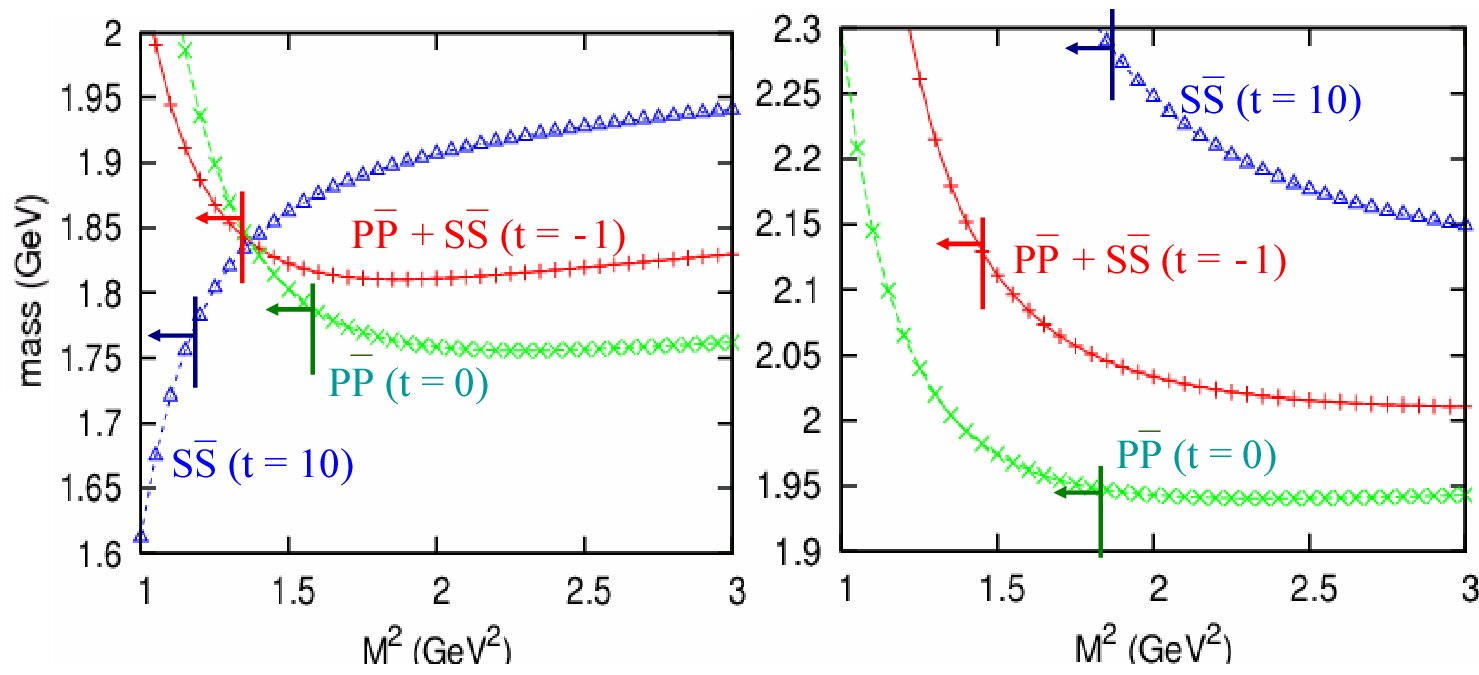 Figure 1
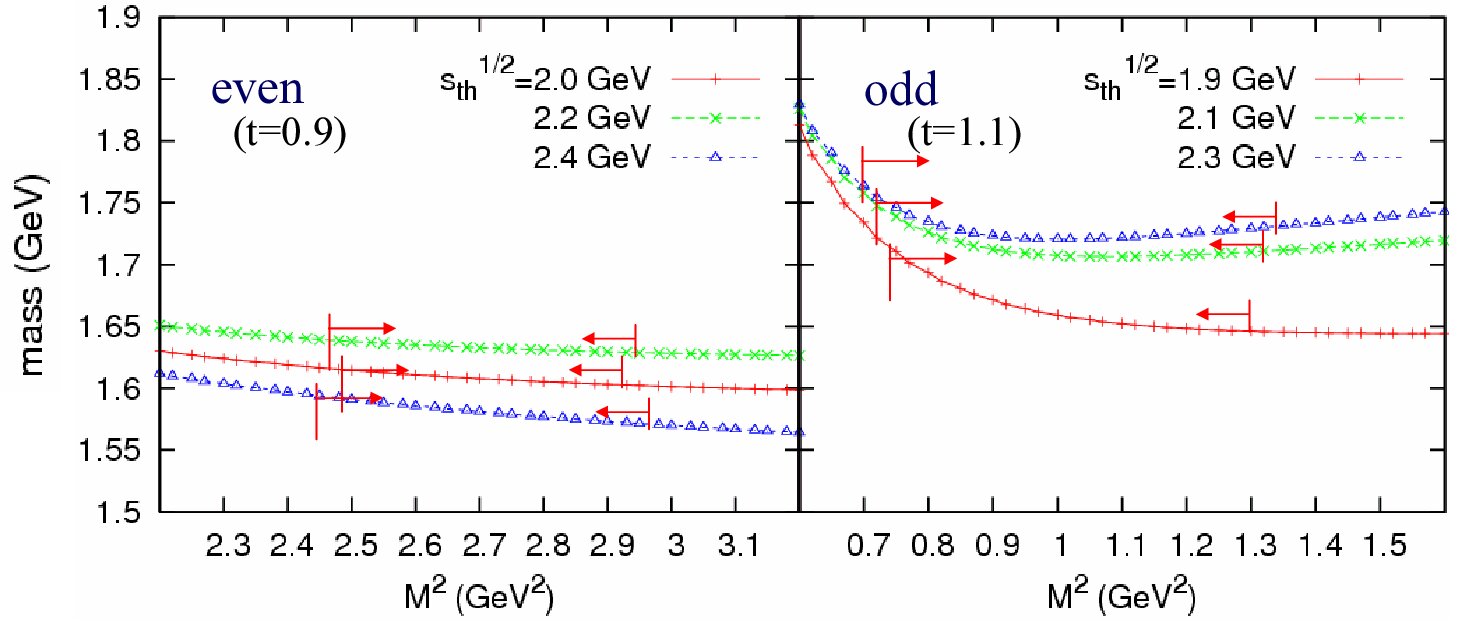 Figure 2
Peer Reviews
No public reviews on file for this paper yet. If you reviewed it on a platform where reviews are public (OpenReview, ICLR, NeurIPS, ICML), you can paste yours below so the community can read it here.
Videos
No videos yet. Explain this paper in a talk, walkthrough, or lecture? Add one.
Exotic Hadron in Pole-dominated QCD Sum Rules
Toru Kojo *1,*111 e-mail address: [email protected]
Daisuke Jido
2 and Arata Hayashigaki 3 1 Department of Physics1 Department of Physics Kyoto University Kyoto University Kyoto 606-8502 Kyoto 606-8502 Japan
2 Yukawa Institute for Theoretical Physics Japan
2 Yukawa Institute for Theoretical Physics Kyoto University Kyoto University Kyoto 606–8502 Kyoto 606–8502 Japan
3Institut für Theoretische Physik Japan
3Institut für Theoretische Physik J.W. Goethe Universität J.W. Goethe Universität D-60438 Frankfurt am Main D-60438 Frankfurt am Main Germany Germany
Abstract
We study pentaquark in the QCD sum rules emphasizing that we can not extract any properties of the pentaquark outside of the Borel window. To find the appropriate Borel window, we prepare a favorable set up of the correlators and carry out the operator product expansion up to dimension 15 within factorization hypothesis. Our procedures reduce the unwanted high energy contaminations and enhance the low energy correlation. In the Borel window, independent analyses for the chiral-even and odd sum rules give the consistent values of the mass, GeV, and the residue. The parity is found to be positive.
1 Introduction
The experimental announcement for the discovery of the pentaquark [1] triggered tremendous amount of theoretical and experimental works on the exotic states. Although the existence of such exotic states is still not so obvious, the exotics provide a good opportunity to get the deeper insight of the hadron structures and their connection to QCD. One of approaches from QCD to exotics is the QCD sum rule (QSR) [2], which relates informations of QCD to the hadronic properties through the correlator analysis for the interpolating fields of hadrons. The Borel transformed sum rules with the simplest pole + continuum parametrization are given as ( correspond to the chiral even and odd part, respectively)
[TABLE]
where the relation holds due to the spinor structure and the relative sign of the residues represents with the parity of the resonance state. Using these sum rules, we can derive the approximated expressions of the mass and residue as a function of and . To extract properties of the low energy excitations with good accuracy, we need to treat sum rules in the appropriate -region, i.e., Borel window, where the low energy correlation is large enough compared to the contaminations from high energy components which have no relations with properties of low-lying resonances. The setting the Borel window is the most important step in QSR and, only within this window, we can evaluate the physical quantities.
In the exotic cases, as reported in Ref. 3), it is extremely difficult to find the appropriate Borel window in contrast to the usual meson and baryon cases. This is because the OPE convergence is very slow and the unwanted high energy components dominate the spectral integral. In addition, we often encounter the artificial stability of the physical quantities against -variation. This is the case that physical quantities depend too strongly on the threshold parameter and not on the low energy correlations which we want to extract. To attack these serious problems common to the exotics, we propose a new approach and apply it to the , assuming its quantum number as , as one example of the exotics [4].
2 OPE and favorable set up of the correlators
To find the Borel window, it is necessary to increase low energy informations in the spectral function efficiently and, at the same time, reduce high energy contaminations. For these purposes, we take the following treatments.
Inclusion of the higher dimension terms of OPE is particularly important because they strongly reflect the low energy dynamics. For example, in the case of the sum rules for and mesons, the dim.0 and 4 terms are the same due to the chiral symmetry realized in the high energy, and the splitting of the masses is explained only after the inclusion of dim.6 terms, , which appear due to the chiral symmetry breaking. From these observations, we perform the OPE calculation up to dim.15 within factorization hypothesis both for taking into account the low energy correlations and for the confirmation of good OPE convergence.
As later shown, simple inclusion of the low energy correlations through the higher dimension terms is found to be not sufficient to find the Borel window because high energy contaminations are too large in the QSR for the exotics. To reduce the high energy contaminations, we take the difference between correlators for two interpolating fields with similar structure but different chirality each other, i.e.,
[TABLE]
where , correspond to the chiral even and odd part respectively, and
[TABLE]
Here the only difference in these interpolating fields is that the first diquark structures have the opposite chirality.
Let us first explain in the case of the chiral even part. Since they show the same behavior in high energy due to the chiral symmetry, after the subtraction of two correlators ( case), the irrelevant high energy contributions are expected to be canceled out in the similar way as the Weinberg sum rules[5]. In terms of OPE, this cancellation corresponds to the cancellation of the lower dimension terms. It is not a priori evident whether the low energy correlations remain enough even after the subtraction because the low energy contribution could also cancel out. Our Borel analysis, however, reveals that, in the case of , the large low energy correlation remains enough even after the subtraction. As a result, we can find the Borel window in the relatively large -region.
On the other hand, for the chiral odd part, the subtraction procedure corresponding to case does not lead the cancellation of the high energy components because chiral odd part is constructed of the chiral symmetry breaking terms. However, in the case of , the OPE convergence is found to be very good and then we can find the Borel window in the small -region where high energy contaminations are suppressed due to the Borel factor in the integral of the spectral function.
3 Borel analysis for mass and residue
Here we explain our criterion for the Borel window. The lower bound of the Borel window is given so that the highest-dimensional terms in the truncated OPE are less than 10% of its whole OPE, while the upper bound is determined by the region where the absolute value of the pole contribution is larger than the absolute value of the integrated spectral function in the region . Note that the 50% pole contribution in our criterion is extremely large in comparison with any prior pentaquark sum rules, where the pole contributions are not more than 20% [3].
To recognize the problems in the case of QSR for exotics, let us see Fig.1 for -dependence of the mass in the cases of corresponding to , , cases respectively. The threshold value is fixed to typical value GeV. In these cases, we fail to find stabilities of the mass in the -region lower than the upper bound of the Borel window. The stabilities above the upper bound are simply artifacts which often appear in QSR. Fig.1 shows that typical mass of case is much smaller than that of , and then we can expect that the low energy correlation of is much larger than that of . This observation leads that even after the subtraction ( case), the low energy correlation can remain enough.
Now we see the case of around . We tune the value of around to get the widest Borel window. As expected, for even part (), the high energy contaminations are canceled out due to chiral symmetry and we find the wide Borel window in the relatively large -region. On the other hand, for odd part (), thanks to the good OPE convergence, we also find the wide Borel window in the small -region. The threshold values are taken to make the physical quantities most stable in the Borel window.
The best stability is achieved with GeV (even) and GeV (odd), giving GeV (even) and GeV (odd) respectively.
The values of the residue are also obtained from the chiral even and odd sum rules as GeV12 and GeV12. It is remarkable that these numbers are quite similar with the close . This implies that our analysis investigates consistently the same state in the two independent sum rules. Note that from the relative sign of the residues, we assign positive parity to the observed state.
In conclusion, we perform the Borel analysis for with special setup of the correlators in order to find the Borel window. Within uncertainties of the condensate value, independent analyses for the chiral-even and odd sum rules give the consistent values of the mass, GeV, and the residue. The parity is found to be positive.
Acknowledgements
We thank Profs. M. Oka, A. Hosaka and S.H. Lee for useful discussions about QSR for the exotics during the YKIS2006 on ”New Frontiers on QCD” held at the Yukawa Institute for Theoretical Physics. This work is supported in part by the Grant for Scientific Research (No.18042001) and by Grant-in-Aid for the 21st Century COE ”Center for Diversity and Universality in Physics” from the Ministry of Education, Culture, Sports, Science and Technology (MEXT) of Japan.
The reference list from the paper itself. Each links out to its DOI / PubMed record.
- 1[1] T. Nakano et al., \PRL 91,2003,012002.
- 2[2] M.A. Shifman, A.I. Vainshtein, and V.I. Zakharow, \NPB 147,1979,385.
- 3[3] R.D. Matheus and S. Narison, Nucl. Phys. Proc. Suppl. 152 (2006), 236.
- 4[4] T. Kojo, A. Hayashigaki, and D. Jido, \PRC 74,2006,045206
- 5[5] S. Weinberg, \PRL 18,1967,507.