Finite Drude weight for 1D low temperature conductors
Dariush Heidarian, Sandro Sorella

TL;DR
This paper uses Quantum Monte Carlo methods to study 1D Bose and Fermi systems at finite temperature, showing that superfluidity or Meissner effect vanish at any non-zero temperature, but a finite Drude weight persists in gapless systems.
Contribution
It provides robust numerical evidence that 1D interacting Bose and Fermi lattice models lack superfluid density or Meissner fraction at any non-zero temperature, challenging previous assumptions.
Findings
No superfluid density for Bosons at non-zero temperature
No Meissner fraction for Fermions at non-zero temperature
Finite Drude weight observed in gapless systems
Abstract
We apply well established finite temperature Quantum Monte Carlo techniques to one dimensional Bose systems with soft and hardcore constraint, as well as to spinless fermion systems. We give clear and robust numerical evidence that, as expected, no superfluid density for Bosons or Meissner fraction for fermions. is possible at {\em any} non zero temperature in one dimensional interacting Bose or fermi lattice models, whereas a finite Drude weight is generally observed in gapless systems, in partial disagreement to previous expectations.
Click any figure to enlarge with its caption.
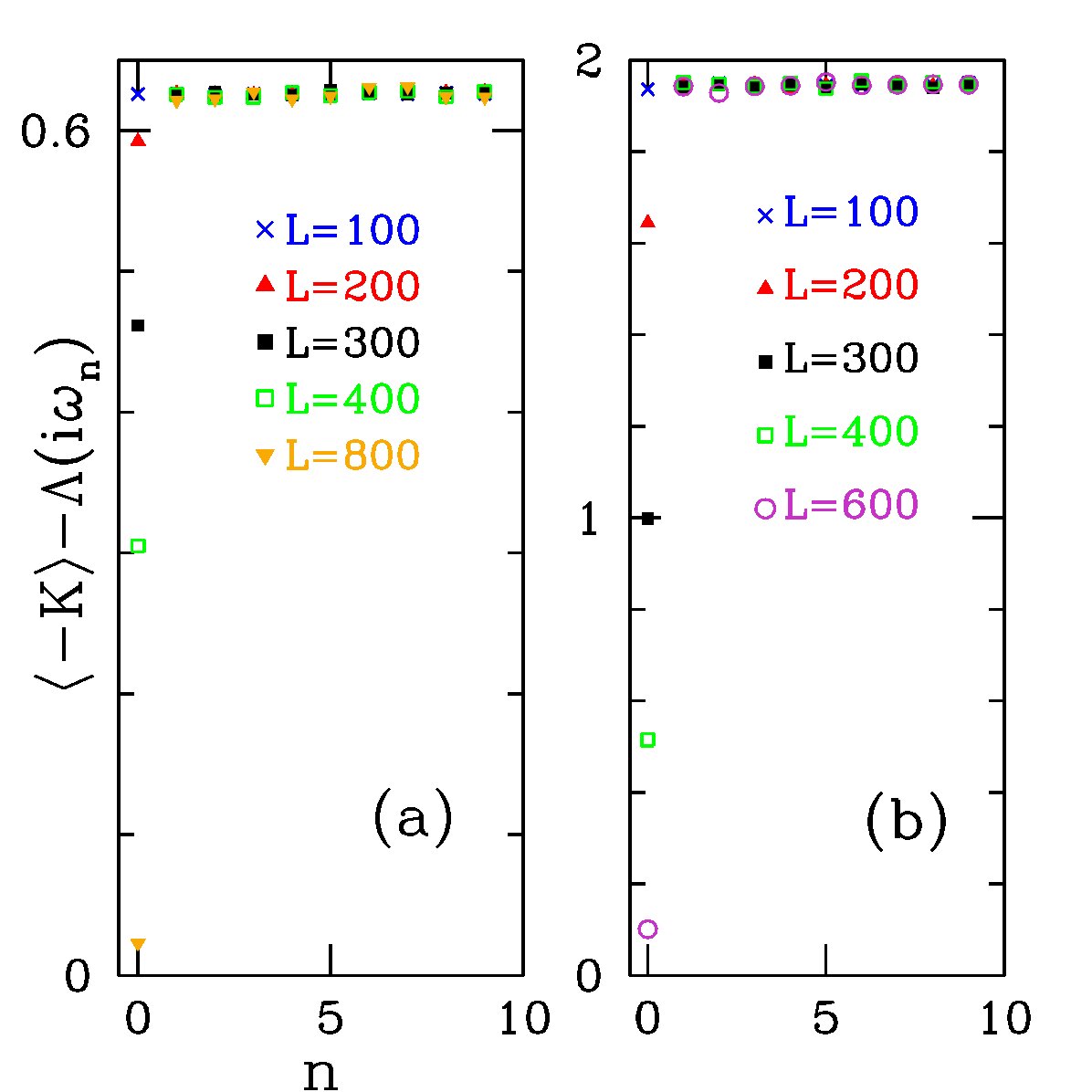 Figure 1
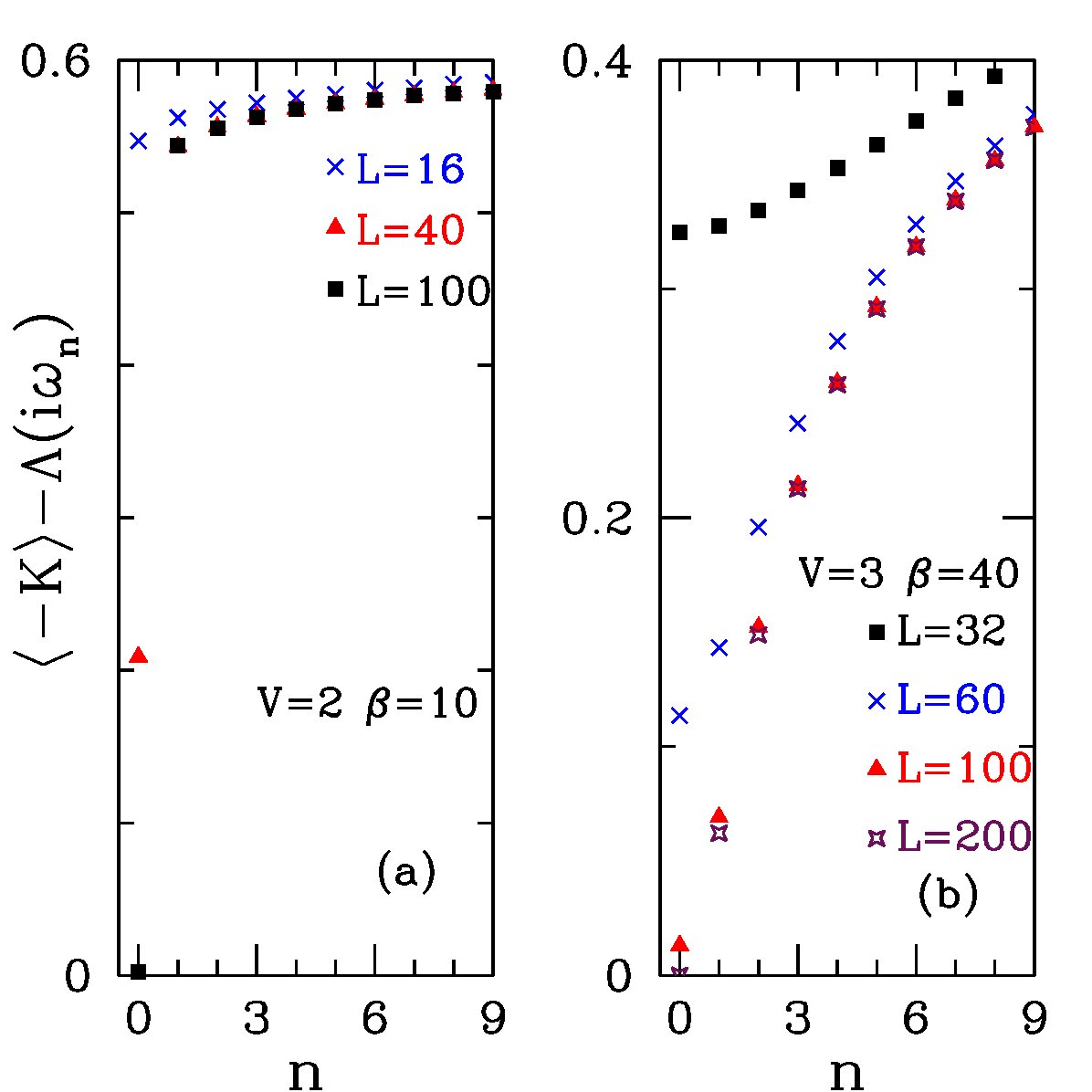 Figure 2
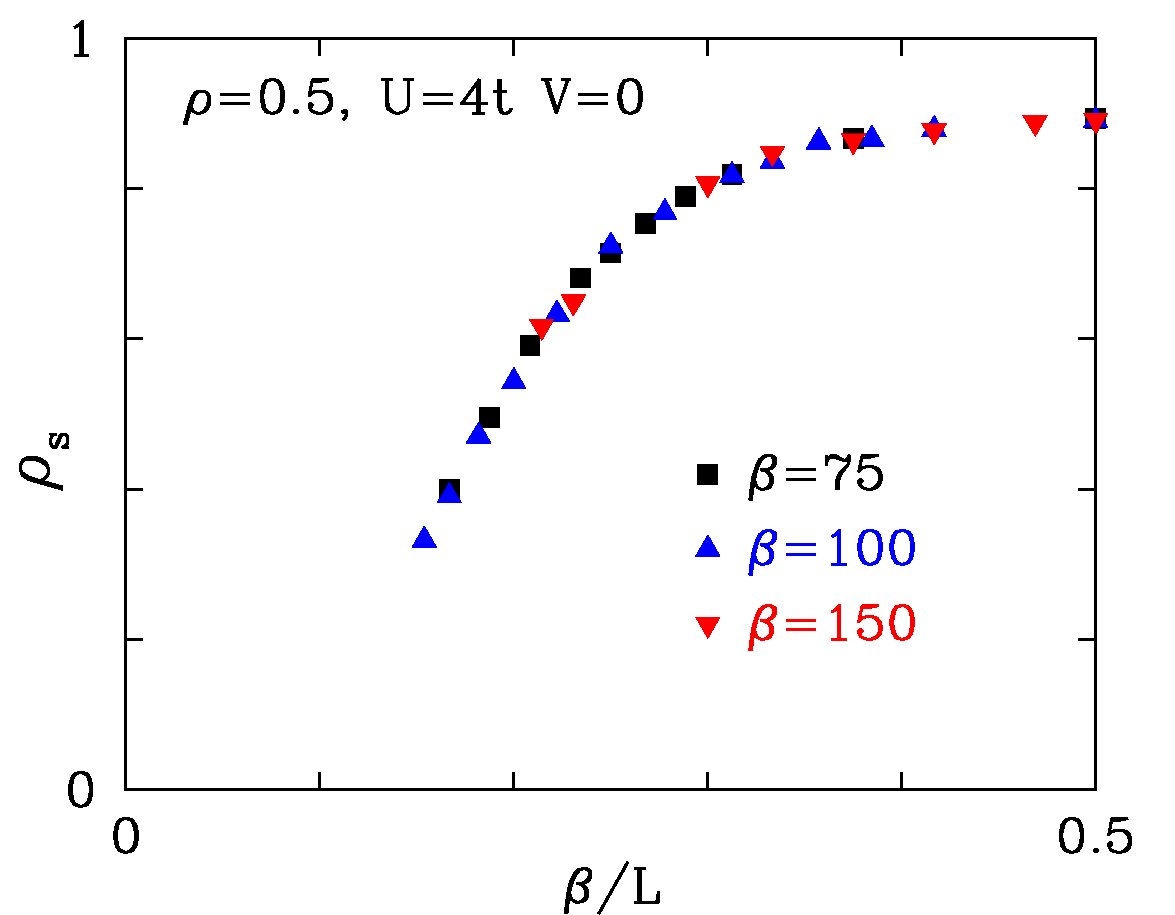 Figure 3
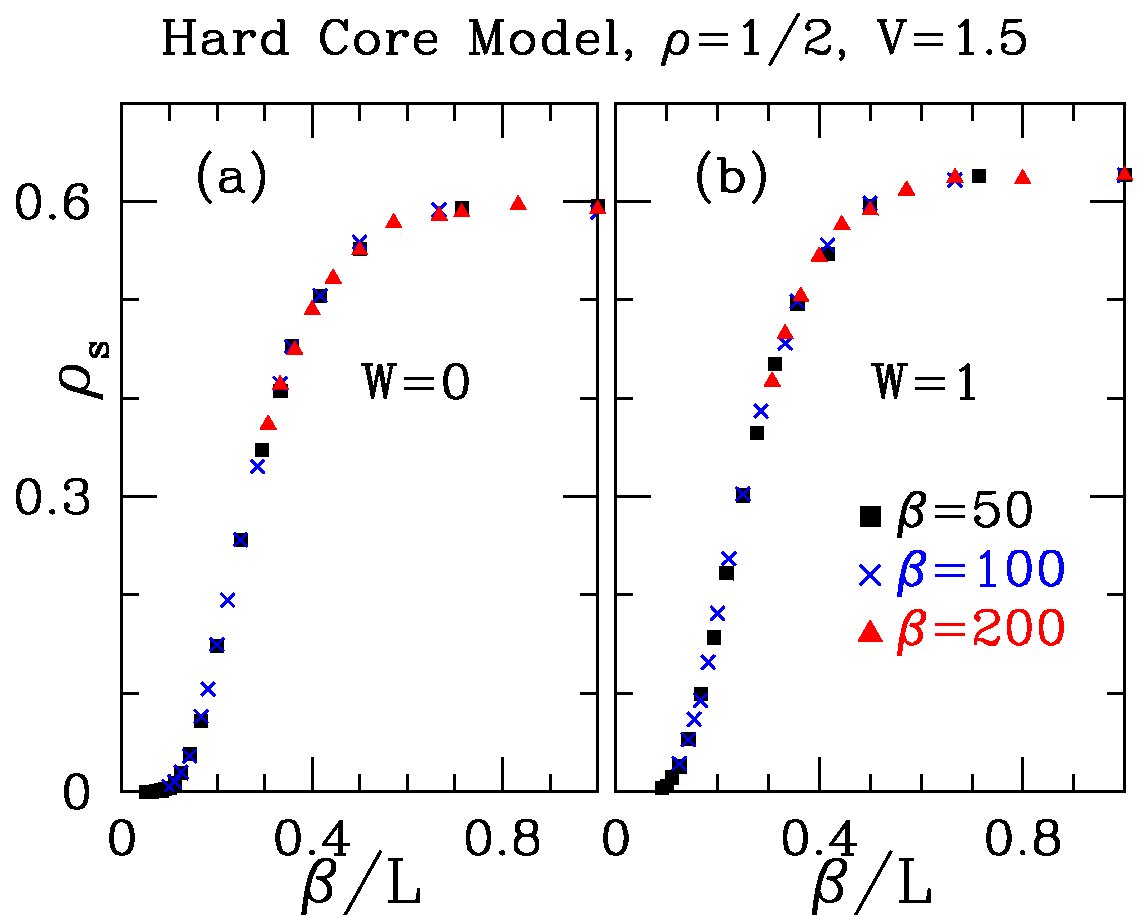 Figure 4
Peer Reviews
No public reviews on file for this paper yet. If you reviewed it on a platform where reviews are public (OpenReview, ICLR, NeurIPS, ICML), you can paste yours below so the community can read it here.
Videos
No videos yet. Explain this paper in a talk, walkthrough, or lecture? Add one.
Taxonomy
TopicsPhysics of Superconductivity and Magnetism · Quantum, superfluid, helium dynamics · Quantum many-body systems
Finite Drude weight for 1D low temperature conductors
Dariush Heidarian and Sandro Sorella
Istituto Nazionale di Fisica della Materia (INFM)-Democritos, National Simulation Centre, and Scuola Internazionale Superiore di Studi Avanzati (SISSA), I-34014 Trieste, Italy
Abstract
We apply well established finite temperature Quantum Monte Carlo techniques to one dimensional Bose systems with soft and hardcore constraint, as well as to spinless fermion systems. We give clear and robust numerical evidence that, as expected, no superfluid density for Bosons or Meissner fraction for fermions. is possible at any non zero temperature in one dimensional interacting Bose or fermi lattice models, whereas a finite Drude weight is generally observed in gapless systems, in partial disagreement to previous expectations.
pacs:
74.25.Fy,71.27.+a,71.10.Fd
I Introduction
In the last decades there have been a lot of numerical and theoretical works to understand the role of strong correlation in lattice model Hamiltonians.ceperley ; scalettar ; dmrgbose ; troyer ; sandvik ; fisher ; cazalilla Recently this issue has acquired an increasing attention and remarkable importance, due to the recent advances in the realization of optical lattices. In these experiments ultracold atoms behave as boson particles trapped on particular lattice sites, whereas the interaction and the hopping parameters can be tuned continuously. This important achievement has opened the possibility to verify directly the crucial role played by the electron correlation in very important model Hamiltonians defined on a lattice. An important example is the realization of a Mott insulating state in a system with strong on site repulsiongreiner2d ; greiner3d . Moreover quite recently the possibility to include the Fermi statistics in optical lattices appears very promising and interesting.boh
In 1D spinless fermion systems are equivalent to interacting Bose systems with hard-core constraint and are described by the same low energy theory -the Luttinger liquid theory-. Indeed this theory holds also for soft-core bosons, as shown in Ref.(cazalilla, ). Therefore, as far as the transport properties are concerned one should expect the same behavior both for fermions and bosons. On the other hand for lattice models, even in absence of disorder, the current does not commute with the Hamiltonian, implying its possible decay at finite temperature due to the backscattering processesandrei . In this case the dynamical current-current correlation function also decays in time, leading to a current Fourier transform without function at zero energy, namely without a finite Drude weight within the linear response theory.
Until few decades ago the absence of the Drude weight was the expected behavior of all interacting metals in lattice models or in real solids at finite temperature. However a quite clear numerical evidence has been reported in Ref.zotos, that current should not decay in integrable 1D models, namely for Hamiltonians that can be solved by Bethe ansatz techniques in 1D. These models essentially possess some hidden conservation law, that was conjectured to forbid the current decay process.zotos ; zotos2 Later several groups have reproduced this surprising effectpoilblanc ; hanke , with a noticeable exception that a finite Drude weight at finite temperature was found also for non-integrable models.hanke On the other hand, from purely theoretical grounds this issue is not settled yet: in Ref.andrei, it was argued that backscattering processes can be effective also at finite temperature and in 1D non integrable models, whereas in Ref.kawakami, , it was proposed that also some particular non integrable model could provide a conserved current.
In this work we propose that the general behavior of 1D gapless systems is eventually characterized by a finite Drude weight at finite temperature, and we have found no exception in the models that we have studied. This conclusion is based on a careful and systematic numerical work on fairly generic one dimensional Bose and Fermi systems, that all show the same behavior, even though strong finite size effects are observed in the non integrable cases.
In the following we investigate the behavior of the Drude weight in 1D systems in the thermodynamic limit and finite temperature.
We have studied hardcore and softcore bosons in a 1D lattice with periodic boundary conditions. The Hamiltonian studied reads,
[TABLE]
The sum is over all lattice sites , is the boson creation/annihilation operator at site , henceforth is the particle number at site and is the chemical potential. is the hopping amplitude which is set to one, is the on-site repulsion, whereas and are the nearest and the next-nearest neighbor interactions, respectively. For hardcore bosons in the limit the Hamiltonian can be mapped onto an spin system with and . In this work we present our results for the half filled case of hardcore and softcore models. Most of our results have been obtained by Quantum Monte Carlo (QMC), using the stochastic series expansion (SSE)sandvik ; sandvik2 with the directed loop updatesyljuasen .
Superfluid density (or spin stiffness in the equivalent spin model), is defined as the second derivative of the free energy with respect to a twist in the boundary conditions. In order to compute this quantity by QMC, it is convenient to apply linear response theory, relating this quantity to the current current response function , where is the current operator and is Matsubara frequency. Then the following expression for the superfluid density is obtained:
[TABLE]
where is the average kinetic energy per site, are the Matsubara frequencies and is the winding number. Similarly the Drude weight is obtained with the same expression but with a different order in the limit and , namelyscalapino ; hanke ; note
[TABLE]
In SSE one can obtain very accurately in terms of Matsubara frequencies. Therefore analytic continuation of the data is required. In order to avoid difficulties of extrapolation to at large temperatures, we have worked at relatively low temperatures ().
In principle, due to the different order of limits, the Drude weight and the superfluid density may be different when the following quantity remains finite in the thermodynamic limithanke : , where, is the current operator, while and are the eigenvalue and eigenstate of the many body system, respectively.
The current operator can be written as where and is the bond index, corresponding to the site index . The ensemble average of product of two local operators and is:
[TABLE]
where is the imaginary time, is partition function and the summation over and comes from Taylor-expansion of and . Following Ref.sandvik2, the relation (4) can be simplified to
[TABLE]
where is the length of sequence of the local operators and it changes in each QMC sampling. is the number of times that two operators and appear in this sequence with distance of local operators, and indicates an arithmetic average using configurations with relative weight . In this work we introduce an efficient way to sample by SSE the current-current response function. To this end, we multiply expression (5) by and integrate over the imaginary time , we obtain:
[TABLE]
where
[TABLE]
is the confluent hypergeometric function.
Therefore, the current-current correlation acquires contributions determined by length of operator string . All these contributions are stochastically sampled in an efficient way, and in each statistical measurement the correlation function has the following estimator:
[TABLE]
where .
Discussion: At zero temperature, for non degenerate ground state, the Drude weight and the superfluidity are the same. In a 1D system at any finite temperature is expected to be zero in the thermodynamic limit, whereas the Drude weight can be non-zero. For hardcore and softcore bosons in a 1D lattice, a systematic size scaling of the superfluid density clearly shows that this quantity vanishes in the thermodynamic limit and for any finite temperature (see figures 1 and 2). Further, we find that, for a fixed set of parameters and at half filling, all superfluidity data versus collapse to one curve whenever the -axis is appropriately scaled with the temperature (see figures 1 and 2). This analysis suggests the scaling form . If one takes the order of limit after , superfluidity remains zero even at zero temperature. Notice that by taking first the limit and then superfluidity has a finite value for the gapless phase, but this is not a signature of superfluidity, rather the occurrence of a finite zero temperature Drude weight. Though in 1D is not possible to have a finite superfluid density at any non zero temperature, several authors have identified the finite zero temperature Drude weight with the superfluid density for a superfluid with vanishing critical temperature. We believe that this identification is a bit confusing and therefore we prefer to think about absence of superfluidity and superconductivity in 1D systems, as commonly reported in the textbooks.
Fig. 3 shows the current-current correlation versus in the metallic and insulating phases of an integrable model (). The zero-frequency value is the superfluid density and the limit gives the Drude weight . For at zero temperature, there exists a critical value below which the Drude weight is finite. In the first case () shown in Fig.(3) with the Drude weight has a finite value at any finite temperature, which is consistent with the previous workszotos . In the insulating phase (case ) with , the superfluid density coincides with the Drude weight and they both tend to zero as the system size increases.
In a non-integrable model such as hard-core bosons with nearest and next nearest neighborer interactions earlier works have suggested zero Drude weight as system size increases. With SSE we can go to very large system sizes and low temperatures and check the scaling dependence of the Drude weight. In Fig. 4 we have plotted current-current correlation versus Matsubara frequency for different , and a fixed temperature . As shown in the same Figure (4) we have also found a finite Drude weight at finite in the celebrated Bose-Hubbard model with softcore constraint and in several other models (not shown). Although some evidence that few particular non integrable models could have a finite Drude weight at finite temperature have been reported before, here we have found a very convincing evidence that this behavior should be generic for 1D gapless system regardless from their integrability. We have supported this statement by state of the art numerical calculations obtained for very large system sizes and low temperature so that all possible extrapolations are perfectly under control.
In conclusion it turns out that, at low energy, all gapless lattice models studied scale to the Luttinger liquid fixed point where the backscattering is a marginally irrelevant coupling and the current is therefore conserved at the fixed point. This is therefore a peculiar and generic feature of 1D. Indeed in 2D systems, such as hardcore bosons with n.n. repulsion in a square and triangular lattice, we found no difference between and .
Acknowledgements.
We thank M. Troyer for useful discussions. This work is partially supported by COFIN-2005 and CNR.
The reference list from the paper itself. Each links out to its DOI / PubMed record.
- 1(1) E. L. Pollock and D. M. Ceperley Phys. Rev. B 36 , 8343 (1987).
- 2(2) G. G. Batrouni, R. T. Scalettar and G. T. Zimanyi Phys. Rev. Lett. 65 , 1765 (1990), ibidem Phys. Rev. B 46 , 9051 (1992).
- 3(3) L. I. Plimak, M. K. Olsen, and M. Fleischhlauer Phys. Rev. A 70 , 013611 (2004).
- 4(4) S. Wessel, F. Alet, M. Troyer, and G. G. Batrouni, Phys. Rev. A 70 , 053615 (2004).
- 5(5) A. W. Sandvik, Phys. Rev. B 56 , 11678 (1997).
- 6(6) M. P. A. Fisher, P.B. Weichman, G. Grinstein and D. S. Fisher, Phys. Rev. B 40 , 546 (1989).
- 7(7) see e.g. M. A. Cazalilla J. Phys. B 37 , S 1 (2004) and references therein.
- 8(8) M. Greiner et al. Nature (London) 415 , 39 (2002).