Low mass visual binaries in the solar neighbourhood: The case of HD141272
T. Eisenbeiss, A. Seifahrt, M. Mugrauer, T.O.B. Schmidt, R., Neuhaeuser, T. Roell

TL;DR
This study reports the discovery of a new stellar companion to HD141272, confirming its co-movement and characterizing its spectral type and mass, contributing to understanding stellar multiplicity in the solar neighborhood.
Contribution
First detection of a co-moving stellar companion to HD141272 using multi-epoch imaging, spectroscopy, and photometry, advancing knowledge of nearby stellar systems.
Findings
Discovered a co-moving M3+-0.5V companion at 350 AU from HD141272.
Confirmed the companion's spectral type and mass as a ~0.26 M_sun dwarf.
System is consistent with the ZAMS, ruling out pre-main sequence status.
Abstract
We search for stellar and substellar companions of young nearby stars to investigate stellar multiplicity and formation of stellar and substellar companions. We detect common proper-motion companions of stars via multi-epoch imaging. Their companionship is finally confirmed with photometry and spectroscopy. Here we report the discovery of a new co-moving (13 sigma) stellar companion ~17.8 arcsec (350 AU in projected separation) north of the nearby star HD141272 (21 pc). With EMMI/NTT optical spectroscopy we determined the spectral type of the companion to be M3+-0.5V. The derived spectral type as well as the near infrared photometry of the companion are both fully consistent with a 0.26+-0.07 Msol dwarf located at the distance of HD141272 (21 pc). Furthermore the photometry data rules out the pre-main sequence status, since the system is consistent with the ZAMS of the Pleiades.
Click any figure to enlarge with its caption.
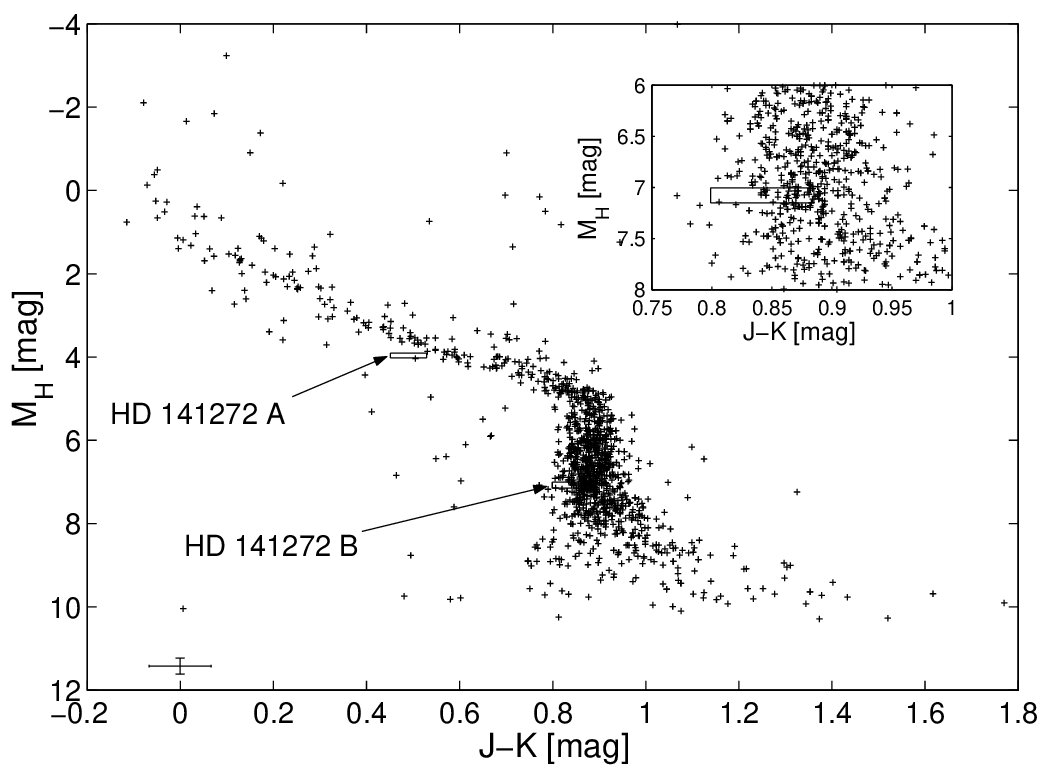 Figure 1
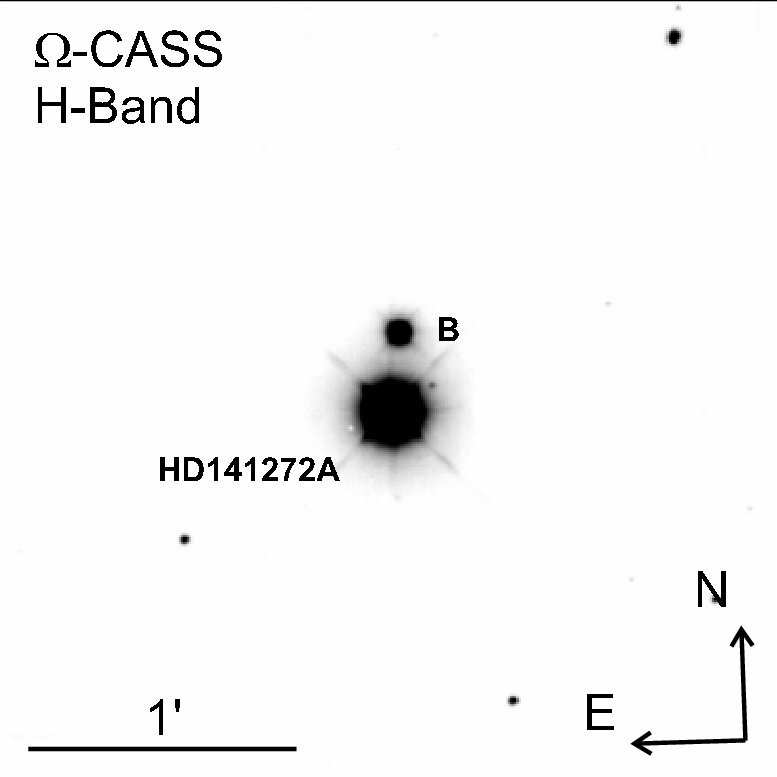 Figure 2
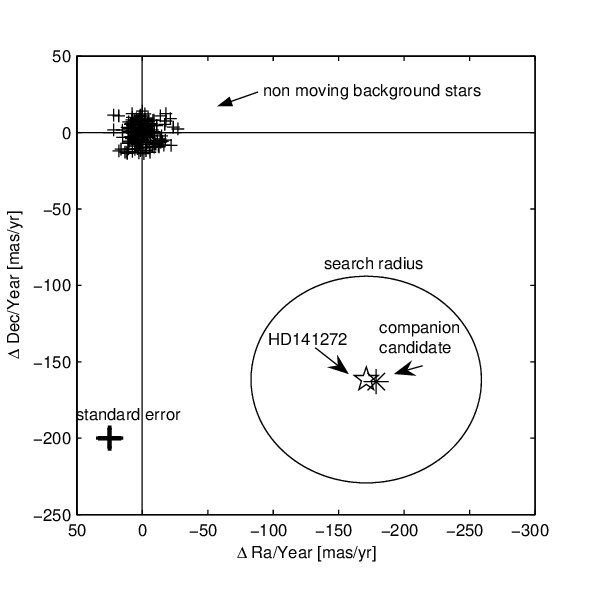 Figure 3
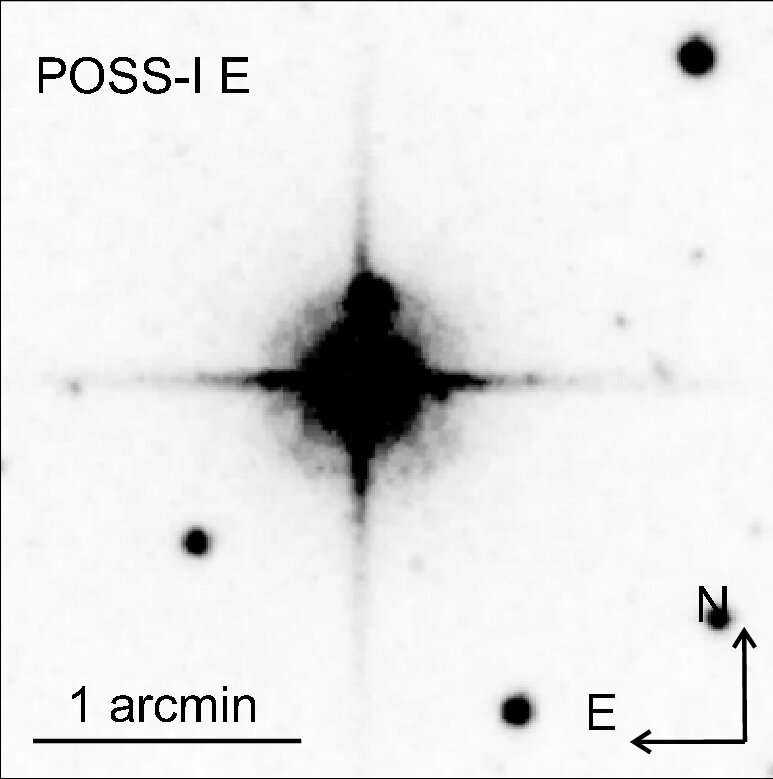 Figure 4
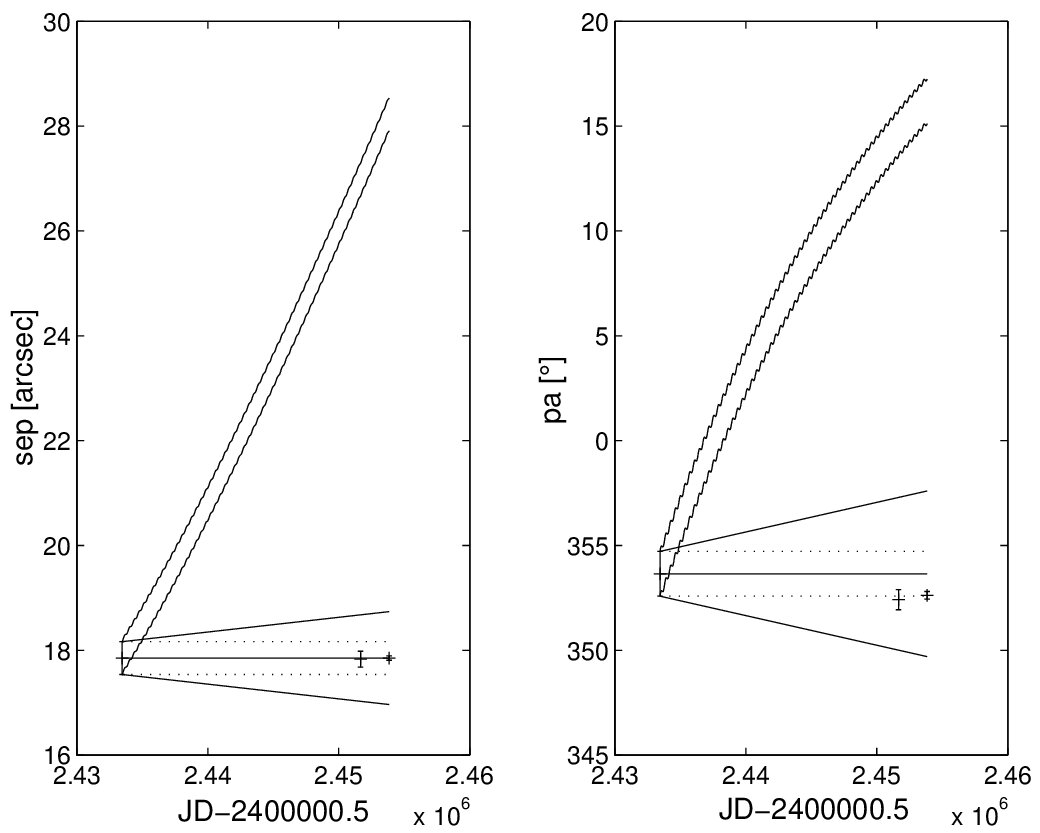 Figure 5
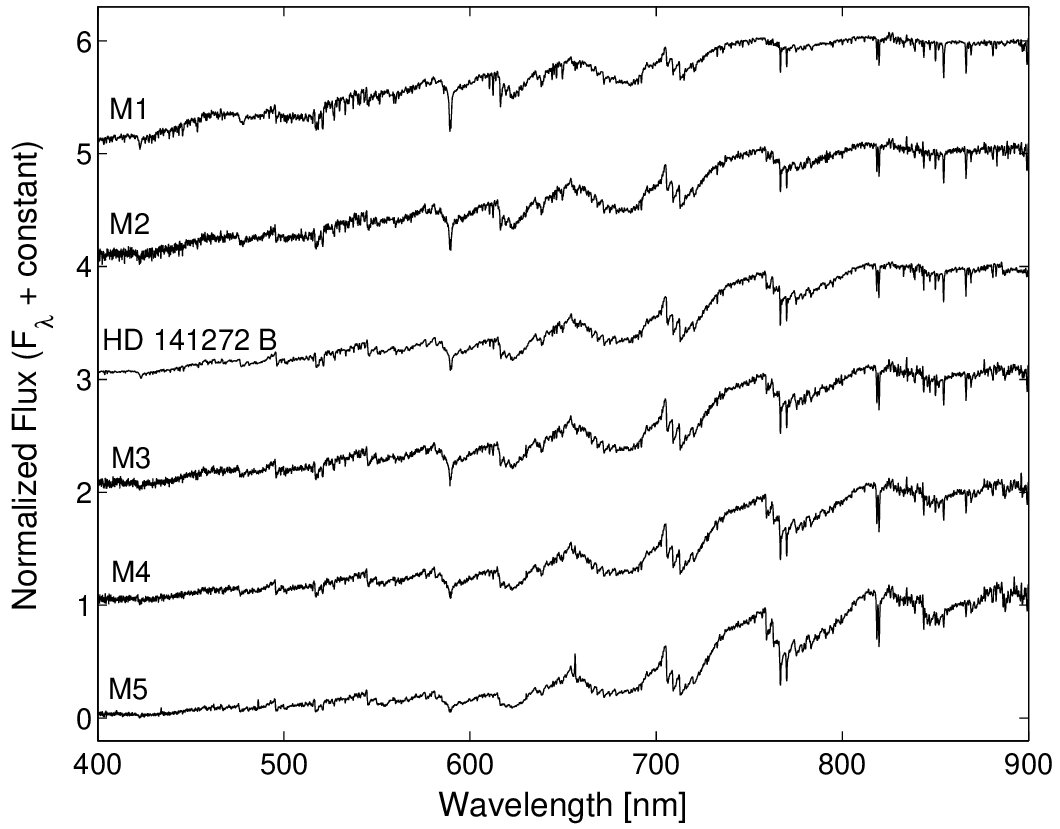 Figure 6
 Figure 7
| epoch | telescope/ | pixel scale | band | sepobs. | sepifback | PAobs. | PAifback |
|---|---|---|---|---|---|---|---|
| dd/mm/yyy | catalogs | arcsec | arcsec | arcsec | |||
| 17/07/1950 | POSS-I | 1.0 | E (6442Å) | 17.850.31 | 353.61.1 | ||
| 29/04/2000 | 2MASS | 0.7 | JHKS | 17.830.150 | 26.920.33 | 352.420.48 | 14.610.75 |
| 20/04/2006 | 3.5m CA | 0.2 | H | 17.8510.041 | 28.120.31 | 352.620.18 | 16.480.68 |
| Comp. | J | H | KS |
|---|---|---|---|
| mag | mag | mag | |
| A | 5.9910.021 | 5.6100.027 | 5.5010.018 |
| B | 9.2980.020 | 8.7250.055 | 8.4560.023 |
Peer Reviews
No public reviews on file for this paper yet. If you reviewed it on a platform where reviews are public (OpenReview, ICLR, NeurIPS, ICML), you can paste yours below so the community can read it here.
Videos
No videos yet. Explain this paper in a talk, walkthrough, or lecture? Add one.
\Pagespan
0 \YearpublicationYear of publication \YearsubmissionYear of submission \MonthMonth of publication \VolumeVolume \IssueIssue \DOIDOI
11institutetext: Astrophysikalisches Institut und Universitäts-Sternwarte Jena, Schillergässchen 2-3, 07745 Jena, Germany 22institutetext: European Southern Observatory, Karl-Schwarzschild-Str. 2, 85748, Garching, Germany
\publonline
…
Low mass visual binaries in the solar neighbourhood:
The case of HD 141272††thanks: Based on observations obtained on La Silla in ESO programs 77.C-0572(A) and Calar Alto project number F06-3.5-016.
T. Eisenbeiss E-mail: [email protected]
A. Seifahrt 1122
M. Mugrauer 11
T. O. B. Schmidt 11
R. Neuhäuser 11
T. Roell 11
(15.08.06; 29.03.07)
Abstract
We search for stellar and substellar companions of young nearby stars to investigate stellar multiplicity and formation of stellar and substellar companions. We detect common proper-motion companions of stars via multi-epoch imaging. Their companionship is finally confirmed with photometry and spectroscopy. Here we report the discovery of a new co-moving () stellar companion 17.8 arcsec (350 AU in projected separation) north of the nearby star HD 141272 (21 pc). With EMMI/NTT optical spectroscopy we determined the spectral type of the companion to be M30.5V. The derived spectral type as well as the near infrared photometry of the companion are both fully consistent with a dwarf located at the distance of HD 141272 (21 pc). Furthermore the photometry data rules out the pre-main sequence status, since the system is consistent with the ZAMS of the Pleiades.
keywords:
binaries: visual – stars: late-type, low mass – astrometry
1 Introduction
HD 141272 is a nearby G8 dwarf with a mass of (Nordström et al. 2004) located in the constellation Serpens Caput (, ). Its proper motion ( mas/yr, mas/yr) and parallax ( mas, i.e. 21 pc) are both well determined by the European astrometry satellite Hipparcos (Perryman et al. 1997). While Montes et al. (2001) list HD 141272 as a member of the Local association with an age of Myr (Martín et al. 2001), Fuhrmann (2004) suggested that this star belongs to the young Her-Lyr moving group, according to its UV-velocities. The age of some Her-Lyr members is estimated by Fuhrmann (2004) to approximately 100 Myr (e.g. HR 857, HD 82443, HD 113449 and HR 5829) which recently reached their main sequence position, while others seemed to be older than Myr (Fuhrmann 2004). Also Fuhrmann (2004) argued that HD 141272, with an effective temperature of K, an absolute bolometric magnitude mag and metallicity of dex appears slightly too bright for its main sequence position, indicating that it might be non single or young.
On the other hand Gaidos, Henry & Henry (2000) measured a Fe corrected Li-equivalent width of mÅ and a rotational velocity of km/s, which might be too small for a 100 Myr old star. Furthermore Chen et al. (2005) observed HD 141272 using the infrared space telescope Spitzer and did not find any IR-excess at 24m and 70m indicating that HD 141272 is not surrounded by an optically thick disk.
Finally López-Santiago et al. (2006) revised the list of Her-Lyr members and candidates of Fuhrmann (2004) and classified HD 141272 as an doubtful member, due to its lithium depletion.
In our program we search for companions to Her-Lyr members and candidates and first results are presented here. We found a co-moving companion of HD 141272 by a combination of archival first epoch images and recent observations. We present our imaging, the astrometric data and reduction techniques in section 2 and 3, followed by a description of the spectroscopic and photometric analysis of the new companion in section 4. The results are discussed in section 5.
2 Archival first epoch data
Astrometry is an effective method to find companions of stars, by comparing two images taken with sufficiently long epoch difference. In order to find late-type stellar and substellar objects, we concentrate our search on companions of young stars. Young objects are still in contraction and are brighter than older objects of the same mass hence, low mass objects are easier to detect.
We found HD 141272 in three epochs of the SuperCOSMOS-Sky-Survey, namely a POSS-I (Palomar Observatory Sky Survey) plate from 1950, as well as in UKST (United Kingdom Schmidt Telescope) infrared and red observations from 1981 and 1992. On all three plates we detected by eye inspection a faint object, located approximately 18 arcsec north of HD 141272, which was not detected by the SuperCOSMOS machine due to its small angular separation to the much brighter star and due to its overlap with the diffraction spike (Fig. 1).
The diffraction spike of HD 141272 intersects the northern object on all three plates hence, the detection of this object would be inaccurate by means of most common detection techniques. Nevertheless, we obtained a position measurement of the companion candidate on the POSS-I plate, using the Source Extractor package (Bertin & Arnouts 1996), included in the Starlink application GAIA (Gray et al. 2004). The source extractor uses thresholding and deblending of point-spread functions hence the method is more accurate than other detection techniques (e.g. Gaussian fitting) under the circumstances in Fig. 1. However, an systematical error is possible, due to the perturbation of the primary’s spike. This error is larger in right accession than in declination and would affect the measurement of the position angle rather than the separation (see section 3, Fig. 4), due to the orientation of the system (Fig. 1 and 3).
Due to its brightness HD 141272 saturates the POSS-I plate. Furthermore the PSF (point spread function) is contaminated by the stray light of the companion candidate hence, position measurement via PSF centering does not work sufficiently. We used the diffraction spikes of the saturated primary to determine its position, since they are unaffected by the companion. We determined the intensity center of a spike taking measurements for each spike using the data reduction and analysis package ESO-MIDAS. The application of a linear regression gives the position of the star as intersection of the two spikes and leads to very small astrometric uncertainties (arcsec and arcsec).
In addition to the detection on the POSS-I plate
HD 141272 and its companion-candidate are also detected in 2MASS images from observing epoch 2000. The 2MASS point source catalog (Cutri et al. 2003) lists the position of both objects with accurate astrometric precision, see Tbl. 1.
Equipped with these data we determined the proper motion of all stars in a 15 arcmin box around HD 141272 which are detected at the POSS-I plate and listed in the 2MASS point source catalog (see Fig. 2). We derived the proper motion of all stars in the field by comparing the positions of all detected objects. The majority of sources only shows small proper motion following a normal distribution, since these stars are most probably at high distances. Using the Lilliefors test for normal distribution we derived the subsample of stars belonging to the background stars, since their proper motion follows a normal distribution (non moving background stars). The standard deviation of the background stars gives the statistically derived proper motion error ( mas/yr, mas/yr). Objects not belonging to the background stars are considered as companion candidates, if they are lying within a 5- vicinity of HD 141272 (ellipse in Fig. 2). Other objects are omitted, since these are either false detections or high-proper-motion stars moving in other directions.
The proper motion of the nearby star HD 141272 is clearly separated from the background stars. The companion candidate clearly shares the proper motion of HD 141272 and will be denoted HD 141272 B, hereafter. Fig. 2 shows with high confidence () that HD 141272 A and B are co-moving over roughly 50 years. Due the above discussed astrometric uncertainties of HD 141272 B this analysis gives a first indication of a new nearby young double star system
Moreover, we used the non-moving background stars to estimate the positional error of the detections in the POSS-I plate. The mean of the distribution shows the systematic error of the POSS-I measurements (mas/yr and mas/yr as offset to . The whole set of data points in Fig. 2 is shifted by that offset to correct for calibration errors between POSS-I and 2MASS data. The standard deviation shows the statistical measurement error () hence, can be applied as standard detection error. The total detection error derived for the POSS-I plate is arcsec and arcsec. The additional systematic error for the companion candidate due to the diffraction spike of HD 141272 is not included in this error analysis.
3 Follow-up observations
In order to get a third epoch on our astrometric result and to detect or rule out further companions we observed HD 141272 again in April 2006 (Fig. 3). We carried out H-band as well as narrow-band observations (m) with the near infrared camera -Cass, installed at the Cassegrain focus of the 3.5 m telescope of the Calar Alto observatory in Spain. -Cass is equipped with a 1024 1024 HgTeCd-detector with a pixel scale of 0.2 arcsec per pixel. We always used the shortest possible detector integration time (0.84 s) to limit strong saturation effects due to the bright star. For background subtraction we applied the standard jitter technique and chose 12 jitter-positions. On each jitter position 49 integrations (0.84 s) were co-added, yielding a total integration time in the H-band of 8.2 min. All images were flatfielded with a skyflat image taken during twilight. The whole data reduction (background subtraction, flatfielding, and shift+add) was carried out with the ESO data-reduction package Eclipse (Devillard 2001).
We calibrated our -Cass image for relative astrometry, using the well known binary systems HIP 63322 and HIP 82817, which we observed during the same night and with the same instrumentation as our science image. Using the Hipparcos astrometry (Perryman et al. 1997) and considering the maximal orbital motion of the calibration binaries we estimated the pixel scale (mas/pixel) and the orientation () of the -Cass images. This yields to the relative astrometric parameters of the system (Tbl. 1). For the detection of both objects we used the Gaussian centroiding technique, implemented in ESO-MIDAS.
Further co-moving companions could be ruled out around HD 141272 within an angular separation of to arcsec (1500 AU of projected separation) with H-band magnitudes down to 18.3 mag (S/N).
HD 141272 A and B are separated by 17.8 arcsec (Fig. 3), hence the projected separation of the system is approximately 380 AU and its orbital period can be estimated with Kepler’s third law to be roughly 7000 years (we use 0.83 M*⊙* for HD 141272 A and 0.26 M*⊙* for B). During 56 years of epoch difference between the POSS-I and our H-band observation, this yields maximal orbital motion as large as 0.5 arcsec in separation (edge-on orbit assumed) or 3*∘* in position angle (face-on orbit assumed). Therefore, we derived the separation and the position angle of the companion for all three observing epochs which are summarized in Tab. 1. These results are also visualized in Fig. 4. Note that absolute calibrated astrometric data, derived for the POSS-I image as described in section 2, as well as catalog data from the 2MASS catalog is used in Fig. 4, while the third epoch data is based on relative astrometry, hence the uncertainties of that data point are significantly smaller.
While the separation between HD 141272 A and B did not change during 56 years, we found a slight decrease of its position angle. This effect is most likely due to the perturbation of the companions PSF by the diffraction spike of the primary (see section 2 and Fig. 1). Nevertheless Fig. 4 ensures the companionship of HD 141272 B, since all data points are lying within the given error bars of the first epoch.
4 Photometry and Spectroscopy
The infrared colors of both components of the new binary system HD 141272 AB are listed in the 2MASS point source catalog, i.e. accurate J, H, and KS band photometry is available for the primary and its co-moving companion, which is summarized in Tab. 2. Additionally the I-band magnitude of both components (mag for A and mag for B) is measured in the second release of the DENIS database, while the accuracy for HD 141272 A is limited due to saturation effects, hence the given error is probably underestimated.
In order to obtain also unsaturated images of the primary we observed the binary system with -Cass in the FeII (1.644m) narrow-band filter. Thereby, we used again the 12 point jitter pattern but co-added 15 integrations (4 s) per jitter position, yielding a total integration time of 12 min. The bright primary as well as its fainter co-moving companion are both well detected in this narrow-band image and their fluxes did not exceed the linearity level of the -Cass detector. Hence, we could use this image to derive the magnitude difference between the primary star and its companion and obtained mag, fully consistent with the magnitude difference derived from the 2MASS data in H-band ( mag.)
Furthermore we acquired a low-resolution optical spectrum with EMMI at the NTT on La Silla to determine the spectral type of HD 141272 B and prove its common distance with HD 141272 A. The spectrum was taken in RILD and REMD mode covering a wavelength of 400-900 nm with a resolution of at 600 nm. The data reduction followed the standard procedure for low-resolution optical spectra: After bias subtraction, flat fielding and wavelength calibration with a HeAr arc spectrum we corrected for the instrumental response and for telluric features using a spectrum of HR5501 taken at the same airmass as HD 141272 B.
We determined the spectral type by comparing our spectrum with a standard sequence of M dwarfs in the same spectral range and with comparable spectral resolution (Bochanski et al. 2006), see Fig. 5. The best fit resulted in a spectral type of which is consistent with a spectral type of determined from the TiO5 spectral index of 0.49 following Cruz & Reid (2002).
Adopting the latter spectral type as final we derived a spectrophotometric distance of pc from the relation given in Cruz & Reid (2002) and the magnitude from 2MASS, assuming that the companion is on the Main sequence. The determined distance is in excellent agreement with the HIPPARCOS measured distance of pc for HD 141272 A, confirming their common distance. Hence, we call the companion HD 141272 B.
5 Conclusions
With the astrometric data reduction and analysis techniques presented in this work, we could verify the common proper motion of both components of the binary system HD 141272 AB during 56 years of epoch difference between the first successful observation of this system on the POSS-I plates taken in July 1950 and our H-band imaging obtained with -Cass in April 2006.
Furthermore we obtained an optical spectrum of the companion and derived its spectral type to range between M2.5V and M3.5V. The infrared apparent magnitudes of the co-moving companion are fully consistent with a M3 dwarf which is located at the distance of HD 141272 A which finally confirms the companionship of this new binary system. The companion is an addition to the Catalog of Nearby Stars within 25 pc (Gliese & Jahreiß 1991).
In order to get an estimation of the system age we compared the infrared photometry of HD 141272 A and B with members of the Pleiades cluster which are listed in the WEBDA database (Mermilliod 1998). All objects are plotted in a J-K vs. MH color-magnitude diagram (Fig. 6). The colors of all objects are obtained from the 2MASS catalog and we derived the absolute H-Band magnitudes of all comparison stars using their 2MASS H-band photometry and a mean distance module of the Pleiades of 5.97 mag (WEBDA database). The expected distance uncertainty of the cluster members which results in an uncertainty of their absolute H-band magnitudes was approximated with the angular diameter of the Pleiades cluster on the sky, assuming a similar extension of the cluster also in the radial direction. The absolute H-band magnitudes of HD 141272 A and B are derived with 2MASS photometry and the Hipparcos parallax of the binary system. Compared to the Pleiades of the same J-K color HD 141272 A and B appear a little fainter, indicating that the system is already on the ZAMS, which is similar to the results of earlier works (Gaidos 1998; Wright et al. 2004).
If we assume that both components of the binary system have already reached the ZAMS we can determine the mass of the secondary using equation (11) from Kirkpatrick & McCarthy (1994) with the given errors for the constants and and the range of the spectral type. We derived a mass of
[TABLE]
Future work should ascertain the age of the system and derive more properties of the M dwarf, which enlarges the list of nearby low mass stars bound in binary systems.
Acknowledgements.
We would like to thank the technical staff of the ESO NTT at La Silla as well as of the Centro Astronómico Hispano Alemán (CAHA) at Calar Alto for all their help and assistance in carrying out the observations. In addition we would like to thank John Bochanski, Andrew West, Suzanne Hawley and Kevin Covey for providing the electronic sequence of M-stars composite spectra. T.O.B. Schmidt acknowledges support from a Thuringian State Scholarship and from a Scholarship of the Evangelisches Studienwerk e.V. Villigst. This publication makes use of data products from the Two Micron All Sky Survey, which is a joint project of the University of Massachusetts and the Infrared Processing and Analysis Center/California Institute of Technology, funded by the National Aeronautics and Space Administration and the National Science Foundation. We use imaging data from the SuperCOSMOS Sky Survey, prepared and hosted by the Wide Field Astronomy Unit, Institute for Astronomy, University of Edinburgh, which is funded by the UK Particle Physics and Astronomy Research Council. This research has made use of the VizieR catalogue access tool and the Simbad database, both operated at the Observatoire Strasbourg, as well as of the WEBDA database, operated at the Institute for Astronomy of the University of Vienna. The DENIS project has been partly funded by the SCIENCE and the HCM plans of the European Commission under grants CT920791 and CT940627. It is supported by INSU, MEN and CNRS in France, by the State of Baden-Württemberg in Germany, by DGICYT in Spain, by CNR in Italy, by FFwFBWF in Austria, by FAPESP in Brazil, by OTKA grants F-4239 and F-013990 in Hungary, and by the ESO C&EE grant A-04-046. Jean Claude Renault from IAP was the Project manager. Observations were carried out thanks to the contribution of numerous students and young scientists from all involved institutes, under the supervision of P. Fouqué, survey astronomer resident in Chile.
The reference list from the paper itself. Each links out to its DOI / PubMed record.
- 1[1996] Bertin, E., Arnouts, S.: 1996, A&AS 117, 393
- 2[2007] Bochanski, J.J., West, A.A., Hawley, et al.: 2007, AJ 133, 531
- 3[2005] Chen, C.H., Patten, B.M., Werner, M.W., et al.: 2005, Ap J 634, 1372
- 4[2002] Cruz, K.L., Reid, I.N.: 2002, AJ 123, 2828
- 5[2003] Cutri, R.M. Skrutskie, M.F., van Dyk, S., et al.: 2003, 2MASS All Sky Catalog of point sources. (The IRSA 2MASS All-Sky Point Source Catalog, NASA/IPAC Infrared Science Archive. http://irsa.ipac.caltech.edu)
- 6[2001] Devillard, N.: 2001, in ASP Conf. Ser. 238: Astronomical Data Analysis Software and Systems X, ed. F. R. Harnden, Jr., F. A. Primini, & H. E. Payne, 525–+
- 7[2004] Fuhrmann, K.: 2004, AN 325,3
- 8[1998] Gaidos, E.J.: 1998, PASP 110, 1259