B --> rho K* decays and other rare vector-vector modes
G. Vasseur

TL;DR
This paper reviews recent experimental results on rare B meson decays into vector-vector final states, highlighting polarization patterns that differentiate penguin and tree-dominated processes.
Contribution
It provides updated measurements of polarization fractions in various rare B decay modes, enhancing understanding of decay dynamics and CP violation.
Findings
Longitudinal polarization ~0.5 in penguin modes
Longitudinal polarization close to 1 in tree modes
Improved experimental constraints on rare decay channels
Abstract
The recent analyses of the following rare vector-vector decays of the B meson are presented: rho K*, omega K*, omega rho, omega omega, and omega phi charmless final states. The latest results indicate that the fraction of longitudinal polarization is about 0.5 in penguin-dominated modes and close to 1 for tree-dominated modes.
Click any figure to enlarge with its caption.
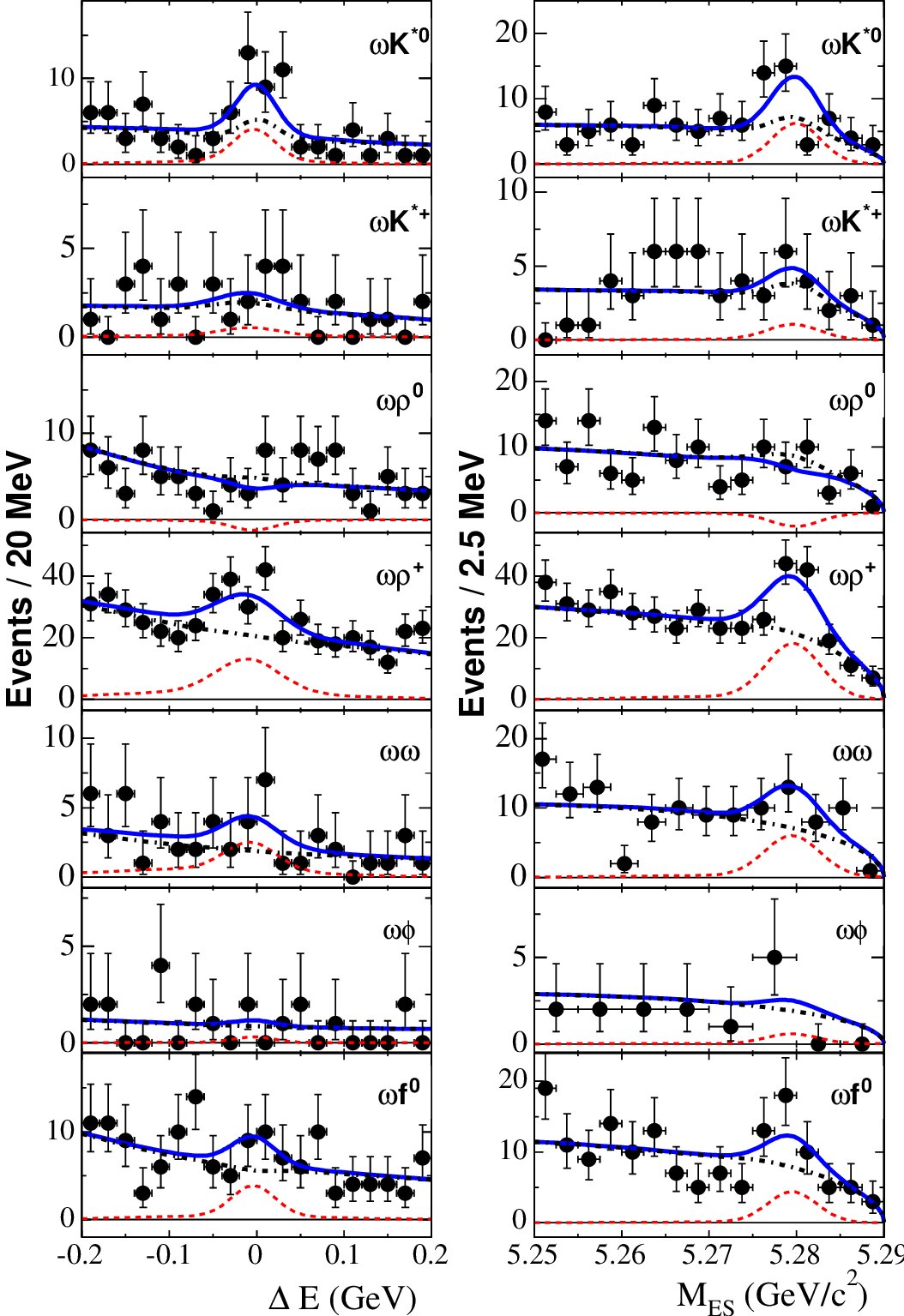 Figure 1
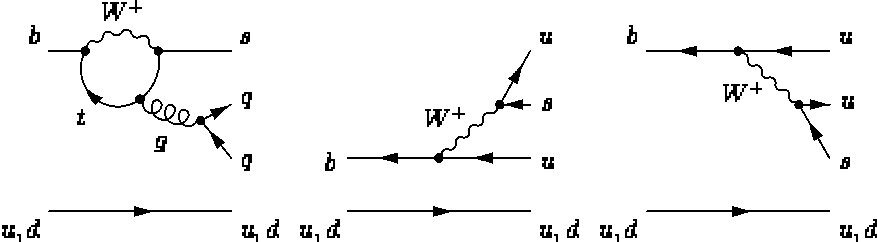 Figure 2
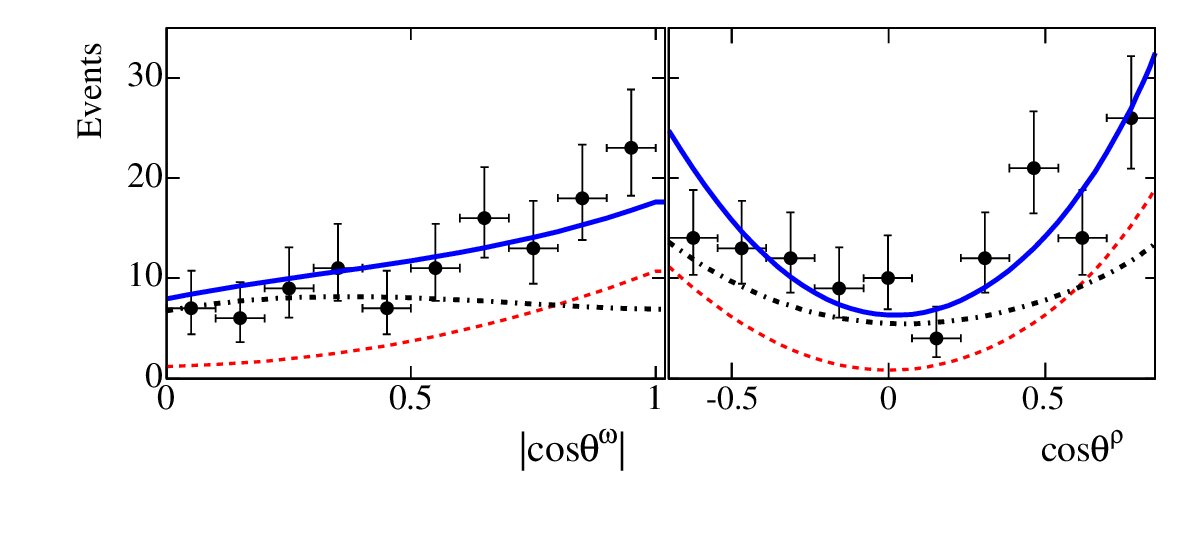 Figure 3
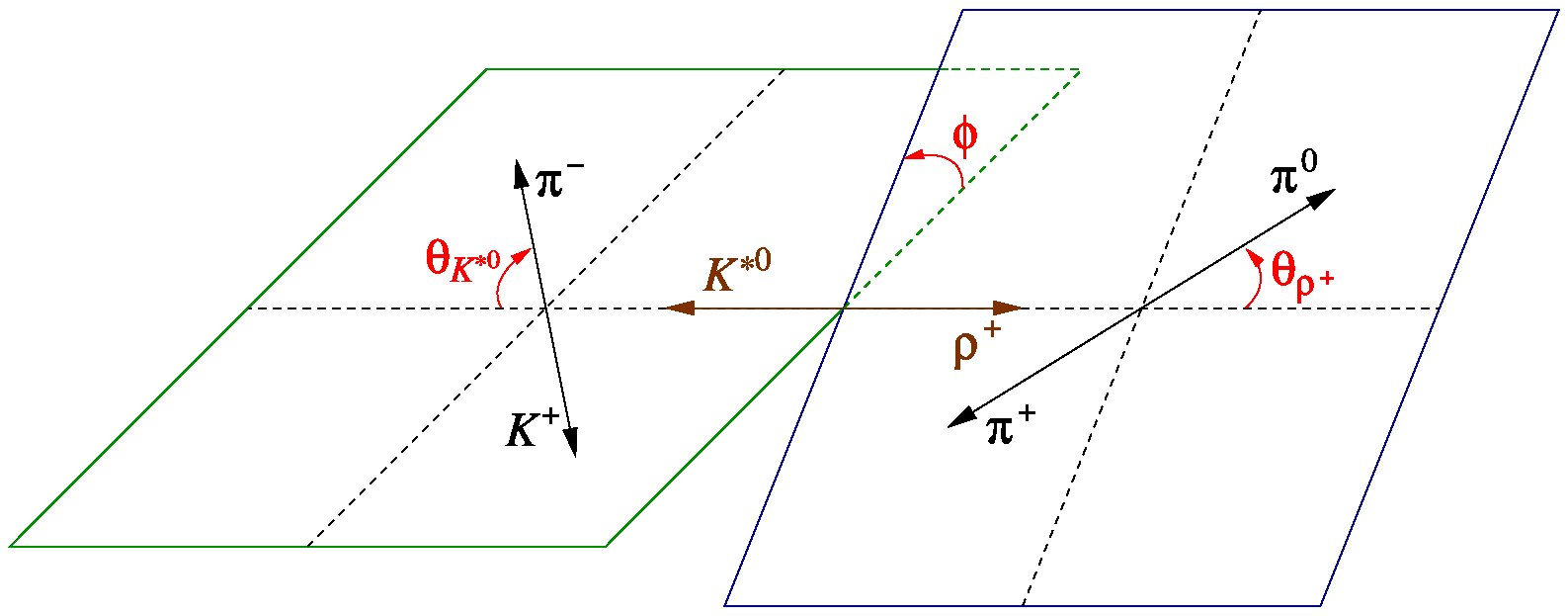 Figure 4
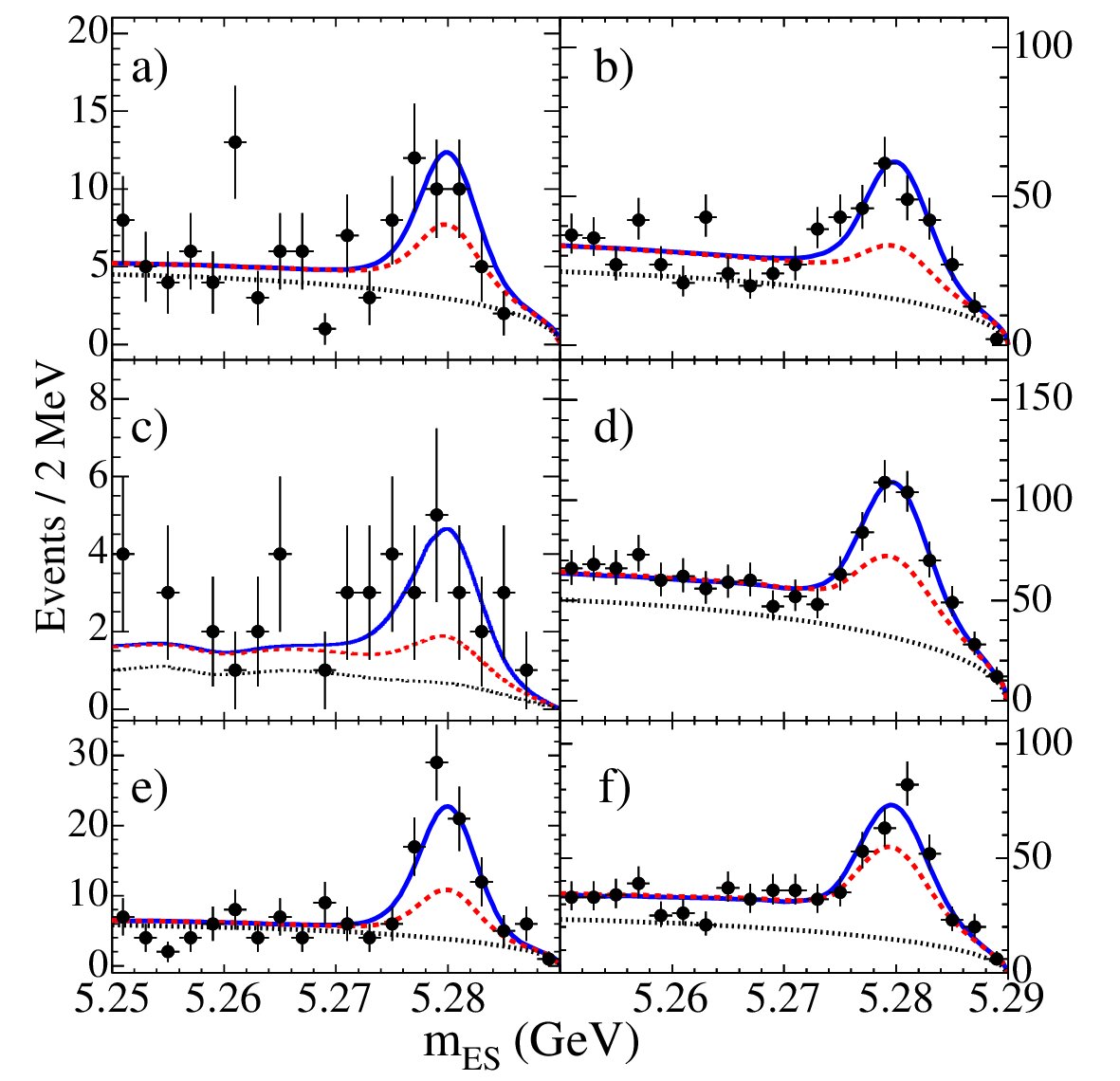 Figure 5
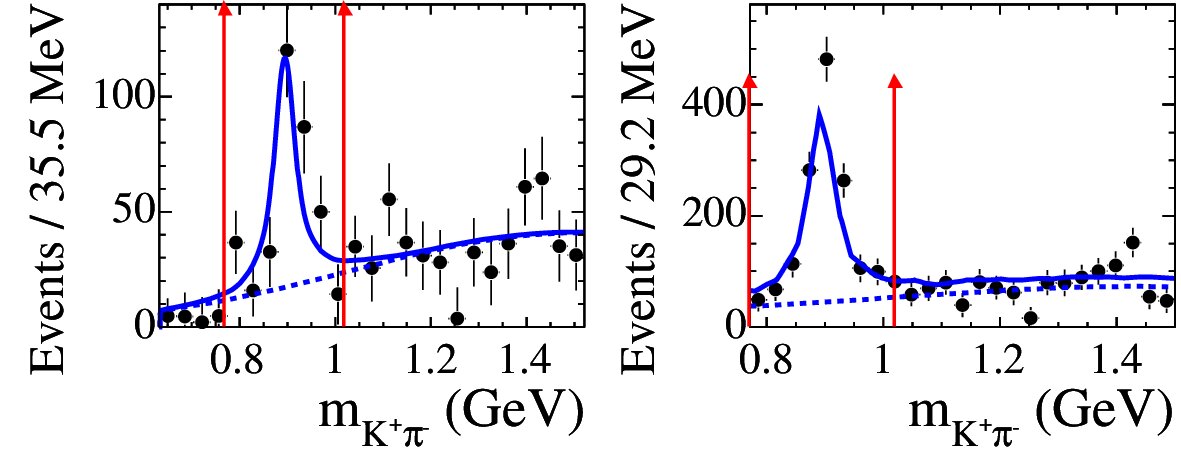 Figure 6
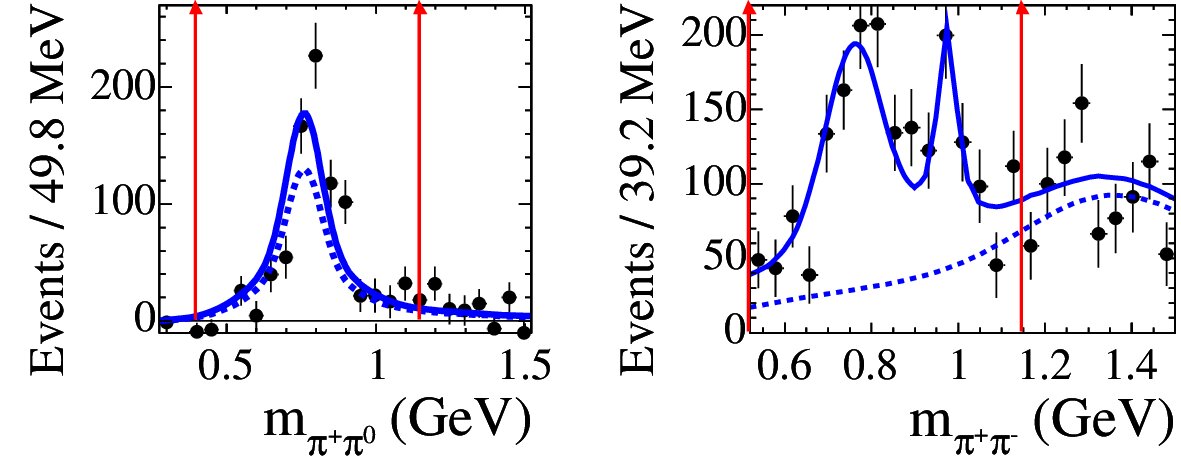 Figure 7
| Mode | Signal yield | Significance () | B() | ||
|---|---|---|---|---|---|
| 2.5 | |||||
| 1.6 | |||||
| 7.1 | |||||
| 5.3 |
| Mode | Signal yield | Significance () | B() | ||
|---|---|---|---|---|---|
| 2.4 | |||||
| 0.4 | |||||
| 0.6 | |||||
| 5.7 | |||||
| 2.1 | |||||
| 0.3 |
Peer Reviews
No public reviews on file for this paper yet. If you reviewed it on a platform where reviews are public (OpenReview, ICLR, NeurIPS, ICML), you can paste yours below so the community can read it here.
Videos
No videos yet. Explain this paper in a talk, walkthrough, or lecture? Add one.
Taxonomy
TopicsQuantum Chromodynamics and Particle Interactions · Particle accelerators and beam dynamics · Particle Accelerators and Free-Electron Lasers
decays and other rare vector-vector modes
111Presented at the International Workshop on the CKM Unitariry Triangle, Nagoya, Japan, December 12-16, 2006. Preprint DAPNIA-06-601.
G. Vasseur
DSM/DAPNIA/SPP, CEA/Saclay, F-91191 Gif-sur-Yvette, France
Abstract
The recent analyses of the following rare vector-vector decays of the meson are presented: , , , , and charmless final states. The latest results indicate that the fraction of longitudinal polarization is about 0.5 in penguin-dominated modes and close to 1 for tree-dominated modes.
I Motivation
The search for rare charmless hadronic decays of the meson to vector-vector final states has become a quite active field in the experiments at the factories, Belle at KEK and BABAR at SLAC. As a lot of these decays have not yet been seen, the first goal of these studies is to observe such modes and measure their branching fraction. The measurements can then be compared to theoretical predictions.
The direct CP-violation asymmetry in these modes can also be measured. It is defined as , where the superscript on the total width indicates the sign of the -quark charge in the meson. Some modes can be used for further CP studies. In fact, the result on has already been used to constrain the effect of the penguin amplitude on the measurement of the angle of the unitarity triangle from using SU(3) flavor symmetry bib:beneke .
A hot topic is the measurement of the fraction of longitudinal polarization. The helicity angles and of the two vector mesons are defined as the angles between the vector meson direction in the meson rest frame and the direction of one of its decay product in the vector meson rest frame, as illustrated on one example in Fig. 1. Integrating over the angle between the decay planes of the two vector mesons, the fraction of longitudinal polarization can be extracted from the angular dependence of the decay rate, which is proportional to
[TABLE]
A value of close to unity of order is expected for light vector mesons from helicity conservation. This is expected to be true for both tree and penguin diagrams. However the experimental situation is more complex. If has indeed been measured close to 1 in the tree-dominated modes bib:somov , it is surprisingly close to 0.5 in the penguin-dominated modes bib:chen . This effect is not yet understood. There are several possible explanations, either within the Standard Model, such as rescattering in the final state, contribution from annihilation or electroweak penguin diagrams, and transverse gluon bib:hou , or in new physics outside the Standard Model. To have a better picture, it is important to measure other vector-vector modes, both tree-dominated, like and , and penguin-dominated like and .
The recent studies of the modes are reviewed in section II, the ones involving an meson in section III. Charge-conjugate modes are implied throughout.
II modes
II.1 Introduction
The charmless decays proceed through dominant gluonic penguin loops and doubly Cabibbo-suppressed tree processes, as shown in Fig. 2. The external tree diagram is only possible with a , and the color-suppressed internal tree diagram with a . Hence is pure penguin.
According to isospin symmetry, the two modes with a charged are expected to have a branching fraction twice as large as the two modes with a neutral .
II.2 Results from Belle
Belle was the first experiment in 2005 to publish a result on the observation of the mode bib:belle , on a sample of 275 millions of pairs. A signal of is extracted from the continuum and backgrounds in an extended unbinned maximum-likelihood fit using the meson beam-constrained mass and energy difference , as shown in Fig 3.
The signal is extracted by fits to and in bins of the vector meson masses and , as shown in Fig 4. This is necessary because there is a large nonresonant background, which gives a continuum in the distribution of . Nethertheless there is a clear signal of events with a significance of 5.2 .
As for , it is obtained by fitting simultaneously the signal yields obtained from - fits in bins of the two helicity angles, assuming an S-wave system in the background. The results for the branching fraction and in are:
[TABLE]
The value found for is similar to the one found in and its error is about twice as large as in .
II.3 Results from BABAR
More recently BABAR published an anlysis of all four modes bib:babarrhoks , performed on a sample of 232 millions of pairs. It is based on an unbinned maximum-likelihood fit, using seven variables: the meson energy-substituted mass and energy difference , a neural network output or a Fischer discriminant combining several event shape variables, the two vector meson masses, and the two helicity angle cosines. The fit allows the simultaneous extraction of the branching ratio and the fraction of longitudinal polarization.
The major challenge in the analysis comes from the nonresonant backgrounds, which share the same final state as the signal. They are studied by enlarging the vector meson mass windows, as illustrated in Fig. 5. As in Belle, a large background is seen in the distribution in the mode. The system in this background is measured to be mostly S-wave. The situation is even more complex in the mode, since in addition to the background there are several contributions seen in the distribution for a in contrast to the one for a . The can be seen clearly. In fact , which is a scalar-vector mode, is considered as another signal to be measured in the same maximum-likelihood fit. Also present are contributions from the and nonresonant . The yields of the nonresonant backgrounds are fitted in the enlarged mass windows, then extrapolated to the standard ones and fixed in the final fit with the standard mass windows.
The projection plots in the mass shown in Fig. 6 illustrate the extraction of the signal from the continuum and backgrounds in the four channels and the two modes. Table 1 summarizes the results. No significant enough signals are observed for and , where upper limits at the 90 % confidence level are set on the branching ratios. For the latter a related signal is observed with a significance of 5.0 and a measured branching fraction of . In , the result is in very good agreement with the result from Belle, with a similar precision. The mode is observed for the first time. The ratio between the branching fractions in these two modes is compatible with the factor 2 expected from isospin symmetry.
The value of is measured in the two significant modes to be compatible with 0, as expected since there is one dominant diagram. Finally is found close to 0.5 in these two modes. It is compatible with the measurement from Belle and has about the same precision. It is again similar to the value found for .
III Modes with
On the same sample of 232 millions of pairs, BABAR has also recently published a search for several vector-vector modes involving an meson bib:babaromega : , , , , , and . The related vector-scalar mode was also searched for. An earlier search for and on 89 millions of pairs resulted in the first observation of the channel bib:oldomega .
The analysis is also based on an extended unbinned maximim-likelihood fit using the same seven variables as in the previous section. Nonresonant and backgrounds are fixed in the fit as determined from extrapolations from higher-mass regions. The projection plots of and of Fig. 7 illustrate the extraction of the signal from the continuum and backgrounds in all these modes. In most of them, no significant enough signal is seen. The only channel where a significant signal is observed is . Its measured branching fraction is about 2 standard deviations smaller than the one of bib:somov , while these two branching fractions are naively expected to be equal. Table 2 summarizes the results in all the modes. To calculate the branching fraction, is left free in the fit for the three modes with a signal significance greater than 2 and is fixed otherwise. Upper limits at the 90 % confidence level are set on the branching fractions for the modes other than .
The maximum-likelihood fit also provides the value of in , which is found to be , a high value expected for this tree-dominated mode. This is illustrared in the projection plots of the helicity angle cosines shown in Fig. 8. The direct CP asymmetry is also measured and found to be compatible with 0.
IV Conclusion
In summary, improved analyses with explicit consideration of nonresonant backgrounds have been performed on several charmless hadronic vector-vector decays of the meson. The , , and modes have been observed and measured in the past few years. Improved upper limits have been set on the branching fraction of other vector-vector modes.
The recent results on vector-vector modes have also brought more pieces to the polarization puzzle. The penguin-dominated and modes have a fraction of longitudinal polarization of about 0.5 like , while the tree-dominated mode has one closer to 1 like . As a lot of charmless vector-vector modes have not yet been observed, new results can be expected with more data.
The reference list from the paper itself. Each links out to its DOI / PubMed record.
- 1(1) M. Beneke et al. , Phys. Lett. B 638 , 68 (2006).
- 2(2) A. Somov, contribution to this conference.
- 3(3) K.F. Chen, contribution to this conference.
- 4(4) G.W.S. Hou, contribution to this conference.
- 5(5) J. Zhang et al. , Phys. Rev. Lett. 95 , 141801 (2005).
- 6(6) B. Aubert et al. , Phys. Rev. Lett. 97 , 201801 (2006).
- 7(7) B. Aubert et al. , Phys. Rev. D 74 , 051102 (2006).
- 8(8) B. Aubert et al. , Phys. Rev. D 71 , 031103 (2005).