Pseudo-random Puncturing: A Technique to Lower the Error Floor of Turbo Codes
Ioannis Chatzigeorgiou, Miguel R. D. Rodrigues, Ian J. Wassell and, Rolando Carrasco

TL;DR
This paper introduces pseudo-random puncturing for rate-1/2 PCCCs, which improves bandwidth efficiency and reduces the error floor compared to traditional codes, with validated analytical and simulation results.
Contribution
The paper proposes a novel pseudo-random puncturing technique for PCCCs that lowers the error floor and enhances bandwidth efficiency, supported by analytical and simulation validation.
Findings
Pseudo-random puncturing consistently lowers the error floor.
Performance converges towards the error floor due to moderate puncturing.
Analytic results align well with simulation outcomes.
Abstract
It has been observed that particular rate-1/2 partially systematic parallel concatenated convolutional codes (PCCCs) can achieve a lower error floor than that of their rate-1/3 parent codes. Nevertheless, good puncturing patterns can only be identified by means of an exhaustive search, whilst convergence towards low bit error probabilities can be problematic when the systematic output of a rate-1/2 partially systematic PCCC is heavily punctured. In this paper, we present and study a family of rate-1/2 partially systematic PCCCs, which we call pseudo-randomly punctured codes. We evaluate their bit error rate performance and we show that they always yield a lower error floor than that of their rate-1/3 parent codes. Furthermore, we compare analytic results to simulations and we demonstrate that their performance converges towards the error floor region, owning to the moderate puncturing…
Click any figure to enlarge with its caption.
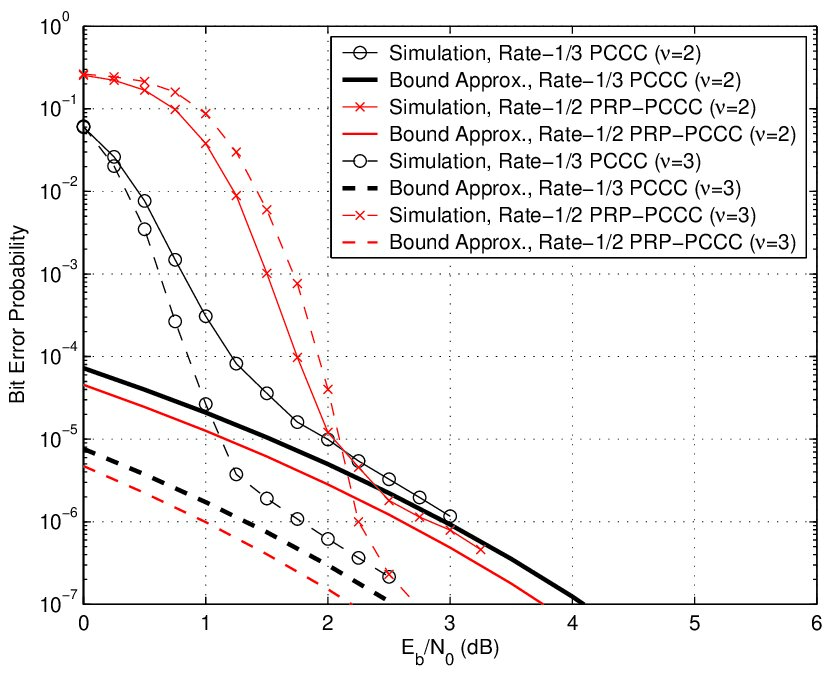 Figure 1
Peer Reviews
No public reviews on file for this paper yet. If you reviewed it on a platform where reviews are public (OpenReview, ICLR, NeurIPS, ICML), you can paste yours below so the community can read it here.
Videos
No videos yet. Explain this paper in a talk, walkthrough, or lecture? Add one.
Pseudo-random Puncturing: A Technique to Lower the Error Floor of Turbo Codes
Ioannis Chatzigeorgiou, Miguel R. D. Rodrigues, Ian J. Wassell
Digital Technology Group, Computer Laboratory
University of Cambridge, United Kingdom
Email: {ic231, mrdr3, ijw24}@cam.ac.uk
Rolando Carrasco
School of EE&C Engineering
University of Newcastle, United Kingdom
Email: [email protected]
Abstract
It has been observed that particular rate-1/2 partially systematic parallel concatenated convolutional codes (PCCCs) can achieve a lower error floor than that of their rate-1/3 parent codes. Nevertheless, good puncturing patterns can only be identified by means of an exhaustive search, whilst convergence towards low bit error probabilities can be problematic when the systematic output of a rate-1/2 partially systematic PCCC is heavily punctured. In this paper, we present and study a family of rate-1/2 partially systematic PCCCs, which we call pseudo-randomly punctured codes. We evaluate their bit error rate performance and we show that they always yield a lower error floor than that of their rate-1/3 parent codes. Furthermore, we compare analytic results to simulations and we demonstrate that their performance converges towards the error floor region, owning to the moderate puncturing of their systematic output. Consequently, we propose pseudo-random puncturing as a means of improving the bandwidth efficiency of a PCCC and simultaneously lowering its error floor.
I Introduction
Although in certain applications, such as satellite communications, link reliability is of essence and low rate codes are used to support it, bandwidth occupancy is more important in wireless communications and hence high rate codes are preferred. A high rate convolutional code can be obtained by periodic elimination, known as puncturing, of particular codeword bits from the output of a parent low rate convolutional encoder. Extensive analyses on punctured convolutional codes have shown that their performance is always inferior to the performance of their low rate parent codes (e.g. see [1, 2]).
The performance of punctured parallel concatenated convolutional codes (PCCCs), also known as punctured turbo codes, has also been investigated. Design considerations have been derived by analytical [3, 4, 5] as well as simulation-based approaches [6, 7, 8], while upper bounds on the bit error probability (BEP) were evaluated in [5, 9]. Punctured turbo codes are usually classified as systematic, partially systematic or non-systematic depending on whether all, some or none of their systematic bits are transmitted [7]. Recent papers [7, 8, 9] have demonstrated that partially systematic PCCCs yield lower error floors than systematic PCCCs of the same rate.
In [10] we showed that rate-1/2 non-systematic PCCCs can achieve error floors, which are lower even than those of their rate-1/3 parent PCCCs. This interesting outcome is valid when maximum-likelihood (ML) decoding is employed. When suboptimal iterative decoding is used, the absence of received systematic bits causes erroneous decisions, which prohibit the iterative decoder from converging to the error floor. Nevertheless, we demonstrated that rate-1/2 child codes, whose BEP performance converges towards an error floor which is lower than that of their rate-1/3 parent PCCC, can still be found by means of an exhaustive search. During this process, the union bound on the BEP of each rate-1/2 punctured PCCC is computed and compared to the union bound of the rate-1/3 parent PCCC. Note that the union bound coincides with the error floor of the code for high values of [11]. Punctured PCCCs that achieve a bound lower than that of their rate-1/3 parent PCCC are selected.
Computation of the exact union bound on the BEP of a punctured PCCC becomes intensive as the interleaver size increases. In [12] we presented a simple technique to approximate the union bound of a turbo code and we demonstrated that this approximation is very accurate when a large interleaver size is used. We used our technique to identify a family of rate-1/2 partially systematic PCCCs, which we called pseudo-randomly punctured PCCCs (PRP-PCCCs). Although we did not explore their BEP performance in detail, we observed that particular PRP-PCCC configurations could achieve a lower error floor than that of their parent codes.
This paper builds upon the work carried out in [10] and [12]. Initially, we provide analytical expressions for the parameters that influence the bit error performance of PCCCs. We then evaluate those parameters and compute the union bound approximations for both rate-1/3 parent PCCCs and rate-1/2 PRP-PCCCs. We demonstrate that the latter always exhibit a lower error floor than the former, when large interleaver sizes are considered. In order to verify our theoretical analysis, we compare analytic results to simulations for specific PCCC configurations. The paper concludes with a summary of the main contributions.
II Performance Evaluation of PCCCs
Turbo codes, in the form of symmetric rate-1/3 PCCCs, consist of two identical rate-1/2 recursive systematic convolutional encoders separated by an interleaver of size [13]. The information bits are input to the first constituent convolutional encoder, while an interleaved version of the information bits are input to the second convolutional encoder. The output of the turbo encoder consists of the systematic bits of the first encoder, which are identical to the information bits, the parity check bits of the first encoder and the parity check bits of the second encoder.
The bit error probability of a PCCC employing ML soft decoding, on an additive white Gaussian noise (AWGN) channel, is upper bounded as follows
[TABLE]
where the union bound is defined as
[TABLE]
Here, the sum runs over all possible values of input information weight , with being the contribution to the union bound of only those codeword sequences which were generated by input sequences of a specific information weight . An individual contribution is given by [11, 14]
[TABLE]
where is the interleaver size, is the code rate of the turbo encoder and denotes the number of codeword sequences having overall output weight , which were generated by input information sequences of weight .
In [11] it was shown that the union bound on the BEP of a PCCC using a uniform interleaver of size coincides with the average of the union bounds obtainable from the whole class of deterministic interleavers of size . For small values of , the union bound can be very loose compared with the actual performance of turbo codes using specific deterministic interleavers. However, for , it has been observed that randomly generated interleavers generally perform better than deterministic interleaver designs [15]. Consequently, the union bound provides a good indication of the actual bit error rate performance of a PCCC operating in the error floor region, when long interleavers are considered.
Derivation of all coefficients becomes a computationally intensive process as the interleaver size increases, especially when punctured PCCCs are considered [12]. However, the union bound can be approximated as follows
[TABLE]
when long interleavers are used. This approximation is based on a number of observations:
Codeword sequences, which were generated by input sequences having the minimum possible information weight, become the main contributors to the bit error rate performance, as the size of the interleaver increases [16, 12]. 2. 2.
Owning to the structure of the constituent encoders, the minimum information weight of an input sequence is always equal to two [16].
Therefore, is the dominant contribution to the union bound over a broad range of bit error probabilities [12, 16] and can be used to predict the error floor of turbo codes.
Throughout this paper, we use the union bound approximation as the basis for the analytic performance comparison of turbo codes. In particular, if and are two PCCCs using long interleavers of identical size, we say that yields a lower error floor than that of when their bound approximations, and respectively, satisfy
[TABLE]
The above condition can be expanded using (3) as follows
[TABLE]
It was demonstrated in [16] that the free effective distance, , which conveys the minimum weight of a codeword sequence for a weight-2 input information sequence, has a major impact on the performance of a turbo code. Consequently, if and denote the free effective distances of and respectively, condition (6) collapses to
[TABLE]
which only considers the first non-zero, that is the most significant, term of each sum.
Function is a monotonically decreasing function of , where is a real number. Therefore, if and are real numbers, with , we deduce that , and vice versa, i.e,
[TABLE]
Consequently, inequality (7) reduces to
[TABLE]
if
[TABLE]
When the code rates are equal, the free effective distance of turbo codes plays a role similar to that of the free distance of convolutional codes, since the performance criterion (9) is simplified to
[TABLE]
Expressions (9) and (10) will be the basis for the comparison of the BEP performance in the error floor region of two PCCCs.
III Determination of Parameters that Influence the Performance of
Turbo Codes
We will now determine the various parameters that affect performance for two classes of turbo codes: conventional rate-1/3 PCCCs and pseudo-randomly punctured rate-1/2 PCCCs. The turbo codes considered throughout this paper are symmetric, i.e., the two constituent encoders are identical.
III-A Rate-1/3 PCCCs
Criteria (9) and (10) require knowledge of the free effective distance and the coefficient of each PCCC. In the remainder of the paper, we use the abbreviation “Par” to denote a rate-1/3 parent PCCC. Its free effective distance can be expressed as the sum of the minimum weight of the codeword sequence generated by the first constituent encoder, and the minimum weight of the parity check sequence generated by the second constituent encoder, when a sequence of information weight in input to the PCCC
[TABLE]
Taking into account that the turbo codes are symmetric and the weight of the systematic output sequence is always 2 since , we can write
[TABLE]
The number of codeword sequences, generated by a turbo encoder using a uniform interleaver of size , can be associated with the number of codeword sequences having weight , generated by the first constituent encoder, and the number of parity check sequences having weight , generated by the second constituent encoder, if we elaborate on the expressions described in [11]. In particular, we obtain
[TABLE]
where and return the same value, since they both consider the same trellis paths. Note that the first index in the above notations refers to the input information weight, which is two.
It was shown in [16] that good rate-1/3 PCCCs are obtained when their feedback generator polynomial is chosen to be primitive, whilst their feedforward generator polynomial is different than . The period of a primitive polynomial is given by [17]
[TABLE]
where is the order of the polynomial, or equivalently, the memory size of each constituent code.
We demonstrated in [12] that when a primitive feedback generator polynomial is used, the minimum weight and the coefficient can be expressed as
[TABLE]
respectively. Consequently, expression (13) assumes the form
[TABLE]
whilst, if we combine (14) and (16), the coefficient can be expressed as a function of the intlerleaver size and the period , as follows
[TABLE]
In the special case when the size of the interleaver is an integer multiple of the period of the feedback generator polynomial, i.e., , we can rewrite (18) as
[TABLE]
III-B Rate-1/2 Pseudo-randomly Punctured PCCCs
A high rate PCCC can be obtained by periodic elimination of specific codeword bits from the output of a rate-1/3 parent PCCC. A puncturing pattern can be represented by a matrix as follows:
[TABLE]
where is the puncturing period and , with and . For the corresponding output bit is punctured, otherwise it is transmitted. The first and second rows of the pattern are used to puncture the systematic and parity check outputs, respectively, of the first constituent encoder. The third row determines which parity check bits from the output of the second constituent encoder will be punctured.
Pseudo-random puncturing has been described in [12], in detail. It is applied to rate-1/3 PCCCs, which use primitive feedback generator polynomials, hence the polynomial period is also given by (15). The puncturing pattern can be constructed once the parity check sequence for an input sequence of length , has been obtained at the output of the first constituent encoder. As long as a trail of zeros follows the first non-zero input bit, the component encoder behaves like a pseudo-random generator, hence the parity check bits from to form a pseudo-random sequence. We set the elements of the second row of the puncturing pattern to be equal to the bits of this pseudo-random sequence, but circularly shifted rightwards by one, i.e., for . Note that in pseudo-random puncturing, the puncturing period is equal to the period of the feedback polynomial, i.e., . The first row of the pattern is set to be the complement of the second row, thus . In order to achieve a code rate of , we do not puncture the parity check output of the second constituent encoder, hence all the elements of the third row are set to one, i.e., .
As an example, let us consider a rate-1/3 PCCC with generator polynomials in octal form. The memory size of each constituent encoder is , thus the period of is found to be . Consequently, we set the input sequence to and we obtain the parity check sequence at the output of the first constituent encoder. The block of the last parity check bits, i.e., , forms a pseudo-random sequence. If we circularly shift the bits of this pseudo-random sequence to the right by one and map them to the elements of the second row of the puncturing pattern, we obtain . Eventually the puncturing pattern, based on which the rate-1/2 PRP-PCCC is generated from the rate-1/3 parent PCCC, assumes the form
[TABLE]
We emphasize that the puncturing pattern depends on the generator polynomials of the rate-1/3 parent PCCC, hence different polynomials yield different puncturing patterns. Furthermore, a rate-1/2 PRP-PCCC can be obtained only if the parent PCCC uses primitive feedback generator polynomials.
We have previously determined [12] the minimum weight of the codeword sequence generated by the first constituent encoder, when a sequence of information weight in input to the rate-1/2 PRP-PCCC. In particular, we found that
[TABLE]
The parity check sequence generated by the second constituent encoder is not punctured, thus its minimum weight is also given by (16). Therefore, we can compute the free effective distance of a rate-1/2 PRP-PCCC as follows
[TABLE]
Every time a particular column of the puncturing pattern is active during the time steps of the coding process, codeword sequences having minimum weight are generated. Their exact number, , can be computed using the expressions in [12]. In particular, we find that for the number of minimum-weight codeword sequences , generated when column is active, is given by
[TABLE]
where denotes the remainder of division of by , and denotes the integer part of . In order to facilitate our analysis, we assume that the interleaver size is an integer multiple of the puncturing period , i.e., , where is a positive integer. Hence, (24) collapses to
[TABLE]
since is always zero and .
It has been demonstrated in [12] that minimum-weight codeword sequences can be obtained only when the active column is in the range ; every time one of these columns of the puncturing pattern is active, minimum-weight codeword sequences are generated. Consequently, the total number of codeword sequences having weight assumes the value
[TABLE]
or, equivalently
[TABLE]
where has been replaced by , since they are equal quantities and they can be used interchangeably.
Similarly to the second constituent encoder of the rate-1/3 parent PCCC, the second constituent encoder of the rate-1/2 PRP-PCCC also generates a total of sequences having weight , since its parity check output is not punctured. Consequently, the coefficient or a rate-1/2 PRP-PCCC can be expressed as
[TABLE]
invoking (14), which can be used when PCCCs employing uniform interleavers of size are considered.
IV Performance Comparison of Analytic to Simulation Results
Having evaluated the parameters that influence the performance of the PCCCs under investigation, we are now in the position to explore whether a rate-1/2 PRP-PCCC exhibits a lower bound approximation than that of its rate-1/3 parent PCCC. We observe that can be expressed in terms of , if we subtract (17) from (23)
[TABLE]
Coefficient can also be represented in terms of , if we divide (28) by (19)
[TABLE]
According to (9) and (10), if both conditions
[TABLE]
and
[TABLE]
are satisfied, a rate-1/2 PRP-PCCC yields a lower bound approximation than that of its rate-1/3 parent code. We deduce from (30) that is always less than , thus the second condition holds true. The first condition assumes the following form, if we substitute with its equivalent, based on (29),
[TABLE]
Nevertheless, we have shown in (17) that the free effective distance of the parent PCCC is given by , which can be rewritten as . Therefore, is always greater than , and hence, both conditions are satisfied.
The outcome of this investigation reveals that rate-1/2 PRP-PCCCs using long interleavers are always expected to yield a lower bound approximation, or equivalently a lower error floor, than that of their rate-1/3 parent codes.
Fig.1 compares bound approximations to simulation results for rate-1/3 parent PCCCs and rate-1/2 PRP-PCCCs of memory size and , over the AWGN channel. For , the generator polynomials of the PCCCs are taken to be , whilst for , the PCCCs are described by . The component decoders employ the conventional exact log-MAP algorithm [18]. A moderate interleaver size of bits has been chosen, so as to allow the bit error rate performance of the PCCCs to approach the corresponding bound approximations at BEPs in the region of to .
As expected, Fig.1 confirms that for high values of , the BEP of each rate-1/2 PRP-PCCC is indeed lower than that of the corresponding rate-1/3 parent code, whilst after 8 iterations the performance curves of all turbo codes approach the respective bound approximation curves.
V Conclusion
In previous work [9, 10, 12] we introduced techniques to evaluate the performance of punctured PCCCs and we observed that, in some cases, the error floor could be lowered by reducing the rate of a PCCC from 1/3 to 1/2. Nevertheless, good puncturing patterns were identified by means of an exhaustive search, whilst convergence towards low bit error probabilities of those rate-1/2 PCCCs whose systematic output was heavily punctured, had to be investigated.
In this paper, we established that rate-1/2 pseudo-randomly punctured PCCCs, which form a subset of rate-1/2 partially systematic PCCCs, not only approach the error floor region for an increasing number of iterations but always yield a lower error floor than that of their rate-1/3 parent codes. Consequently, pseudo-random puncturing can be used to reduce the rate of a PCCC from 1/3 to 1/2 and at the same time achieve a coding gain at low bit error probabilities.
The reference list from the paper itself. Each links out to its DOI / PubMed record.
- 1[1] J. Hagenauer, “Rate compatible punctured convolutional codes and their applications,” IEEE Trans. Commun. , vol. 36, pp. 389–400, Apr. 1988.
- 2[2] D. Haccoun and G. Bégin, “High-rate punctured convolutional codes for Viterbi and sequential decoding,” IEEE Trans. Commun. , vol. 37, pp. 1113–1125, Nov. 1989.
- 3[3] Ö. Açikel and W. E. Ryan, “Punctured turbo-codes for BPSK/QPSK channels,” IEEE Trans. Commun. , vol. 47, pp. 1315–1323, Sept. 1999.
- 4[4] F. Babich, G. Montorsi, and F. Vatta, “Design of rate-compatible punctured turbo (RCPT) codes,” in Proc. Int. Conf. Comm. (ICC’02) , New York, USA, Apr. 2002, pp. 1701–1705.
- 5[5] M. A. Kousa and A. H. Mugaibel, “Puncturing effects on turbo codes,” Proc. IEE Comm. , vol. 149, pp. 132–138, June 2002.
- 6[6] M. Fan, S. C. Kwatra, and K. Junghwan, “Analysis of puncturing pattern for high rate turbo codes,” in Proc. Military Comm. Conf. (MILCOM’99) , New Jersey, USA, Oct. 1999, pp. 547–550.
- 7[7] I. Land and P. Hoeher, “Partially systematic rate 1/2 turbo codes,” in Proc. Int. Symp. Turbo Codes , Brest, France, Sept. 2000, pp. 287–290.
- 8[8] Z. Blazek, V. K. Bhargava, and T. A. Gulliver, “Some results on partially systematic turbo codes,” in Proc. Vehicular Tech. Conf. (VTC-Fall’02) , Vancouver, Canada, Sept. 2002, pp. 981–984.