Diffuse X-ray Emission from the Carina Nebula Observed with Suzaku
Kenji Hamaguchi, the Suzaku Eta Carinae team, the Carinae D-1 team

TL;DR
This study uses Suzaku's spectral capabilities to analyze the diffuse X-ray emission in the Carina Nebula, revealing plasma characteristics that suggest origins from supernova activity or super shells.
Contribution
First detailed Suzaku spectral analysis of the Carina Nebula's diffuse X-ray emission, identifying plasma properties and potential supernova origins.
Findings
Detected strong emission lines of iron and silicon in the nebula.
Measured plasma temperatures of approximately 0.2 and 0.6 keV.
Indicated abundance variations and possible supernova origins.
Abstract
A number of giant HII regions are associated with soft diffuse X-ray emission. Among these, the Carina nebula possesses the brightest soft diffuse emission. The required plasma temperature and thermal energy can be produced by collisions or termination of fast winds from main-sequence or embedded young O stars, but the extended emission is often observed from regions apart from massive stellar clusters. The origin of the X-ray emission is unknown. The XIS CCD camera onboard Suzaku has the best spectral resolution for extended soft sources so far, and is therefore capable of measuring key emission lines in the soft band. Suzaku observed the core and the eastern side of the Carina nebula (Car-D1) in 2005 Aug and 2006 June, respectively. Spectra of the south part of the core and Car-D1 similarly showed strong L-shell lines of iron ions and K-shell lines of silicon ions, while in the…
Click any figure to enlarge with its caption.
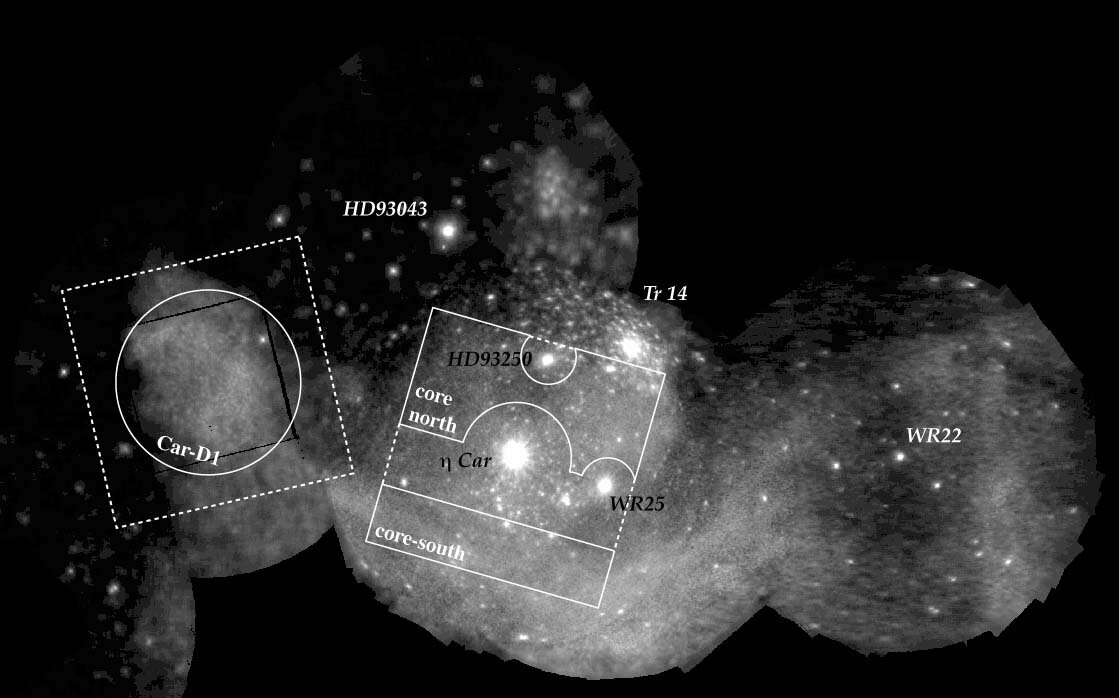 Figure 1
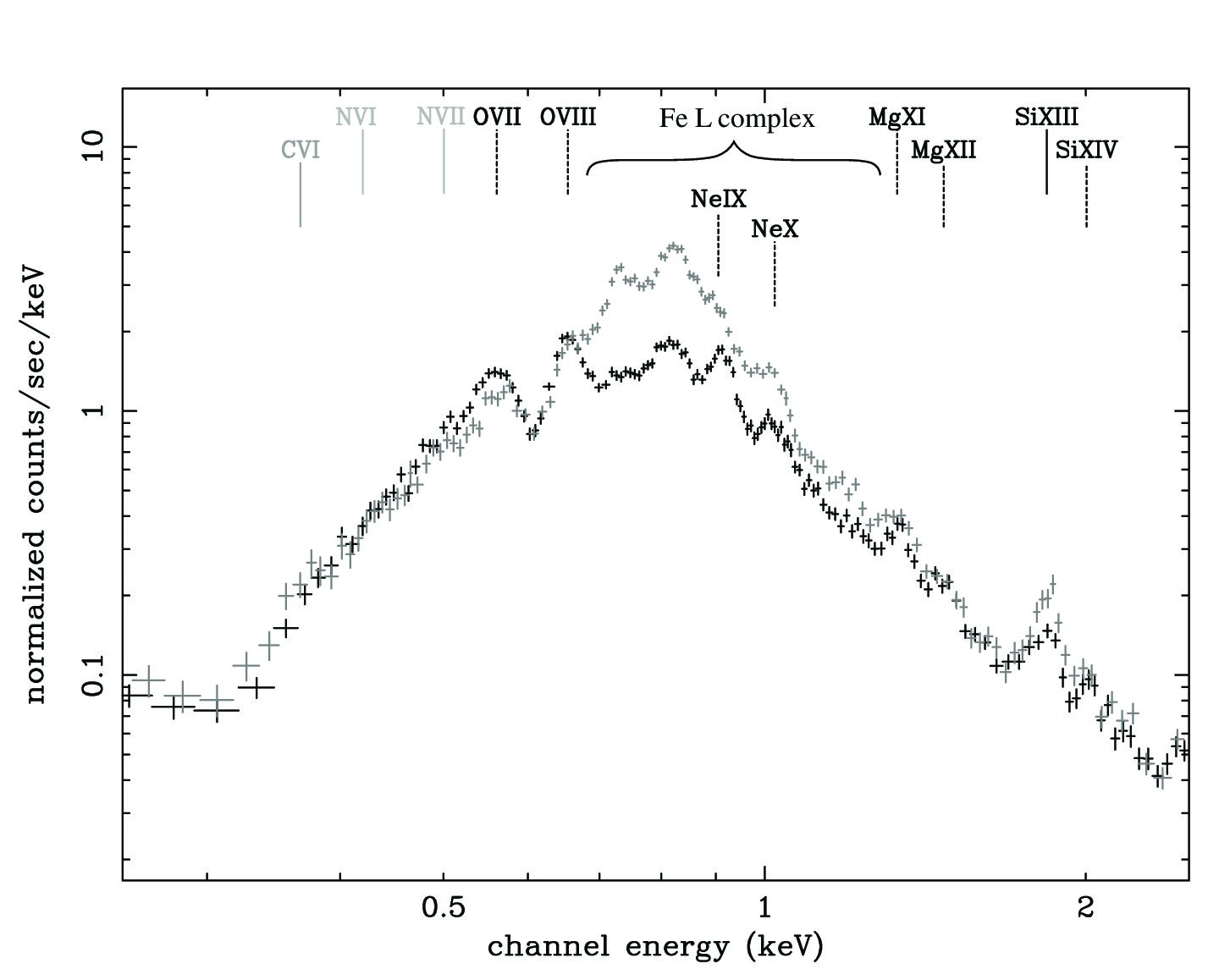 Figure 2
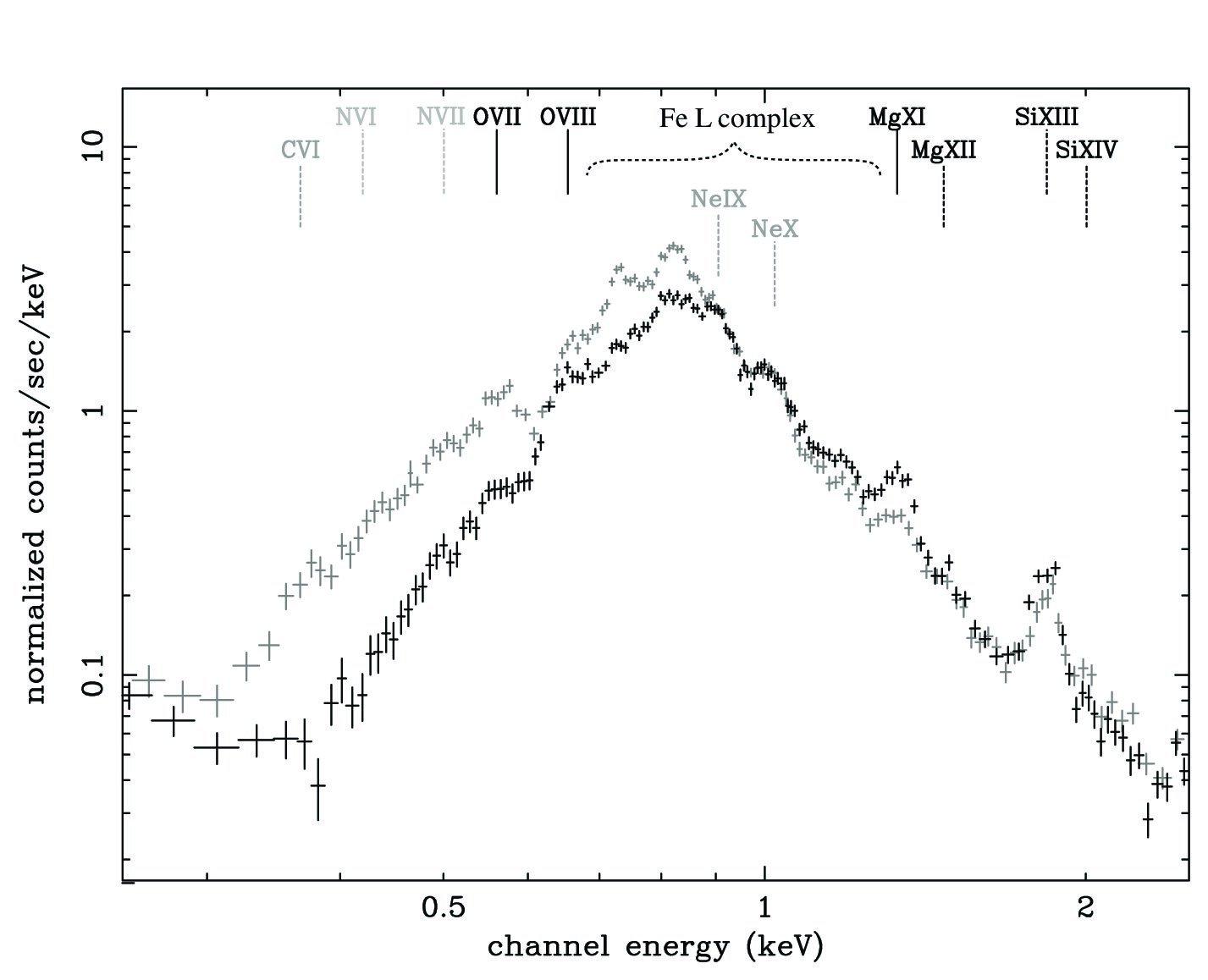 Figure 2
Peer Reviews
No public reviews on file for this paper yet. If you reviewed it on a platform where reviews are public (OpenReview, ICLR, NeurIPS, ICML), you can paste yours below so the community can read it here.
Videos
No videos yet. Explain this paper in a talk, walkthrough, or lecture? Add one.
Diffuse X-ray Emission from the Carina Nebula Observed with Suzaku
Kenji Hamaguchi1,2
the Suzaku Carinae team and the Carinae D-1 team 1CRESST and X-ray Astrophysics Laboratory NASA/GSFC1CRESST and X-ray Astrophysics Laboratory NASA/GSFC Greenbelt Greenbelt MD 20771
and
2Universities Space Research Association MD 20771
and
2Universities Space Research Association 10211 Wincopin Circle 10211 Wincopin Circle Suite 500 Suite 500 Columbia Columbia MD 21044 MD 21044
Abstract
A number of giant HII regions are associated with soft diffuse X-ray emission. Among these, the Carina nebula possesses the brightest soft diffuse emission. The required plasma temperature and thermal energy can be produced by collisions or termination of fast winds from main-sequence or embedded young O stars, but the extended emission is often observed from regions apart from massive stellar clusters. The origin of the X-ray emission is unknown.
The XIS CCD camera onboard Suzaku has the best spectral resolution for extended soft sources so far, and is therefore capable of measuring key emission lines in the soft band. Suzaku observed the core and the eastern side of the Carina nebula (Car-D1) in 2005 Aug and 2006 June, respectively. Spectra of the south part of the core and Car-D1 similarly showed strong L-shell lines of iron ions and K-shell lines of silicon ions, while in the north of the core these lines were much weaker. Fitting the spectra with an absorbed thin-thermal plasma model showed kT0.2, 0.6 keV and NH121021 cm-2 with a factor of 2-3 abundance variation in oxygen, magnesium, silicon and iron. The plasma might originate from an old supernova, or a super shell of multiple supernovae.
1 Extended X-ray Emission from the Star Forming Region
Soft X-ray emission nebulae with kT0.1–0.8 keV, log LX33-35 ergs s-1, and size of 1–103 pc accompany a number of giant HII regions (see Table 4 of Ref. \citenTownsley2003. Chandra observations of extended emission in a few star forming clusters indicate that the emission may arise from the fast O star stellar winds thermalized either by wind-wind collisions or by a termination shock. However, the emission is often found outside of the massive stellar clusters, so that another origin, such as an otherwise unrecognized supernova remnant, cannot be ruled out.
In principle, the origin of the diffuse emission can be determined by measuring its composition. For example, the plasma should be overabundant in nitrogen and neon if it originates from winds from nitrogen-rich Wolf-Rayet stars (WN), while it would be overabundant in oxygen if it arises from a Type II SNR. The temperature of the plasma, typically a few million degrees, makes soft X-ray band studies highly desirable, because of the presence in this band of strong lines from these elements, plus carbon, silicon and iron.
The Carina Nebula, which contains several evolved and main-sequence massive stars such as Car, WR 25 and massive stellar clusters such as Trumpler 14 (Tr 14), emits soft diffuse X-rays 10–100 times stronger than any other Galactic giant HII region (LX 1035 ergs s*-1*) [4]. The high surface brightness made possible the discovery of the diffuse emission by the Einstein Observatory in the late 1970’s. The Einstein observations revealed that the diffuse emission tends to be associated with optically bright regions containing massive stars. Recent Chandra observations provided a point source free measurement of the diffuse flux [1], and suggested the presence of a north-south Fe and Ne abundance gradient [5].
The X-ray CCD cameras (XISs: X-ray Imaging Spectrometer) onboard the Suzaku observatory have the best spectral resolution for extended soft X-ray emission and thus they provide good diagnostics of emission lines especially below 1 keV.
2 Suzaku and XMM-Newton Observations of the Carina Nebula
Figure 1 shows a mosaic image of the Carina nebula between 0.47 keV created from 32 XMM-Newton observations. The image depicts several bright X-ray point sources: Car (an LBV), WR25, WR22 (Wolf-Rayet stars), HD 93250, HD 93043 (O3 stars), and Tr 14, Tr 16 (massive stellar clusters). The image also clearly shows apparently extended emission toward the east-west direction. In a color image (e.g. Figure 1 of Ref. \citenHamaguchi2007a, XMM-Newton Image Gallery111http://xmm.esac.esa.int/external/xmm_science/gallery/public) the emission is softer between Tr 14, WR 25 and Car.
We analyzed the Suzaku data of the core and the eastern side (named Car-D1) of the Carina nebula taken on 2005 Aug. 29 and 2006 June 5. The XIS FOVs of these observations are shown in Figure 1 with dotted lines. To investigate the color variation in detail, we divided the core region into two and thus extracted three spectra from two Suzaku observations (core-north, core-south and Car-D1). The background was reproduced with the night earth data. The spectra showed strong emission between 0.3 and 2 keV, which is probably dominated by soft diffuse emission associated with the Carina nebula, while the spectra above 2 keV may be explained with CXB, Galactic Ridge X-ray Emission, X-ray point sources resolved with Chandra and unresolved pre-main-sequence stars.
Figure 2 shows an overlay of the BI spectra between 0.3–2 keV. The left panel compares spectra of the core-north region with the core-south region. A strong difference is seen between 0.7 keV and 1.2 keV, which apparently is the source of the two colors of diffuse emission. The band in which the difference is found is dominated by emission lines from the iron L-shell complex. Additionally, the core-south spectrum shows a stronger Si line. The Car-D1 spectrum shows similar intensity in the Si and Fe lines to the core-south spectrum (right panel of Figure 2) while it shows relatively strong magnesium and oxygen lines. All these spectra look similar except for these emission lines. This suggests that the differences represent an elemental abundance variation, and not a temperature difference.
This is supported by spectral fits of the individual spectra. All three spectra between 0.32 keV were reproduced by an absorbed 2T thin-thermal plasma models although the best-fit models are not formally acceptable. The plasma temperatures of all three regions are 0.2 and 0.6 keV, and their column densities are 31021 cm*-2*, which is consistent with extinction toward the Carina nebula [3]. The abundances of some elements show a factor of 24 variations: the core-north region has a factor of 2 lower silicon abundance and a factor of 4 lower iron abundance than the core-south region, while the Car-D1 region has a factor of 2 higher oxygen and magnesium abundances. On the other hand, spectral fits of the core region with higher sensitivity around 0.5 keV gave small upper-limits (0.02 solar) of the nitrogen abundance.
3 Origin of the Diffuse Plasma
The N/O abundance ratio inferred from the spectral fits is 0.4, over 20 times less than around Car. The abundance distribution is totally contrary to that expected from stellar winds from evolved massive stars, unless the winds somehow heat the interstellar matter without enriching it, thus leaving the X-ray plasma with abundances typical of interstellar matter. At the same time, the X-ray luminosity of the Carina Nebula is about two orders of magnitude higher than that of other Galactic star forming regions, but the number of early O stars is only an order of magnitude higher (see Table 4 in Ref. \citenTownsley2003. These results suggest an additional energy source is needed to power the X-ray emission in the Carina Nebula.
An obvious possibility is one or more core-collapse supernovae (i.e. Type Ib,c or II), mentioned as a possibility by Ref. \citenTownsley2003. The regions vary strongly in oxygen, magnesium, silicon, and iron abundances. These elements are products of core-collapse supernovae, and young SNRs such as Cas A and Vela show strong abundance variation from location to location. The total energy content in the hot gas of 21050 ergs is a modest fraction of the 1051 ergs of kinetic energy produced by a canonical supernova, while assuming an iron abundance of 0.30 solar, the total iron mass in the diffuse gas requires at least 3-5 supernovae.
Acknowledgements
K. H. is financially supported by a US Chandra grant No. GO3-4008A and US Suzaku grant.
The reference list from the paper itself. Each links out to its DOI / PubMed record.
- 1[1] N. R. Evans, F. D. Seward, M. I. Krauss, T. Isobe, J. Nichols, E. M. Schlegel, and S. J. Wolk, \JL Astrophysical Journal,2003,589,509
- 2[2] K. Hamaguchi, R. Petre, H. Matsumoto, M. Tsujimoto, S. S. Holt, Y. Ezoe, H. Ozawa, Y. Tsuboi, Y. Soong, S. Kitamoto, A. Sekiguchi, and M. Kokubun. \JL Publication of Astronomical Society of Japan,2007,59,151
- 3[3] M. A. Leutenegger, S. M. Kahn, and G. Ramsay. \JL Astrophysical Journal,2003,585,1015
- 4[4] F. D. Seward and T. Chlebowski. \JL Astrophysical Journal,1982,256,530
- 5[5] L. K. Townsley. Proceeding of the ST Sc I May Symposium, ”Massive Stars: From Pop III and GR Bs to the Milky Way , 2006, (astro–ph/0608173)
- 6[6] L. K. Townsley, E. D. Feigelson, T. Montmerle, P. S. Broos, Y.-H. Chu, and G. P. Garmire. \JL Astrophysical Journal,2003,593,874